AQA · GCSE · Combined Science
Course version: 8464 · Version from Sept 2018
Microwaves – satellite communications, cooking food
Full specification wording
Uses and applications of electromagnetic waves: microwaves – satellite communications, cooking food
Microwaves are electromagnetic waves with shorter wavelengths and higher frequencies than radio waves.
Checked against the AQA 8464 specification (opens in a new tab) on .
- Point 3 of 8
- 4 key terms
Study notes
From the checked teaching notes for this specification point.
The idea
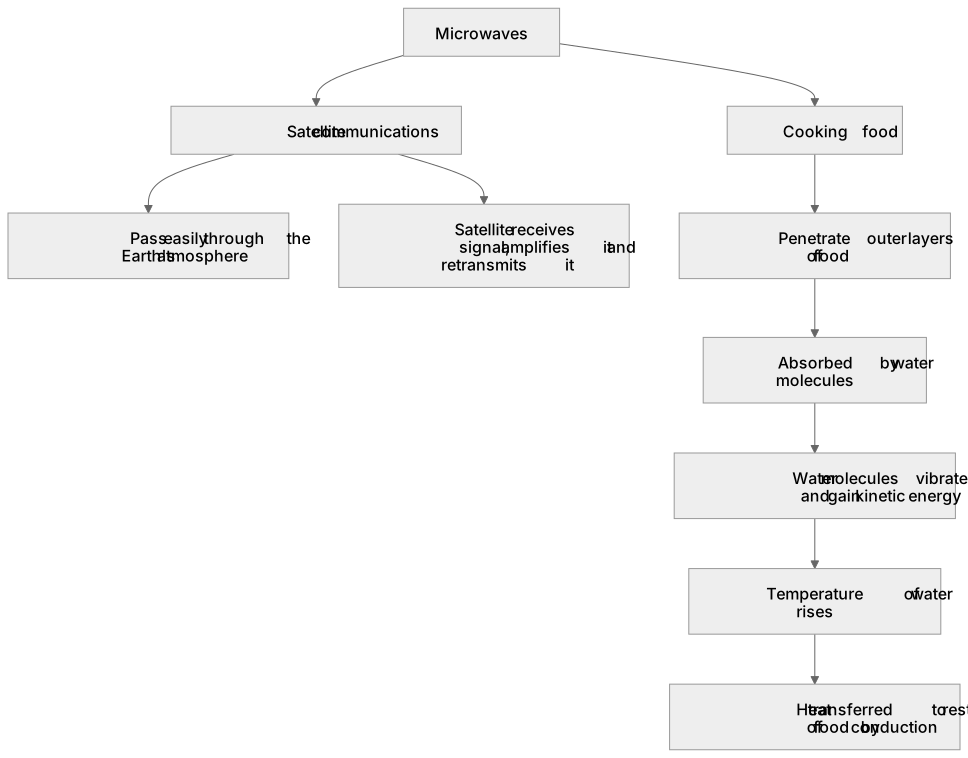
Microwaves are electromagnetic waves with shorter wavelengths and higher frequencies than radio waves. They are used for satellite communications and cooking food. Microwaves can pass easily through the Earth's atmosphere and are not strongly absorbed by it, so they are used to send signals to and from satellites. In a microwave oven, microwaves penetrate the outer layers of food and are absorbed by water molecules, causing them to vibrate and gain kinetic energy. This raises the temperature of the water, and the heat is then transferred to the rest of the food by conduction.
What earns the marks
- Microwaves are transverse electromagnetic waves with shorter wavelengths and higher frequencies than radio waves.
- (HT only) They can penetrate the atmosphere without being absorbed, making them suitable for satellite communications.
- (HT only) A satellite receives a microwave signal, amplifies it and retransmits it to a different location on Earth.
- (HT only) In microwave ovens, microwaves penetrate the food and are absorbed by water molecules, increasing their kinetic energy.
- (HT only) The increase in kinetic energy of the water molecules raises the temperature, and heat transfers through the food via conduction.
Common mistakes and how to put them right
Confusing satellite communication with radio wave broadcasting.
Put it right by noting that microwaves are used for satellite links, while radio waves are used for terrestrial TV and radio.
(HT only) Thinking microwaves cook food by heating the container first.
Put it right by explaining that microwaves are absorbed by water molecules inside the food.
(HT only) Believing microwaves heat food exclusively 'from the inside out'.
Put it right by noting they penetrate the outer layers and heat transfers via conduction.
Exam tips
- State clearly that microwaves are used for satellite communications and cooking food.
- (HT only) When explaining cooking, refer to water molecules absorbing microwaves and gaining kinetic energy, leading to a temperature rise.
- (HT only) For satellite communication, describe the signal path: transmitter to satellite, amplification, then retransmission to a receiver.
Try the lesson
The start of the Uses and applications of electromagnetic waves: microwaves – satellite communications, cooking food lesson, made from checked teaching notes for this specification point.
Have a go first
Which two practical applications rely on the use of microwaves?
Listen
Microwaves are electromagnetic waves with shorter wavelengths and higher frequencies than radio waves. They are used for satellite communications and cooking food. Microwaves can pass easily through the Earth's atmosphere and are not strongly absorbed by it, so they are used to send signals to and from satellites. In a microwave oven, microwaves penetrate the outer layers of food and are absorbed by water molecules, causing them to vibrate and gain kinetic energy. This raises the temperature of the water, and the heat is then transferred to the rest of the food by conduction. A strong answer earns marks for these points. Microwaves are transverse electromagnetic waves with shorter wavelengths and higher frequencies than radio waves. HT only) They can penetrate the atmosphere without being absorbed, making them suitable for satellite communications. HT only) A satellite receives a microwave signal, amplifies it and retransmits it to a different location on Earth. HT only) In microwave ovens, microwaves penetrate the food and are absorbed by water molecules, increasing their kinetic energy. A common slip: Confusing satellite communication with radio wave broadcasting. Instead, noting that microwaves are used for satellite links, while radio waves are used for terrestrial TV and radio. Exam tip: State clearly that microwaves are used for satellite communications and cooking food.
See it
Key words
Say what each word means before you turn the card.
Microwaves
Try answering aloud or in your head before turning the card.
Satellite communications
Try answering aloud or in your head before turning the card.
Absorption by water molecules
Try answering aloud or in your head before turning the card.
Conduction
Try answering aloud or in your head before turning the card.
See every definition
- Microwaves
- Electromagnetic waves with shorter wavelengths and higher frequencies than radio waves, used for satellite communications and cooking food.
- Satellite communications
- Sending signals to and from satellites, because microwaves can pass easily through the Earth's atmosphere and are not strongly absorbed by it.
- Absorption by water molecules
- Microwaves penetrate the outer layers of food and are absorbed by water molecules, causing them to vibrate and gain kinetic energy.
- Conduction
- The way heat is transferred from the water to the rest of the food after the temperature of the water is raised.
Label the diagram
Some boxes have lost their names. Pick the right name for each number.
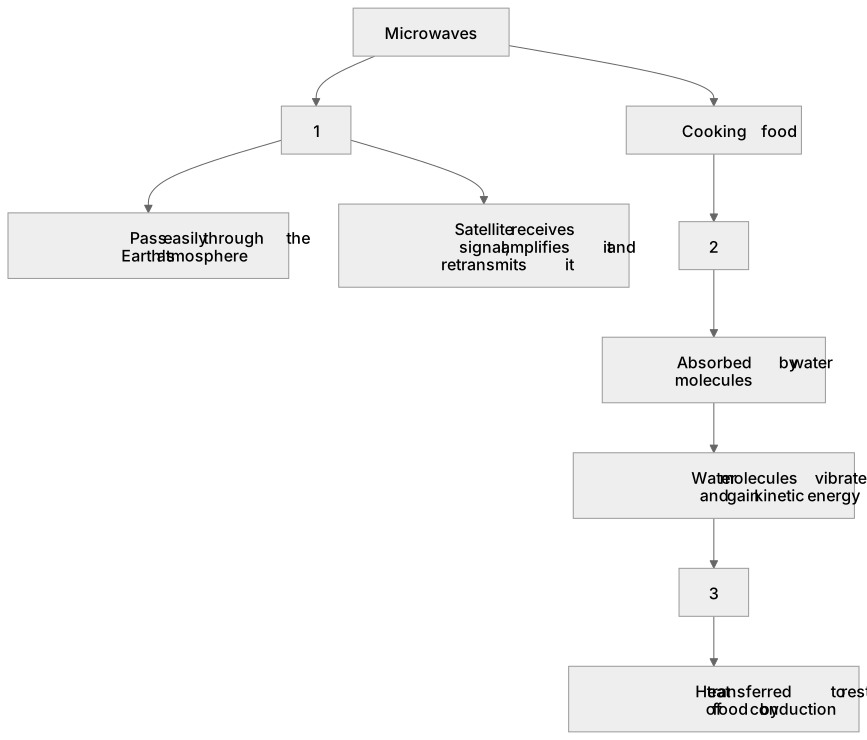
1Box 1
2Box 2
3Box 3
There is more to this lesson
The full lesson goes on to check your understanding and help you earn the marks. Create a free account to carry on, with your progress saved.
A week of Premium from your first lesson · Then the free plan continues · No card, no charge
Test your understanding of Uses and applications of electromagnetic waves: microwaves – satellite communications, cooking food
Active recall beats re-reading. Take an instant quiz now to test what you’ve learned and lock it into long-term memory.
A week of Premium from your first lesson · Then the free plan continues · No card, no charge