OCR · GCSE · Computer Science
Course version: J277 · Version from Sept 2022
Boolean logic: Applying logical operators in truth tables to solve problems
A truth table lists every possible combination of input values and the resulting output for a Boolean expression.
Checked against the OCR J277 specification on .
- Point 4 of 4
- 3 key terms
Study notes
From the checked teaching notes for this specification point.
The idea
A truth table lists every possible combination of input values and the resulting output for a Boolean expression. For two inputs there are four rows, for three inputs there are eight rows, following 2ⁿ combinations. To build one, list inputs in a consistent order such as 00, 01, 10, 11, then add a column for each intermediate operation before the final output. For example, for A AND (NOT B), first work out NOT B, then combine it with A using AND. Truth tables solve problems by showing exactly when a system outputs True, which helps design logic circuits, test program conditions and check whether two expressions are equivalent. A complete table must include every input combination and a correct output for each row.
What earns the marks
- Constructs a truth table with the correct number of rows, using 2ⁿ for n inputs.
- Lists all input combinations systematically, for example 00, 01, 10, 11 for two inputs.
- Adds intermediate columns for sub-expressions such as NOT B before the final output column.
- Applies AND, OR and NOT correctly in every row of the table.
- Uses the completed table to identify when the output is True or to compare expressions.
- Interprets a truth table in a problem context, such as deciding which input combination activates an alarm.
Common mistakes and how to put them right
Missing or duplicating input combinations.
Put it right by counting 2ⁿ rows and listing combinations in binary order.
Filling the output column directly without working out intermediate values.
Put it right by adding a column for each operator in turn.
Mixing up AND and OR outputs in some rows.
Put it right by checking each row against the rule that AND needs both True and OR needs at least one True.
Exam tips
- Write the number of rows before drawing the table, then fill inputs in a fixed pattern to avoid omissions.
- Use separate columns for intermediate results so each step can be checked and marks are not lost through a single error.
- After completing the table, test one or two rows mentally against the original expression to confirm the outputs.
Try the lesson
The start of the Boolean logic: Applying logical operators in truth tables to solve problems lesson, made from checked teaching notes for this specification point.
Have a go first
A truth table is being created for the Boolean expression P AND Q. Which of the following rows is correct?
Listen
A truth table lists every possible combination of input values and the resulting output for a Boolean expression. For two inputs there are four rows, for three inputs there are eight rows, following 2ⁿ combinations. To build one, list inputs in a consistent order such as 00, 01, 10, 11, then add a column for each intermediate operation before the final output. For example, for A AND (NOT B), first work out NOT B, then combine it with A using AND. Truth tables solve problems by showing exactly when a system outputs True, which helps design logic circuits, test program conditions and check whether two expressions are equivalent. A complete table must include every input combination and a correct output for each row. A strong answer earns marks for these points. Constructs a truth table with the correct number of rows, using 2ⁿ for n inputs. Lists all input combinations systematically, for example 00, 01, 10, 11 for two inputs. Adds intermediate columns for sub-expressions such as NOT B before the final output column. Applies AND, OR and NOT correctly in every row of the table. A common slip: Missing or duplicating input combinations. Instead, counting 2ⁿ rows and listing combinations in binary order. Exam tip: Write the number of rows before drawing the table, then fill inputs in a fixed pattern to avoid omissions.
See it
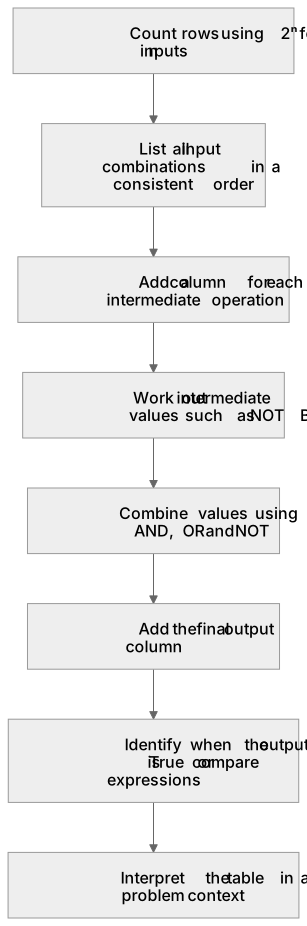
Put it in order
Put these steps in the order they happen.
- 1. Combine values using AND, OR and NOT
- 2. Interpret the table in a problem context
- 3. Add the final output column
- 4. Count rows using 2ⁿ for n inputs
- 5. List all input combinations in a consistent order
- 6. Identify when the output is True or compare expressions
- 7. Add a column for each intermediate operation
- 8. Work out intermediate values such as NOT B
Key words
Say what each word means before you turn the card.
Truth table construction
Try answering aloud or in your head before turning the card.
Systematic enumeration of input combinations
Try answering aloud or in your head before turning the card.
Problem solving with logic
Try answering aloud or in your head before turning the card.
See every definition
- Truth table construction
- A table lists every possible combination of input values and the resulting output for a Boolean expression, with a column for each intermediate operation before the final output.
- Systematic enumeration of input combinations
- Listing inputs in a consistent order such as 00, 01, 10, 11, where two inputs give four rows and three inputs give eight rows, following 2ⁿ combinations.
- Problem solving with logic
- Truth tables show exactly when a system outputs True, which helps design logic circuits, test program conditions and check whether two expressions are equivalent.
Label the diagram
Some boxes have lost their names. Pick the right name for each number.
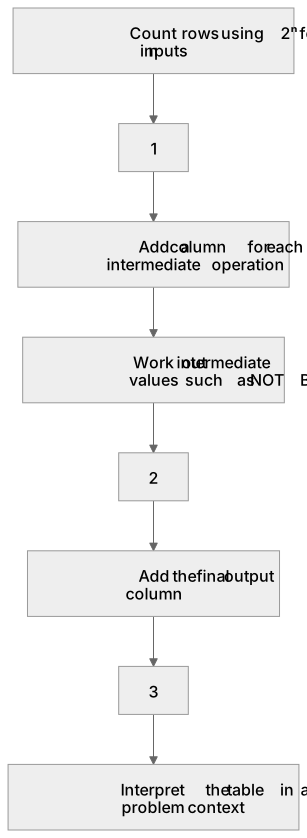
1Box 1
2Box 2
3Box 3
There is more to this lesson
The full lesson goes on to check your understanding and help you earn the marks. Create a free account to carry on, with your progress saved.
A week of Premium from your first lesson · Then the free plan continues · No card, no charge
Test your understanding of Boolean logic: Applying logical operators in truth tables to solve problems
Active recall beats re-reading. Take an instant quiz now to test what you’ve learned and lock it into long-term memory.
A week of Premium from your first lesson · Then the free plan continues · No card, no charge