OCR · GCSE · Computer Science
Course version: J277 · Version from Sept 2022
Primary storage (memory): The difference between RAM and ROM
RAM and ROM are both primary storage, but they differ in volatility, contents and purpose.
Checked against the OCR J277 specification on .
- Point 2 of 6
- 4 key terms
Study notes
From the checked teaching notes for this specification point.
The idea
RAM and ROM are both primary storage, but they differ in volatility, contents and purpose. RAM is volatile: it loses its contents when power is removed. It stores the operating system, currently running programs and the data being processed, and its contents can be read from and written to. ROM is non-volatile: it keeps its contents when power is removed. It stores fixed instructions such as the bootstrap/BIOS program used at start-up, and normally its contents can only be read, not changed by ordinary programs. RAM is typically larger and can be upgraded; ROM is small and fixed.
For example: When a computer starts, ROM runs the power-on self-test and locates the boot loader, then the operating system is copied into RAM so the CPU can execute it quickly.
What earns the marks
- RAM is volatile and loses its contents when power is removed; ROM is non-volatile and retains its contents.
- RAM stores the operating system, currently running programs and data being processed; ROM stores fixed start-up instructions such as the bootstrap/BIOS.
- RAM can be read from and written to; ROM is normally read-only during normal operation.
- RAM is usually larger and can be upgraded; ROM is small and fixed in the system.
- At start-up, ROM instructions run first and cause the operating system to be loaded into RAM.
Common mistakes and how to put them right
Saying ROM stores the operating system.
Put it right by stating the operating system is stored in secondary storage and loaded into RAM when running.
Saying RAM keeps data when the computer is switched off.
Put it right by stating RAM is volatile and its contents are lost without power.
Treating ROM as a type of secondary storage.
Put it right by explaining ROM is primary storage because the CPU can access it directly.
Exam tips
- Structure comparisons around volatility, contents, read/write ability and typical size.
- Use a start-up sequence example to show how ROM and RAM work together.
- Avoid saying ROM can never be changed; say it is normally read-only and is not written to by ordinary programs.
Try the lesson
The start of the Primary storage (memory): The difference between RAM and ROM lesson, made from checked teaching notes for this specification point.
Have a go first
Which statement describes RAM?
Listen
RAM and ROM are both primary storage, but they differ in volatility, contents and purpose. RAM is volatile: it loses its contents when power is removed. It stores the operating system, currently running programs and the data being processed, and its contents can be read from and written to. ROM is non-volatile: it keeps its contents when power is removed. It stores fixed instructions such as the bootstrap/BIOS program used at start-up, and normally its contents can only be read, not changed by ordinary programs. RAM is typically larger and can be upgraded; ROM is small and fixed. For example, when a computer starts, ROM runs the power-on self-test and locates the boot loader, then the operating system is copied into RAM so the CPU can execute it quickly. A strong answer earns marks for these points. RAM is volatile and loses its contents when power is removed; ROM is non-volatile and retains its contents. RAM stores the operating system, currently running programs and data being processed; ROM stores fixed start-up instructions such as the bootstrap/BIOS. RAM can be read from and written to; ROM is normally read-only during normal operation. RAM is usually larger and can be upgraded; ROM is small and fixed in the system. A common slip: Saying ROM stores the operating system. Instead, stating the operating system is stored in secondary storage and loaded into RAM when running. Exam tip: Structure comparisons around volatility, contents, read/write ability and typical size.
See it
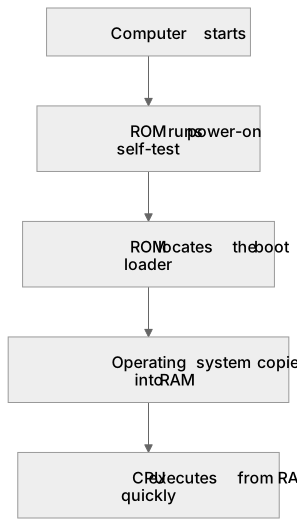
Put it in order
Put these steps in the order they happen.
- 1. ROM runs power-on self-test
- 2. ROM locates the boot loader
- 3. Computer starts
- 4. CPU executes from RAM quickly
- 5. Operating system copied into RAM
Key words
Say what each word means before you turn the card.
Volatility
Try answering aloud or in your head before turning the card.
Read/write access
Try answering aloud or in your head before turning the card.
Start-up and firmware
Try answering aloud or in your head before turning the card.
Primary storage roles
Try answering aloud or in your head before turning the card.
See every definition
- Volatility
- The property by which RAM loses its contents when power is removed, whereas ROM keeps its contents when power is removed.
- Read/write access
- RAM can be read from and written to, while ROM is normally read-only and not changed by ordinary programs.
- Start-up and firmware
- ROM stores fixed instructions such as the bootstrap/BIOS program used at start-up, running the power-on self-test and locating the boot loader.
- Primary storage roles
- Both RAM and ROM are primary storage directly accessible by the CPU, but they serve different roles.
Label the diagram
Some boxes have lost their names. Pick the right name for each number.
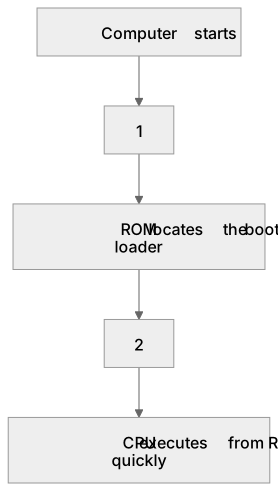
1Box 1
2Box 2
There is more to this lesson
The full lesson goes on to check your understanding and help you earn the marks. Create a free account to carry on, with your progress saved.
A week of Premium from your first lesson · Then the free plan continues · No card, no charge
Test your understanding of Primary storage (memory): The difference between RAM and ROM
Active recall beats re-reading. Take an instant quiz now to test what you’ve learned and lock it into long-term memory.
A week of Premium from your first lesson · Then the free plan continues · No card, no charge