OCR · GCSE · Computer Science
Course version: J277 · Version from Sept 2022
Testing: Types of testing Iterative Final/terminal
Testing is not a single event but a process carried out at different points in development.
Checked against the OCR J277 specification on .
- Point 2 of 5
- 3 key terms
Study notes
From the checked teaching notes for this specification point.
The idea
Testing is not a single event but a process carried out at different points in development. Iterative testing happens repeatedly as each module or feature is written: the programmer runs the code, checks outputs against expected results, fixes defects and runs it again. This tight loop catches errors early, when they are cheap to fix, and supports incremental development. Final or terminal testing happens once the whole program is complete and integrated. It checks the system as a whole against the original requirements, including normal, boundary and erroneous data, and confirms that earlier fixes have not broken other parts.
For example: A quiz program might be tested question by question during coding, then tested end-to-end with a full set of answers before release.
What earns the marks
- Iterative testing is repeated throughout development, typically after each small change or module is written.
- Iterative testing supports early detection and correction of defects, reducing the cost and risk of later failures.
- Final or terminal testing is carried out on the completed, integrated program rather than on isolated parts.
- Final testing checks the whole system against the original requirements and user needs.
- Regression checking after a fix is part of iterative testing because a change can introduce new faults elsewhere.
Common mistakes and how to put them right
Treating iterative and final testing as the same activity.
Put it right: Iterative testing is repeated during development, while final testing occurs once the whole program is complete.
Assuming final testing only means running the program once.
Put it right: It should cover the full range of expected and unexpected inputs and the original requirements.
Believing that finding no errors in final testing proves the program is perfect.
Put it right: Testing can only show the presence of errors, not their absence.
Exam tips
- Link each type of testing to a stage of the development cycle so your answer shows when and why it happens.
- Use a short scenario, such as testing one function then testing the whole program, to make the distinction concrete.
- When asked to compare, give one point about timing and one about scope for each type rather than listing definitions only.
Try the lesson
The start of the Testing: Types of testing Iterative Final/terminal lesson, made from checked teaching notes for this specification point.
Have a go first
Which type of testing is carried out repeatedly while a program is being developed?
Listen
Testing is not a single event but a process carried out at different points in development. Iterative testing happens repeatedly as each module or feature is written: the programmer runs the code, checks outputs against expected results, fixes defects and runs it again. This tight loop catches errors early, when they are cheap to fix, and supports incremental development. Final or terminal testing happens once the whole program is complete and integrated. It checks the system as a whole against the original requirements, including normal, boundary and erroneous data, and confirms that earlier fixes have not broken other parts. For example, a quiz program might be tested question by question during coding, then tested end-to-end with a full set of answers before release. A strong answer earns marks for these points. Iterative testing is repeated throughout development, typically after each small change or module is written. Iterative testing supports early detection and correction of defects, reducing the cost and risk of later failures. Final or terminal testing is carried out on the completed, integrated program rather than on isolated parts. Final testing checks the whole system against the original requirements and user needs. Exam tip: Link each type of testing to a stage of the development cycle so your answer shows when and why it happens.
See it
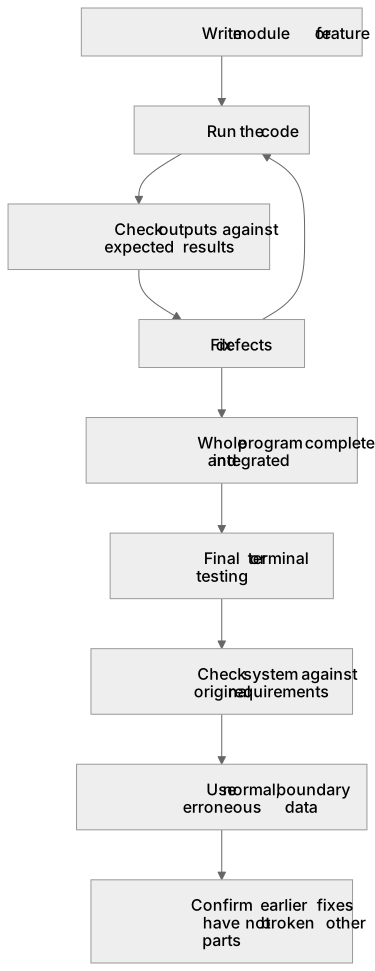
Key words
Say what each word means before you turn the card.
Iterative testing
Try answering aloud or in your head before turning the card.
Final or terminal testing
Try answering aloud or in your head before turning the card.
Regression checking
Try answering aloud or in your head before turning the card.
See every definition
- Iterative testing
- Repeated testing carried out as each module or feature is written, where the programmer runs the code, checks outputs against expected results, fixes defects and runs it again.
- Final or terminal testing
- Testing carried out once the whole program is complete and integrated, checking the system as a whole against the original requirements.
- Regression checking
- Checking after a fix that a change has not introduced new faults elsewhere, as part of iterative testing.
Label the diagram
Some boxes have lost their names. Pick the right name for each number.
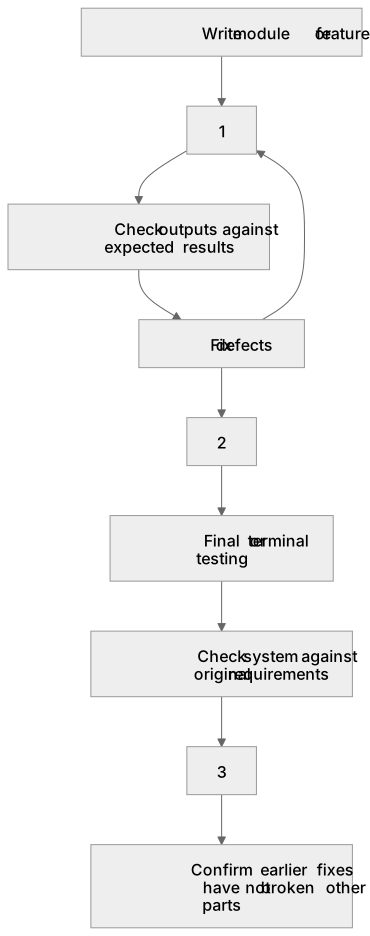
1Box 1
2Box 2
3Box 3
There is more to this lesson
The full lesson goes on to check your understanding and help you earn the marks. Create a free account to carry on, with your progress saved.
A week of Premium from your first lesson · Then the free plan continues · No card, no charge
Test your understanding of Testing: Types of testing Iterative Final/terminal
Active recall beats re-reading. Take an instant quiz now to test what you’ve learned and lock it into long-term memory.
A week of Premium from your first lesson · Then the free plan continues · No card, no charge