OCR · GCSE · Computer Science
Course version: J277 · Version from Sept 2022
Wired and wireless networks, protocols and layers: Bluetooth
Bluetooth is a short-range wireless technology that lets devices form a personal area network and exchange data directly.
Checked against the OCR J277 specification on .
- Point 4 of 9
- 4 key terms
Study notes
From the checked teaching notes for this specification point.
The idea
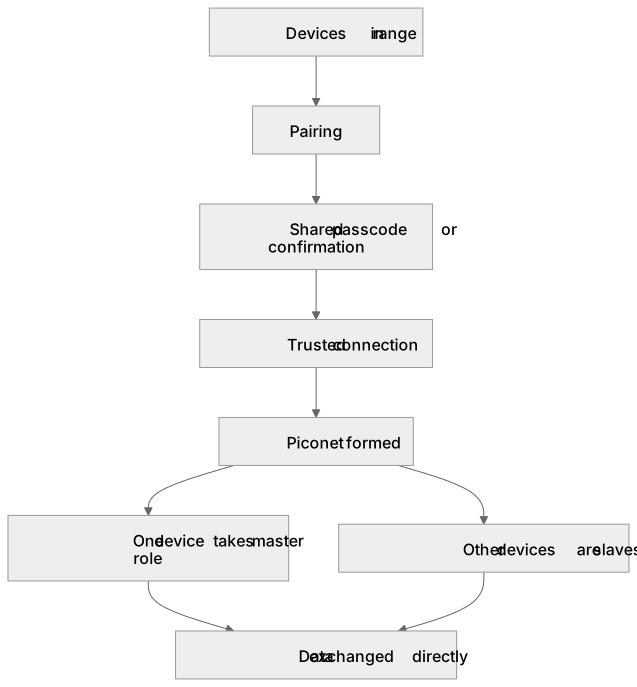
Bluetooth is a short-range wireless technology that lets devices form a personal area network and exchange data directly. It uses radio waves in the 2.4 GHz band and is designed for low power consumption, which suits battery-powered devices such as wireless earbuds, keyboards, fitness trackers and car systems. To connect, devices go through pairing, often involving a shared passcode or confirmation, and then create a small network called a piconet in which one device takes the master role and others are slaves. Because range is typically only a few metres and data rates are lower than Wi-Fi, Bluetooth is used for close-range links rather than general internet access. In an exam answer, explain the pairing process and link the technology to a suitable context, such as streaming audio from a phone to headphones, while noting limitations such as short range and possible interference.
What earns the marks
- States that Bluetooth is a short-range wireless technology used to connect devices over a personal area network.
- Explains that Bluetooth operates using radio waves, commonly in the 2.4 GHz band, and is designed for low power consumption.
- Describes pairing as the process of establishing a trusted connection between devices, often using a passcode or confirmation step.
- Identifies typical uses such as connecting peripherals, audio devices or wearables, and explains why short range and low power suit those uses.
- Compares Bluetooth with Wi-Fi, noting that Bluetooth has shorter range and lower data rates but uses less power and is intended for direct device-to-device links.
Common mistakes and how to put them right
Saying Bluetooth provides internet access directly.
Put it right: Bluetooth connects devices to each other over short distances, and internet access normally comes through another network such as Wi-Fi or a mobile network.
Believing Bluetooth has a long range like Wi-Fi.
Put it right: Bluetooth is designed for short-range personal area connections, typically a few metres, so distance and obstacles quickly weaken the link.
Ignoring the need for pairing.
Put it right: Devices must usually be paired and may require confirmation or a passcode before they can exchange data, which helps prevent unwanted connections.
Exam tips
- Use the term personal area network or PAN when describing Bluetooth so the scale of the network is clear.
- Give a named example, such as wireless earbuds or a game controller, and explain why low power and short range make Bluetooth suitable.
- If asked to compare, state one clear difference from Wi-Fi, such as range, data rate or power consumption, and link it to a user consequence.
Try the lesson
The start of the Wired and wireless networks, protocols and layers: Bluetooth lesson, made from checked teaching notes for this specification point.
Have a go first
What type of network connection does Bluetooth provide between devices?
Listen
Bluetooth is a short-range wireless technology that lets devices form a personal area network and exchange data directly. It uses radio waves in the 2.4 GHz band and is designed for low power consumption, which suits battery-powered devices such as wireless earbuds, keyboards, fitness trackers and car systems. To connect, devices go through pairing, often involving a shared passcode or confirmation, and then create a small network called a piconet in which one device takes the master role and others are slaves. Because range is typically only a few metres and data rates are lower than Wi-Fi, Bluetooth is used for close-range links rather than general internet access. In an exam answer, explain the pairing process and link the technology to a suitable context, such as streaming audio from a phone to headphones, while noting limitations such as short range and possible interference. A strong answer earns marks for these points. States that Bluetooth is a short-range wireless technology used to connect devices over a personal area network. Explains that Bluetooth operates using radio waves, commonly in the 2.4 GHz band, and is designed for low power consumption. Describes pairing as the process of establishing a trusted connection between devices, often using a passcode or confirmation step. Identifies typical uses such as connecting peripherals, audio devices or wearables, and explains why short range and low power suit those uses. A common slip: Saying Bluetooth provides internet access directly. Instead, Bluetooth connects devices to each other over short distances, and internet access normally comes through another network such as Wi-Fi or a mobile network. Exam tip: Use the term personal area network or PAN when describing Bluetooth so the scale of the network is clear.
See it
Key words
Say what each word means before you turn the card.
Short-range wireless communication
Try answering aloud or in your head before turning the card.
Personal area networks
Try answering aloud or in your head before turning the card.
Low-power device connectivity
Try answering aloud or in your head before turning the card.
Pairing and device security
Try answering aloud or in your head before turning the card.
See every definition
- Short-range wireless communication
- A technology that lets devices exchange data directly over a short distance, typically only a few metres.
- Personal area networks
- A small network formed by devices connected over a short range, such as a piconet in which one device is master and others are slaves.
- Low-power device connectivity
- A design for low power consumption that suits battery-powered devices such as wireless earbuds, keyboards, fitness trackers and car systems.
- Pairing and device security
- The process of establishing a trusted connection between devices, often involving a shared passcode or confirmation, which helps prevent unwanted connections.
Label the diagram
Some boxes have lost their names. Pick the right name for each number.
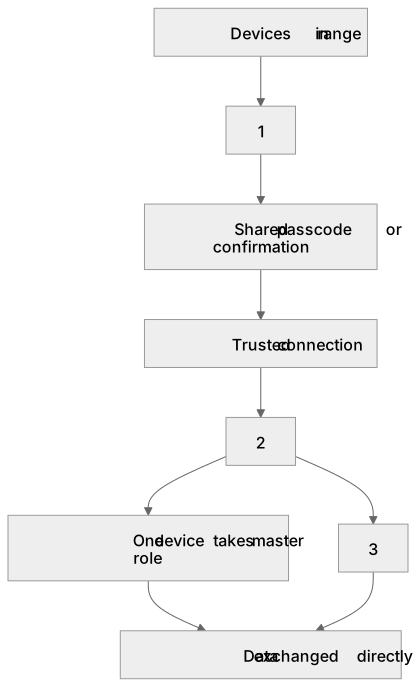
1Box 1
2Box 2
3Box 3
There is more to this lesson
The full lesson goes on to check your understanding and help you earn the marks. Create a free account to carry on, with your progress saved.
A week of Premium from your first lesson · Then the free plan continues · No card, no charge
Test your understanding of Wired and wireless networks, protocols and layers: Bluetooth
Active recall beats re-reading. Take an instant quiz now to test what you’ve learned and lock it into long-term memory.
A week of Premium from your first lesson · Then the free plan continues · No card, no charge