OCR · GCSE · Computer Science
Course version: J277 · Version from Sept 2022
Wired and wireless networks, protocols and layers: Encryption
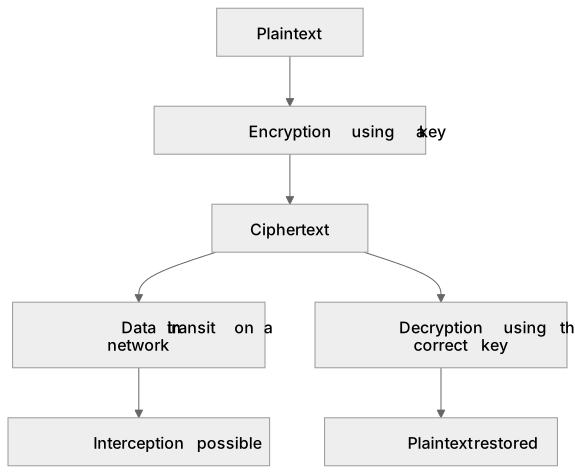
Encryption scrambles data into ciphertext so that anyone intercepting it cannot read the original plaintext.
Checked against the OCR J277 specification on .
- Point 5 of 9
- 4 key terms
Study notes
From the checked teaching notes for this specification point.
The idea
Encryption scrambles data into ciphertext so that anyone intercepting it cannot read the original plaintext. A key controls the scrambling and unscrambling. In a network context, encryption protects data in transit. For example, when a browser opens an HTTPS connection, the client and server agree a session key and all later traffic is encrypted. The OCR J277 specification places encryption under 1.3.2 Wired and wireless networks, protocols and layers, and does not require knowledge of symmetric and asymmetric encryption at GCSE.
What earns the marks
- Encryption converts plaintext into ciphertext so the meaning is hidden from anyone who intercepts the data.
- A key is required to encrypt and decrypt; without the correct key the ciphertext should remain unreadable.
- Encryption protects data in transit on networks, including wireless traffic that can be intercepted more easily.
- HTTPS combines HTTP with encryption, so data such as passwords and card details is protected between client and server.
- Encryption does not prevent interception; it makes the intercepted data meaningless without the key.
- Encryption is reversible with the correct key, unlike hashing, which is one-way.
Common mistakes and how to put them right
Saying encryption stops data being intercepted.
Put it right: Describe encryption as protecting confidentiality of intercepted data.
Confusing encryption with hashing.
Put it right: State that encryption can be decrypted and hashing cannot.
Assuming encryption requires no key.
Put it right: Explain that the key controls the scrambling and unscrambling.
Exam tips
- Link every explanation to a network scenario, such as a user logging in over public Wi-Fi, so the purpose of encryption is clear.
- Use the terms plaintext, ciphertext and key accurately; these words carry credit because they show understanding of the process.
- Remember that OCR J277 places encryption under 1.3.2 Wired and wireless networks, protocols and layers, so check the section when revising.
Try the lesson
The start of the Wired and wireless networks, protocols and layers: Encryption lesson, made from checked teaching notes for this specification point.
Have a go first
What is the main purpose of encryption when data is sent across a network?
Listen
Encryption scrambles data into ciphertext so that anyone intercepting it cannot read the original plaintext. A key controls the scrambling and unscrambling. In a network context, encryption protects data in transit. For example, when a browser opens an HTTPS connection, the client and server agree a session key and all later traffic is encrypted. The OCR J277 specification places encryption under 1.3.2 Wired and wireless networks, protocols and layers, and does not require knowledge of symmetric and asymmetric encryption at GCSE. A strong answer earns marks for these points. Encryption converts plaintext into ciphertext so the meaning is hidden from anyone who intercepts the data. A key is required to encrypt and decrypt; without the correct key the ciphertext should remain unreadable. Encryption protects data in transit on networks, including wireless traffic that can be intercepted more easily. HTTPS combines HTTP with encryption, so data such as passwords and card details is protected between client and server. A common slip: Saying encryption stops data being intercepted: it does not prevent interception, it makes the intercepted data meaningless without the key. Instead, describe encryption as protecting confidentiality of intercepted data. Exam tip: Link every explanation to a network scenario, such as a user logging in over public Wi-Fi, so the purpose of encryption is clear.
See it
Key words
Say what each word means before you turn the card.
Encryption
Try answering aloud or in your head before turning the card.
Key
Try answering aloud or in your head before turning the card.
Plaintext
Try answering aloud or in your head before turning the card.
Ciphertext
Try answering aloud or in your head before turning the card.
See every definition
- Encryption
- Scrambles data into ciphertext so that anyone intercepting it cannot read the original plaintext.
- Key
- Controls the scrambling and unscrambling, and is required to encrypt and decrypt.
- Plaintext
- The original data that encryption scrambles into ciphertext.
- Ciphertext
- The scrambled form of data that should remain unreadable without the correct key.
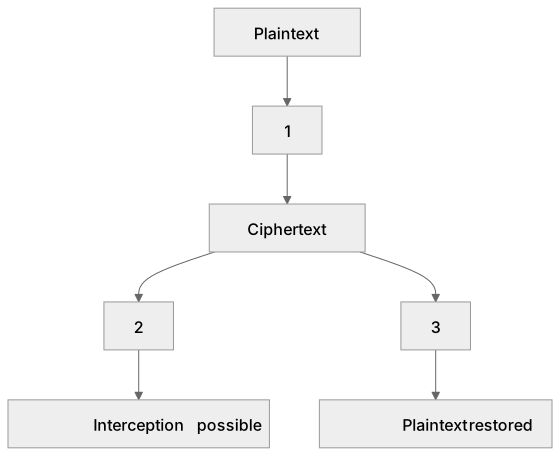
Label the diagram
Some boxes have lost their names. Pick the right name for each number.
1Box 1
2Box 2
3Box 3
There is more to this lesson
The full lesson goes on to check your understanding and help you earn the marks. Create a free account to carry on, with your progress saved.
A week of Premium from your first lesson · Then the free plan continues · No card, no charge
Test your understanding of Wired and wireless networks, protocols and layers: Encryption
Active recall beats re-reading. Take an instant quiz now to test what you’ve learned and lock it into long-term memory.
A week of Premium from your first lesson · Then the free plan continues · No card, no charge