Pearson Edexcel · GCSE · Computer Science
Course version: 1CP2 · Version from Sept 2020
Understand why hexadecimal notation is used and be able to convert between…
Full specification wording
Binary: 2.1.6 understand why hexadecimal notation is used and be able to convert between hexadecimal and binary
Hexadecimal is base 16, using 0–9 then A–F for 10–15.
Checked against the Pearson Edexcel 1CP2 specification (opens in a new tab) on .
- Point 6 of 6
- 3 key terms
Study notes
From the checked teaching notes for this specification point.
The idea
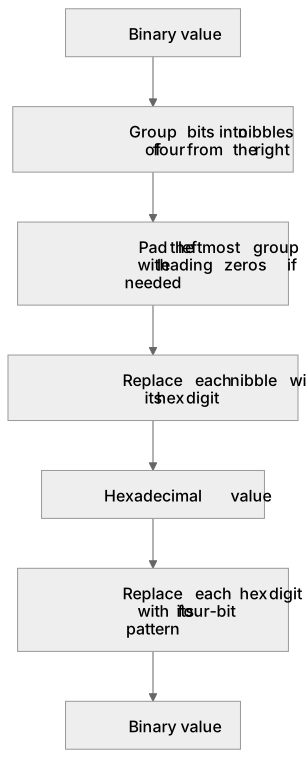
Hexadecimal is base 16, using 0–9 then A–F for 10–15. It is used because one hex digit maps exactly to four binary bits, so long binary strings become shorter and less error-prone to read and write; 1011 1110₂ is BE₁₆. This makes hex convenient for memory addresses, colour codes and machine-level data. To convert binary to hex, group the bits into nibbles of four from the right, pad the leftmost group with leading zeros if needed, then replace each nibble with its hex digit: 1101 0110₂ becomes D6₁₆. To convert hex to binary, replace each hex digit with its four-bit pattern: 3F₁₆ becomes 0011 1111₂.
What earns the marks
- Hexadecimal is base 16 and uses the digits 0–9 and A–F, where A = 10, B = 11, C = 12, D = 13, E = 14 and F = 15.
- One hexadecimal digit represents exactly four binary bits, so hex is a compact shorthand for binary.
- Hex is used because it is shorter and less error-prone for humans to read and write than long binary strings, especially for memory addresses and colour codes.
- To convert binary to hex, group bits into nibbles of four from the right, pad the leftmost group with leading zeros, then convert each nibble.
- To convert hex to binary, replace each hex digit with its four-bit binary pattern.
- Example: 1011 1110₂ = BE₁₆ and 3F₁₆ = 0011 1111₂.
Common mistakes and how to put them right
Grouping binary digits from the left instead of from the right, which misaligns the nibbles.
Put it right: Group from the right and pad the leftmost group.
Using only three bits for a hex digit.
Put it right: Every hex digit needs exactly four bits, so 7₁₆ is 0111₂, not 111₂.
Treating A–F as letters with no numeric value.
Put it right: A = 10 through F = 15.
Forgetting to pad the leftmost nibble, so 101₂ is written as 5₁₆ instead of 0101₂ = 5₁₆ with the correct four-bit grouping.
Exam tips
- Write the four-bit pattern for each hex digit before combining, to avoid misalignment.
- When converting binary to hex, mark the nibbles from the right and pad the leftmost group with leading zeros.
- Check your answer by converting back to the original form.
Try the lesson
The start of the Binary: 2.1.6 understand why hexadecimal notation is used and be able to convert between hexadecimal and binary lesson, made from checked teaching notes for this specification point.
Have a go first
A student writes the 8-bit binary number 1010 1111. Which hexadecimal number represents this same value?
Listen
Hexadecimal is base 16, using 0–9 then A–F for 10–15. It is used because one hex digit maps exactly to four binary bits, so long binary strings become shorter and less error-prone to read and write; 1011 1110₂ is BE₁₆. This makes hex convenient for memory addresses, colour codes and machine-level data. To convert binary to hex, group the bits into nibbles of four from the right, pad the leftmost group with leading zeros if needed, then replace each nibble with its hex digit: 1101 0110₂ becomes D6₁₆. To convert hex to binary, replace each hex digit with its four-bit pattern: 3F₁₆ becomes 0011 1111₂. A strong answer earns marks for these points. Hexadecimal is base 16 and uses the digits 0–9 and A–F, where A = 10, B = 11, C = 12, D = 13, E = 14 and F = 15. One hexadecimal digit represents exactly four binary bits, so hex is a compact shorthand for binary. Hex is used because it is shorter and less error-prone for humans to read and write than long binary strings, especially for memory addresses and colour codes. To convert binary to hex, group bits into nibbles of four from the right, pad the leftmost group with leading zeros, then convert each nibble. Exam tip: Write the four-bit pattern for each hex digit before combining, to avoid misalignment.
See it
Key words
Say what each word means before you turn the card.
Base 16 place value
Try answering aloud or in your head before turning the card.
Nibble-to-hex-digit mapping
Try answering aloud or in your head before turning the card.
Compact representation of binary
Try answering aloud or in your head before turning the card.
See every definition
- Base 16 place value
- Hexadecimal is base 16, using 0–9 then A–F for 10–15.
- Nibble-to-hex-digit mapping
- One hex digit maps exactly to four binary bits, so each nibble is replaced with its hex digit.
- Compact representation of binary
- Long binary strings become shorter and less error-prone to read and write, making hex a compact shorthand for binary.
There is more to this lesson
The full lesson goes on to check your understanding and help you earn the marks. Create a free account to carry on, with your progress saved.
A week of Premium from your first lesson · Then the free plan continues · No card, no charge
Test your understanding of Binary: 2.1.6 understand why hexadecimal notation is used and be able to convert between hexadecimal and binary
Active recall beats re-reading. Take an instant quiz now to test what you’ve learned and lock it into long-term memory.
A week of Premium from your first lesson · Then the free plan continues · No card, no charge