Pearson Edexcel · GCSE · Computer Science
Course version: 1CP2 · Version from Sept 2020
Understand the benefit of using decomposition and abstraction to model…
Full specification wording
Decomposition and abstraction: 1.1.1 understand the benefit of using decomposition and abstraction to model aspects of the real world and analyse, understand and solve problems
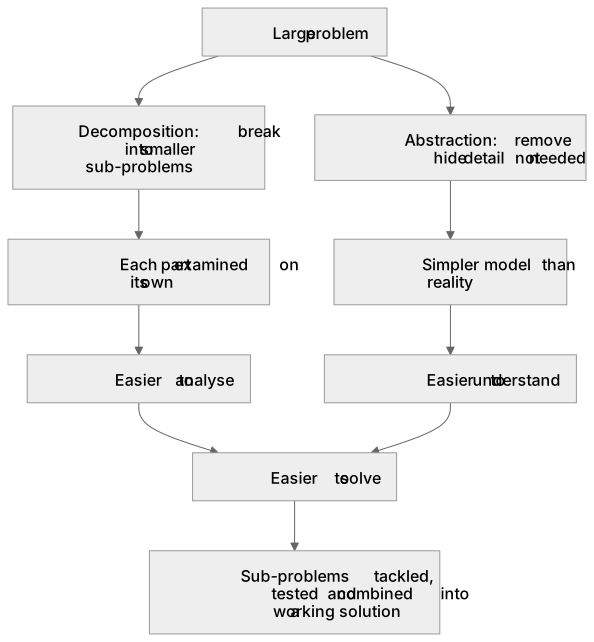
Decomposition means breaking a large problem into smaller sub-problems that can each be tackled separately, then combining the solutions.
Checked against the Pearson Edexcel 1CP2 specification (opens in a new tab) on .
- Point 1 of 2
- 4 key terms
Study notes
From the checked teaching notes for this specification point.
The idea
Decomposition means breaking a large problem into smaller sub-problems that can each be tackled separately, then combining the solutions. Abstraction means removing or hiding detail that is not needed for the current purpose, so only the essential features are modelled. Together they let a programmer model aspects of the real world: a hospital appointment system can be decomposed into patients, appointments and reminders, while abstraction ignores irrelevant detail such as a patient's favourite colour. This makes a problem easier to analyse, because each part can be examined on its own; easier to understand, because the model is simpler than reality; and easier to solve, because work can be shared and each sub-problem tested separately.
What earns the marks
- Decomposition is breaking a complex problem into smaller sub-problems that can be solved separately.
- Abstraction is removing or hiding unnecessary detail so that only the features relevant to the problem remain.
- Decomposition supports analysis because each smaller part can be examined and understood on its own.
- Abstraction supports understanding because the simplified model is easier to reason about than the full real-world situation.
- Using both together helps solve problems: sub-problems can be tackled, tested and combined into a working solution.
- A real-world model, such as a hospital appointment system, keeps only the essential entities and relationships.
Common mistakes and how to put them right
Confusing abstraction with decomposition.
Put it right: Keep the two definitions distinct and link each to its own benefit.
Believing abstraction means deleting all detail permanently.
Put it right: Abstraction hides detail that is not needed for the current purpose; the detail may still exist in the real world.
Thinking decomposition only means writing more code.
Put it right: Decomposition is a planning technique that makes a problem easier to analyse, understand and solve before coding begins.
Assuming a model must copy every real-world feature.
Put it right: A useful model deliberately leaves out features that do not affect the problem being solved.
Exam tips
- Learn a one-line definition of each term and a one-line benefit, then apply both to the scenario given in the question.
- When a question names a system, identify two or three sub-problems and one piece of detail that can safely be ignored.
- Check whether the question asks for a benefit of decomposition, of abstraction, or of both, and answer only what is asked.
Try the lesson
The start of the Decomposition and abstraction: 1.1.1 understand the benefit of using decomposition and abstraction to model aspects of the real world and analyse, understand and solve problems lesson, made from checked teaching notes for this specification point.
Have a go first
A team of programmers is developing a software application to manage a school library, with separate modules for borrowing, returning and charging fines. Which benefit does breaking the problem down into these smaller parts give the team?
Listen
Decomposition means breaking a large problem into smaller sub-problems that can each be tackled separately, then combining the solutions. Abstraction means removing or hiding detail that is not needed for the current purpose, so only the essential features are modelled. Together they let a programmer model aspects of the real world: a hospital appointment system can be decomposed into patients, appointments and reminders, while abstraction ignores irrelevant detail such as a patient's favourite colour. This makes a problem easier to analyse, because each part can be examined on its own; easier to understand, because the model is simpler than reality; and easier to solve, because work can be shared and each sub-problem tested separately. A strong answer earns marks for these points. Decomposition is breaking a complex problem into smaller sub-problems that can be solved separately. Abstraction is removing or hiding unnecessary detail so that only the features relevant to the problem remain. Decomposition supports analysis because each smaller part can be examined and understood on its own. Abstraction supports understanding because the simplified model is easier to reason about than the full real-world situation. A common slip: Confusing abstraction with decomposition: decomposition splits a problem into parts, whereas abstraction removes irrelevant detail. Instead, keep the two definitions distinct and link each to its own benefit. Exam tip: Learn a one-line definition of each term and a one-line benefit, then apply both to the scenario given in the question.
See it
Watch it explained
What is the one idea the video explains? Say it in a sentence.
Read the described scene instead
Two techniques sit at the heart of solving problems with a computer: decomposition and abstraction. This short lesson explains what each one means, how they work together, and why a programmer uses them to model parts of the real world. Keep two ideas in mind: breaking a problem into smaller parts, and removing detail that is not needed. Decomposition means breaking a large problem into smaller sub-problems. Each sub-problem can be tackled separately, and the solutions are then combined. Abstraction means removing or hiding detail that is not needed for the current purpose, so only the essential features are modelled. Keep the two definitions distinct: decomposition splits a problem into parts, whereas abstraction removes irrelevant detail. Why does this help? Decomposition supports analysis, because each smaller part can be examined and understood on its own. Abstraction supports understanding, because the simplified model is easier to reason about than the full real-world situation. Together they make a problem easier to solve: sub-problems can be shared out, tackled, tested separately and combined into one working solution. Before the next scene, pause and think which details a hospital booking system really needs. Take a hospital appointment system, a real-world situation to model. Decomposing it gives sub-problems such as patients, appointments and reminders, and each can be designed and tested on its own. Abstraction then decides what to keep: a patient's name, contact details and booked slot matter. A patient's favourite colour does not, so the model leaves it out. That detail may still exist in the real world — abstraction hides it because it is not needed for this purpose. Two mistakes are common. The first is confusing the terms: decomposition splits a problem into parts, whereas abstraction removes irrelevant detail. Keep them apart and link each to its own benefit. The second is thinking abstraction deletes detail permanently. It does not: it hides detail that is not needed for the current purpose, and that detail may still exist in the real world. A useful model deliberately leaves out features that do not affect the problem being solved. So, to recap. Decomposition breaks a complex problem into smaller sub-problems that can be solved separately. Abstraction removes or hides unnecessary detail so that only the relevant features remain. Used together, they let you model aspects of the real world, analyse each part, understand a simplified version, and solve the problem by tackling, testing and combining the pieces.
Key words
Say what each word means before you turn the card.
Decomposition
Try answering aloud or in your head before turning the card.
Abstraction
Try answering aloud or in your head before turning the card.
Modelling aspects of the real world
Try answering aloud or in your head before turning the card.
Analysing, understanding and solving problems
Try answering aloud or in your head before turning the card.
See every definition
- Decomposition
- Breaking a large problem into smaller sub-problems that can each be tackled separately, then combining the solutions.
- Abstraction
- Removing or hiding detail that is not needed for the current purpose, so only the essential features are modelled.
- Modelling aspects of the real world
- Using decomposition and abstraction so that only the essential features of a real-world situation are represented.
- Analysing, understanding and solving problems
- Examining each part on its own, reasoning about a simpler model than reality, and sharing and testing work separately.
Label the diagram
Some boxes have lost their names. Pick the right name for each number.
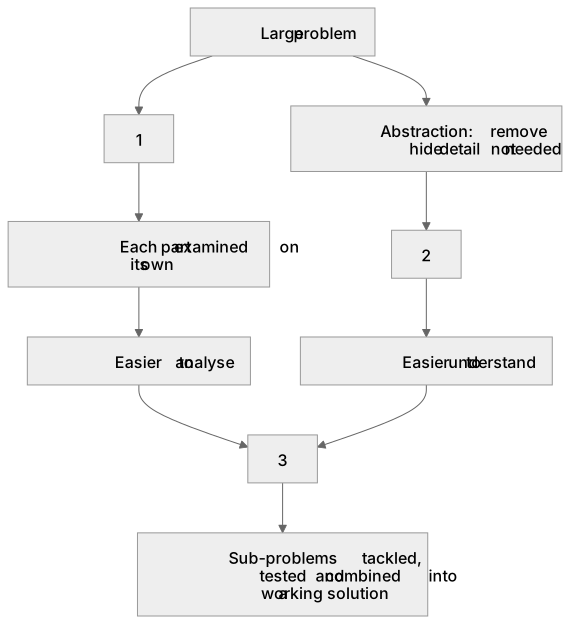
1Box 1
2Box 2
3Box 3
There is more to this lesson
The full lesson goes on to check your understanding and help you earn the marks. Create a free account to carry on, with your progress saved.
A week of Premium from your first lesson · Then the free plan continues · No card, no charge
Test your understanding of Decomposition and abstraction: 1.1.1 understand the benefit of using decomposition and abstraction to model aspects of the real world and analyse, understand and solve problems
Active recall beats re-reading. Take an instant quiz now to test what you’ve learned and lock it into long-term memory.
A week of Premium from your first lesson · Then the free plan continues · No card, no charge