Pearson Edexcel · GCSE · Computer Science
Course version: 1CP2 · Version from Sept 2020
Understand methods of intellectual property protection for computer…
Full specification wording
Ethical and legal: 5.2.3 understand methods of intellectual property protection for computer systems and software (copyright, patents, trademarks, licencing)
Intellectual property (IP) law gives creators and businesses legal rights over what they make, including computer systems and software.
- 4 key terms
Study notes
From the teaching notes for this specification point.
The idea
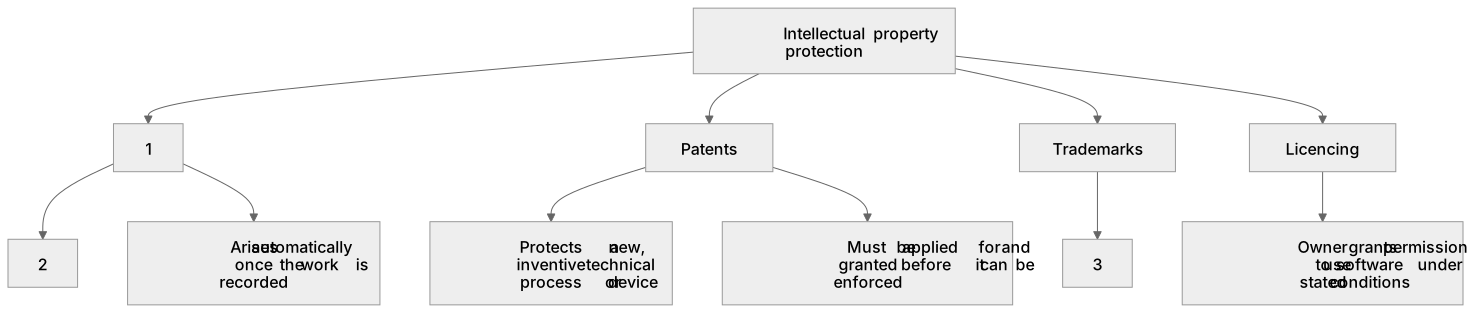
Intellectual property (IP) law gives creators and businesses legal rights over what they make, including computer systems and software. Copyright protects the fixed expression of original work, such as source code, artwork, music and documentation; it arises automatically when the work is recorded and generally lasts many decades, so a programmer owns the code they write unless an employer or contract says otherwise. A patent protects a new, inventive technical process or device, for example a novel data-compression algorithm or hardware design, and must be applied for and granted before it can be enforced. A trademark protects brand identity: names, logos and slogans that distinguish a product, such as a software company's logo.
What earns the marks
- Copyright protects the fixed expression of original work such as source code, and arises automatically once the work is recorded.
- A patent protects a new, inventive technical process or device and must be applied for and granted before it can be enforced.
- A trademark protects brand identity such as a name, logo or slogan that distinguishes a product or company.
- Licencing is the owner granting permission to use software under stated conditions, for example single-user, site or open-source licences.
- The four methods are complementary and can be used together on the same product.
Common mistakes and how to put them right
Confusing copyright with patents.
Put it right: Copyright protects the expression of a work automatically, whereas a patent protects an inventive technical process and must be applied for and granted.
Believing a trademark protects the code itself.
Put it right: A trademark protects brand identity such as a name or logo, not the underlying program.
Thinking that buying software transfers ownership of the IP.
Put it right: A licence grants permission to use the software under conditions, while ownership of the IP usually stays with the creator or company.
Exam tips
- Read the scenario and identify exactly what is being protected: code, an invention, a brand or permission to use.
- Match each option to one method and check whether the method's defining feature (automatic, granted, brand identity, permission) fits.
- Eliminate options that describe a different method from the one the question asks about before choosing.
Try the lesson
The start of the Ethical and legal: 5.2.3 understand methods of intellectual property protection for computer systems and software (copyright, patents, trademarks, licencing) lesson, made from teaching notes for this specification point.
Have a go first
A developer writes the source code for a new mobile game and does not apply to any official body for protection. Which form of intellectual property protection applies to the written code automatically?
Listen
Intellectual property (IP) law gives creators and businesses legal rights over what they make, including computer systems and software. Copyright protects the fixed expression of original work, such as source code, artwork, music and documentation; it arises automatically when the work is recorded and generally lasts many decades, so a programmer owns the code they write unless an employer or contract says otherwise. A patent protects a new, inventive technical process or device, for example a novel data-compression algorithm or hardware design, and must be applied for and granted before it can be enforced. A trademark protects brand identity: names, logos and slogans that distinguish a product, such as a software company's logo. A strong answer earns marks for these points. Copyright protects the fixed expression of original work such as source code, and arises automatically once the work is recorded. A patent protects a new, inventive technical process or device and must be applied for and granted before it can be enforced. A trademark protects brand identity such as a name, logo or slogan that distinguishes a product or company. Licencing is the owner granting permission to use software under stated conditions, for example single-user, site or open-source licences. Exam tip: Read the scenario and identify exactly what is being protected: code, an invention, a brand or permission to use.
See it

Key words
Say what each word means before you turn the card.
Copyright
Try answering aloud or in your head before turning the card.
Patents
Try answering aloud or in your head before turning the card.
Trademarks
Try answering aloud or in your head before turning the card.
Licencing
Try answering aloud or in your head before turning the card.
See every definition
- Copyright
- Protects the fixed expression of original work such as source code, and arises automatically once the work is recorded.
- Patents
- Protects a new, inventive technical process or device and must be applied for and granted before it can be enforced.
- Trademarks
- Protects brand identity such as a name, logo or slogan that distinguishes a product or company.
- Licencing
- The owner granting permission to use software under stated conditions, for example single-user, site or open-source licences.
Label the diagram
Some boxes have lost their names. Pick the right name for each number.
1Box 1
2Box 2
3Box 3
There is more to this lesson
The full lesson goes on to check your understanding and help you earn the marks. Create a free account to carry on, with your progress saved.
A week of Premium from your first lesson · Then the free plan continues · No card, no charge
Test your understanding of Ethical and legal: 5.2.3 understand methods of intellectual property protection for computer systems and software (copyright, patents, trademarks, licencing)
Active recall beats re-reading. Take an instant quiz now to test what you’ve learned and lock it into long-term memory.
A week of Premium from your first lesson · Then the free plan continues · No card, no charge