Pearson Edexcel · GCSE · Computer Science
Course version: 1CP2 · Version from Sept 2020
Understand the concept of an embedded system and what embedded systems are…
Full specification wording
Hardware: 3.1.3 understand the concept of an embedded system and what embedded systems are used for
An embedded system is a computer built into a larger device to carry out one dedicated job, rather than being a general-purpose machine you program for many tasks.
Checked against the Pearson Edexcel 1CP2 specification (opens in a new tab) on .
- Point 3 of 3
- 3 key terms
Study notes
From the checked teaching notes for this specification point.
The idea
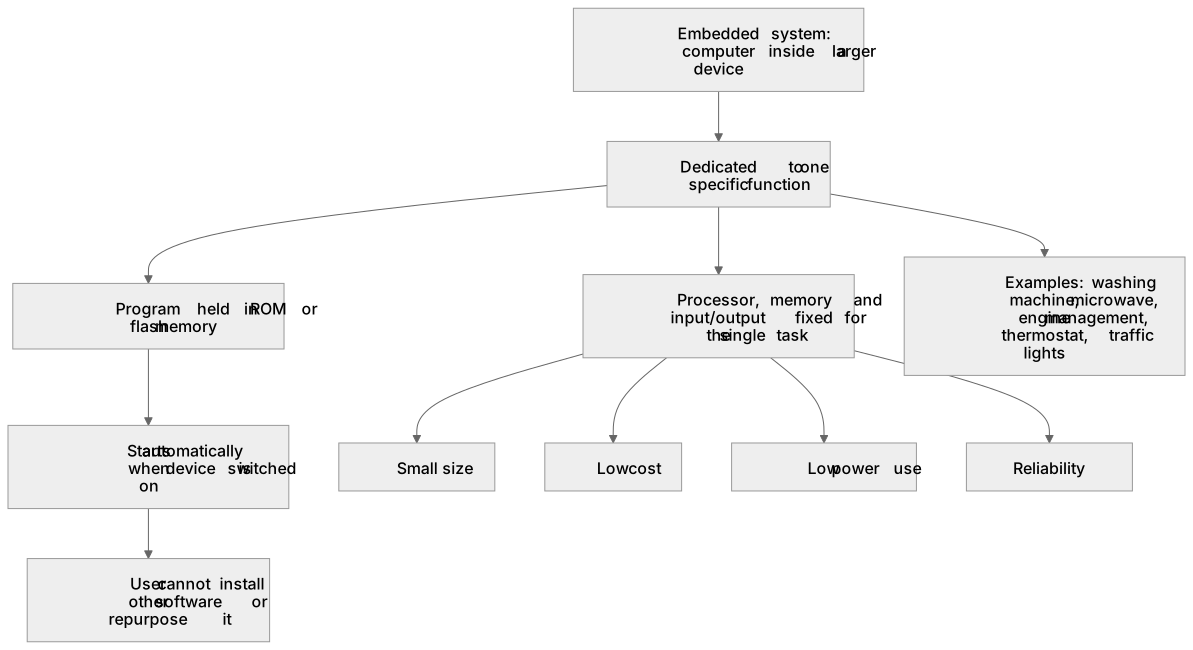
An embedded system is a computer built into a larger device to carry out one dedicated job, rather than being a general-purpose machine you program for many tasks. Its program is usually stored in ROM or flash memory and runs automatically when the device is switched on, so the user does not install software or choose what it does. The processor, memory and input/output are chosen and fixed for that single function, which keeps the unit small, cheap, low-power and reliable. Typical uses include washing machines controlling wash cycles, microwave ovens timing cooking, car engine management adjusting fuel and ignition, central heating thermostats sensing temperature, and traffic lights sequencing signals. Because the function is fixed, embedded systems are assessed by matching a described device to its dedicated purpose and explaining why it is embedded rather than general-purpose.
What earns the marks
- Defines an embedded system as a computer dedicated to one specific function within a larger device.
- States that its program is typically held in ROM or flash memory and starts automatically.
- Explains that the user cannot normally install other software or repurpose the device.
- Identifies that processor, memory and input/output are fixed and chosen for the single task.
- Links the design to benefits such as small size, low cost, low power use or reliability.
- Gives a valid example such as a washing machine, microwave, car engine management unit, thermostat or traffic light controller and names its dedicated job.
Common mistakes and how to put them right
Thinking any small computer is embedded.
Put it right: An embedded system is defined by its single dedicated function inside a host device, not by physical size.
Believing embedded systems run a full general-purpose operating system with user-installed apps.
Put it right: Their firmware is fixed and runs one task automatically.
Confusing an embedded system with a desktop PC used for many tasks.
Put it right: A general-purpose computer can run many different programs chosen by the user, while an embedded system cannot.
Assuming embedded systems have no processor or memory.
Put it right: They contain a processor and memory, but these are selected and fixed for the dedicated job.
Exam tips
- Read the question stem to see whether it asks for a definition, a purpose or an example, and answer only that.
- When giving an example, name both the device and the specific job it controls, for example a washing machine controlling wash cycles.
- Eliminate options that describe general-purpose computers or user-installed software, because these contradict the embedded concept.
Try the lesson
The start of the Hardware: 3.1.3 understand the concept of an embedded system and what embedded systems are used for lesson, made from checked teaching notes for this specification point.
Have a go first
A washing machine uses a small microcontroller to run a fixed set of wash programmes selected from a dial on the front panel. Which statement best explains why this control system is an embedded system?
Listen
An embedded system is a computer built into a larger device to carry out one dedicated job, rather than being a general-purpose machine you program for many tasks. Its program is usually stored in ROM or flash memory and runs automatically when the device is switched on, so the user does not install software or choose what it does. The processor, memory and input/output are chosen and fixed for that single function, which keeps the unit small, cheap, low-power and reliable. Typical uses include washing machines controlling wash cycles, microwave ovens timing cooking, car engine management adjusting fuel and ignition, central heating thermostats sensing temperature, and traffic lights sequencing signals. Because the function is fixed, embedded systems are assessed by matching a described device to its dedicated purpose and explaining why it is embedded rather than general-purpose. A strong answer earns marks for these points. Defines an embedded system as a computer dedicated to one specific function within a larger device. States that its program is typically held in ROM or flash memory and starts automatically. Explains that the user cannot normally install other software or repurpose the device. Identifies that processor, memory and input/output are fixed and chosen for the single task. A common slip: Thinking any small computer is embedded. Instead, an embedded system is defined by its single dedicated function inside a host device, not by physical size. Exam tip: Read the question stem to see whether it asks for a definition, a purpose or an example, and answer only that.
See it
Key words
Say what each word means before you turn the card.
Embedded system
Try answering aloud or in your head before turning the card.
Dedicated single function
Try answering aloud or in your head before turning the card.
Firmware in ROM or flash memory
Try answering aloud or in your head before turning the card.
See every definition
- Embedded system
- A computer built into a larger device to carry out one dedicated job rather than being a general-purpose machine.
- Dedicated single function
- The one job the processor, memory and input/output are chosen and fixed for, keeping the unit small, cheap, low-power and reliable.
- Firmware in ROM or flash memory
- The program usually stored in ROM or flash memory that runs automatically when the device is switched on, so the user does not install software.
Label the diagram
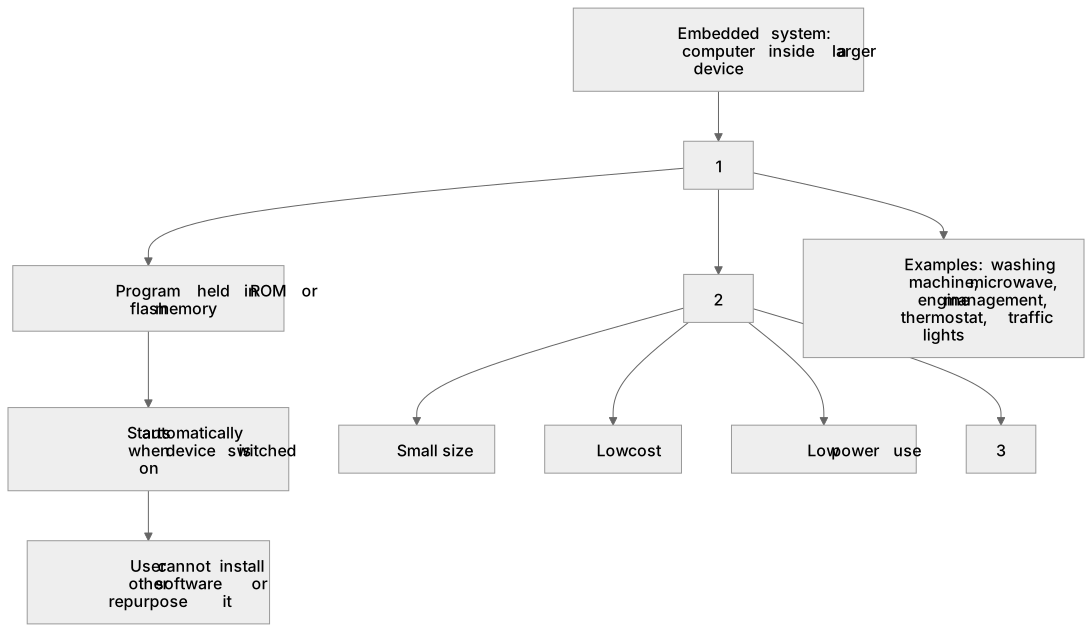
Some boxes have lost their names. Pick the right name for each number.
1Box 1
2Box 2
3Box 3
There is more to this lesson
The full lesson goes on to check your understanding and help you earn the marks. Create a free account to carry on, with your progress saved.
A week of Premium from your first lesson · Then the free plan continues · No card, no charge
Test your understanding of Hardware: 3.1.3 understand the concept of an embedded system and what embedded systems are used for
Active recall beats re-reading. Take an instant quiz now to test what you’ve learned and lock it into long-term memory.
A week of Premium from your first lesson · Then the free plan continues · No card, no charge