Pearson Edexcel · GCSE · Computer Science
Course version: 1CP2 · Version from Sept 2020
Understand the need for and be able to write programs that implement…
Full specification wording
Input/output: 6.4.4 understand the need for and be able to write programs that implement authentication (ID and password, lookup)
Authentication confirms that a user is who they claim to be before allowing access.
Checked against the Pearson Edexcel 1CP2 specification (opens in a new tab) on .
- Point 2 of 2
- 3 key terms
Study notes
From the checked teaching notes for this specification point.
The idea
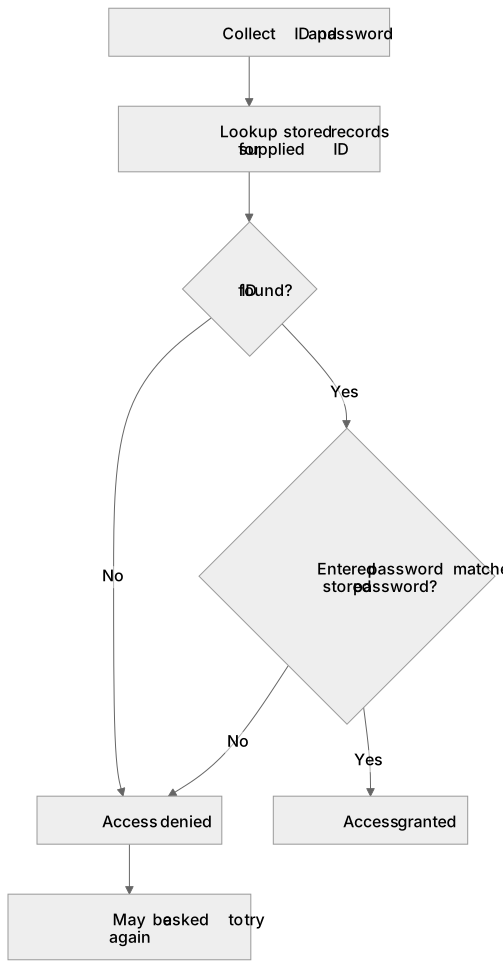
Authentication confirms that a user is who they claim to be before allowing access. A common method asks for an ID and a password, then performs a lookup: the program searches stored records for the supplied ID and compares the stored password with the one entered. If both match, access is granted; otherwise access is denied and the user may be asked to try again. The need is to protect systems and data from unauthorised use. Programs implement this with selection, iteration and data structures such as lists or dictionaries. A lookup may also retrieve other details linked to the ID. Authentication differs from validation: validation checks the format of input, while authentication checks identity against stored credentials.
What earns the marks
- Authentication confirms a user's identity before granting access to a system or its data.
- A typical method collects an ID and a password from the user.
- A lookup searches stored records for the supplied ID and retrieves the associated stored password or credential.
- The program compares the entered password with the stored password and grants access only when both the ID and password match.
- If the ID is not found or the password does not match, the program denies access and may allow a limited number of retries.
- Authentication is implemented using selection, iteration and data structures such as lists or dictionaries.
Common mistakes and how to put them right
Confusing authentication with validation.
Put it right by stating that authentication compares entered details with stored records.
Thinking a lookup means checking the password only.
Put it right by describing both stages.
Assuming authentication guarantees the data is accurate.
Put it right by stating that authentication controls access, not data truth.
Writing code that grants access when either the ID or the password matches.
Put it right by testing the combined condition.
Exam tips
- State the purpose of authentication before describing the ID and password process.
- When writing code, show the lookup step and the comparison, and make the access decision depend on both matching.
- Use terms such as stored record, lookup, credentials and access granted or denied accurately.
Try the lesson
The start of the Input/output: 6.4.4 understand the need for and be able to write programs that implement authentication (ID and password, lookup) lesson, made from checked teaching notes for this specification point.
Have a go first
A program stores each user's ID and password as a record in a list. A user types in an ID to log in. Before any password can be checked, what must the program do with the typed ID?
Listen
Authentication confirms that a user is who they claim to be before allowing access. A common method asks for an ID and a password, then performs a lookup: the program searches stored records for the supplied ID and compares the stored password with the one entered. If both match, access is granted; otherwise access is denied and the user may be asked to try again. The need is to protect systems and data from unauthorised use. Programs implement this with selection, iteration and data structures such as lists or dictionaries. A lookup may also retrieve other details linked to the ID. Authentication differs from validation: validation checks the format of input, while authentication checks identity against stored credentials. A strong answer earns marks for these points. Authentication confirms a user's identity before granting access to a system or its data. A typical method collects an ID and a password from the user. A lookup searches stored records for the supplied ID and retrieves the associated stored password or credential. The program compares the entered password with the stored password and grants access only when both the ID and password match. A common slip: Confusing authentication with validation: validation checks that input is in a sensible format, while authentication checks identity against stored credentials. Instead, stating that authentication compares entered details with stored records. Exam tip: State the purpose of authentication before describing the ID and password process.
See it
Key words
Say what each word means before you turn the card.
Authentication
Try answering aloud or in your head before turning the card.
ID and password
Try answering aloud or in your head before turning the card.
Lookup
Try answering aloud or in your head before turning the card.
See every definition
- Authentication
- Confirms that a user is who they claim to be before allowing access to a system or its data.
- ID and password
- Details collected from the user, where the program searches stored records for the supplied ID and compares the stored password with the one entered.
- Lookup
- Searches stored records for the supplied ID and retrieves the associated stored password or credential.
Label the diagram
Some boxes have lost their names. Pick the right name for each number.
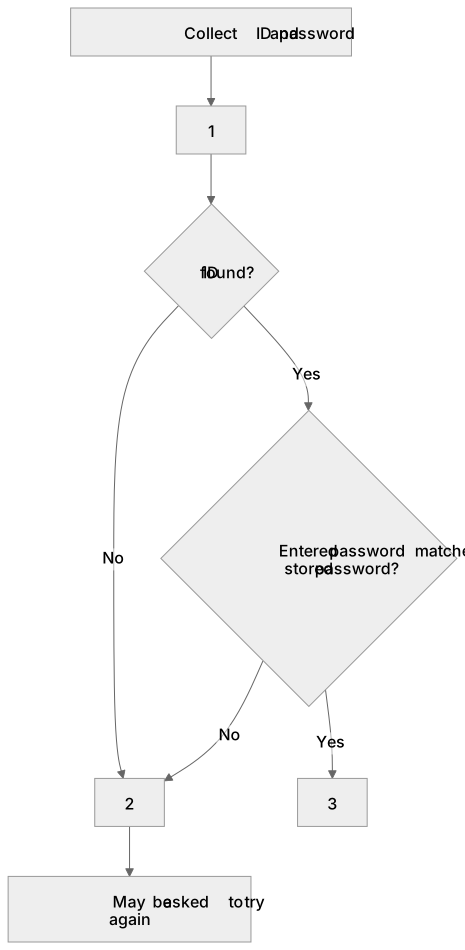
1Box 1
2Box 2
3Box 3
There is more to this lesson
The full lesson goes on to check your understanding and help you earn the marks. Create a free account to carry on, with your progress saved.
A week of Premium from your first lesson · Then the free plan continues · No card, no charge
Test your understanding of Input/output: 6.4.4 understand the need for and be able to write programs that implement authentication (ID and password, lookup)
Active recall beats re-reading. Take an instant quiz now to test what you’ve learned and lock it into long-term memory.
A week of Premium from your first lesson · Then the free plan continues · No card, no charge