Pearson Edexcel · GCSE · Computer Science
Course version: 1CP2 · Version from Sept 2020
Understand that network speeds are measured in bits per second (kilobit,…
Full specification wording
Networks: 4.1.5 understand that network speeds are measured in bits per second (kilobit, megabit, gigabit) and be able to construct expressions involving file size, transmission rate and time
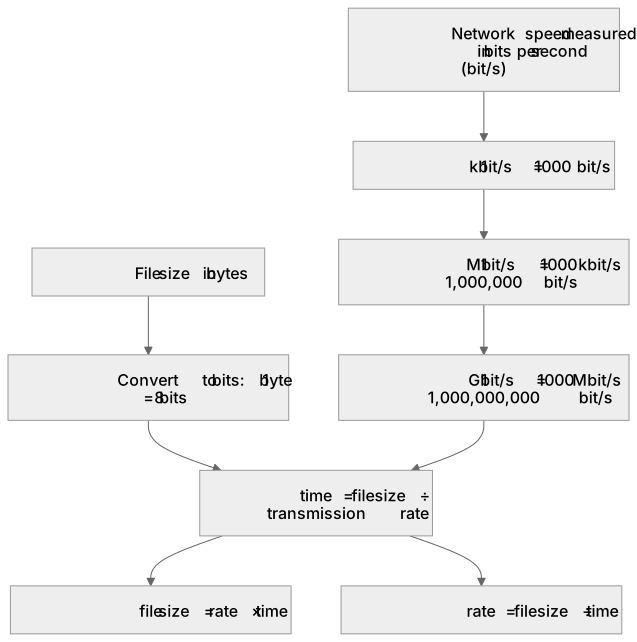
Network speed is a rate: how many bits pass a point each second, written in bits per second (bit/s).
Checked against the Pearson Edexcel 1CP2 specification (opens in a new tab) on .
- Point 5 of 8
- 4 key terms
Study notes
From the checked teaching notes for this specification point.
The idea
Network speed is a rate: how many bits pass a point each second, written in bits per second (bit/s). The prefixes scale by 1000: 1 kilobit per second (kbit/s) = 1000 bit/s, 1 megabit per second (Mbit/s) = 1000 kbit/s = 1,000,000 bit/s, and 1 gigabit per second (Gbit/s) = 1000 Mbit/s = 1,000,000,000 bit/s. File size is a quantity of bits, so time = file size ÷ transmission rate. Convert units before dividing: 2 MB = 2 × 8 × 1,000,000 = 16,000,000 bits; at 8 Mbit/s, time = 16,000,000 ÷ 8,000,000 = 2 s. Rearranged expressions give file size = rate × time and rate = file size ÷ time. Keep bits and bytes distinct: 1 byte = 8 bits.
What earns the marks
- States that network speed is measured in bits per second (bit/s), with kilobit, megabit and gigabit prefixes scaling by 1000.
- Converts between bit/s, kbit/s, Mbit/s and Gbit/s correctly, e.g. 1 Mbit/s = 1,000,000 bit/s.
- Distinguishes bits from bytes and applies 1 byte = 8 bits when a file size is given in bytes.
- Selects and rearranges the relationship time = file size ÷ transmission rate to find time, file size or rate.
- Carries out a multi-step calculation with consistent units and states the unit of the answer, e.g. seconds.
Common mistakes and how to put them right
Treating bits and bytes as interchangeable.
Put it right: A file size in bytes must be multiplied by 8 to give bits before dividing by a rate in bit/s.
Using 1024 instead of 1000 for kilobit, megabit and gigabit.
Put it right: These network-speed prefixes scale by powers of 1000.
Dividing rate by file size instead of file size by rate.
Put it right: Time = file size ÷ transmission rate, so the larger the rate the smaller the time.
Forgetting to convert a rate such as 8 Mbit/s into 8,000,000 bit/s before dividing, which gives an answer 1,000,000 times too large.
Exam tips
- Write the formula triangle or equation first: time = file size ÷ rate, file size = rate × time, rate = file size ÷ time.
- Convert every quantity to bits and bit/s before substituting, and show the conversion line so method marks are visible.
- Check the magnitude of the answer: a small file at a fast rate should give a small time, and include the unit (s, bit/s or bits).
Try the lesson
The start of the Networks: 4.1.5 understand that network speeds are measured in bits per second (kilobit, megabit, gigabit) and be able to construct expressions involving file size, transmission rate and time lesson, made from checked teaching notes for this specification point.
Have a go first
A broadband connection transfers data at a rate of 25 megabits per second. Using 1 megabit = 1,000,000 bits, how many bits are transferred in one second?
Listen
Network speed is a rate: how many bits pass a point each second, written in bits per second (bit/s). The prefixes scale by 1000: 1 kilobit per second (kbit/s) = 1000 bit/s, 1 megabit per second (Mbit/s) = 1000 kbit/s = 1,000,000 bit/s, and 1 gigabit per second (Gbit/s) = 1000 Mbit/s = 1,000,000,000 bit/s. File size is a quantity of bits, so time = file size ÷ transmission rate. Convert units before dividing: 2 MB = 2 × 8 × 1,000,000 = 16,000,000 bits; at 8 Mbit/s, time = 16,000,000 ÷ 8,000,000 = 2 s. Rearranged expressions give file size = rate × time and rate = file size ÷ time. Keep bits and bytes distinct: 1 byte = 8 bits. A strong answer earns marks for these points. States that network speed is measured in bits per second (bit/s), with kilobit, megabit and gigabit prefixes scaling by 1000. Converts between bit/s, kbit/s, Mbit/s and Gbit/s correctly, e.g. 1 Mbit/s = 1,000,000 bit/s. Distinguishes bits from bytes and applies 1 byte = 8 bits when a file size is given in bytes. Selects and rearranges the relationship time = file size ÷ transmission rate to find time, file size or rate. Exam tip: Write the formula triangle or equation first: time = file size ÷ rate, file size = rate × time, rate = file size ÷ time.
See it
Key words
Say what each word means before you turn the card.
bits per second
Try answering aloud or in your head before turning the card.
kilobit, megabit and gigabit
Try answering aloud or in your head before turning the card.
time = file size ÷ transmission rate
Try answering aloud or in your head before turning the card.
1 byte = 8 bits
Try answering aloud or in your head before turning the card.
See every definition
- bits per second
- The rate at which bits pass a point each second, used to measure network speed.
- kilobit, megabit and gigabit
- Prefixes that scale by 1000, so 1 megabit per second is 1000 kilobit per second.
- time = file size ÷ transmission rate
- The relationship linking file size, transmission rate and time, which can be rearranged to find file size or rate.
- 1 byte = 8 bits
- The conversion keeping bits and bytes distinct, applied when a file size is given in bytes.
Label the diagram
Some boxes have lost their names. Pick the right name for each number.
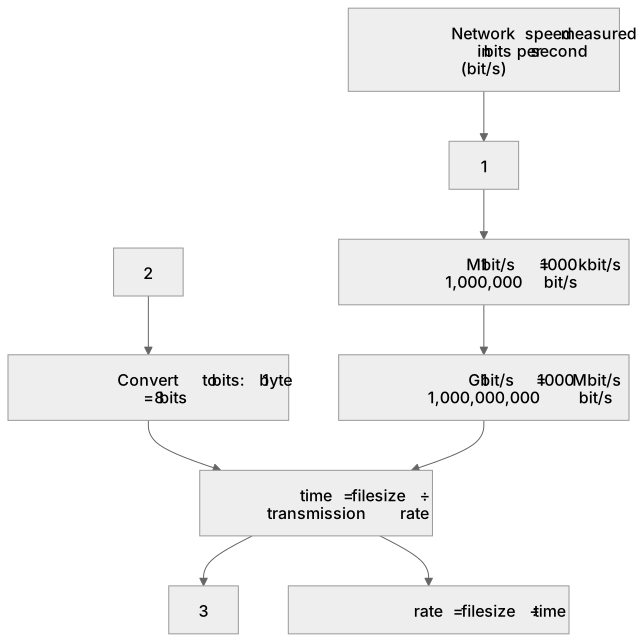
1Box 1
2Box 2
3Box 3
There is more to this lesson
The full lesson goes on to check your understanding and help you earn the marks. Create a free account to carry on, with your progress saved.
A week of Premium from your first lesson · Then the free plan continues · No card, no charge
Test your understanding of Networks: 4.1.5 understand that network speeds are measured in bits per second (kilobit, megabit, gigabit) and be able to construct expressions involving file size, transmission rate and time
Active recall beats re-reading. Take an instant quiz now to test what you’ve learned and lock it into long-term memory.
A week of Premium from your first lesson · Then the free plan continues · No card, no charge