Pearson Edexcel · GCSE · Design and Technology
Timbers: Design contexts
This topic explores the diverse world of timbers, covering natural and manufactured boards, their working properties, and environmental impacts. Mastering this section is essential for making justified material choices in your coursework and scoring highly in the written exam.
- 6 min read
- 3 worked examples
- 3 practice questions
- 6 key terms
Study Notes
Overview
Timbers: Design Contexts (7.1) is a fundamental topic in GCSE Design and Technology. It requires candidates to apply their knowledge of natural and manufactured timbers, components, and manufacturing processes when designing or modifying products. Examiners look for a holistic understanding—you must not only identify materials but also justify your selection based on physical characteristics, working properties, structural forces, and environmental sustainability.
Key Knowledge & Theory
Core Concepts: Timber Classification
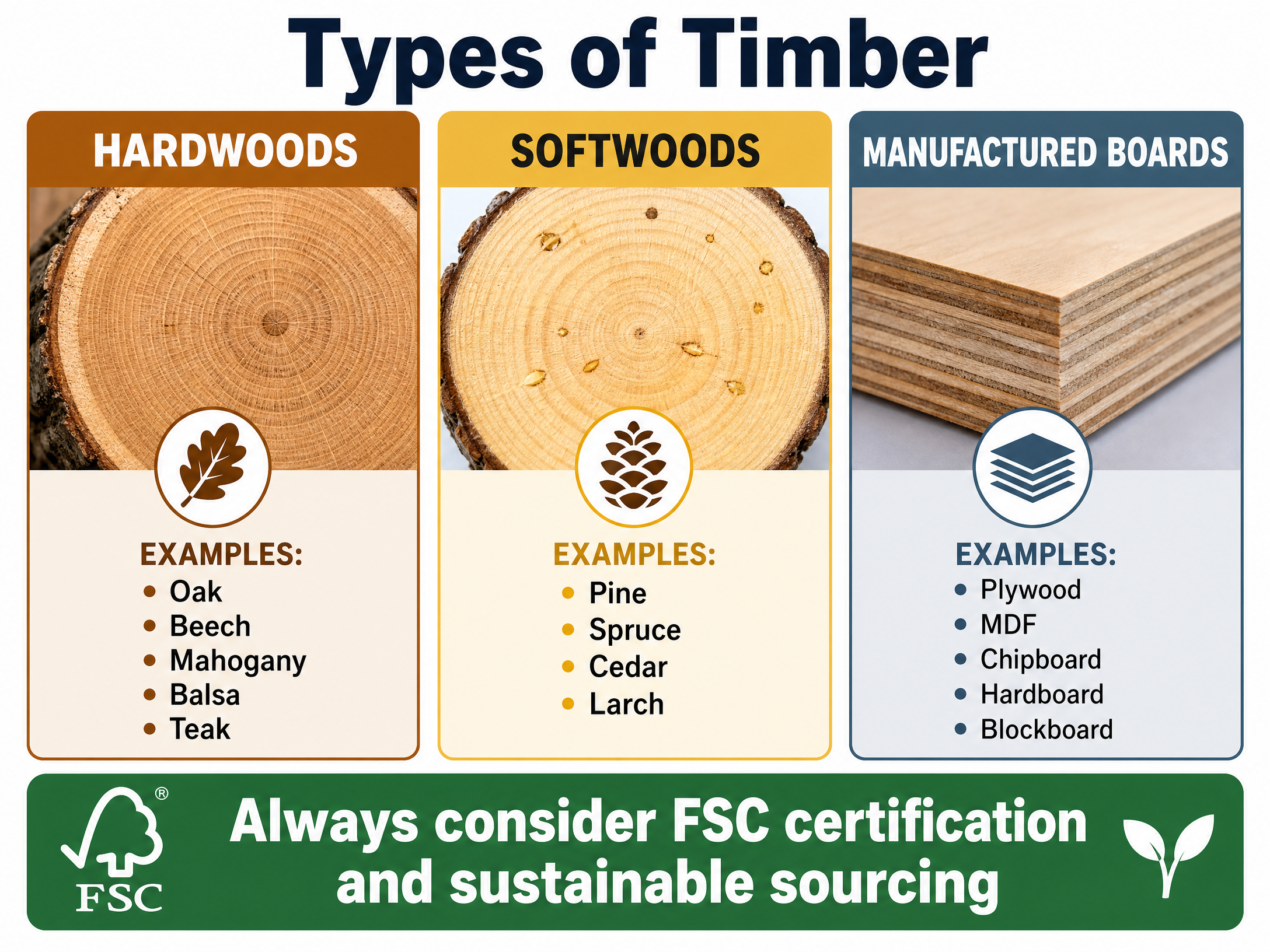
Timber is broadly categorised into three groups: Hardwoods, Softwoods, and Manufactured Boards.
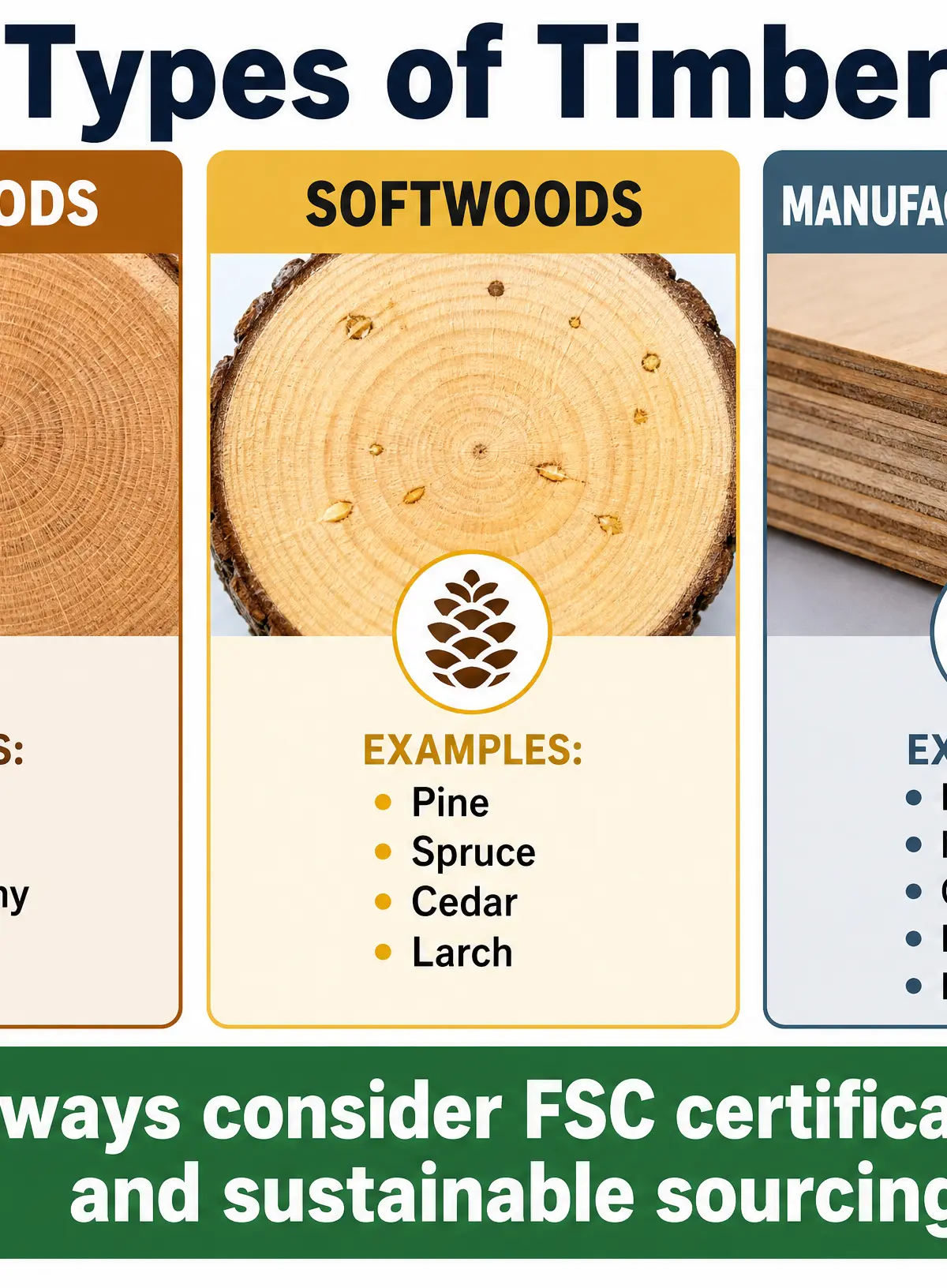
Hardwoods come from deciduous trees (broad-leaved trees that lose their leaves in autumn). They generally grow slowly, resulting in dense, durable timber with complex grain structures.
- Examples: Oak (hard, tough, durable), Mahogany (rich colour, easy to work), Beech (hard, tough, prone to warping), Balsa (very soft and light, exceptional strength-to-weight ratio).
Softwoods come from coniferous trees (evergreen, cone-bearing trees). They grow faster than hardwoods, making them more abundant and generally cheaper, though often less durable.
- Examples: Pine (straight grain, easy to work), Spruce (good strength-to-weight ratio), Cedar (natural oils make it weather resistant), Larch (tough, water resistant).
Manufactured Boards are engineered wood products made by binding wood particles, fibres, or veneers together with adhesives under heat and pressure.
- Examples: Plywood (alternating veneer layers, very strong), MDF (smooth surface, no grain), Chipboard (made from wood chips, economical but weak), Blockboard (central core of softwood strips).
Working Properties
When selecting a material, candidates must evaluate its working properties against the design context:
- Hardness: The ability to withstand scratching, rubbing, or denting.
- Toughness: The ability to absorb impact without breaking or snapping.
- Durability: Resistance to decay, weathering, and insect attack.
- Elasticity: The ability to deform under load and return to its original shape.
- Tensile Strength: Resistance to being pulled apart.
- Compressive Strength: Resistance to being crushed or pushed together.
Forces and Stresses
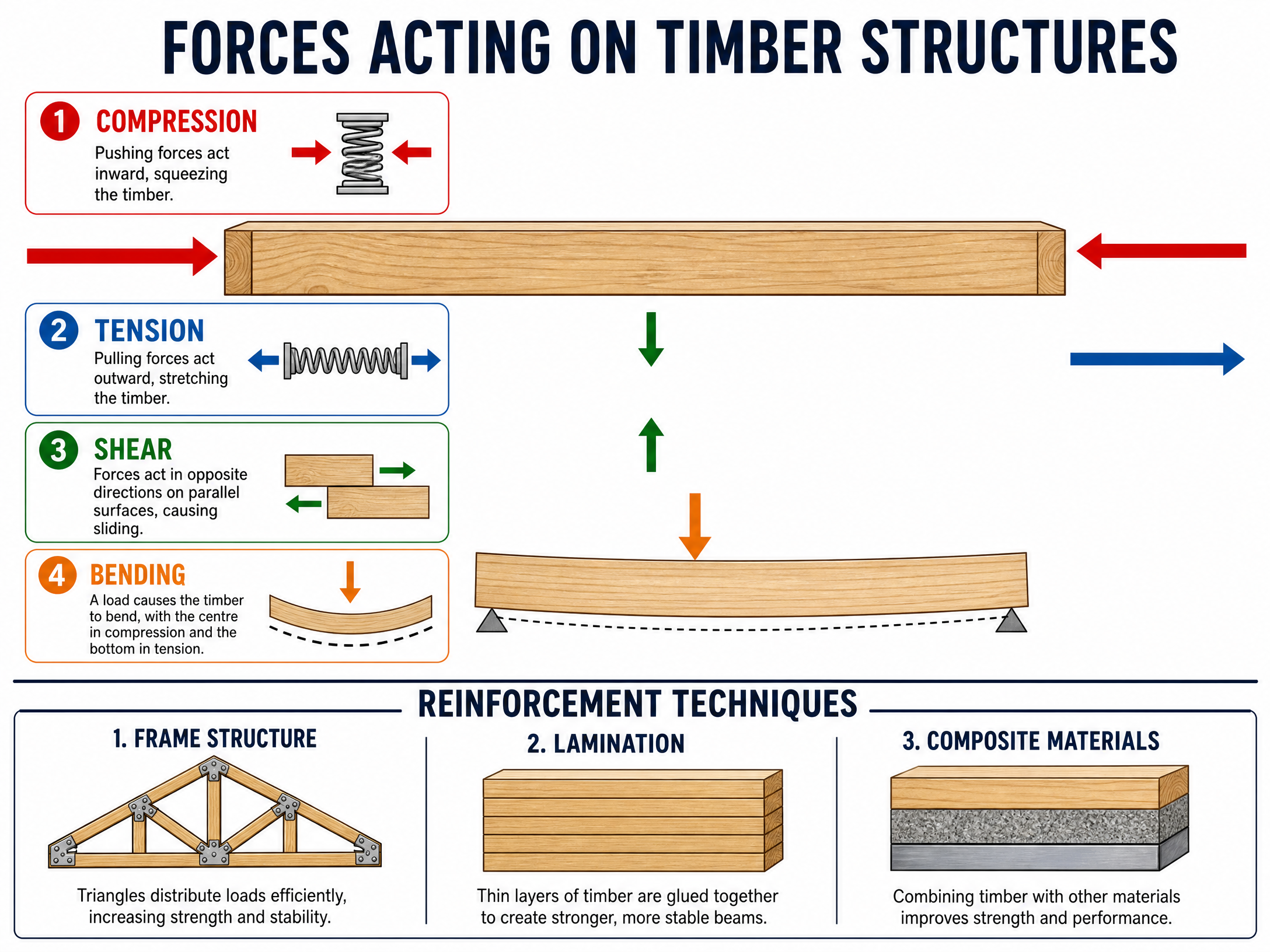
Timber structures are subjected to various forces. Understanding these is crucial for designing stable products.
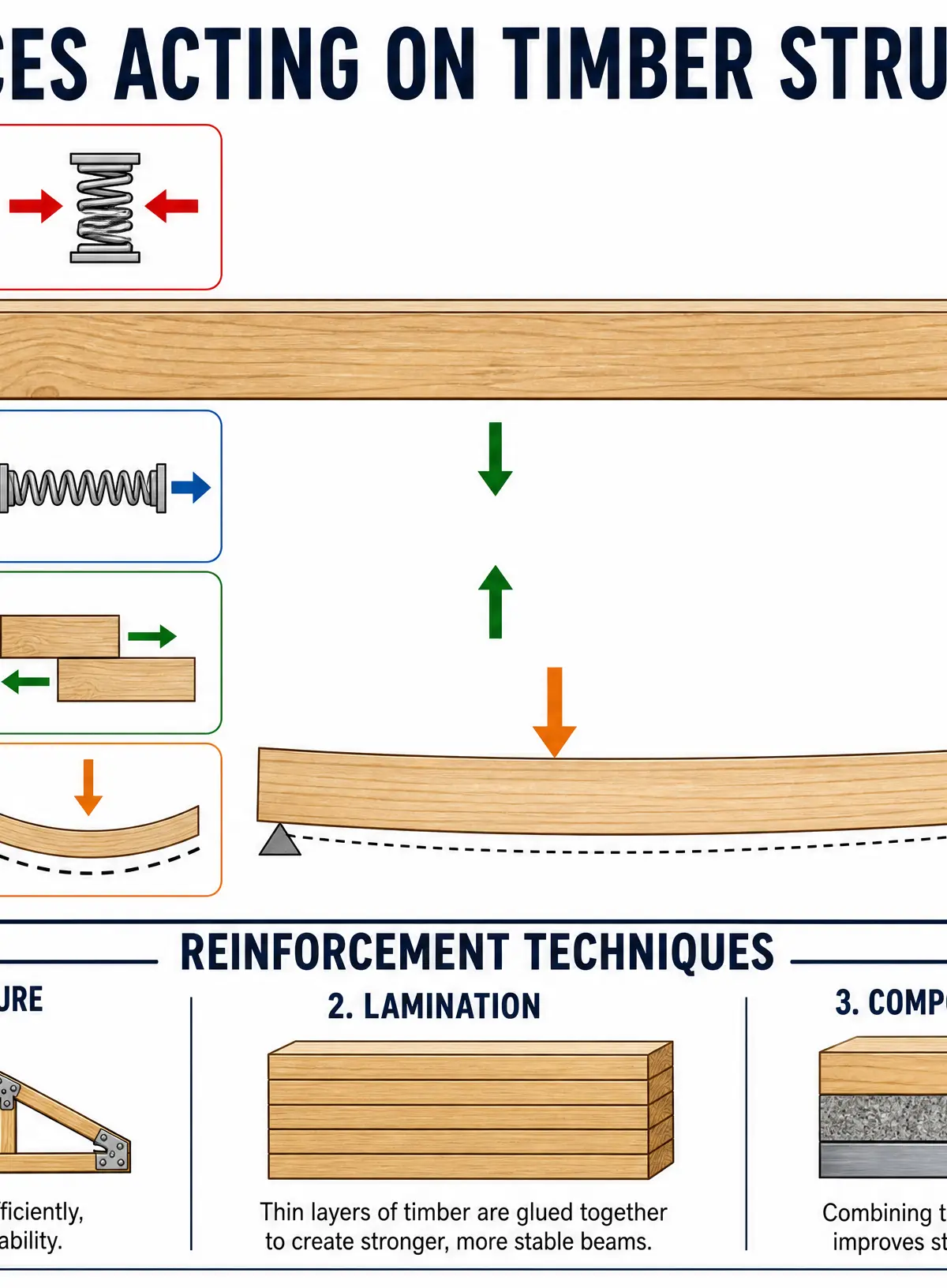
- Compression: Pushing forces that squeeze the material.
- Tension: Pulling forces that stretch the material.
- Shear: Forces acting across the material in opposite directions.
- Bending: A combination of tension (on the outside of the curve) and compression (on the inside).
Sustainability and Ecological Footprint
The environmental impact of timber is a frequent exam topic. Candidates must consider:
- Deforestation: The permanent removal of trees, leading to habitat destruction and loss of biodiversity.
- Processing and Transportation: The carbon footprint associated with logging, milling, kiln drying, and shipping timber globally.
- FSC Certification: The Forest Stewardship Council guarantees that timber is sourced from responsibly managed forests where trees are replanted.
Audio Revision: The Timbers Podcast
Listen to this 10-minute revision podcast covering the core concepts, common exam mistakes, and a quick-fire recall quiz.
Practical Skills
Techniques & Processes
In your coursework, you will need to demonstrate practical skills using timber:
- Marking Out: Using a try square, marking gauge, and marking knife for precision.
- Cutting and Shaping: Selecting the correct saw (e.g., tenon saw for straight cuts, coping saw for curves) and using chisels or planes for shaping.
- Jointing: Creating strong joints such as mortise and tenon, dovetail, or finger joints, rather than relying solely on butt joints and screws.
- Lamination: Gluing thin layers of timber (veneers) together over a former to create strong, curved shapes.
Surface Treatments and Finishes
Finishes are applied for both functional (protection) and aesthetic (appearance) reasons:
- Varnish: Provides a hard, protective, transparent layer.
- Wax: Offers a dull gloss finish, nourishing the wood but offering less protection against heat and liquids.
- Oil (e.g., Teak or Danish oil): Penetrates the grain to protect from within, enhancing the natural colour.
- Paint: Completely covers the grain, offering high protection and a solid colour finish (ideal for MDF).
Portfolio/Coursework Guidance
Assessment Criteria
Examiners award marks in coursework for:
- Investigation: Analysing the design context and researching materials.
- Design Ideas: Generating creative concepts and specifying appropriate timbers.
- Development: Refining ideas, modelling (e.g., using balsa or MDF), and testing joints.
- Making: Demonstrating high-level practical skills, accuracy, and safe working practices.
- Evaluation: Testing the final product against the specification and suggesting improvements.
Building a Strong Portfolio
To secure high marks, your portfolio must clearly document your material choices. Do not simply state, "I will use pine because it is cheap." Instead, write: "I have selected pine for the prototype because it is a readily available softwood that is easy to work with hand tools, allowing for rapid iteration of the frame structure."
Exam Component
Written Exam Knowledge
In the written paper, expect questions that require you to:
- Identify timbers from descriptions or images.
- Compare the properties of natural timbers with manufactured boards.
- Calculate material quantities and costs based on standard stock forms.
- Evaluate the environmental impact of a product's lifecycle.
Exam Strategy
For extended response questions (6-8 marks), use a structured approach. State the material property, explain how it relates to the product's function, and discuss any secondary factors (such as aesthetics or sustainability).
Visual Resources
2 diagrams and illustrations
Interactive Diagrams
1 interactive diagram to visualise key concepts
Conceptual Flow Outline
The Timber Design and Selection Process
Worked Examples
3 worked examples — open one to explore the question and available guidance.
Practice Questions
Test your understanding — click to reveal model answers
Identify two manufactured boards and state one specific application for each. (4 marks)
Hint: Think about sheet materials used in furniture or construction.
Explain how the process of lamination improves the structural integrity of timber. (4 marks)
Hint: Consider what happens to the grain direction and the role of the adhesive.
A manufacturer is designing a range of outdoor garden benches. Evaluate the environmental and functional factors they must consider when choosing between Teak (a hardwood) and treated Pine (a softwood). (8 marks)
Hint: Structure your answer to cover both functional (durability, weather resistance) and environmental (sustainability, growth rate) factors for both materials.