Pearson Edexcel · A-Level · Economics B
Course version: 9EB0 · Version from Sept 2015
Conditions that prompt trade: c) Possibility of offshoring and outsourcing
Full specification wording
Conditions that prompt trade: c) Possibility of offshoring and outsourcing
The possibility of offshoring and outsourcing is a major condition prompting international trade.
Checked against the Pearson Edexcel 9EB0 specification (opens in a new tab) on .
- Point 3 of 5
- 4 key terms
Study notes
From the checked teaching notes for this specification point.
The idea
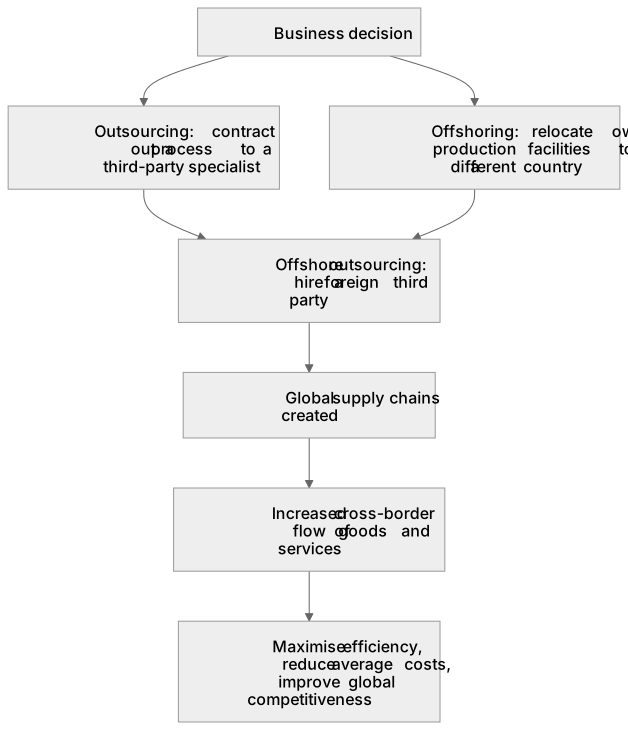
The possibility of offshoring and outsourcing is a major condition prompting international trade. Outsourcing occurs when a business contracts out a process, such as IT support, to a third-party specialist. Offshoring involves relocating a company's own production facilities to a different country to exploit lower costs, such as cheaper labour. For example, a UK brand might offshore manufacturing to Bangladesh to reduce costs. Firms often combine both by offshore outsourcing, hiring a foreign third party. These strategies prompt trade by creating global supply chains, increasing the cross-border flow of goods and services as firms seek to maximise efficiency, reduce average costs, and improve their overall global competitiveness.
What earns the marks
- Define outsourcing as delegating business processes to external third-party providers.
- Define offshoring as relocating business activities to another country, keeping them within the same company.
- Explain that offshore outsourcing combines both, using a foreign third party.
- Identify cost reduction, such as lower labour or raw material costs, as a primary driver for offshoring.
- Explain how offshoring and outsourcing prompt international trade by creating global supply chains and increasing imports and exports of intermediate goods and services.
Common mistakes and how to put them right
Using offshoring and outsourcing interchangeably.
Put it right: Offshoring refers to geographic relocation (which can be internal), while outsourcing refers to contracting out to a third party (which can be domestic).
Assuming offshoring always leads to lower costs.
Put it right: Offshoring can introduce hidden costs, such as increased transportation expenses, quality control issues, or tariffs.
Believing outsourcing only applies to manufacturing.
Put it right: Outsourcing is highly prevalent in the service sector, such as call centres, accounting, and software development.
Exam tips
- Clearly distinguish between offshoring and outsourcing in your definitions to secure knowledge marks.
- Evaluate the risks of offshoring, such as supply chain disruptions or reputational damage from poor working conditions abroad.
- Use real-world examples of global supply chains to illustrate how offshore outsourcing increases the volume of international trade in services.
Try the lesson
The start of the Conditions that prompt trade: c) Possibility of offshoring and outsourcing lesson, made from checked teaching notes for this specification point.
Have a go first
Which of the following best describes the process of offshoring as a condition that prompts international trade?
Listen
The possibility of offshoring and outsourcing is a major condition prompting international trade. Outsourcing occurs when a business contracts out a process, such as IT support, to a third-party specialist. Offshoring involves relocating a company's own production facilities to a different country to exploit lower costs, such as cheaper labour. For example, a UK brand might offshore manufacturing to Bangladesh to reduce costs. Firms often combine both by offshore outsourcing, hiring a foreign third party. These strategies prompt trade by creating global supply chains, increasing the cross-border flow of goods and services as firms seek to maximise efficiency, reduce average costs, and improve their overall global competitiveness. A strong answer earns marks for these points. Define outsourcing as delegating business processes to external third-party providers. Define offshoring as relocating business activities to another country, keeping them within the same company. Explain that offshore outsourcing combines both, using a foreign third party. Identify cost reduction, such as lower labour or raw material costs, as a primary driver for offshoring. A common slip: Using offshoring and outsourcing interchangeably. Instead, Offshoring refers to geographic relocation (which can be internal), while outsourcing refers to contracting out to a third party (which can be domestic). Exam tip: Clearly distinguish between offshoring and outsourcing in your definitions to secure knowledge marks.
See it
Key words
Say what each word means before you turn the card.
Outsourcing
Try answering aloud or in your head before turning the card.
Offshoring
Try answering aloud or in your head before turning the card.
Offshore outsourcing
Try answering aloud or in your head before turning the card.
Global supply chains
Try answering aloud or in your head before turning the card.
See every definition
- Outsourcing
- Occurs when a business contracts out a process, such as IT support, to a third-party specialist.
- Offshoring
- Involves relocating a company's own production facilities to a different country to exploit lower costs, such as cheaper labour.
- Offshore outsourcing
- Combines both strategies by hiring a foreign third party to carry out a business process.
- Global supply chains
- Created by offshoring and outsourcing, increasing the cross-border flow of goods and services as firms seek to maximise efficiency and reduce average costs.
Label the diagram
Some boxes have lost their names. Pick the right name for each number.
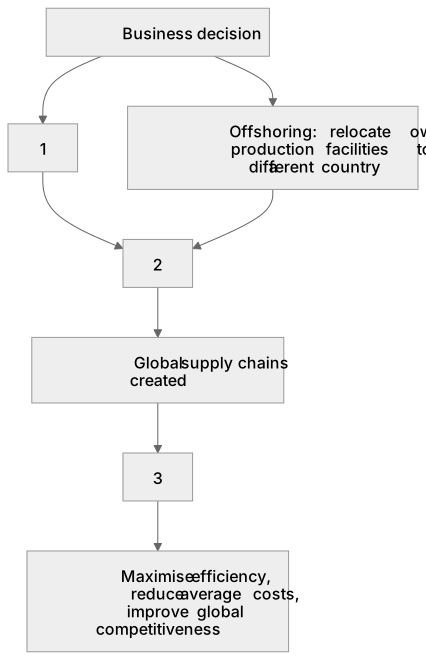
1Box 1
2Box 2
3Box 3
There is more to this lesson
The full lesson goes on to check your understanding and help you earn the marks. Create a free account to carry on, with your progress saved.
A week of Premium from your first lesson · Then the free plan continues · No card, no charge
Test your understanding of Conditions that prompt trade: c) Possibility of offshoring and outsourcing
Active recall beats re-reading. Take an instant quiz now to test what you’ve learned and lock it into long-term memory.
A week of Premium from your first lesson · Then the free plan continues · No card, no charge