Pearson Edexcel · A-Level · Economics B
Course version: 9EB0 · Version from Sept 2015
C) The distinction between movements along a demand curve and shifts of a…
Full specification wording
Demand: c) The distinction between movements along a demand curve and shifts of a demand curve
Understanding the distinction between movements along a demand curve and shifts of the curve is crucial for market analysis.
Checked against the Pearson Edexcel 9EB0 specification (opens in a new tab) on .
- Point 3 of 4
- 4 key terms
Study notes
From the checked teaching notes for this specification point.
The idea
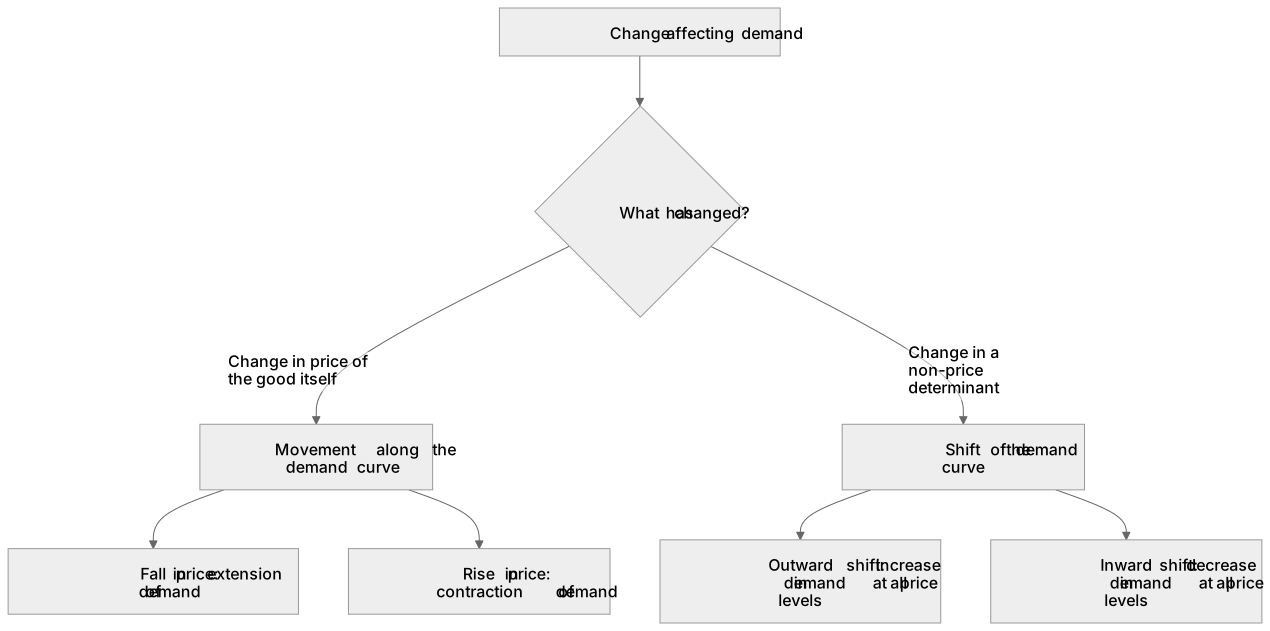
Understanding the distinction between movements along a demand curve and shifts of the curve is crucial for market analysis. A movement along the demand curve is caused solely by a change in the price of the good itself, resulting in an extension (increase in quantity demanded) or contraction (decrease in quantity demanded). In contrast, a shift of the entire demand curve occurs when a non-price determinant of demand changes, such as consumer income, tastes, or the prices of substitute goods. For instance, a successful advertising campaign shifts the demand curve to the right, meaning more is demanded at every price, whereas a price cut merely causes a downward movement along the existing curve.
What earns the marks
- A movement along the demand curve is caused only by a change in the price of the product itself.
- A fall in price causes an extension of demand, while a rise in price causes a contraction of demand.
- A shift of the demand curve is caused by changes in non-price factors, such as income, trends, or the price of related goods.
- An outward shift represents an increase in demand at all price levels, while an inward shift represents a decrease in demand.
Common mistakes and how to put them right
Confusing the cause of a shift with the cause of a movement.
Put it right: Only a change in the good's own price causes a movement, while non-price factors cause a shift.
Using the terms 'extension' and 'increase' interchangeably.
Put it right: 'extension' refers to a movement along the curve due to a price fall, while 'increase' refers to an outward shift of the entire curve.
Writing the index number on the baseline when labelling a new demand curve.
Put it right: Use a superscript, such as shifting from D to D¹, to denote the new curve.
Exam tips
- When illustrating a shift, draw directional arrows between the original and new demand curves to clearly show the change.
- Explicitly state whether a scenario causes a 'movement along' or a 'shift of' the demand curve in your written analysis.
- Memorise the acronym PIRATES (Population, Income, Related goods, Advertising, Tastes, Expectations, Seasons) to recall the conditions that shift the demand curve.
Try the lesson
The start of the Demand: c) The distinction between movements along a demand curve and shifts of a demand curve lesson, made from checked teaching notes for this specification point.
Have a go first
Which of the following events will cause a movement along the existing demand curve for electric vehicles, rather than a shift of the demand curve?
Listen
Understanding the distinction between movements along a demand curve and shifts of the curve is crucial for market analysis. A movement along the demand curve is caused solely by a change in the price of the good itself, resulting in an extension (increase in quantity demanded) or contraction (decrease in quantity demanded). In contrast, a shift of the entire demand curve occurs when a non-price determinant of demand changes, such as consumer income, tastes, or the prices of substitute goods. For instance, a successful advertising campaign shifts the demand curve to the right, meaning more is demanded at every price, whereas a price cut merely causes a downward movement along the existing curve. A strong answer earns marks for these points. A movement along the demand curve is caused only by a change in the price of the product itself. A fall in price causes an extension of demand, while a rise in price causes a contraction of demand. A shift of the demand curve is caused by changes in non-price factors, such as income, trends, or the price of related goods. An outward shift represents an increase in demand at all price levels, while an inward shift represents a decrease in demand. Exam tip: When illustrating a shift, draw directional arrows between the original and new demand curves to clearly show the change.
See it
Key words
Say what each word means before you turn the card.
Movement along the demand curve
Try answering aloud or in your head before turning the card.
Shift of the demand curve
Try answering aloud or in your head before turning the card.
Extension of demand
Try answering aloud or in your head before turning the card.
Contraction of demand
Try answering aloud or in your head before turning the card.
See every definition
- Movement along the demand curve
- Caused solely by a change in the price of the good itself, resulting in an extension or contraction of demand.
- Shift of the demand curve
- Occurs when a non-price determinant of demand changes, such as consumer income, tastes, or the prices of substitute goods.
- Extension of demand
- An increase in quantity demanded caused by a fall in price, shown as a movement along the existing curve.
- Contraction of demand
- A decrease in quantity demanded caused by a rise in price, shown as a movement along the existing curve.
There is more to this lesson
The full lesson goes on to check your understanding and help you earn the marks. Create a free account to carry on, with your progress saved.
A week of Premium from your first lesson · Then the free plan continues · No card, no charge
Test your understanding of Demand: c) The distinction between movements along a demand curve and shifts of a demand curve
Active recall beats re-reading. Take an instant quiz now to test what you’ve learned and lock it into long-term memory.
A week of Premium from your first lesson · Then the free plan continues · No card, no charge