Pearson Edexcel · A-Level · Economics B
Course version: 9EB0 · Version from Sept 2015
D) Supply chain considerations: o exploitation of labour o child labour
Full specification wording
Ethical issues: d) Supply chain considerations: o exploitation of labour o child labour
Ethical supply chain management requires businesses to scrutinise suppliers to prevent labour exploitation and child labour.
Checked against the Pearson Edexcel 9EB0 specification (opens in a new tab) on .
- Point 4 of 5
- 2 key terms
Study notes
From the checked teaching notes for this specification point.
The idea
Ethical supply chain management requires businesses to scrutinise suppliers to prevent labour exploitation and child labour. Exploitation occurs when workers face unsafe conditions, excessive hours, or wages below a living standard. Child labour involves employing minors in work that deprives them of education or harms their development. For example, a clothing retailer might face severe reputational damage and boycotts if an audit reveals its overseas factories employ underage workers or force staff to work unpaid overtime. Businesses must balance the drive for lower production costs against the ethical imperative and long-term brand value of ensuring fair labour practices throughout their global supply chain.
What earns the marks
- Identify exploitation of labour as paying below subsistence wages or providing unsafe working conditions.
- Define child labour as the employment of children in an industry or business, especially when illegal or considered exploitative.
- Explain that unethical supply chain practices can lead to significant reputational damage and loss of consumer trust.
- Evaluate the trade-off between minimising supply chain costs and maintaining ethical labour standards.
Common mistakes and how to put them right
Assuming exploitation only refers to child labour.
Put it right: Exploitation also includes adult workers facing poor conditions, low pay, or forced overtime.
Believing businesses are only responsible for their direct employees.
Put it right: Businesses are increasingly held accountable for the ethical standards of their entire supply chain, including third-party suppliers.
Thinking ethical supply chains always reduce profitability.
Put it right: While costs may rise, ethical practices can enhance brand loyalty, allow for premium pricing, and reduce the risk of costly scandals.
Exam tips
- Use real-world examples of multinational companies facing backlash over supply chain ethics to illustrate your points.
- When evaluating, contrast the short-term cost savings of cheap labour with the long-term financial risks of reputational damage.
- Read case study data carefully to identify whether the ethical issue stems from direct operations or a tier-two supplier.
Try the lesson
The start of the Ethical issues: d) Supply chain considerations: o exploitation of labour o child labour lesson, made from checked teaching notes for this specification point.
Have a go first
Which of the following is an example of an ethical issue related to supply chain considerations?
Listen
Ethical supply chain management requires businesses to scrutinise suppliers to prevent labour exploitation and child labour. Exploitation occurs when workers face unsafe conditions, excessive hours, or wages below a living standard. Child labour involves employing minors in work that deprives them of education or harms their development. For example, a clothing retailer might face severe reputational damage and boycotts if an audit reveals its overseas factories employ underage workers or force staff to work unpaid overtime. Businesses must balance the drive for lower production costs against the ethical imperative and long-term brand value of ensuring fair labour practices throughout their global supply chain. A strong answer earns marks for these points. Identify exploitation of labour as paying below subsistence wages or providing unsafe working conditions. Define child labour as the employment of children in an industry or business, especially when illegal or considered exploitative. Explain that unethical supply chain practices can lead to significant reputational damage and loss of consumer trust. Evaluate the trade-off between minimising supply chain costs and maintaining ethical labour standards. A common slip: Assuming exploitation only refers to child labour. Instead, exploitation also includes adult workers facing poor conditions, low pay, or forced overtime. Exam tip: Use real-world examples of multinational companies facing backlash over supply chain ethics to illustrate your points.
See it
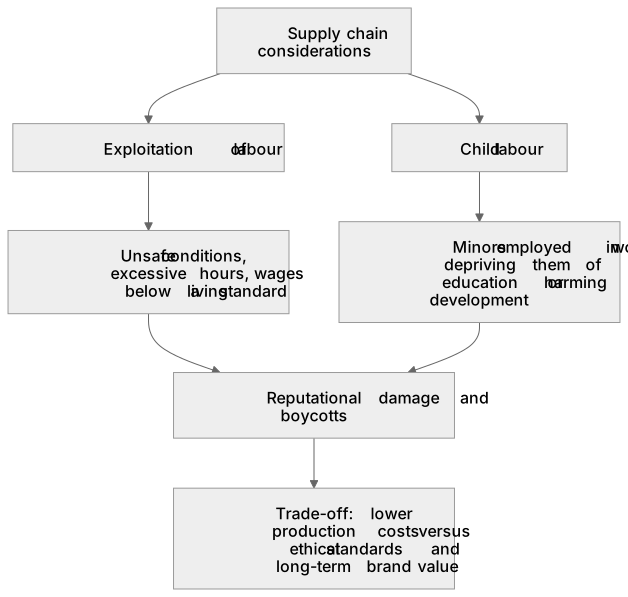
Key words
Say what each word means before you turn the card.
Exploitation of labour
Try answering aloud or in your head before turning the card.
Child labour
Try answering aloud or in your head before turning the card.
See every definition
- Exploitation of labour
- When workers face unsafe conditions, excessive hours, or wages below a living standard.
- Child labour
- Employing minors in work that deprives them of education or harms their development.
Label the diagram
Some boxes have lost their names. Pick the right name for each number.
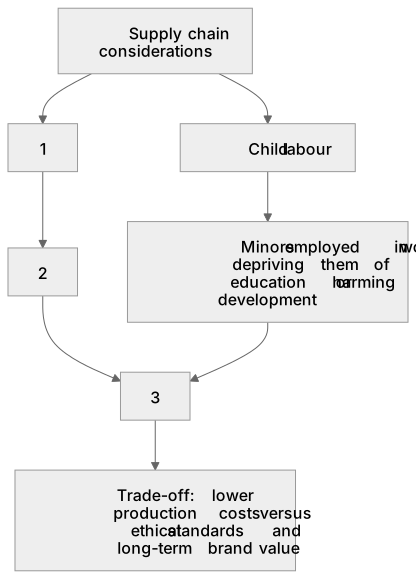
1Box 1
2Box 2
3Box 3
There is more to this lesson
The full lesson goes on to check your understanding and help you earn the marks. Create a free account to carry on, with your progress saved.
A week of Premium from your first lesson · Then the free plan continues · No card, no charge
Test your understanding of Ethical issues: d) Supply chain considerations: o exploitation of labour o child labour
Active recall beats re-reading. Take an instant quiz now to test what you’ve learned and lock it into long-term memory.
A week of Premium from your first lesson · Then the free plan continues · No card, no charge