Pearson Edexcel · A-Level · Economics B
Course version: 9EB0 · Version from Sept 2015
Exchange rates: b) Impact of changing exchange rates on firms
Changing exchange rates significantly impact firms, particularly those engaged in international trade.
Checked against the Pearson Edexcel 9EB0 specification (opens in a new tab) on .
- Point 2 of 4
Study notes
From the checked teaching notes for this specification point.
The idea
Changing exchange rates significantly impact firms, particularly those engaged in international trade. An appreciation of the domestic currency makes exports more expensive for foreign buyers, potentially reducing sales volume for exporting firms. However, it lowers the cost of imported raw materials, benefiting firms relying on foreign inputs. Conversely, a depreciation makes exports cheaper and more competitive abroad, while increasing the cost of imported components. Firms can mitigate exchange rate risks through strategies like forward contracts. The net impact on a firm depends on its price elasticity of demand for exports and the proportion of imported raw materials used in production.
What earns the marks
- Explain how an appreciation of the currency affects the price competitiveness of a firm's exports.
- Analyse the impact of a depreciation on the cost of imported raw materials and components for domestic firms.
- Evaluate how the price elasticity of demand for a firm's products determines the effect of exchange rate changes on total revenue.
- Identify strategies firms use to manage exchange rate risk, such as hedging or forward contracts.
- Assess the net impact of exchange rate movements on a firm's profit margins, considering both revenue and cost effects.
Common mistakes and how to put them right
Stating that a depreciation always increases a firm's profits.
Put it right: A depreciation increases the cost of imported raw materials, which can squeeze profit margins if the firm cannot pass costs onto consumers.
Ignoring the role of price elasticity of demand.
Put it right: The impact of an exchange rate change on export revenue depends heavily on whether demand for the firm's exports is price elastic or inelastic.
Assuming all firms are affected equally by exchange rate changes.
Put it right: Firms that do not import or export are less directly affected, though they may face indirect effects through changes in domestic competition or inflation.
Exam tips
- Use the concept of price elasticity of demand to evaluate the extent to which exchange rate changes will impact a firm's sales revenue.
- Consider both the revenue side from exports and the cost side from imported inputs when assessing the overall impact on a firm's profitability.
- Apply the acronym WPIDEC (Weak Pound Imports Dear Exports Cheap) to quickly recall the effects of a depreciation on firms.
Try the lesson
The start of the Exchange rates: b) Impact of changing exchange rates on firms lesson, made from checked teaching notes for this specification point.
Have a go first
What is the most likely impact on a UK-based manufacturing firm that exports to the US if the pound sterling (£) depreciates against the US dollar ($)?
Listen
Changing exchange rates significantly impact firms, particularly those engaged in international trade. An appreciation of the domestic currency makes exports more expensive for foreign buyers, potentially reducing sales volume for exporting firms. However, it lowers the cost of imported raw materials, benefiting firms relying on foreign inputs. Conversely, a depreciation makes exports cheaper and more competitive abroad, while increasing the cost of imported components. Firms can mitigate exchange rate risks through strategies like forward contracts. The net impact on a firm depends on its price elasticity of demand for exports and the proportion of imported raw materials used in production. A strong answer earns marks for these points. Explain how an appreciation of the currency affects the price competitiveness of a firm's exports. Analyse the impact of a depreciation on the cost of imported raw materials and components for domestic firms. Evaluate how the price elasticity of demand for a firm's products determines the effect of exchange rate changes on total revenue. Identify strategies firms use to manage exchange rate risk, such as hedging or forward contracts. A common slip: Stating that a depreciation always increases a firm's profits. Instead, A depreciation increases the cost of imported raw materials, which can squeeze profit margins if the firm cannot pass costs onto consumers. Exam tip: Use the concept of price elasticity of demand to evaluate the extent to which exchange rate changes will impact a firm's sales revenue.
See it
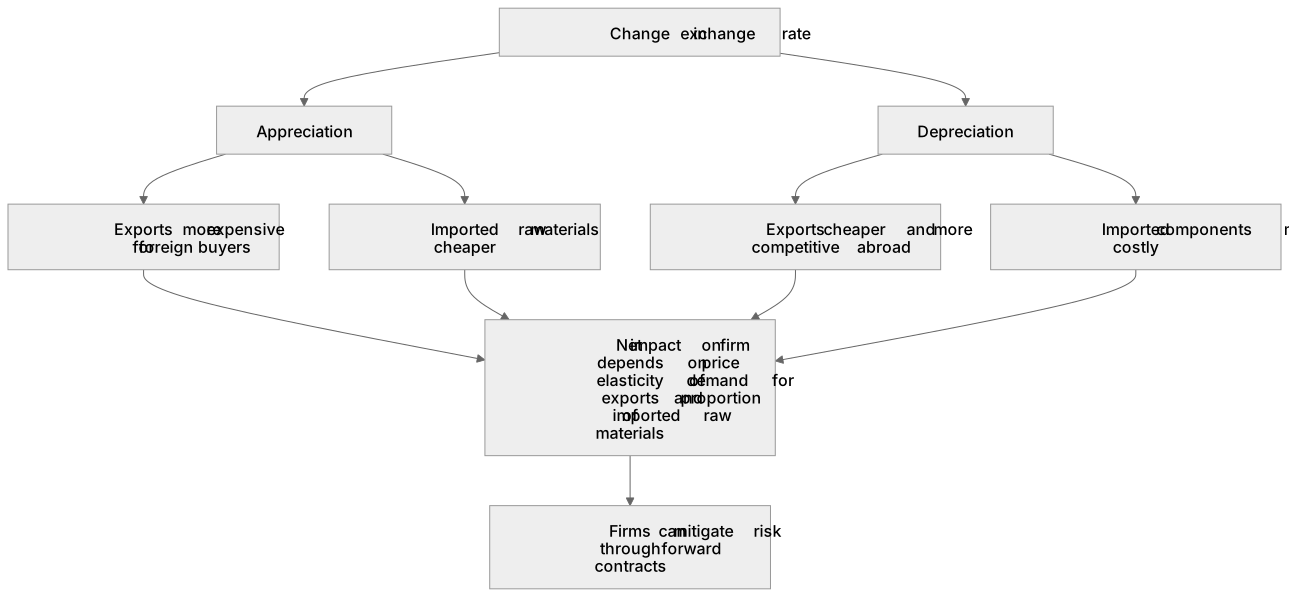
Label the diagram
Some boxes have lost their names. Pick the right name for each number.
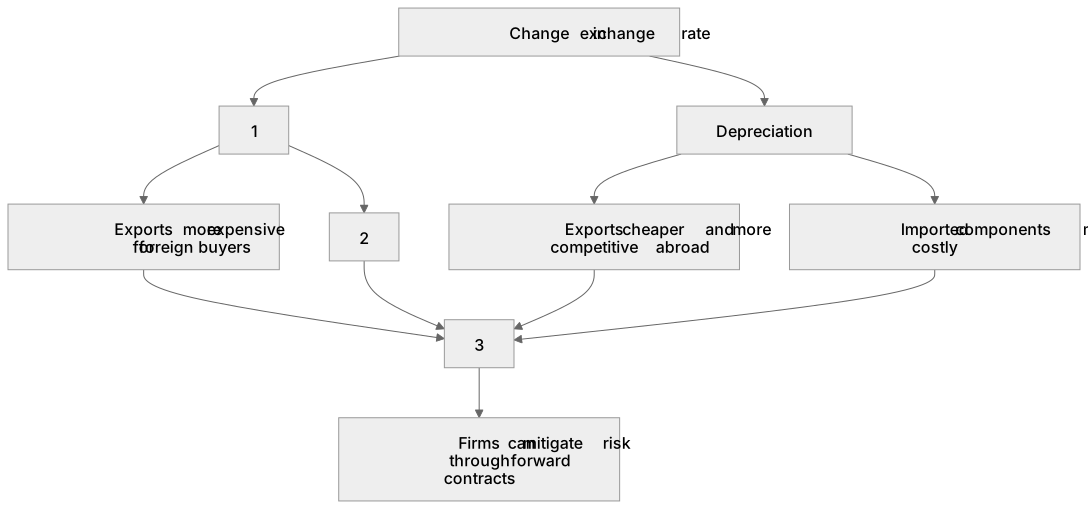
1Box 1
2Box 2
3Box 3
There is more to this lesson
The full lesson goes on to check your understanding and help you earn the marks. Create a free account to carry on, with your progress saved.
A week of Premium from your first lesson · Then the free plan continues · No card, no charge
Test your understanding of Exchange rates: b) Impact of changing exchange rates on firms
Active recall beats re-reading. Take an instant quiz now to test what you’ve learned and lock it into long-term memory.
A week of Premium from your first lesson · Then the free plan continues · No card, no charge