Pearson Edexcel · A-Level · Economics B
Course version: 9EB0 · Version from Sept 2015
A) Market information in the digital economy: o price comparison sites o…
Full specification wording
How the digital economy affects markets and firms: a) Market information in the digital economy: o price comparison sites o viral marketing o social media
The digital economy transforms how market information is accessed.
Checked against the Pearson Edexcel 9EB0 specification (opens in a new tab) on .
- Point 1 of 4
- 3 key terms
Study notes
From the checked teaching notes for this specification point.
The idea
The digital economy transforms how market information is accessed. Price comparison sites reduce information asymmetry by allowing consumers to easily compare prices across suppliers. This increases price elasticity of demand and intensifies competition, forcing firms to be efficient. Viral marketing leverages digital networks to rapidly spread promotional messages through user sharing, offering a cost-effective way to build brand awareness. Social media platforms provide firms with vast consumer data for targeted advertising and enable direct customer engagement.
For example: A brand might use social media analytics to target demographics with a viral campaign, while consumers use comparison sites to find the best deal on those products.
What earns the marks
- Explanation of how price comparison sites reduce information asymmetry for consumers.
- Analysis of the impact of viral marketing on a firm's promotional costs and brand reach.
- Evaluation of how social media allows firms to gather market information and target specific consumer segments.
- Assessment of how increased market information in the digital economy affects price elasticity of demand and competition.
Common mistakes and how to put them right
Assuming viral marketing is always successful and cost-free.
Put it right: It requires initial investment in content creation and carries the risk of negative publicity spreading rapidly.
Stating that price comparison sites benefit firms by allowing them to charge higher prices.
Put it right: They typically increase competition and drive prices down by empowering consumers.
Confusing social media marketing with traditional advertising.
Put it right: Social media allows for two-way engagement and data-driven targeting, unlike traditional broadcast media.
Exam tips
- When discussing price comparison sites, explicitly mention the reduction of information asymmetry and its effect on market efficiency.
- Evaluate the risks associated with viral marketing, such as loss of control over the brand message, to demonstrate balanced analysis.
- Use specific examples of how firms utilise social media data to tailor their products or marketing strategies to specific demographics.
Try the lesson
The start of the How the digital economy affects markets and firms: a) Market information in the digital economy: o price comparison sites o viral marketing o social media lesson, made from checked teaching notes for this specification point.
Have a go first
Which of the following best describes the primary function of price comparison sites in the digital economy?
Listen
The digital economy transforms how market information is accessed. Price comparison sites reduce information asymmetry by allowing consumers to easily compare prices across suppliers. This increases price elasticity of demand and intensifies competition, forcing firms to be efficient. Viral marketing leverages digital networks to rapidly spread promotional messages through user sharing, offering a cost-effective way to build brand awareness. Social media platforms provide firms with vast consumer data for targeted advertising and enable direct customer engagement. For example, a brand might use social media analytics to target demographics with a viral campaign, while consumers use comparison sites to find the best deal on those products. A strong answer earns marks for these points. Explanation of how price comparison sites reduce information asymmetry for consumers. Analysis of the impact of viral marketing on a firm's promotional costs and brand reach. Evaluation of how social media allows firms to gather market information and target specific consumer segments. Assessment of how increased market information in the digital economy affects price elasticity of demand and competition. Exam tip: When discussing price comparison sites, explicitly mention the reduction of information asymmetry and its effect on market efficiency.
See it
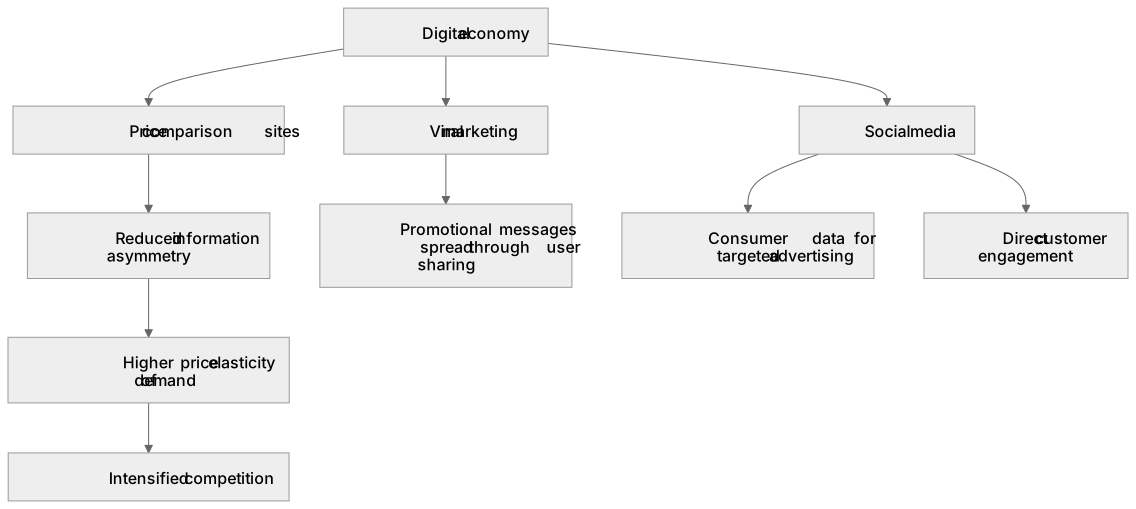
Key words
Say what each word means before you turn the card.
Viral marketing
Try answering aloud or in your head before turning the card.
Social media
Try answering aloud or in your head before turning the card.
Price comparison sites
Try answering aloud or in your head before turning the card.
See every definition
- Viral marketing
- A promotional strategy that leverages digital networks to rapidly spread promotional messages through user sharing, offering a cost-effective way to build brand awareness.
- Social media
- Platforms that provide firms with vast consumer data for targeted advertising and enable direct customer engagement.
- Price comparison sites
- Services that reduce information asymmetry by allowing consumers to easily compare prices across suppliers.
Label the diagram
Some boxes have lost their names. Pick the right name for each number.
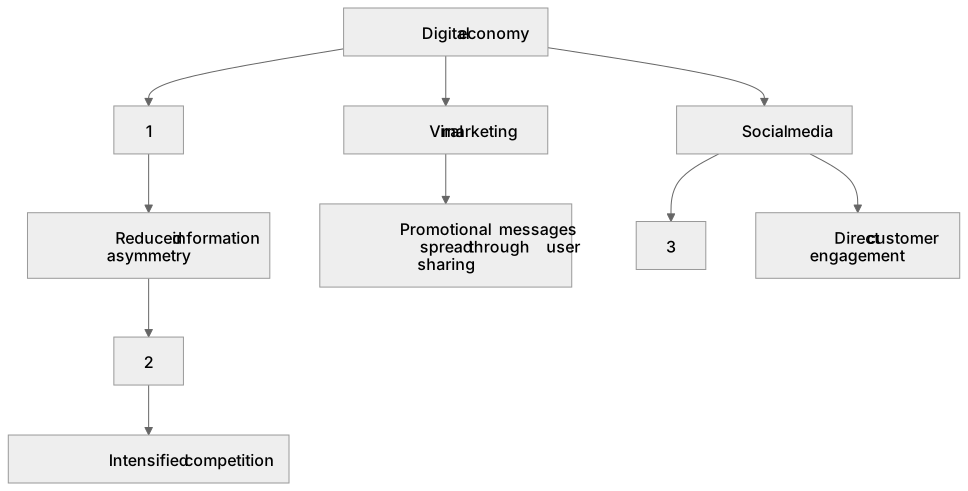
1Box 1
2Box 2
3Box 3
There is more to this lesson
The full lesson goes on to check your understanding and help you earn the marks. Create a free account to carry on, with your progress saved.
A week of Premium from your first lesson · Then the free plan continues · No card, no charge
Test your understanding of How the digital economy affects markets and firms: a) Market information in the digital economy: o price comparison sites o viral marketing o social media
Active recall beats re-reading. Take an instant quiz now to test what you’ve learned and lock it into long-term memory.
A week of Premium from your first lesson · Then the free plan continues · No card, no charge