Pearson Edexcel · A-Level · Economics B
Course version: 9EB0 · Version from Sept 2015
B) The supply-side: o micromarketing o online retailing and online…
Full specification wording
How the digital economy affects markets and firms: b) The supply-side: o micromarketing o online retailing and online distribution o recruiting and training staff with digital skills
The digital economy transforms the supply-side of markets by altering how firms operate.
Checked against the Pearson Edexcel 9EB0 specification (opens in a new tab) on .
- Point 2 of 4
- 4 key terms
Study notes
From the checked teaching notes for this specification point.
The idea
The digital economy transforms the supply-side of markets by altering how firms operate. Micromarketing allows businesses to target specific customer segments using data analytics, tailoring promotions to individual preferences rather than mass markets. Online retailing and online distribution reduce the need for physical premises, lowering fixed costs and enabling direct-to-consumer sales. However, this shift requires firms to adapt their workforce by recruiting and training staff with digital skills, such as data analysis and digital marketing. A firm transitioning to e-commerce must invest in these skills to maintain competitiveness, balancing the cost savings of online distribution against the expense of digital upskilling.
What earns the marks
- Define micromarketing as the use of digital data to target specific individuals or very small consumer segments.
- Explain how online retailing reduces fixed costs associated with maintaining physical store networks.
- Identify the role of online distribution in shortening supply chains and allowing firms to reach consumers directly.
- Analyse the necessity and financial cost of recruiting or training staff with specific digital skills to support e-commerce operations.
Common mistakes and how to put them right
Confusing micromarketing with mass marketing.
Put it right: Micromarketing targets individuals or very small niches, whereas mass marketing targets the whole market with a single message.
Assuming online retailing eliminates all business costs.
Put it right: While physical store costs fall, digital infrastructure, distribution, and marketing costs may rise.
Believing digital skills are only needed in technology firms.
Put it right: All firms engaging in online retailing require staff with digital skills to manage platforms, logistics, and customer data.
Exam tips
- Use examples of targeted social media advertisements to illustrate micromarketing in action.
- Evaluate the trade-off between lower physical fixed costs and higher digital training and recruitment costs.
- Link the need for digital skills to structural changes in the labour market and potential occupational immobility.
Try the lesson
The start of the How the digital economy affects markets and firms: b) The supply-side: o micromarketing o online retailing and online distribution o recruiting and training staff with digital skills lesson, made from checked teaching notes for this specification point.
Have a go first
Which of the following best describes micromarketing in the context of the digital economy?
Listen
The digital economy transforms the supply-side of markets by altering how firms operate. Micromarketing allows businesses to target specific customer segments using data analytics, tailoring promotions to individual preferences rather than mass markets. Online retailing and online distribution reduce the need for physical premises, lowering fixed costs and enabling direct-to-consumer sales. However, this shift requires firms to adapt their workforce by recruiting and training staff with digital skills, such as data analysis and digital marketing. A firm transitioning to e-commerce must invest in these skills to maintain competitiveness, balancing the cost savings of online distribution against the expense of digital upskilling. A strong answer earns marks for these points. Define micromarketing as the use of digital data to target specific individuals or very small consumer segments. Explain how online retailing reduces fixed costs associated with maintaining physical store networks. Identify the role of online distribution in shortening supply chains and allowing firms to reach consumers directly. Analyse the necessity and financial cost of recruiting or training staff with specific digital skills to support e-commerce operations. A common slip: Confusing micromarketing with mass marketing. Instead, micromarketing targets individuals or very small niches, whereas mass marketing targets the whole market with a single message. Exam tip: Use examples of targeted social media advertisements to illustrate micromarketing in action.
See it

Key words
Say what each word means before you turn the card.
Micromarketing
Try answering aloud or in your head before turning the card.
Online retailing
Try answering aloud or in your head before turning the card.
Online distribution
Try answering aloud or in your head before turning the card.
Digital skills
Try answering aloud or in your head before turning the card.
See every definition
- Micromarketing
- The use of digital data to target specific individuals or very small consumer segments, tailoring promotions to individual preferences rather than mass markets.
- Online retailing
- Selling to consumers over the internet, which reduces the need for physical premises and lowers fixed costs.
- Online distribution
- Reaching consumers directly online, which shortens supply chains and enables direct-to-consumer sales.
- Digital skills
- Skills such as data analysis and digital marketing that firms must recruit and train staff in to support e-commerce operations.
Label the diagram
Some boxes have lost their names. Pick the right name for each number.
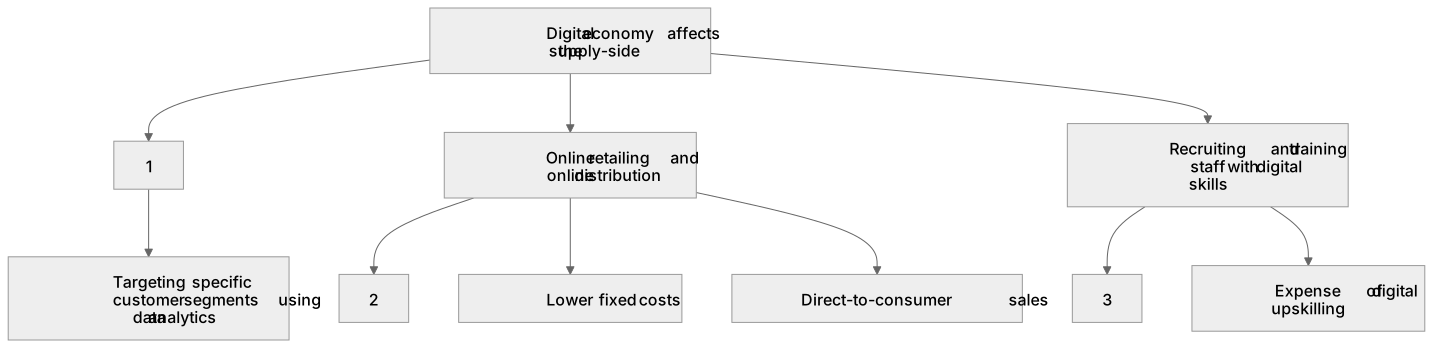
1Box 1
2Box 2
3Box 3
There is more to this lesson
The full lesson goes on to check your understanding and help you earn the marks. Create a free account to carry on, with your progress saved.
A week of Premium from your first lesson · Then the free plan continues · No card, no charge
Test your understanding of How the digital economy affects markets and firms: b) The supply-side: o micromarketing o online retailing and online distribution o recruiting and training staff with digital skills
Active recall beats re-reading. Take an instant quiz now to test what you’ve learned and lock it into long-term memory.
A week of Premium from your first lesson · Then the free plan continues · No card, no charge