Pearson Edexcel · A-Level · Economics B
Course version: 9EB0 · Version from Sept 2015
C) The demand-side: o satisfying consumers with the long tail o wider…
Full specification wording
How the digital economy affects markets and firms: c) The demand-side: o satisfying consumers with the long tail o wider geographical markets
The digital economy impacts the demand-side of markets by altering consumer access.
Checked against the Pearson Edexcel 9EB0 specification (opens in a new tab) on .
- Point 3 of 4
- 2 key terms
Study notes
From the checked teaching notes for this specification point.
The idea
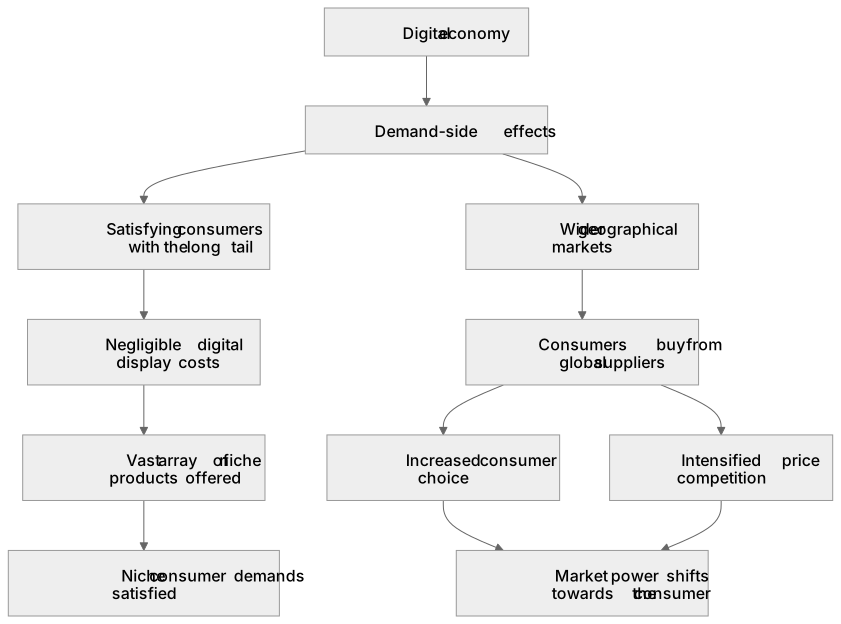
The digital economy impacts the demand-side of markets by altering consumer access. The 'long tail' concept explains how digital platforms allow firms to satisfy consumers by offering a vast array of niche products that would be unprofitable to stock in physical stores. Because digital display costs are negligible, consumers can easily find and purchase highly specialised items. Furthermore, the digital economy creates wider geographical markets, enabling consumers to purchase goods from global suppliers rather than being restricted to local retailers. This increases consumer choice and price competition, as buyers can easily compare products across international borders, shifting market power towards the consumer.
What earns the marks
- Define the long tail as the strategy of selling a large number of unique, niche items in relatively small quantities.
- Explain how digital platforms reduce inventory and display costs, making it viable to satisfy niche consumer demands.
- Identify how the internet removes geographical barriers, allowing consumers to access global markets.
- Analyse how wider geographical markets increase consumer choice and intensify price competition among firms.
Common mistakes and how to put them right
Misunderstanding the 'long tail' as selling large volumes of popular items.
Put it right: The long tail refers to selling small volumes of many different niche items.
Assuming wider geographical markets only benefit firms.
Put it right: They also benefit consumers through increased choice and lower prices due to global competition.
Believing physical location still strictly limits digital purchases.
Put it right: Digital markets allow consumers to buy from anywhere, provided distribution networks exist.
Exam tips
- Use an example like an online bookstore offering rare titles to illustrate the long tail concept.
- Discuss how wider geographical markets increase the price elasticity of demand for many goods by providing more substitutes.
- Link the satisfaction of niche consumer demands to increased consumer surplus in digital markets.
Try the lesson
The start of the How the digital economy affects markets and firms: c) The demand-side: o satisfying consumers with the long tail o wider geographical markets lesson, made from checked teaching notes for this specification point.
Have a go first
In the digital economy, what does the concept of the 'long tail' refer to on the demand side?
Listen
The digital economy impacts the demand-side of markets by altering consumer access. The 'long tail' concept explains how digital platforms allow firms to satisfy consumers by offering a vast array of niche products that would be unprofitable to stock in physical stores. Because digital display costs are negligible, consumers can easily find and purchase highly specialised items. Furthermore, the digital economy creates wider geographical markets, enabling consumers to purchase goods from global suppliers rather than being restricted to local retailers. This increases consumer choice and price competition, as buyers can easily compare products across international borders, shifting market power towards the consumer. A strong answer earns marks for these points. Define the long tail as the strategy of selling a large number of unique, niche items in relatively small quantities. Explain how digital platforms reduce inventory and display costs, making it viable to satisfy niche consumer demands. Identify how the internet removes geographical barriers, allowing consumers to access global markets. Analyse how wider geographical markets increase consumer choice and intensify price competition among firms. A common slip: Misunderstanding the 'long tail' as selling large volumes of popular items. Instead, the long tail refers to selling small volumes of many different niche items. Exam tip: Use an example like an online bookstore offering rare titles to illustrate the long tail concept.
See it
Key words
Say what each word means before you turn the card.
Long tail
Try answering aloud or in your head before turning the card.
Wider geographical markets
Try answering aloud or in your head before turning the card.
See every definition
- Long tail
- The strategy of selling a large number of unique, niche items in relatively small quantities.
- Wider geographical markets
- Markets created by the digital economy that enable consumers to purchase goods from global suppliers rather than being restricted to local retailers.
Label the diagram
Some boxes have lost their names. Pick the right name for each number.
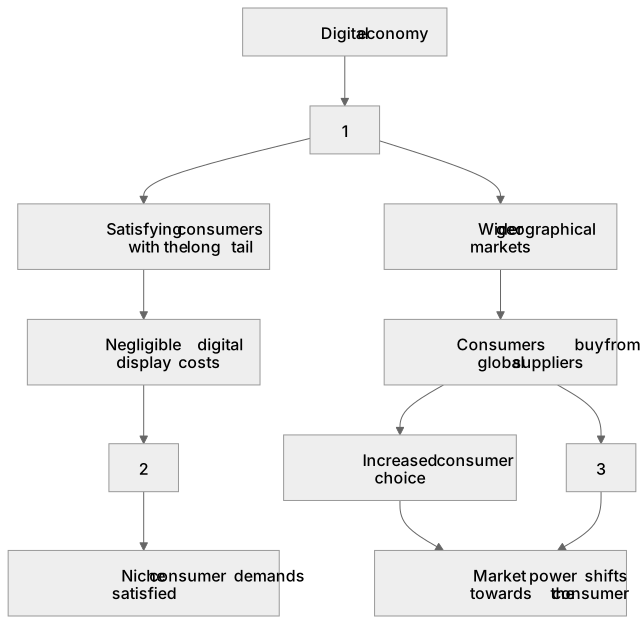
1Box 1
2Box 2
3Box 3
There is more to this lesson
The full lesson goes on to check your understanding and help you earn the marks. Create a free account to carry on, with your progress saved.
A week of Premium from your first lesson · Then the free plan continues · No card, no charge
Test your understanding of How the digital economy affects markets and firms: c) The demand-side: o satisfying consumers with the long tail o wider geographical markets
Active recall beats re-reading. Take an instant quiz now to test what you’ve learned and lock it into long-term memory.
A week of Premium from your first lesson · Then the free plan continues · No card, no charge