Pearson Edexcel · GCSE · Economics
Business competition
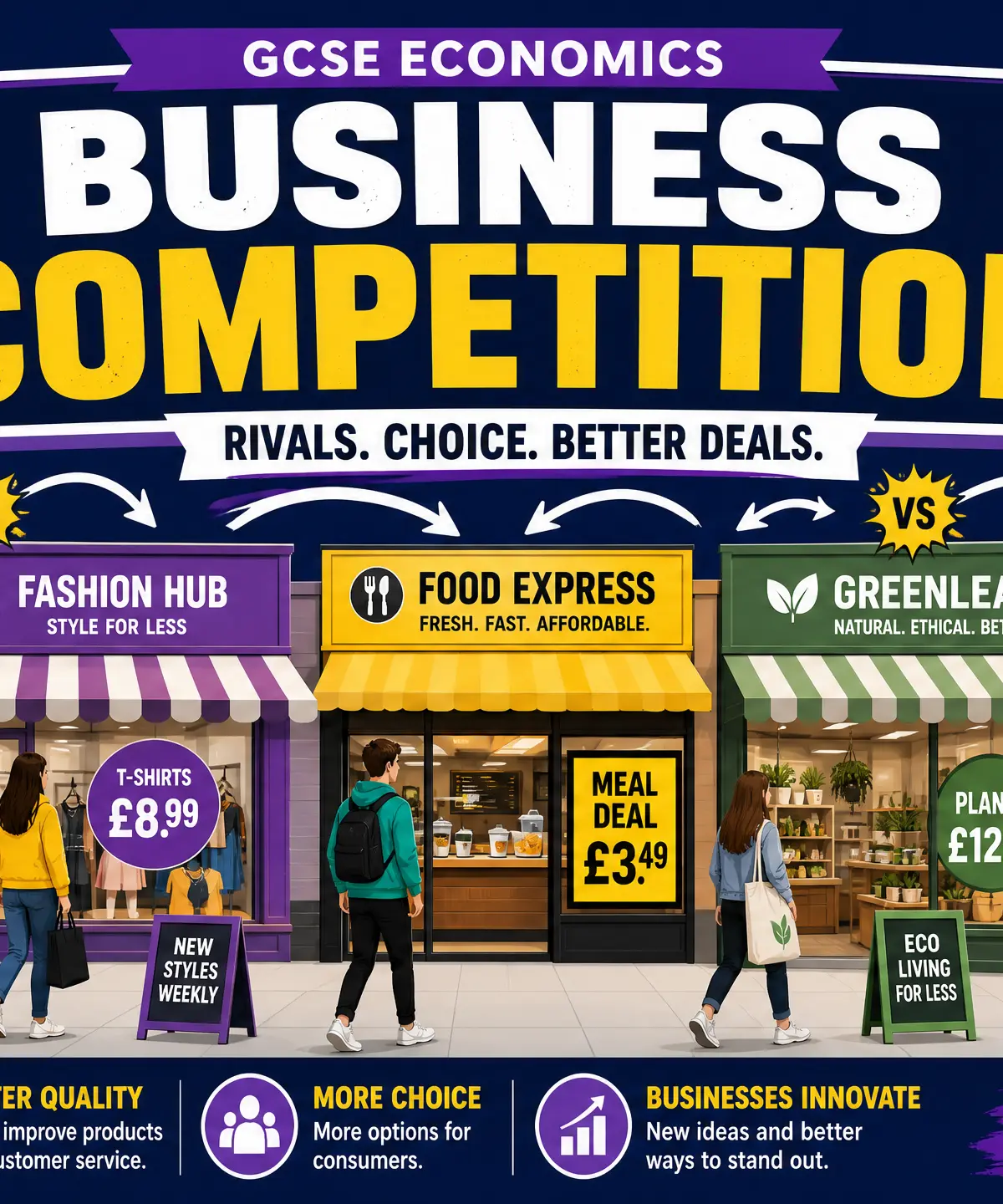
Business competition is the driving force behind modern market economies. Understanding how firms rival one another for customers, and the profound effects this has on prices, quality, and innovation, is essential for securing top marks in GCSE Economics.
- 6 min read
- 3 worked examples
- 5 practice questions
- 6 key terms
Study Notes
Overview
Welcome to the GCSE Economics study guide on Business Competition. This topic explores how firms interact in markets to attract customers, maximise their market share, and generate profit. Examiners consistently test candidates' understanding of the different market structures—from the theoretical extreme of perfect competition to the reality of monopolies. Crucially, you must be able to analyse the effects of competition on both businesses and consumers, applying concepts like barriers to entry and non-price competition to real-world scenarios. A strong grasp of these dynamics, supported by specific examples such as the UK supermarket sector or global tech giants, will enable you to construct the analytical chains of reasoning required for the highest mark bands.
Listen to the companion podcast for a comprehensive overview of the core concepts, exam tips, and a quick-fire recall quiz:

Market Structures
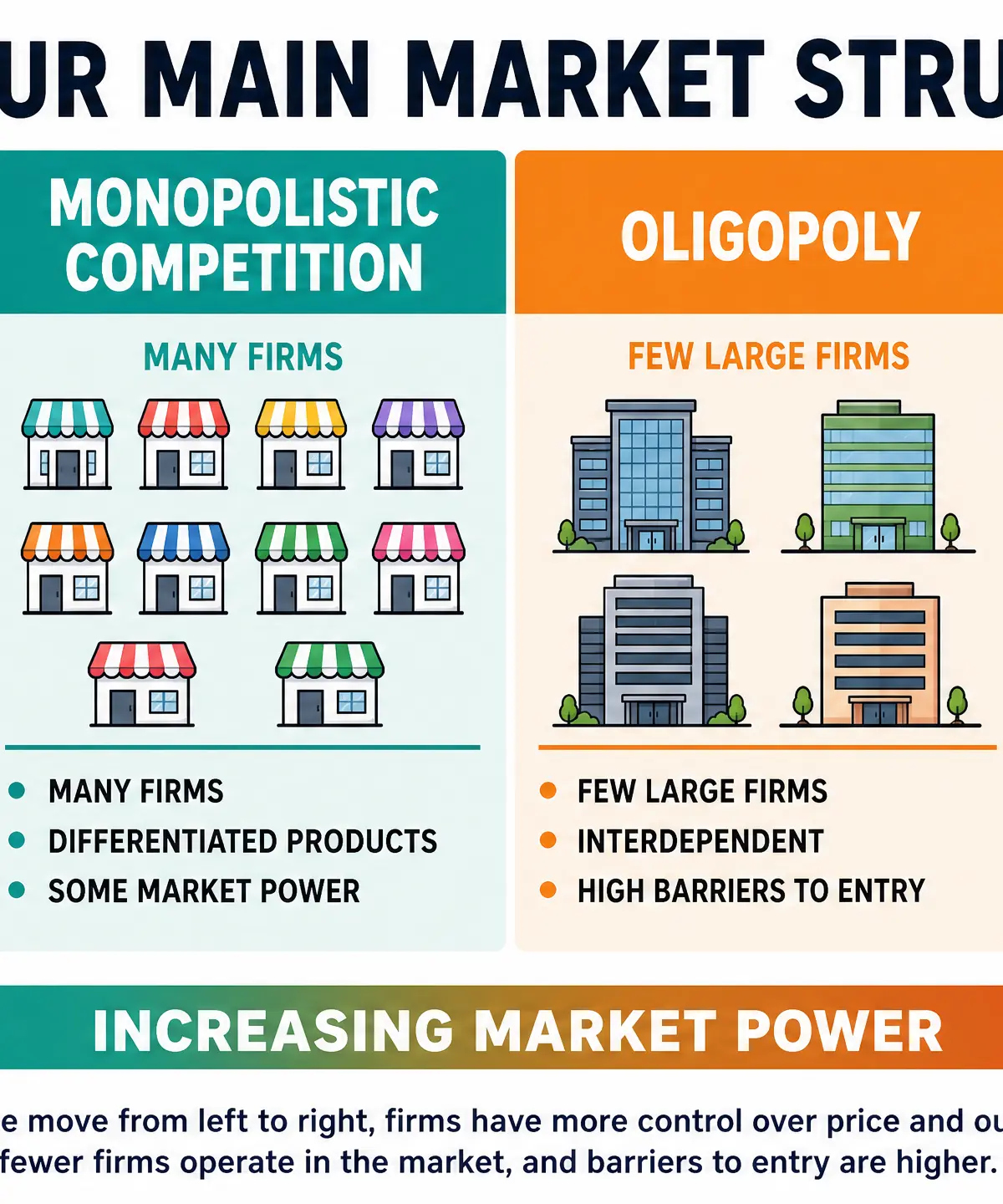
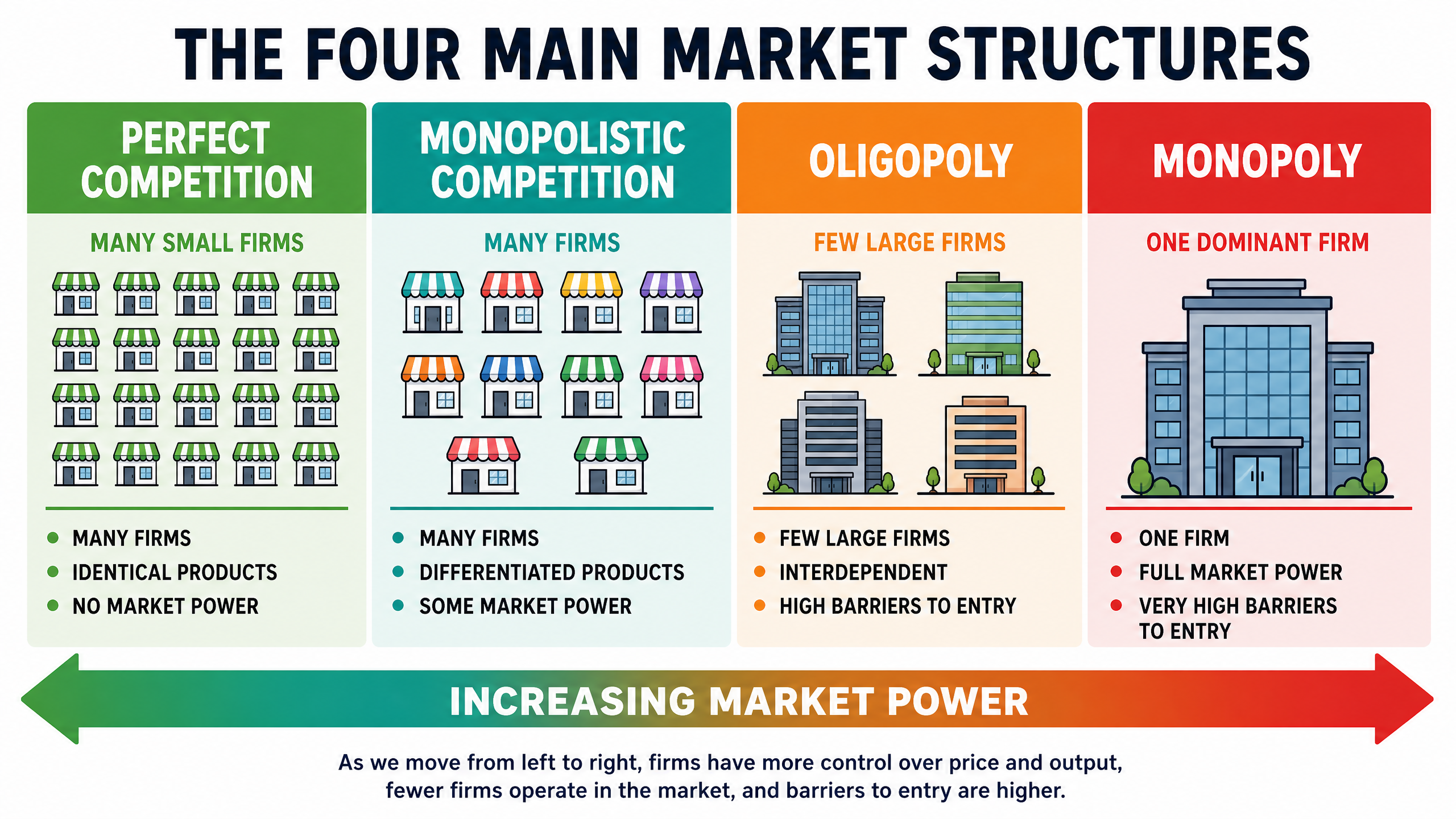
Examiners expect candidates to differentiate between four primary market structures. These define the level of competition and the behaviour of firms within a given market.
Perfect Competition
Definition: A theoretical market structure characterised by many small firms producing identical (homogeneous) products.
Key Features:
- Many buyers and sellers: No individual firm or consumer can influence the market price.
- Identical products: Consumers have no preference between suppliers.
- No barriers to entry or exit: Firms can freely join or leave the market.
- Perfect information: All participants know the prices charged by all firms.
Significance: In perfect competition, firms are 'price takers'. They must accept the market price; if they charge more, they will sell nothing. This drives prices down to the lowest possible level, maximising consumer welfare.
Monopolistic Competition
Definition: A market structure with many firms selling differentiated products. This is common in the real world.
Key Features:
- Many firms: The market is not dominated by a few giants.
- Differentiated products: Firms use branding, quality, or location to make their product distinct.
- Low barriers to entry: It is relatively easy for new firms to start up.
- Some price-making power: Because products are differentiated, firms can charge slightly different prices.
Examples: Hairdressers, local restaurants, coffee shops.
Oligopoly
Definition: A market dominated by a few large firms.
Key Features:
- Few dominant firms: A high concentration ratio (e.g., the top 4 firms control 70% of the market).
- Interdependence: The actions of one firm directly affect the others (e.g., if one cuts prices, others must follow).
- High barriers to entry: Significant costs or brand loyalty prevent new firms from entering.
- Non-price competition: Firms compete heavily on advertising, loyalty schemes, and customer service rather than just price.
Examples: UK supermarkets (Tesco, Sainsbury's, Asda, Morrisons), mobile phone networks (EE, O2, Vodafone, Three).
Monopoly
Definition: A market dominated by a single firm.
Key Features:
- One dominant firm: A pure monopoly has 100% market share. In the UK, the Competition and Markets Authority (CMA) defines a working monopoly as any firm with 25% or more market share.
- Price maker: The firm has significant power to set prices.
- Very high barriers to entry: Impossible or extremely difficult for new firms to enter.
- Potential for inefficiency: Without competition, the firm may lack the incentive to innovate or cut costs.
Examples: Historically, Royal Mail (letters); regional water companies (natural monopolies).
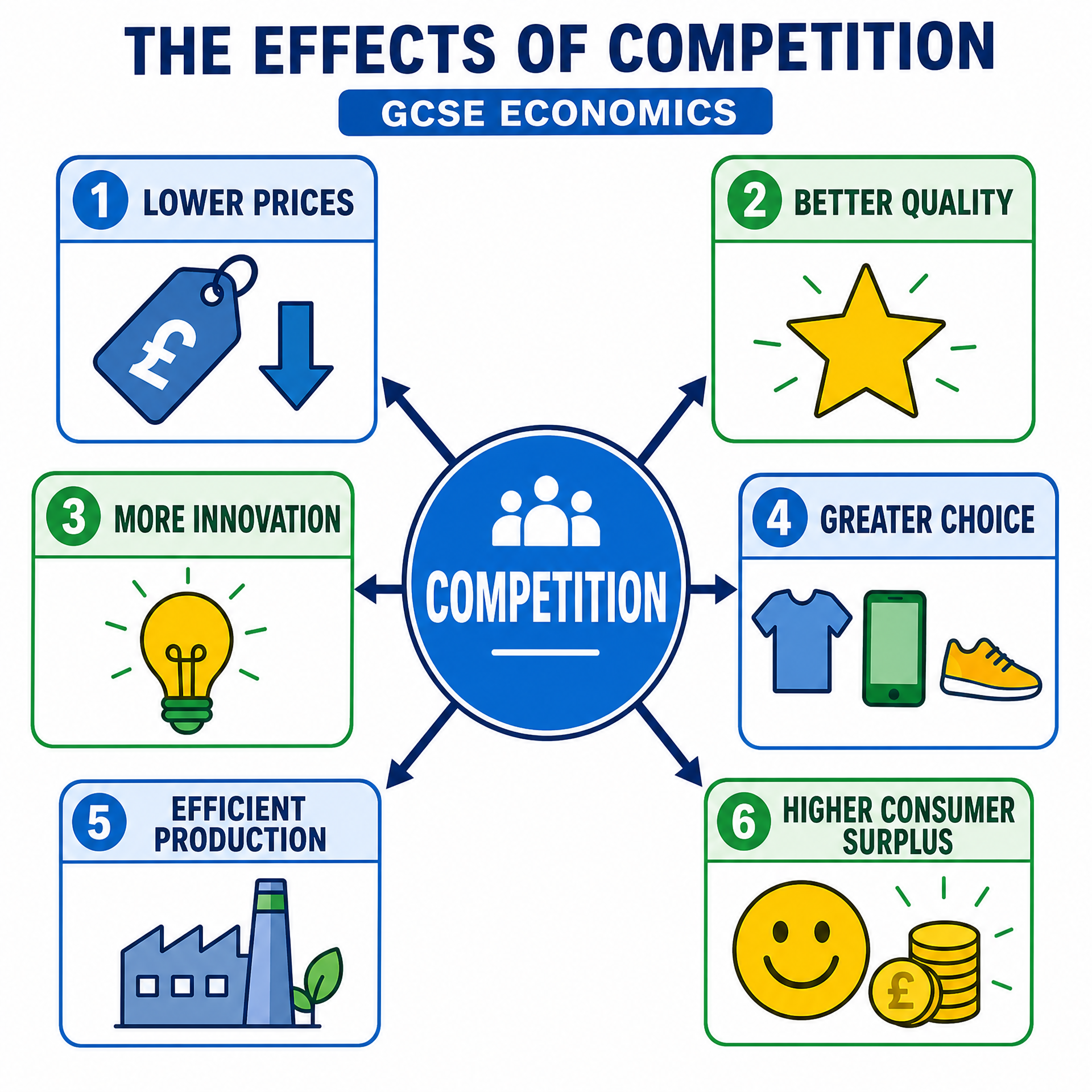
The Effects of Competition
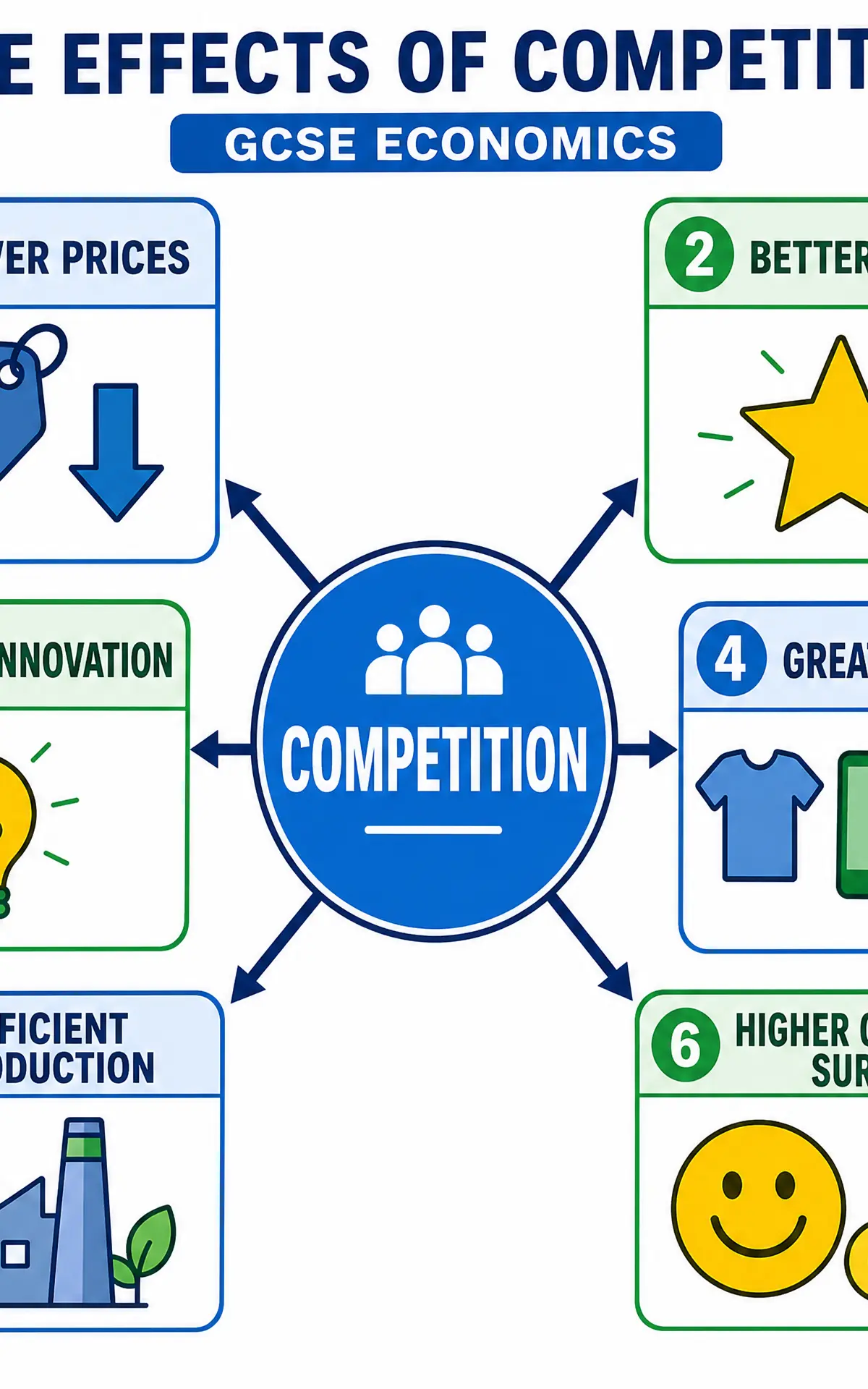
Examiners frequently ask candidates to analyse the impact of competition. You must be able to construct logical chains of reasoning showing how competition leads to specific outcomes.
Effects on Consumers
- Lower Prices: Rival firms undercut each other to win market share, increasing consumer surplus.
- Better Quality: Firms improve their products and customer service to stand out from competitors.
- Greater Choice: A competitive market supports a wider variety of goods and services.
- More Innovation: Firms invest in Research and Development (R&D) to create new products and maintain a competitive edge.
Effects on Businesses
- Pressure to be Efficient: Firms must minimise their costs of production to survive against rivals offering lower prices.
- Lower Profit Margins: Intense price competition reduces the amount of profit firms can make on each item sold.
- Need for Differentiation: Firms must spend money on marketing and branding to build customer loyalty.
- Risk of Failure: In highly competitive markets, inefficient firms will be forced to exit the market.
Barriers to Entry
Definition: Obstacles that make it difficult for a new firm to enter a market and compete with existing firms.
Understanding barriers to entry is crucial for explaining why some markets remain uncompetitive (like oligopolies and monopolies).
Types of Barriers:
- Capital Costs: High initial set-up costs (e.g., buying aircraft to start an airline).
- Economies of Scale: Existing large firms have lower average costs, allowing them to charge prices that new entrants cannot match.
- Brand Loyalty: Consumers are heavily attached to existing brands (e.g., Coca-Cola), making them reluctant to switch.
- Legal Barriers: Patents, copyrights, or government licences (e.g., pharmaceutical drugs, broadcasting licences) prevent others from copying or entering.
- Sunk Costs: Costs that cannot be recovered if the business fails (e.g., advertising spend), which deters new entrants.
Visual Resources
2 diagrams and illustrations
Interactive Diagrams
1 interactive diagram to visualise key concepts
Conceptual Flow Outline
The chain of reasoning showing how competition benefits consumers.
Worked Examples
3 worked examples — open one to explore the question and available guidance.
Practice Questions
Test your understanding — click to reveal model answers
Explain two ways in which a small local bakery might compete with a large national supermarket chain. (6 marks)
Hint: Think about non-price competition. Small firms usually can't compete on price due to economies of scale, so what else can they offer?
State what is meant by the term 'oligopoly'. (2 marks)
Hint: Mention the number of firms and their relationship.
Discuss the view that the government should always intervene to break up monopolies. (9 marks)
Hint: Provide reasons why monopolies are bad (higher prices), but also reasons why they might be acceptable (economies of scale, R&D). Conclude.
Identify two features of a perfectly competitive market. (2 marks)
Hint: Think about the number of buyers/sellers and the type of product.
Explain why high barriers to entry can lead to higher prices for consumers. (6 marks)
Hint: Link barriers to entry to the number of firms, the level of competition, and finally the impact on price.