Pearson Edexcel · GCSE · Economics
Business costs, revenues and profit
Master the financial foundations of every enterprise: how businesses calculate their costs, generate revenue, and ultimately determine their profit or loss. This core topic is essential for understanding business decision-making and is heavily tested in every GCSE Economics paper.
- 5 min read
- 3 worked examples
- 5 practice questions
- 6 key terms
Study Notes
Overview
This topic covers the fundamental financial mechanics that drive all commercial activity: business costs, revenues, and profit. At the heart of GCSE Economics is the understanding that businesses exist primarily to make a profit, and to do so, they must carefully balance the money flowing out (costs) with the money flowing in (revenue). Examiners expect candidates to not only define these terms precisely but also to confidently perform calculations and analyse how changes in costs or prices impact a firm's profitability and break-even point. Mastering this topic provides the analytical tools needed to evaluate real-world business scenarios, from a local coffee shop to multinational corporations.
Business Costs
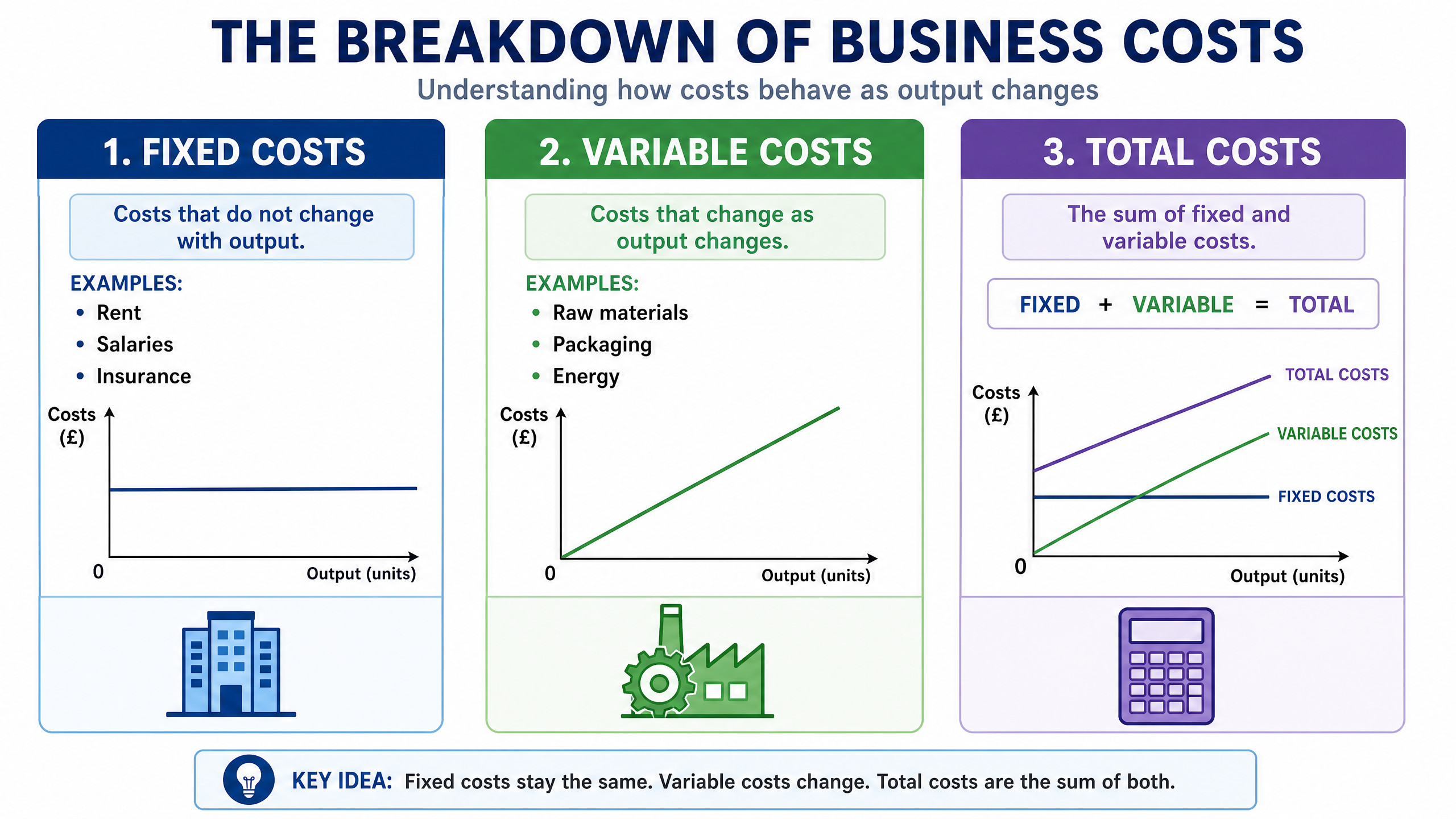
A cost is any payment a business must make in order to produce its goods or services. Costs are broadly categorised into two types based on how they behave as output changes.
Fixed Costs (FC)
Definition: Costs that do not change with the level of output in the short run.
Characteristics: These must be paid even if the business produces nothing at all (e.g., during a temporary closure). On a graph, total fixed costs are represented by a horizontal line.
Key Examples:
- Rent for premises
- Salaries of permanent management staff
- Insurance premiums
- Interest payments on bank loans
Variable Costs (VC)
Definition: Costs that change directly and proportionally with the level of output.
Characteristics: If production increases, variable costs increase. If production falls to zero, variable costs fall to zero. On a graph, total variable costs are represented by an upward-sloping line starting from the origin.
Key Examples:
- Raw materials and components
- Packaging
- Piece-rate wages (paying workers per item produced)
- Energy used directly in the production process
Total Costs (TC)
Formula: Total Costs = Fixed Costs + Variable Costs (TC = FC + VC)
Business Revenue
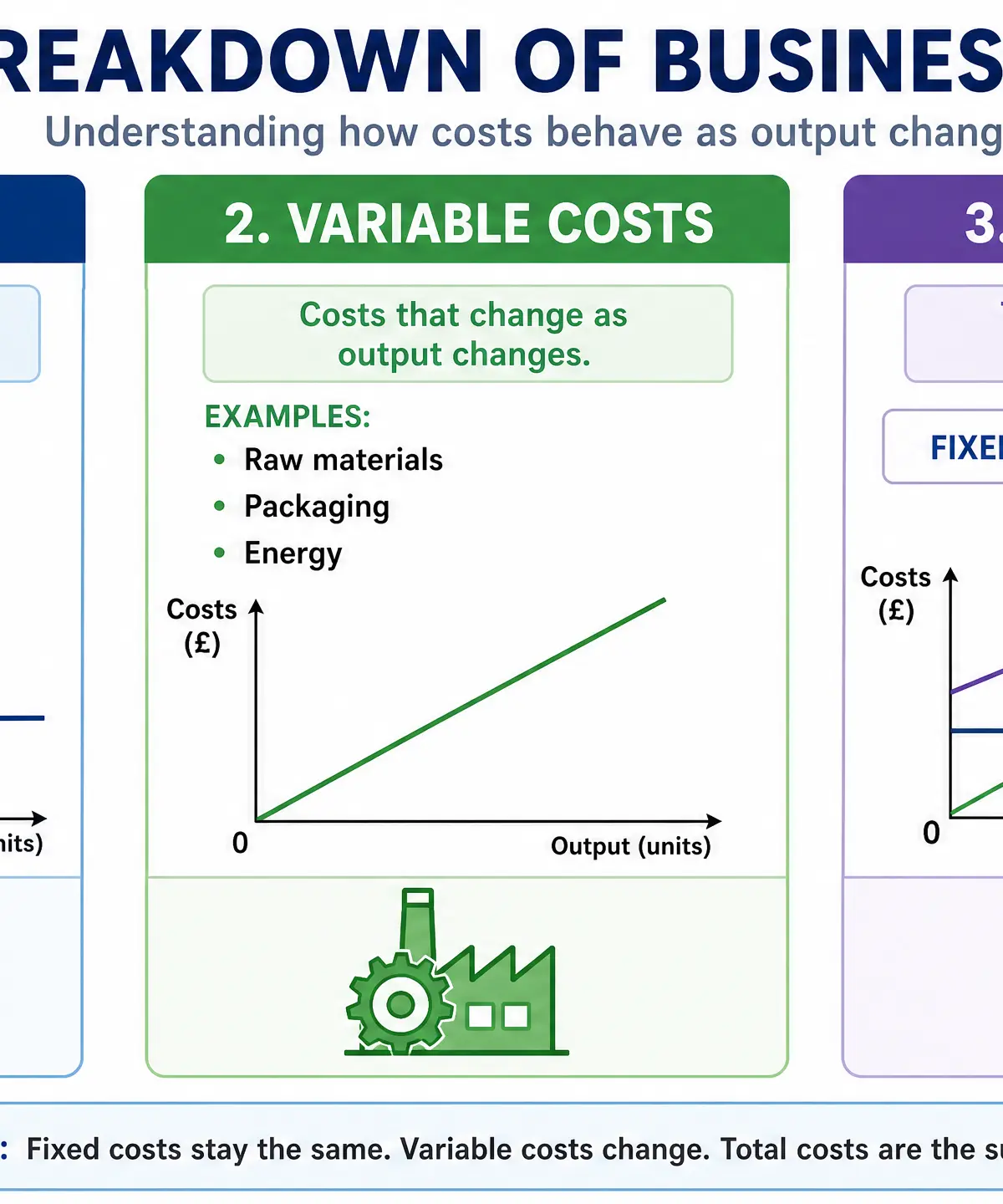
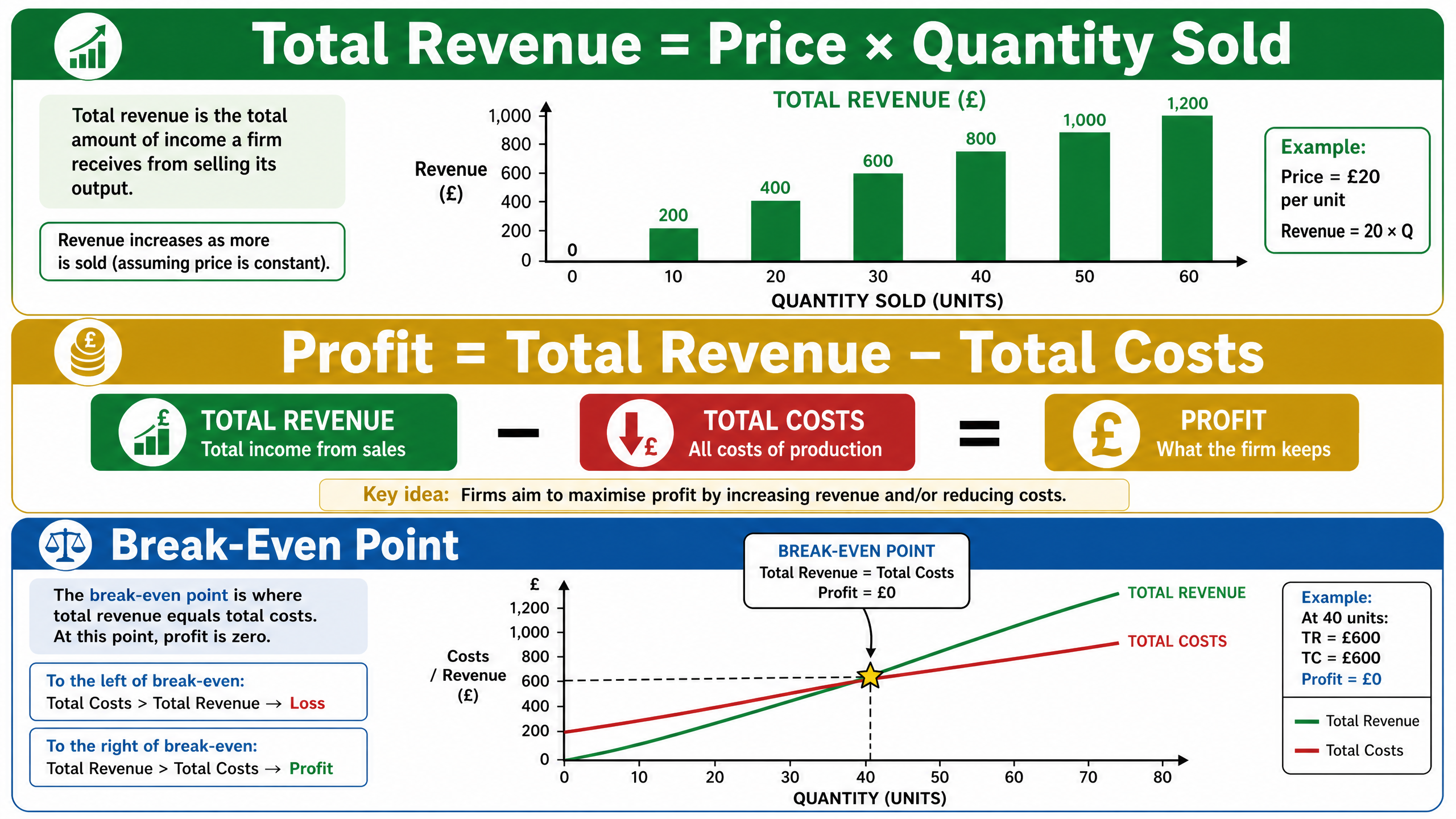
Revenue (often called sales revenue or turnover) is the income a business receives from selling its goods or services.
Formula: Total Revenue = Selling Price × Quantity Sold (TR = P × Q)
Crucial Distinction: Revenue is not profit. Revenue is the total money coming into the till; profit is what remains after all costs have been deducted. Examiners frequently penalise candidates who use these terms interchangeably.
Profit and Loss
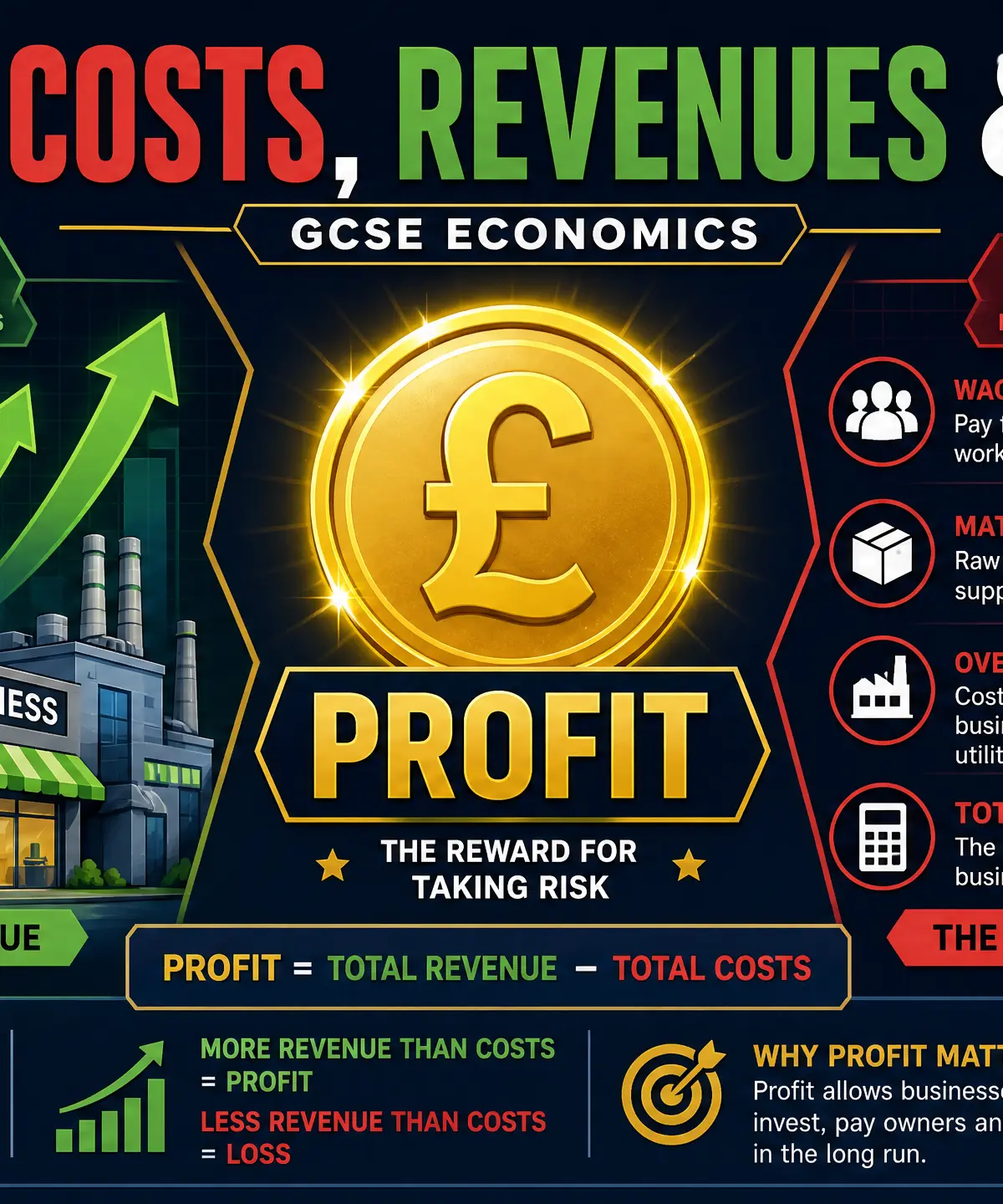
Profit is the financial reward for taking the risk of running a business. It is the surplus remaining when total costs are deducted from total revenue.
Formula: Profit = Total Revenue - Total Costs
- Profit: Occurs when Total Revenue > Total Costs.
- Loss: Occurs when Total Costs > Total Revenue.
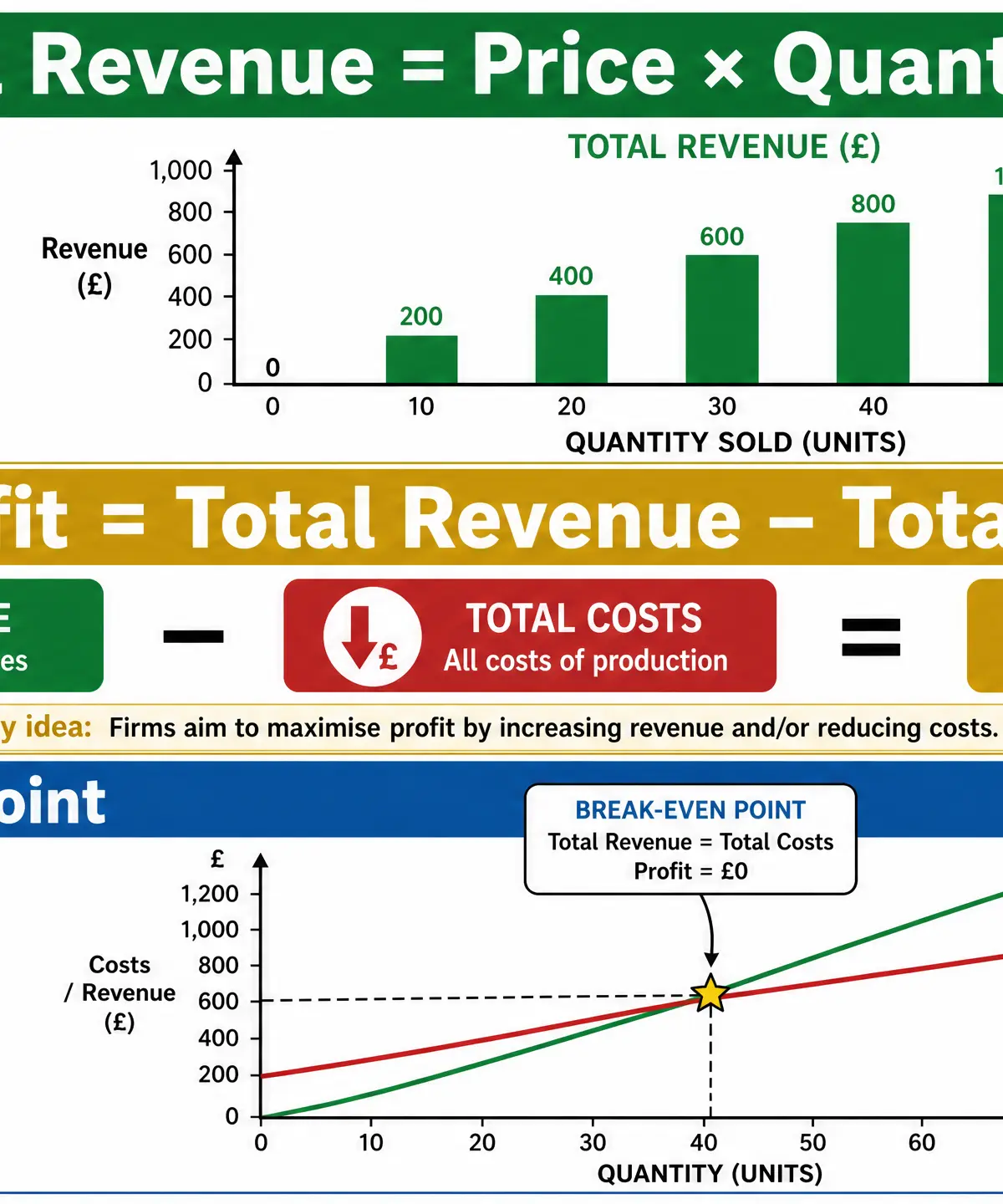
- Break-Even: Occurs when Total Revenue = Total Costs (Profit is £0).
The Importance of Profit
Profit serves several vital functions in a market economy:
- Reward for Risk: It compensates entrepreneurs for investing time and capital.
- Source of Finance: Retained profit is a key source of internal finance for expansion, research, and development.
- Signal for Resource Allocation: High profits in a sector signal to other firms that they should enter that market, reallocating resources to where consumer demand is strongest.
- Measure of Success: It is a key indicator of business performance and efficiency.
The Break-Even Point
The break-even point is the exact level of output at which a business makes neither a profit nor a loss.
Calculation Method (Contribution Method):
- First, calculate Contribution per Unit:
Selling Price - Variable Cost per Unit - Then, calculate Break-Even Output:
Fixed Costs ÷ Contribution per Unit
Why it matters: Businesses use break-even analysis to set sales targets, determine whether a new product is viable, and secure loans from banks by demonstrating when they expect to become profitable.
Audio Revision
Listen to our comprehensive 10-minute podcast covering all the key concepts, formulas, and exam techniques for this topic.

Visual Resources
2 diagrams and illustrations
Interactive Diagrams
1 interactive diagram to visualise key concepts
Conceptual Flow Outline
Flowchart showing the relationship between costs, revenue, and profit
Worked Examples
3 worked examples — open one to explore the question and available guidance.
Practice Questions
Test your understanding — click to reveal model answers
A business sells 500 units of its product at a price of £25 each. Its fixed costs are £4,000 and its variable costs are £10 per unit. Calculate the total profit made by the business. (4 marks)
Hint: Calculate Total Revenue first, then Total Costs (Fixed + Variable), then subtract TC from TR.
Explain how an increase in the price of raw materials would affect a firm's break-even point. (3 marks)
Hint: Think about how raw materials affect variable costs, and how that affects contribution per unit.
State two examples of fixed costs for a high street clothing retailer. (2 marks)
Hint: Think of bills the shop must pay even if they sell zero clothes that month.
A tech start-up has fixed costs of £50,000. They sell their software for £100 per licence, and the variable cost per licence is £20. Calculate the break-even output. (3 marks)
Hint: Calculate contribution per unit first (Price - VC), then divide FC by that number.
Discuss whether a business should always aim to maximise its revenue. (6 marks)
Hint: Consider what happens to costs when you try to maximise revenue. Is revenue the same as profit?