Pearson Edexcel · GCSE · Economics
Business economics
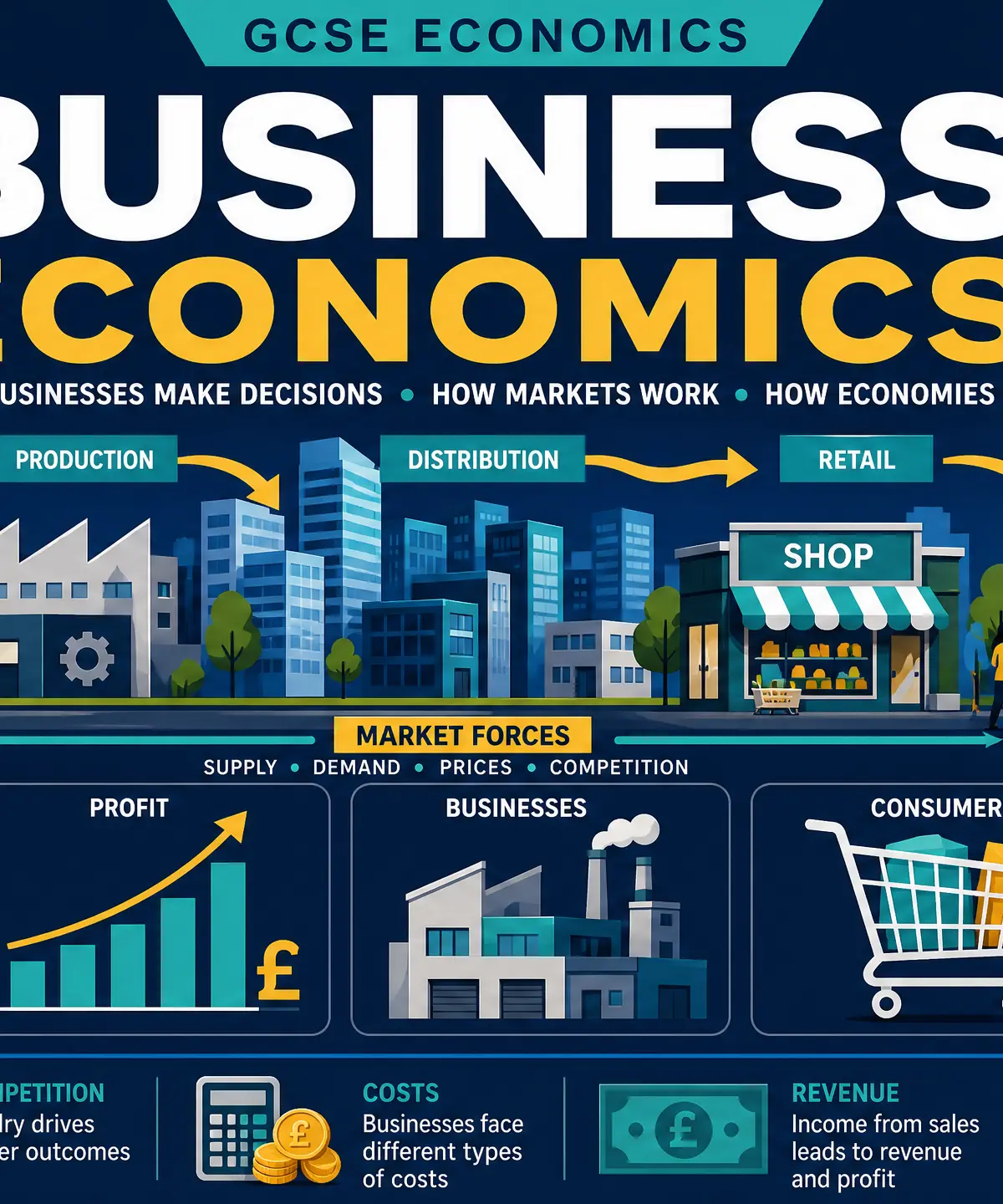
Business Economics examines how firms make decisions about production, pricing, and competition. It's crucial for understanding real-world markets and is heavily tested in GCSE Economics, particularly through calculations and evaluation of different market structures.
- 5 min read
- 3 worked examples
- 2 practice questions
- 6 key terms
Study Notes
Overview
Business Economics is the study of how firms operate within markets. It covers the fundamental decisions businesses must make: what to produce, how much to produce, what price to charge, and how to compete with rivals. Examiners expect candidates to demonstrate a firm grasp of core financial concepts (costs, revenue, and profit) alongside a deeper understanding of market structures and competitive behaviour.
This topic is highly synoptic, linking closely with supply and demand, government intervention, and the wider macroeconomy. To succeed, candidates must be comfortable moving between quantitative skills (calculating profit, identifying break-even points) and qualitative analysis (evaluating the impact of monopolies or economies of scale).
Core Financial Concepts
Costs
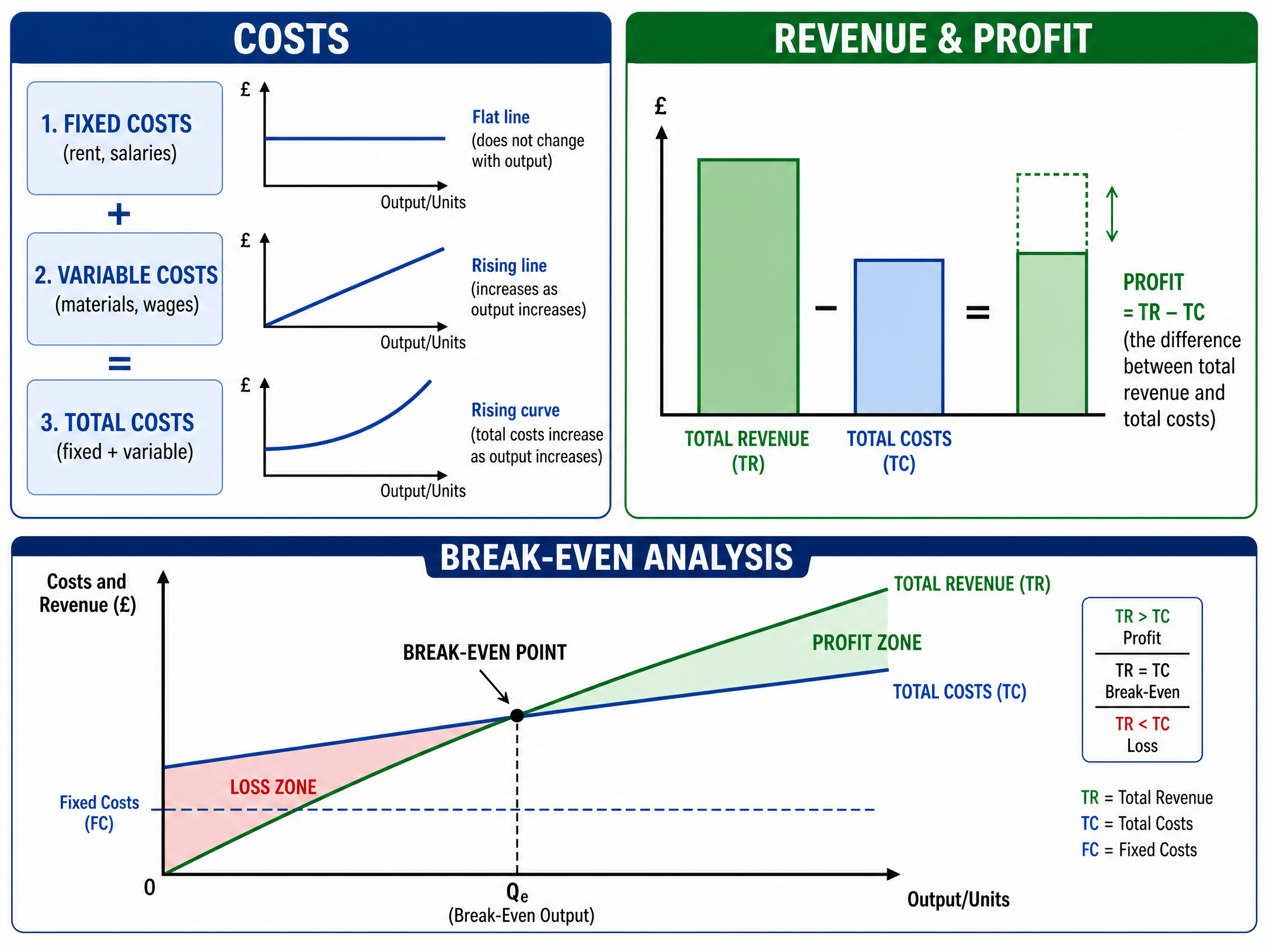
Understanding costs is the foundation of business economics. Examiners frequently test the distinction between fixed and variable costs.
- Fixed Costs (FC): Costs that do not change with the level of output. Even if a firm produces nothing, it must still pay its fixed costs. Examples include rent, insurance, and salaried staff.
- Variable Costs (VC): Costs that change directly with the level of output. If a firm produces more, these costs rise. Examples include raw materials, piece-rate wages, and energy used in production.
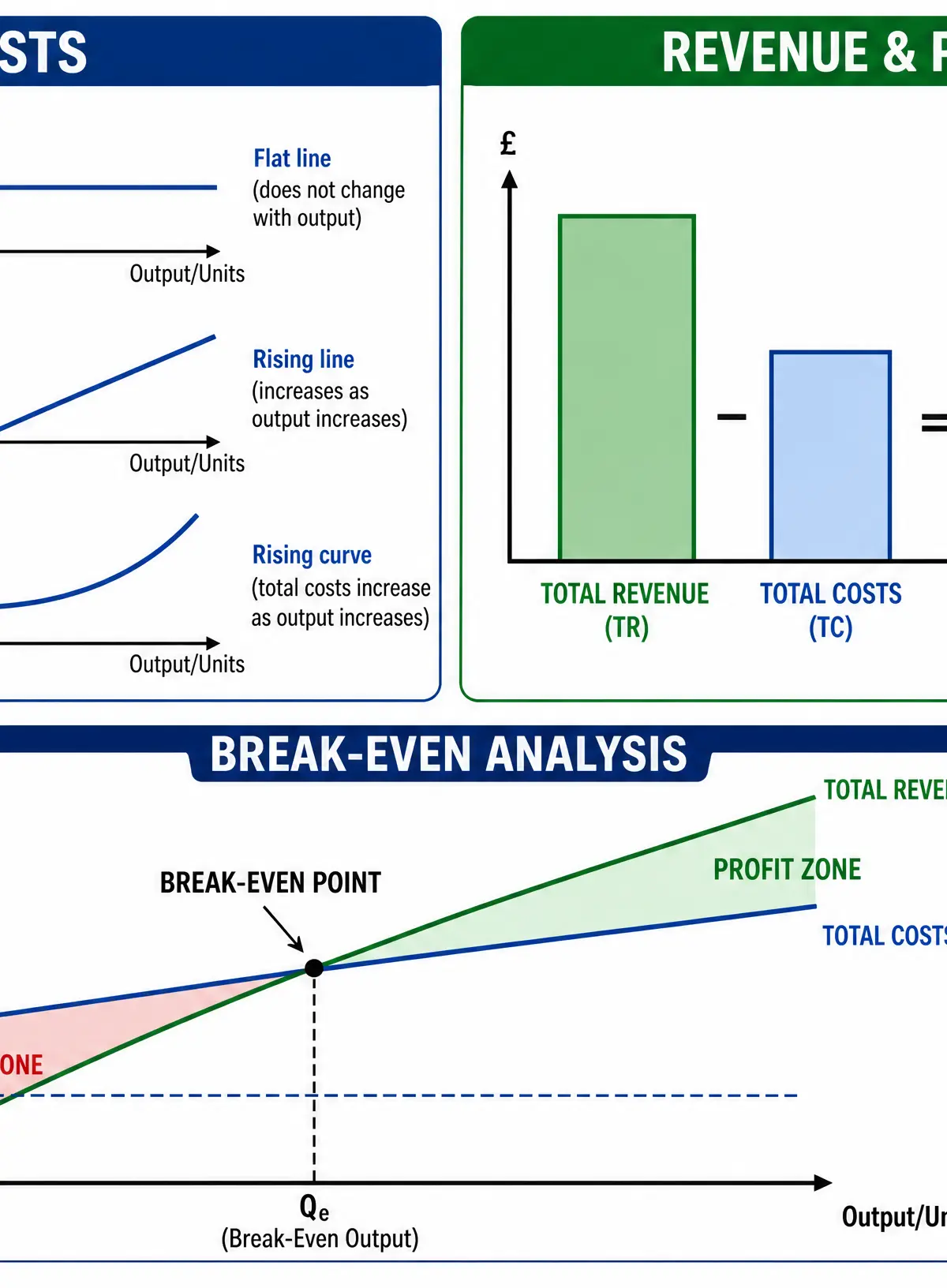
- Total Costs (TC): The sum of fixed and variable costs (TC = FC + VC).
- Average Cost (AC): The cost per unit produced (AC = TC / Quantity).
Revenue and Profit
- Total Revenue (TR): The total amount of money a firm receives from selling its goods or services (TR = Price \times Quantity).
- Profit: The financial gain made when revenue exceeds costs (Profit = TR - TC). If costs exceed revenue, the firm makes a loss.
Break-Even Analysis
The break-even point is the level of output at which total revenue exactly equals total costs (TR = TC). At this point, the firm makes neither a profit nor a loss. Break-even analysis is a vital decision-making tool, helping firms understand the minimum sales required to survive.
Market Structures
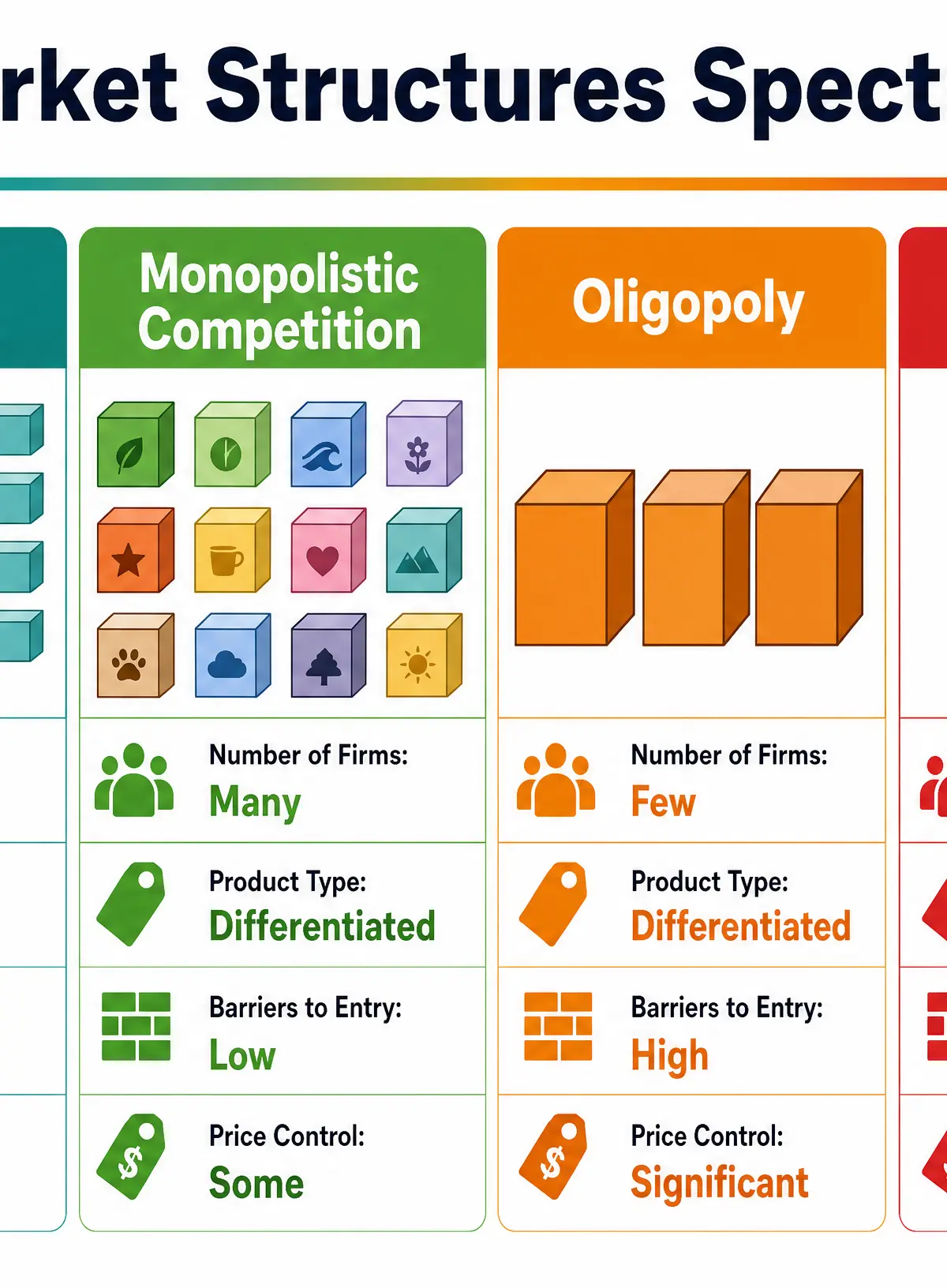
Market structure refers to the characteristics of a market that influence the behaviour and performance of firms. Examiners love testing this area, particularly the differences between the four main types.
1. Perfect Competition
- Characteristics: Many small buyers and sellers, identical (homogeneous) products, no barriers to entry or exit, perfect information.
- Implications: Firms are 'price takers'—they must accept the market price determined by supply and demand. They cannot charge more, or they will lose all customers.
- Exam Relevance: Often used as a theoretical benchmark to compare against real-world markets.
2. Monopolistic Competition
- Characteristics: Many buyers and sellers, differentiated products (e.g., branding, quality), low barriers to entry.
- Implications: Because products are slightly different (think restaurants or hairdressers), firms have some price-setting power.
3. Oligopoly
- Characteristics: A market dominated by a few large firms (e.g., UK supermarkets, mobile networks). High barriers to entry.
- Implications: Firms are highly interdependent. They often engage in non-price competition (advertising, loyalty schemes) rather than price wars, which could destroy profits for all.
4. Monopoly
- Characteristics: A single firm dominates the market (legally defined in the UK as having >25% market share). Very high barriers to entry.
- Implications: The firm is a 'price maker'. Monopolies can exploit consumers with high prices, but they may also benefit from economies of scale and invest heavily in research and development.
Economies of Scale
As a firm grows and increases its scale of production, its average costs per unit tend to fall. This is known as an economy of scale.
- Internal Economies: Arise from the firm's own growth. Examples include purchasing economies (buying in bulk), technical economies (using large, efficient machinery), and financial economies (borrowing at lower interest rates).
- Diseconomies of Scale: Occur when a firm grows too large, leading to rising average costs. This is often due to communication problems or poor management coordination in massive organisations.
Listen to the Podcast
Review these core concepts with our audio guide:

Visual Resources
2 diagrams and illustrations
Interactive Diagrams
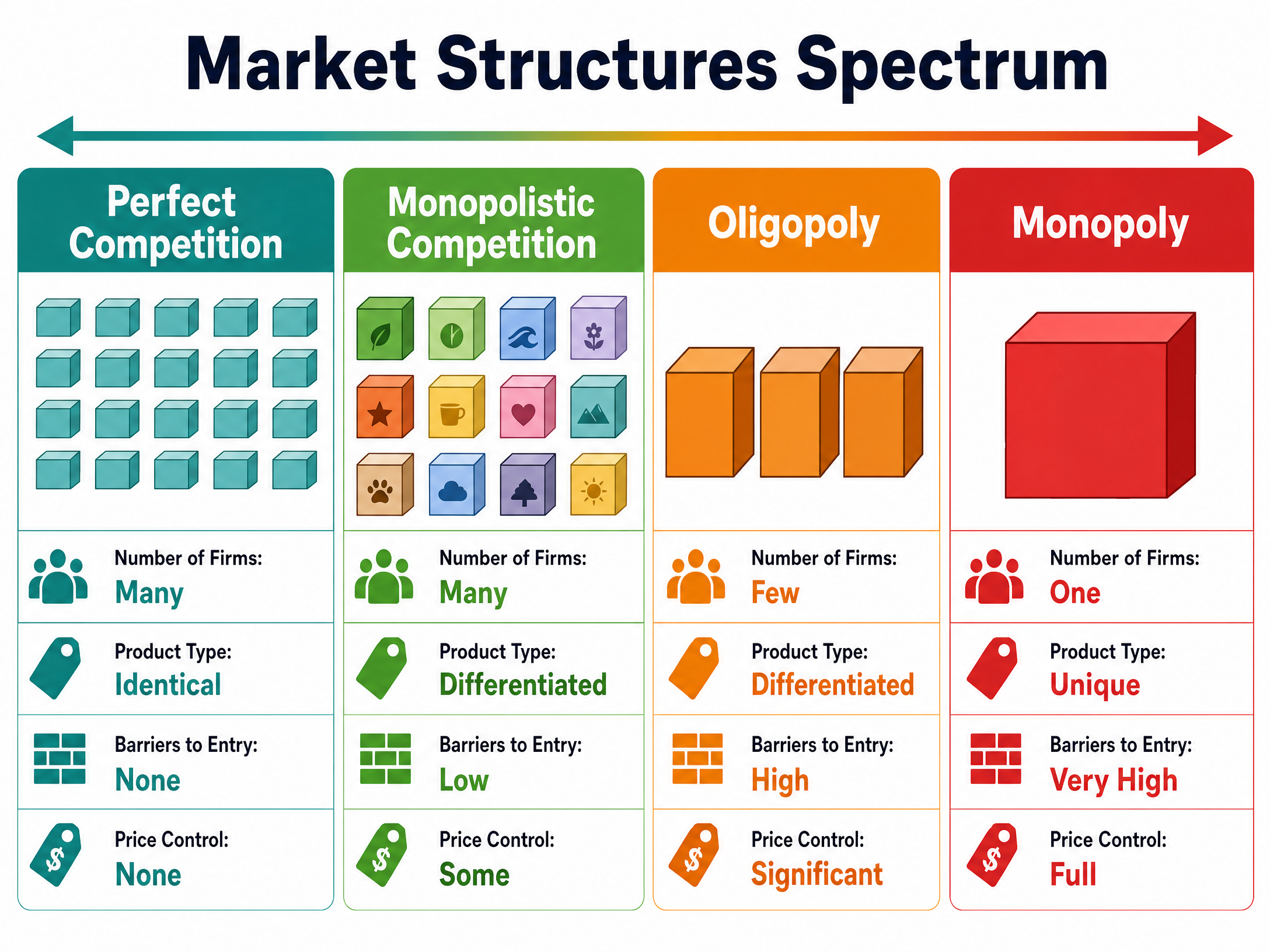
1 interactive diagram to visualise key concepts
Conceptual Flow Outline
How Economies of Scale Work
Worked Examples
3 worked examples — open one to explore the question and available guidance.
Practice Questions
Test your understanding — click to reveal model answers
State two characteristics of a perfectly competitive market. (2 marks)
Hint: Think about the number of firms and the type of product they sell.
Explain one reason why an oligopoly might choose to compete on non-price factors rather than cutting prices. (3 marks)
Hint: What happens if one supermarket cuts the price of bread? What will the others do?