Pearson Edexcel · GCSE · Economics
Economic assumptions
Economic assumptions form the foundation of all economic theory, simplifying the complex real world so we can build models and predict behaviour. For your GCSE, understanding that consumers aim for utility and producers aim for profit is crucial, but examiners also want you to know why these assumptions break down in reality.
- 4 min read
- 3 worked examples
- 5 practice questions
- 6 key terms
Study Notes
Overview
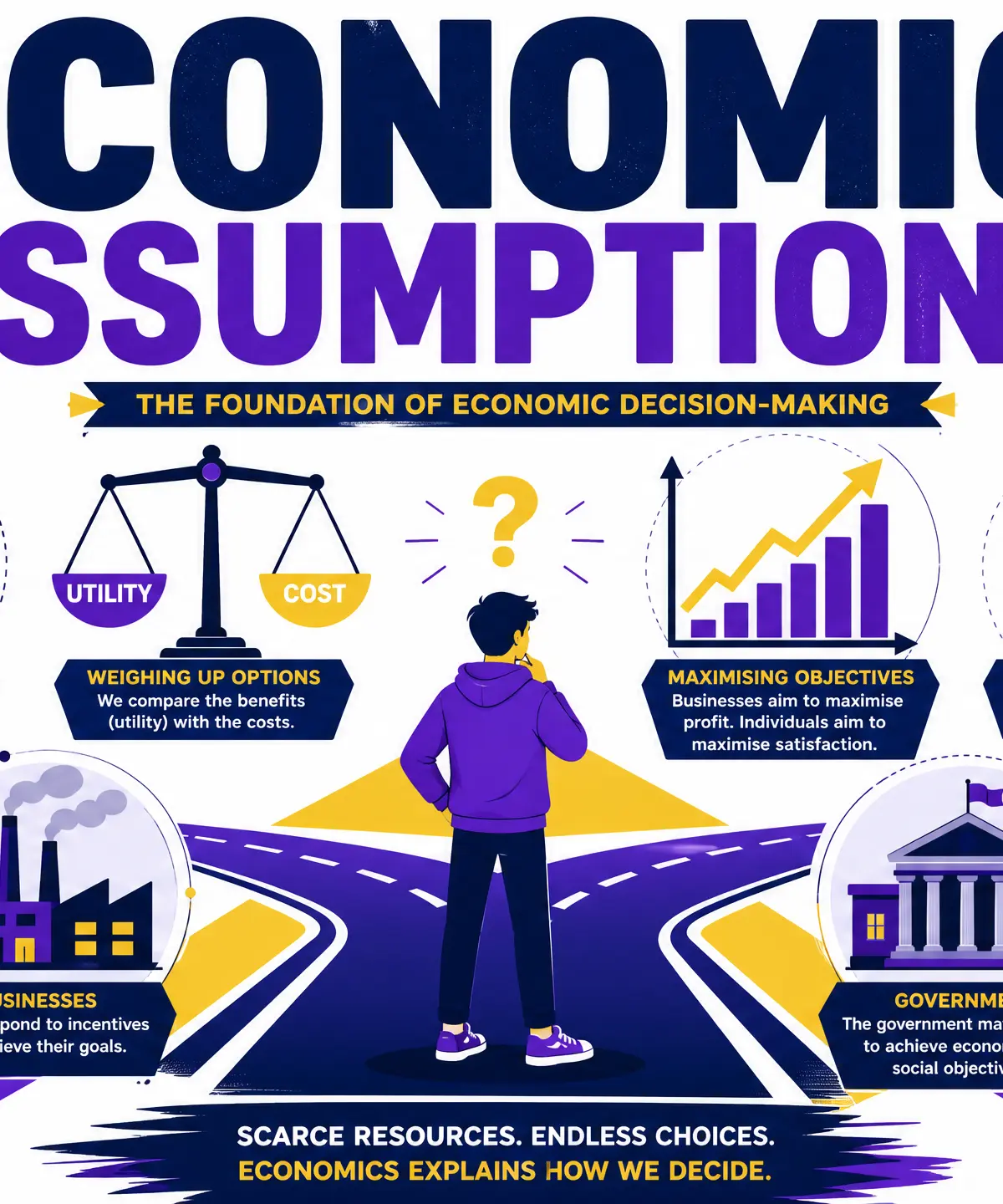
Economic assumptions are the bedrock of economic theory. The real world is incredibly complex, with billions of people making millions of decisions every day, influenced by emotions, habits, and imperfect information. To make sense of this chaos, economists use assumptions to simplify reality, allowing them to build models that explain and predict economic behaviour.
For your GCSE, examiners expect you to understand the core assumption: that all economic agents are rational. You need to know what this means for the three main economic agents (consumers, producers, and governments) and their specific objectives. Crucially, top-band answers must also evaluate this assumption by acknowledging that in the real world, limited information and behavioural biases mean people don't always act rationally.
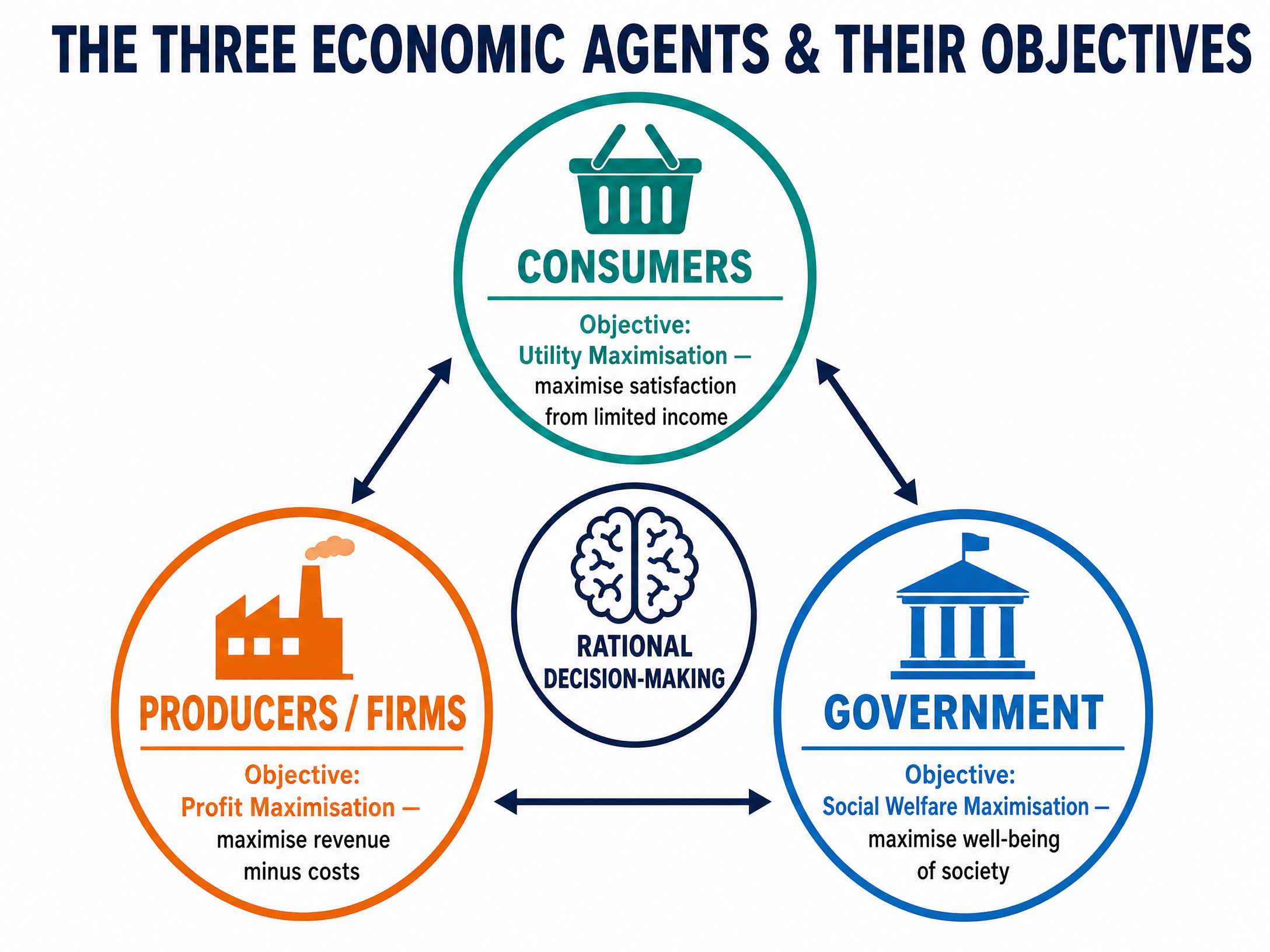
The Three Economic Agents
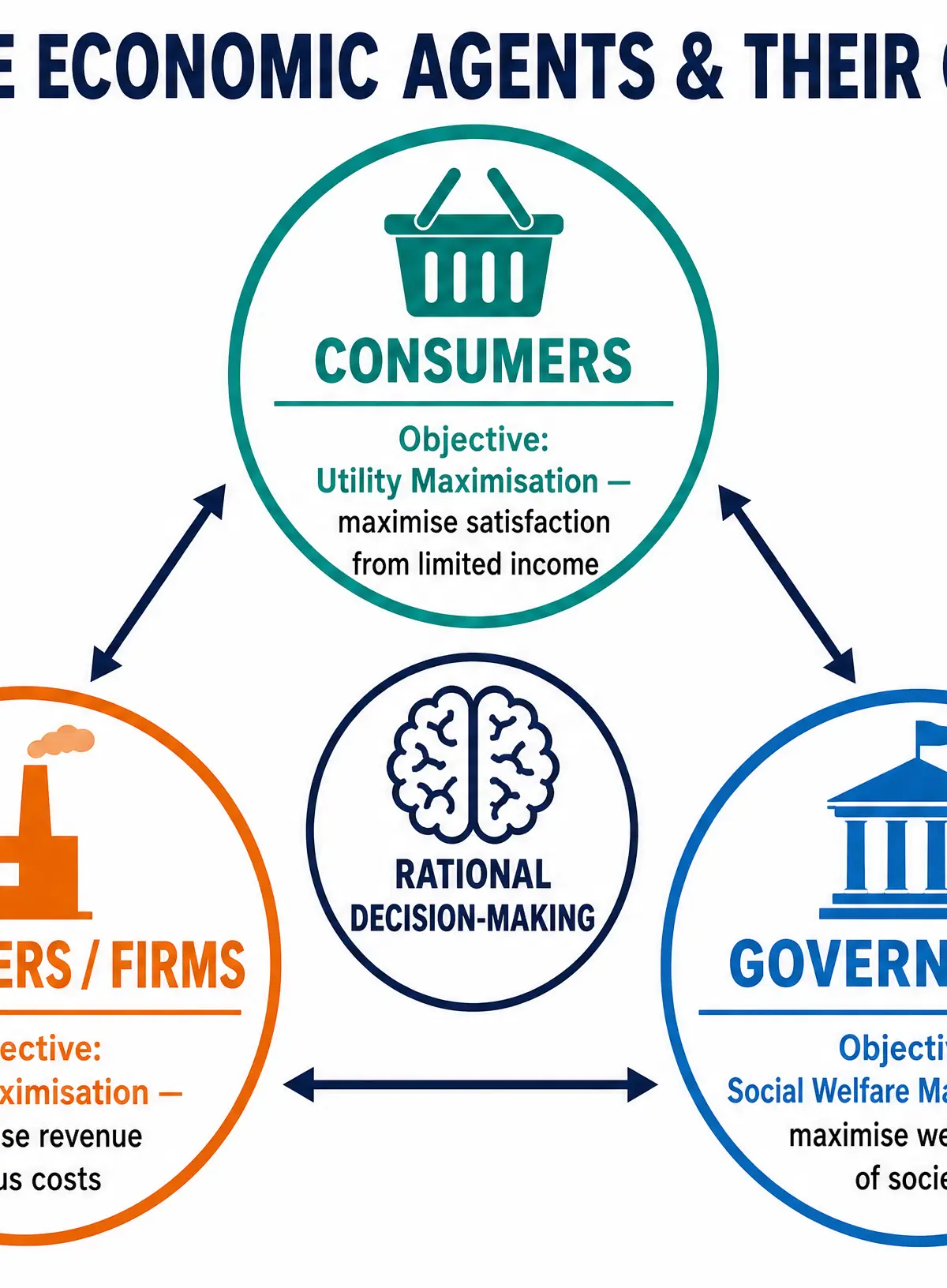
Consumers
Role: Individuals or households that purchase goods and services.
Key Objective: Utility Maximisation. Consumers are assumed to spend their limited income in a way that gives them the greatest possible satisfaction or happiness (utility).
Impact: This explains why consumers weigh up the price of a good against the benefit it provides. If the price of a good falls, its utility relative to its cost increases, so rational consumers will demand more of it.
Producers (Firms)
Role: Businesses that supply goods and services to the market.
Key Objective: Profit Maximisation. Producers are assumed to make decisions (what to produce, how to produce it, and what price to charge) with the primary goal of maximising their profit (total revenue minus total costs).
Impact: This explains why firms try to keep their costs as low as possible and why they supply more of a good when its market price rises.
Government
Role: The state or local authorities that intervene in the economy.
Key Objective: Social Welfare Maximisation. Governments are assumed to act rationally to improve the overall well-being of society, using policies like taxation, spending, and regulation.
Impact: This explains government intervention, such as taxing harmful goods (like tobacco) or providing public goods (like street lighting).
Second-Order Concepts
Rational Decision-Making
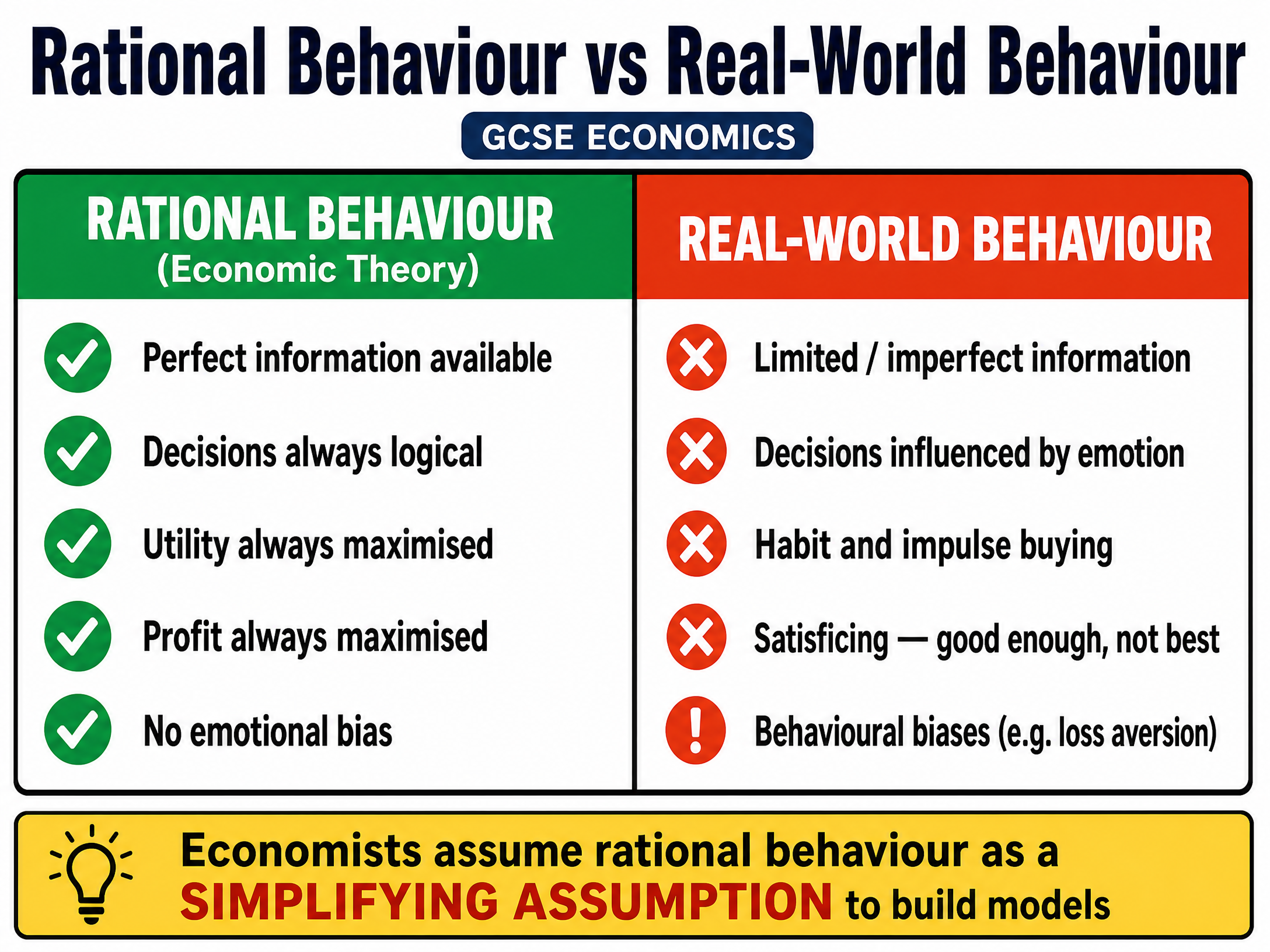
Rational decision-making is the process by which economic agents weigh up the costs and benefits of each option and choose the one that best serves their objective. It assumes that agents have perfect information and are not influenced by emotion.
The Reality Gap (Evaluation)
Examiners love to test your understanding of the gap between theory and reality.
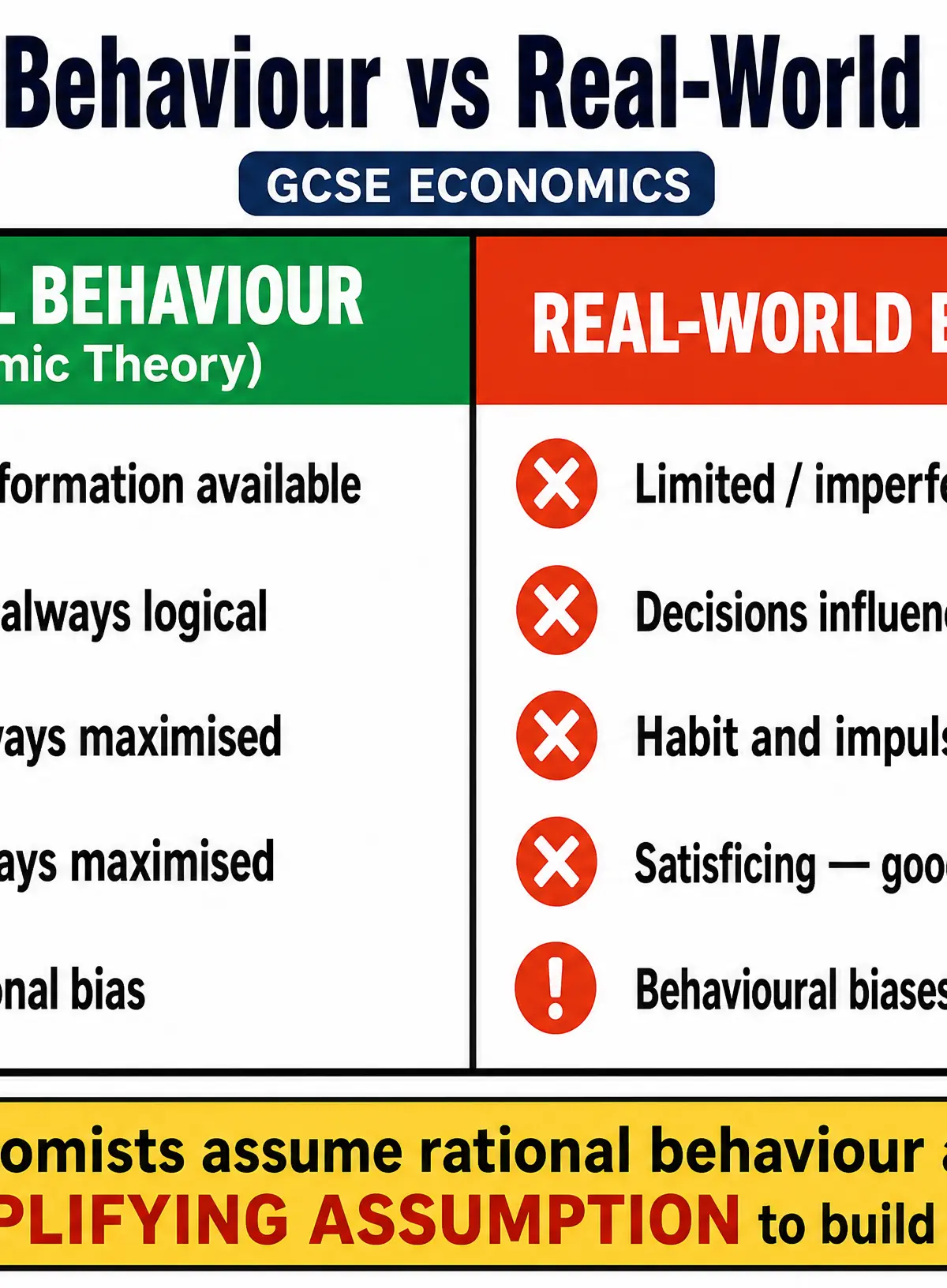
In reality, agents face constraints:
- Imperfect Information: Consumers don't know every price in every shop. Firms don't know exactly what their competitors are doing.
- Time Constraints: People don't have the time to perfectly calculate the utility of every purchase.
- Behavioural Biases: Consumers are influenced by habits, emotions, and impulse buying.

Source Skills
When evaluating economic data or case studies in the exam, always look for evidence of irrational behaviour. For example, if a source shows consumers continuing to buy a product even after a massive price increase, consider whether habit or brand loyalty is overriding rational utility maximisation.
Worked Examples
3 worked examples — open one to explore the question and available guidance.
Practice Questions
Test your understanding — click to reveal model answers
State the assumed objective of a consumer. (1 mark)
Hint: Think about satisfaction.
Explain the role of the government as an economic agent. (3 marks)
Hint: What is their objective, and how do they achieve it?
Explain how imperfect information prevents rational decision-making. (4 marks)
Hint: Define rational decision-making first, then explain what happens when facts are missing.
Assess whether profit maximisation is the only objective of firms. (9 marks)
Hint: Look at the 8-mark worked example above and expand on it.
Evaluate the usefulness of assuming consumers act rationally. (9 marks)
Hint: Why do economists need the assumption? Why is it flawed in reality?