Pearson Edexcel · GCSE · Economics
Elasticity
Mastering elasticity is crucial for GCSE Economics, as it bridges the gap between basic supply and demand theory and real-world business strategy. This comprehensive guide covers both Price and Income Elasticity of Demand, providing the precise definitions, calculations, and analytical links to total revenue that examiners consistently reward.
- 6 min read
- 3 worked examples
- 5 practice questions
- 6 key terms
Study Notes
Overview
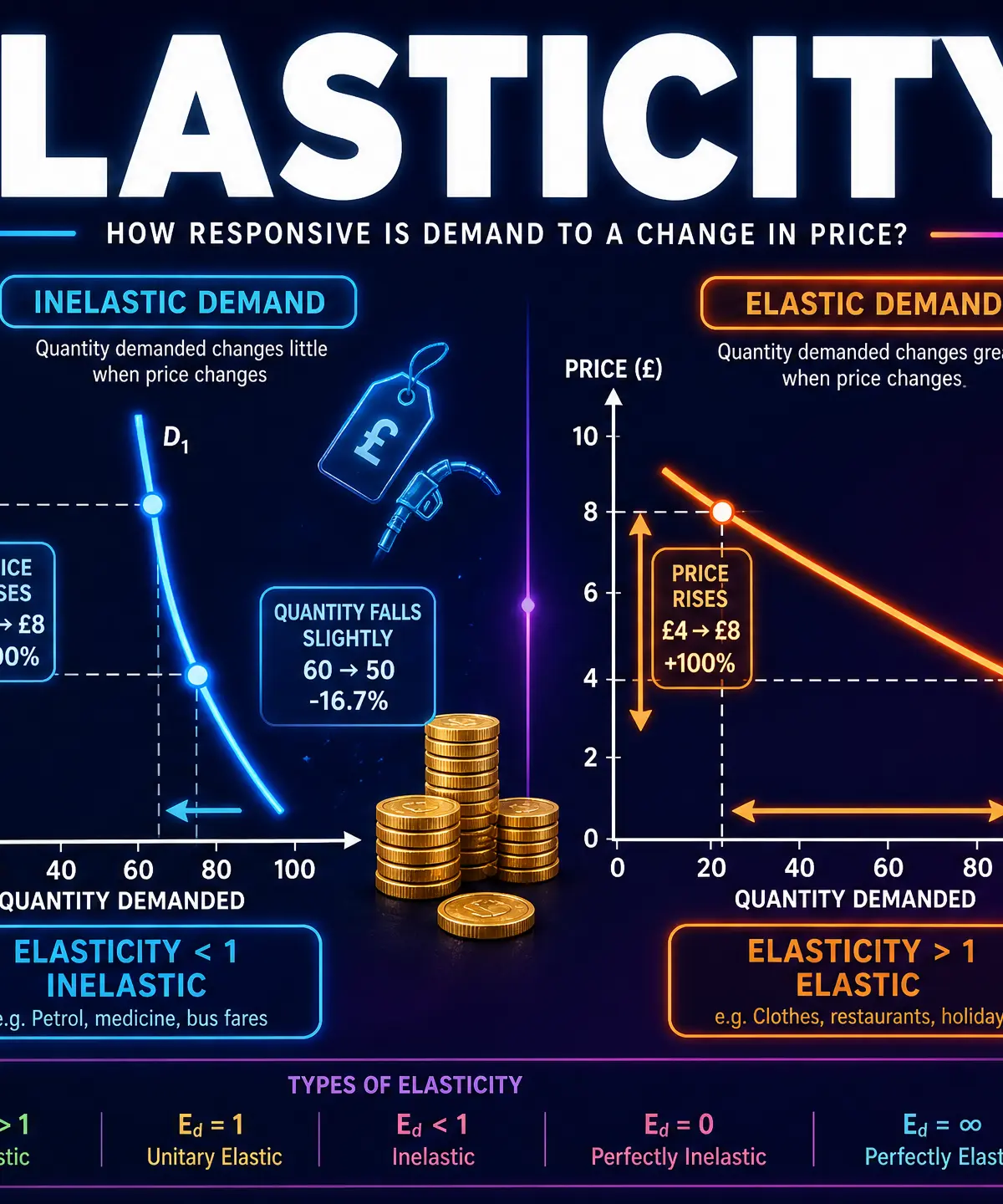
Elasticity is one of the most frequently tested concepts in GCSE Economics across all major exam boards (AQA, Edexcel, OCR). It measures the responsiveness of quantity demanded to changes in either price (PED) or consumer income (YED). Examiners expect candidates to not only calculate these values accurately but also interpret their significance for business decision-making. The highest marks are awarded to students who can confidently link Price Elasticity of Demand to a firm's total revenue, demonstrating a synoptic understanding of how theoretical concepts drive real-world pricing strategies.
Price Elasticity of Demand (PED)
Definition and Calculation
Definition: Price Elasticity of Demand (PED) measures the responsiveness of the quantity demanded of a good or service to a change in its price.
Formula:
PED = \frac{% \text{ change in quantity demanded}}{% \text{ change in price}}
Examiner Tip: Because of the law of demand (an inverse relationship between price and quantity), the PED calculation almost always yields a negative number. However, examiners typically look for the absolute value when determining whether demand is elastic or inelastic. Always show your working clearly to secure method marks, even if your final calculation is incorrect.
Interpreting PED Values
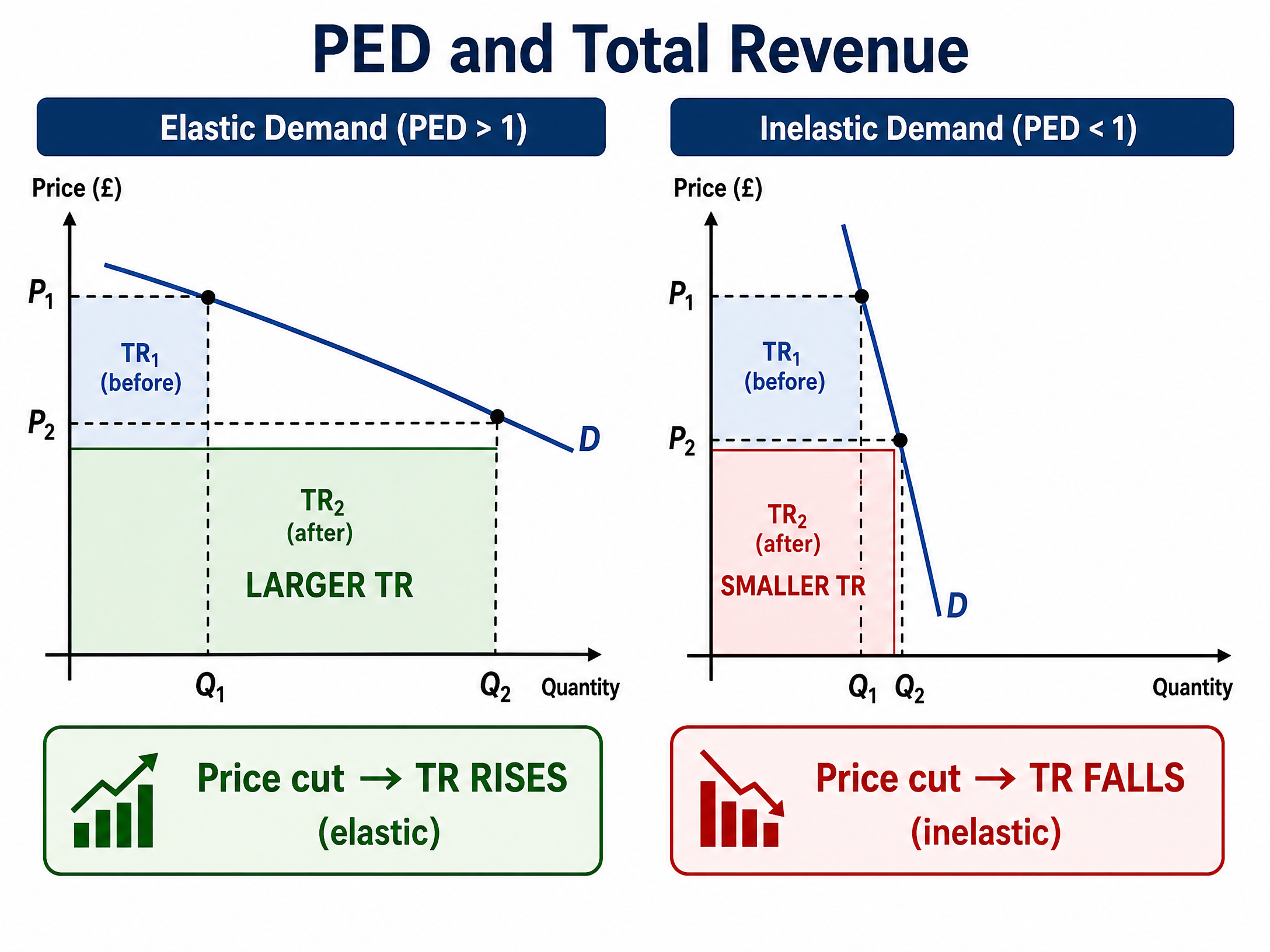
- Elastic Demand (PED > 1): Quantity demanded is highly responsive to price changes. A small percentage change in price leads to a larger percentage change in quantity demanded. (e.g., branded clothing, restaurant meals).
- Inelastic Demand (PED < 1): Quantity demanded is relatively unresponsive to price changes. A large percentage change in price leads to a smaller percentage change in quantity demanded. (e.g., petrol, essential medicines, cigarettes).
- Unitary Elasticity (PED = 1): The percentage change in quantity demanded is exactly equal to the percentage change in price.
Factors Affecting PED
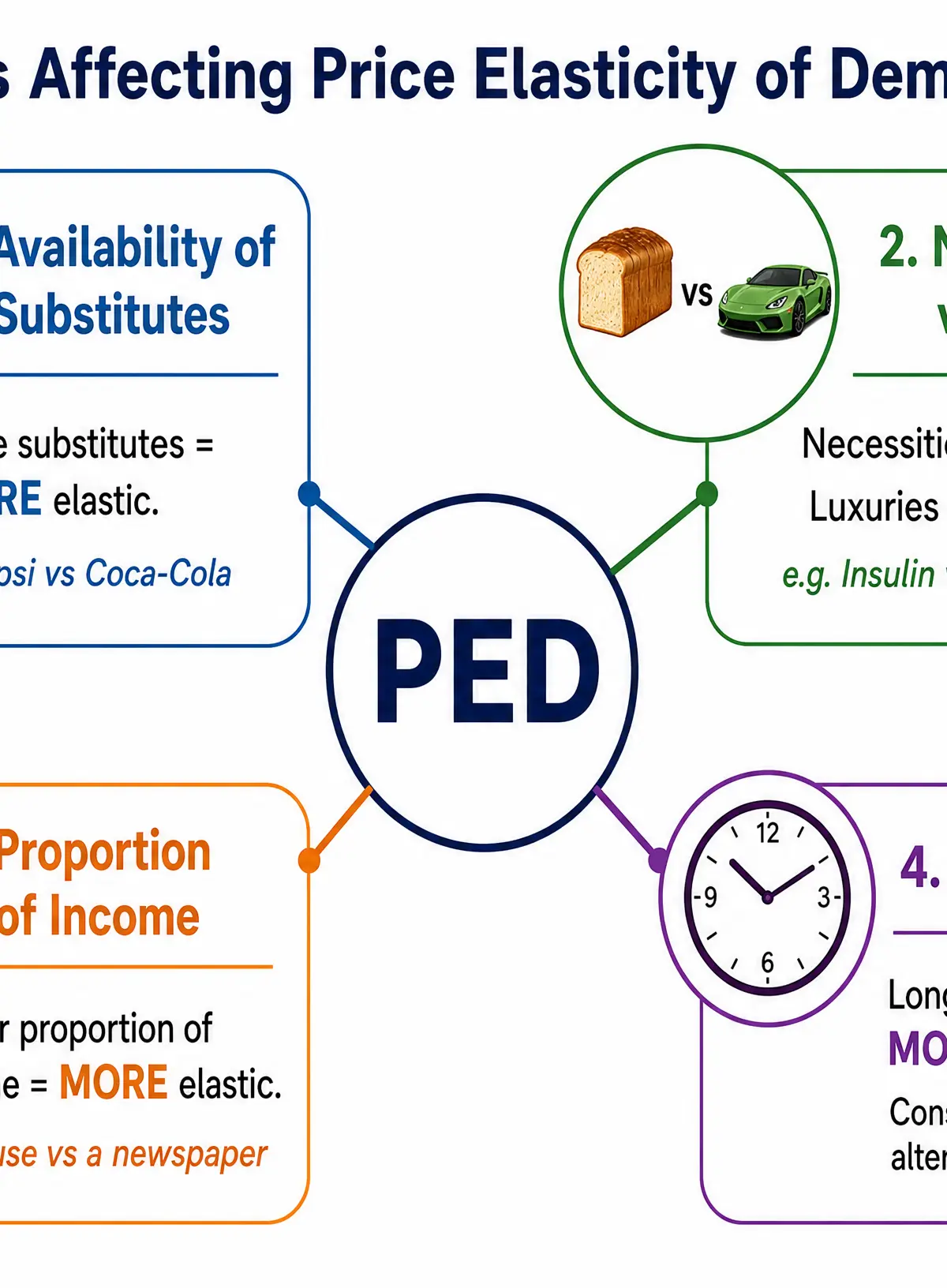
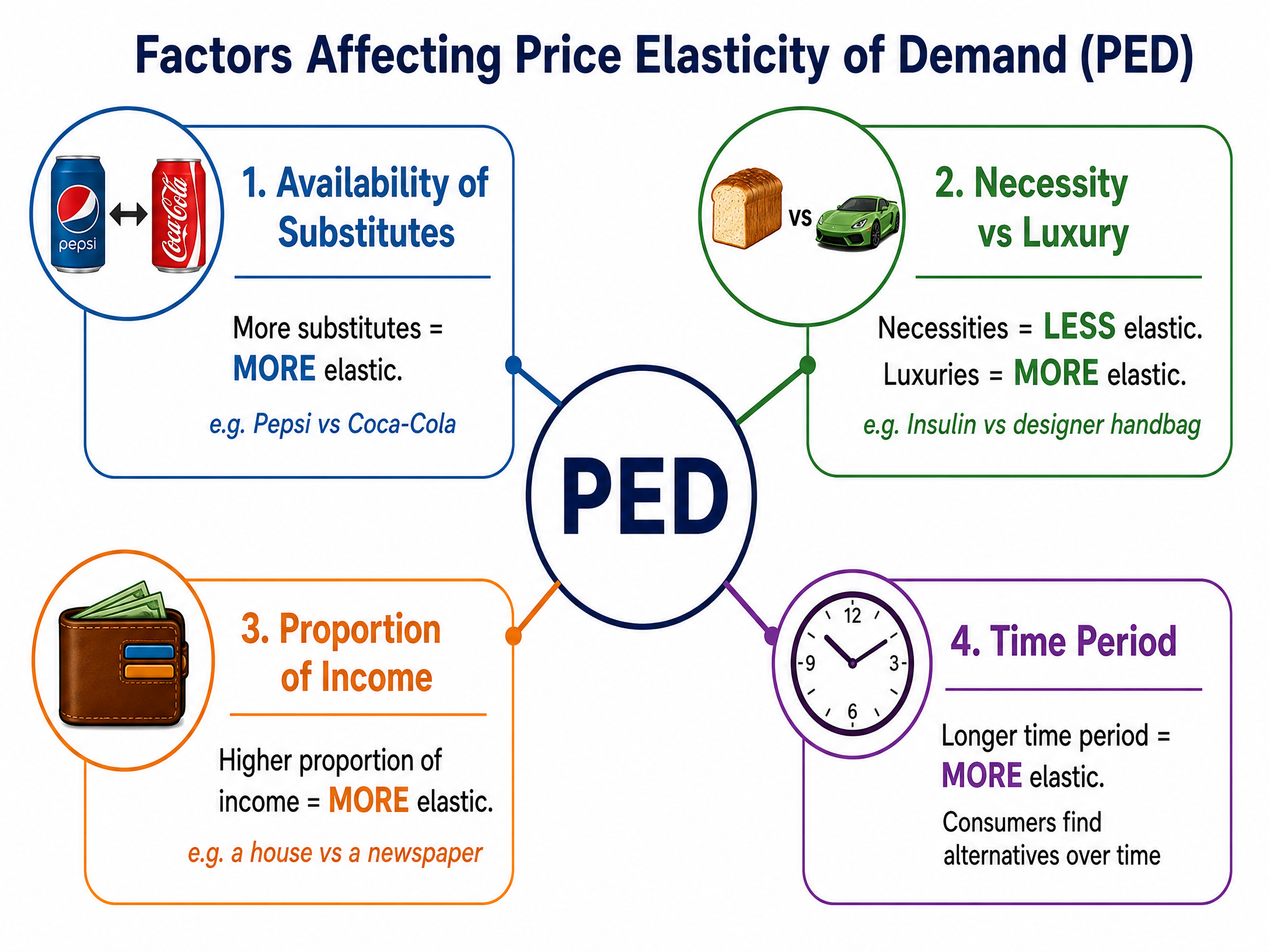
Examiners frequently ask candidates to explain why a good has a certain elasticity. Use the following factors:
- Availability of Substitutes: This is the most significant factor. Goods with many close substitutes (e.g., different brands of baked beans) have highly elastic demand because consumers can easily switch if the price rises. Goods with few substitutes (e.g., rail travel on a specific route) have inelastic demand.
- Necessity vs. Luxury: Necessities (e.g., bread, electricity) have inelastic demand as consumers must buy them regardless of price. Luxuries (e.g., foreign holidays) have elastic demand as they can be easily forgone.
- Proportion of Income: Goods that take up a small percentage of a consumer's income (e.g., a box of matches) tend to have inelastic demand. Goods requiring a large proportion of income (e.g., a car) have elastic demand.
- Time Period: Demand becomes more elastic over time as consumers find alternatives and adjust their habits. In the short run, demand for petrol is highly inelastic, but over five years, consumers may switch to electric vehicles or public transport.
The Relationship Between PED and Total Revenue
This is a critical area for high-mark evaluation questions. Total Revenue (TR) is calculated as Price × Quantity.
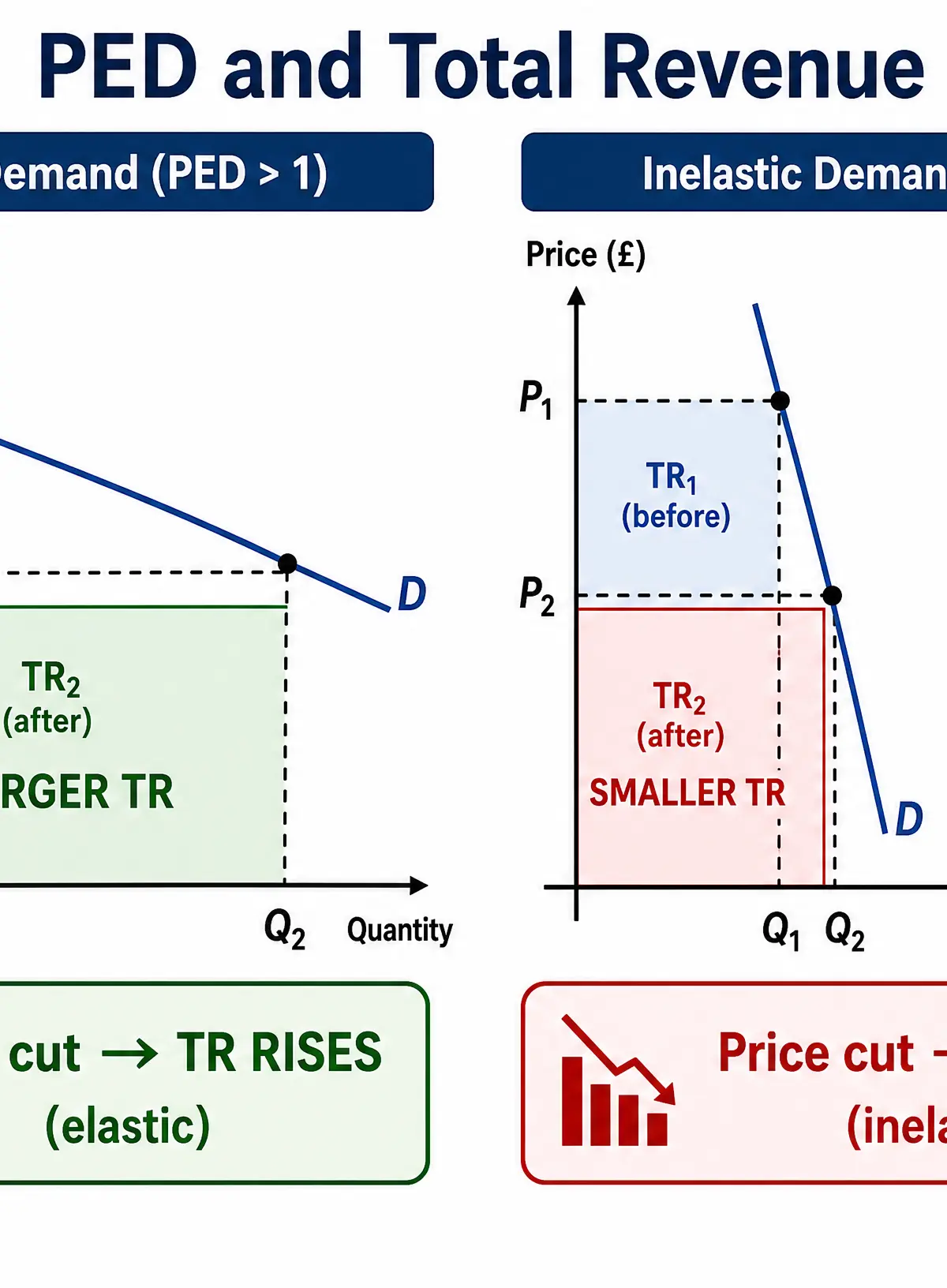
- When Demand is Inelastic: A firm should raise its price to increase total revenue. The percentage fall in quantity demanded will be smaller than the percentage increase in price. (Price and TR move in the same direction).
- When Demand is Elastic: A firm should lower its price to increase total revenue. The percentage increase in quantity demanded will be larger than the percentage fall in price. (Price and TR move in opposite directions).
Income Elasticity of Demand (YED)
Definition and Calculation
Definition: Income Elasticity of Demand (YED) measures the responsiveness of the quantity demanded of a good or service to a change in consumer income.
Formula:
YED = \frac{% \text{ change in quantity demanded}}{% \text{ change in income}}
Interpreting YED Values
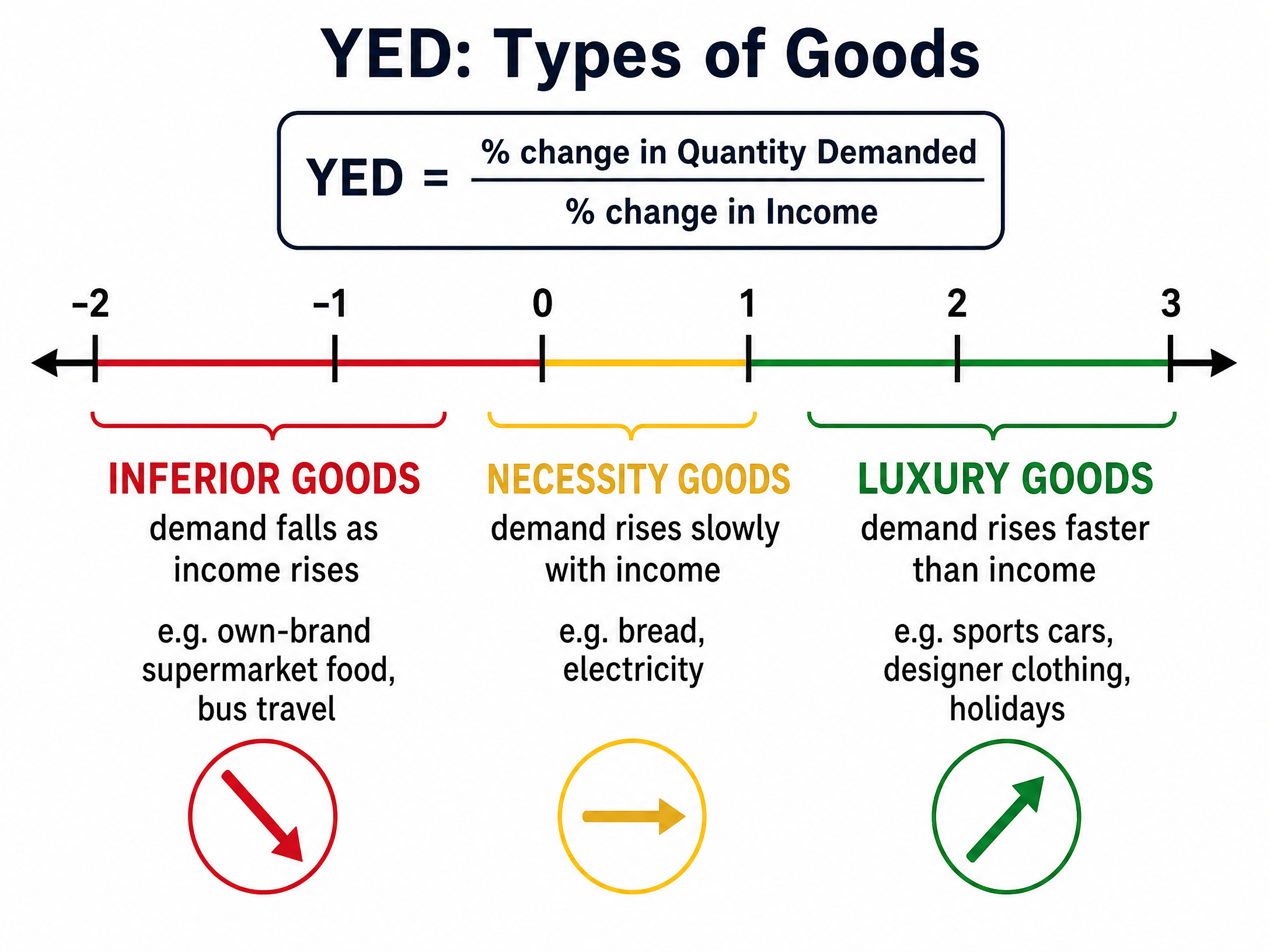
Unlike PED, the sign of the YED calculation is crucial, as it categorises the type of good:
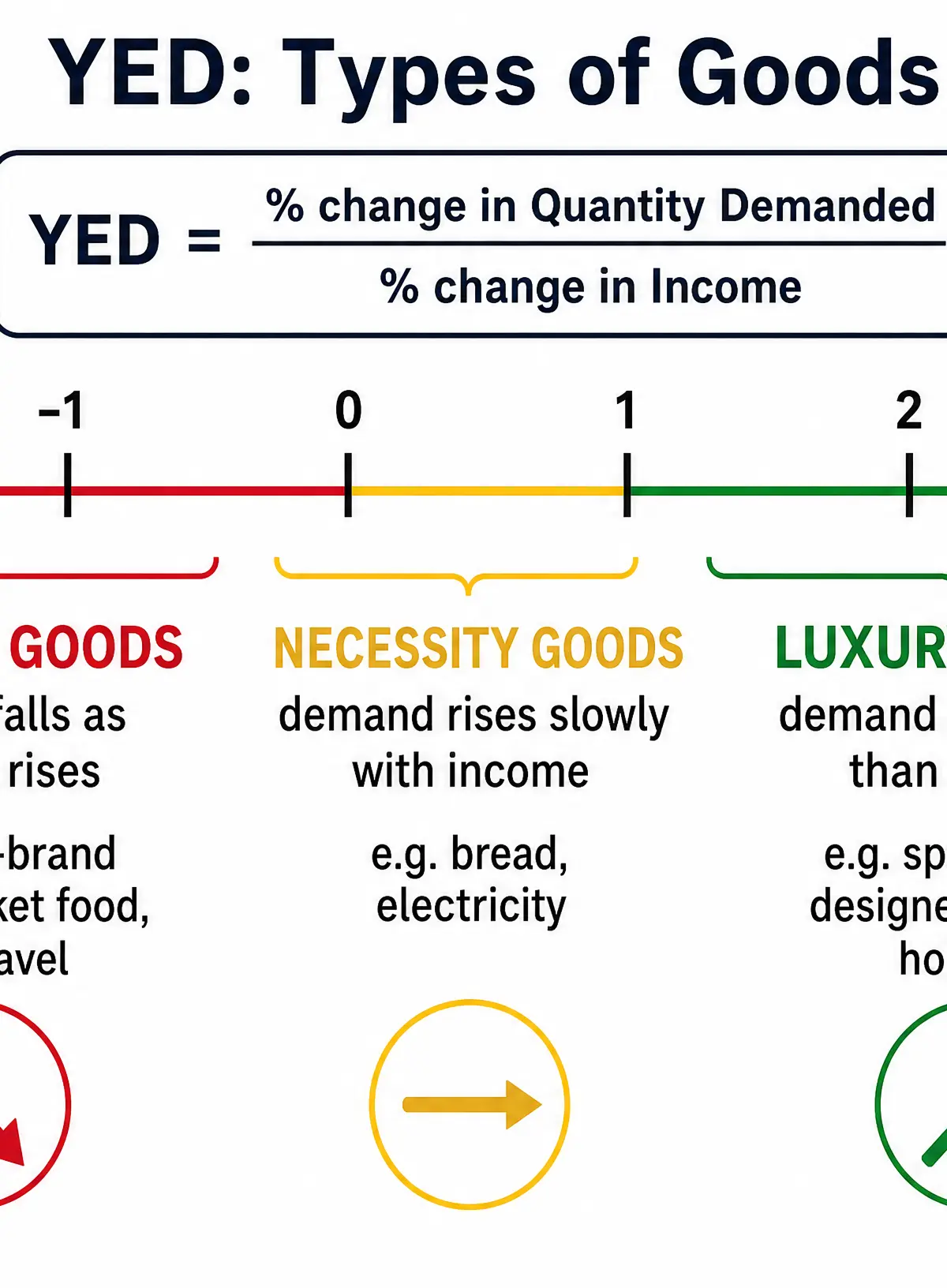
- Normal Goods (Positive YED): As income rises, demand rises.
- Necessities (YED between 0 and 1): Demand rises, but slower than income (e.g., basic groceries).
- Luxuries (YED > 1): Demand rises faster than income (e.g., designer goods, sports cars).
- Inferior Goods (Negative YED): As income rises, demand falls. Consumers switch to higher-quality alternatives (e.g., own-brand supermarket value ranges, instant noodles, bus travel).
Significance for Businesses
Understanding YED helps businesses plan for economic cycles. During an economic boom (rising incomes), firms selling luxury goods will see a surge in demand, while those selling inferior goods will struggle. Conversely, during a recession (falling incomes), discount retailers selling inferior goods often experience significant growth as consumers "trade down". Firms may diversify their product portfolios to include both normal and inferior goods to mitigate risk.
Audio Revision
Listen to our comprehensive 4-minute audio guide covering all key concepts, formulas, and examiner tips for Elasticity.

Visual Resources
3 diagrams and illustrations
Interactive Diagrams
1 interactive diagram to visualise key concepts
Conceptual Flow Outline
Flowchart linking PED to Pricing Strategy and Total Revenue
Worked Examples
3 worked examples — open one to explore the question and available guidance.
Practice Questions
Test your understanding — click to reveal model answers
A bakery reduces the price of its artisan sourdough loaves from £4.00 to £3.50. Consequently, weekly sales increase from 200 to 260 loaves. Calculate the PED and state whether demand is elastic or inelastic. (4 marks)
Hint: Remember to calculate the percentage changes first, not just the raw numerical changes.
Explain the difference between a normal good and an inferior good, using examples. (4 marks)
Hint: Focus on the relationship with consumer income, not the manufacturing quality.
Assess the impact of a recession on a business that primarily sells luxury holidays. (6 marks)
Hint: Use the concept of Income Elasticity of Demand (YED) in your answer.
State the formula for Price Elasticity of Demand. (1 mark)
Hint: Quantity goes on top.
A public transport company calculates that the PED for its bus tickets is -0.4. It wants to increase its total revenue to fund new buses. Advise the company on whether it should increase or decrease its ticket prices. (4 marks)
Hint: Identify the elasticity first, then apply the total revenue rule.