Pearson Edexcel · GCSE · Economics
Exchange rates
Exchange rates determine the value of a currency in international trade, fundamentally shaping a nation's global competitiveness. Understanding how currencies fluctuate and impact imports and exports is essential for grasping the real-world dynamics of international economics and achieving top marks in your GCSE exams.
- 5 min read
- 3 worked examples
- 3 practice questions
- 6 key terms
Study Notes

Overview
This study guide covers the crucial topic of Exchange Rates within GCSE Economics. The exchange rate is simply the price of one currency expressed in terms of another. It acts as the vital link connecting the UK economy to the rest of the world. Examiners expect candidates to not only define exchange rates accurately but to trace the complex consequences of currency fluctuations on domestic consumers, businesses, and the broader macroeconomic objectives. A strong understanding of how exchange rates are determined—whether floating freely via market forces or fixed by central banks—is foundational. Furthermore, candidates must master the application of the SPICED mnemonic to analyse how appreciation and depreciation impact the balance of payments, while critically evaluating these effects using concepts like the J-Curve and price elasticity of demand.
Key Concepts & Mechanisms
Determining Exchange Rates
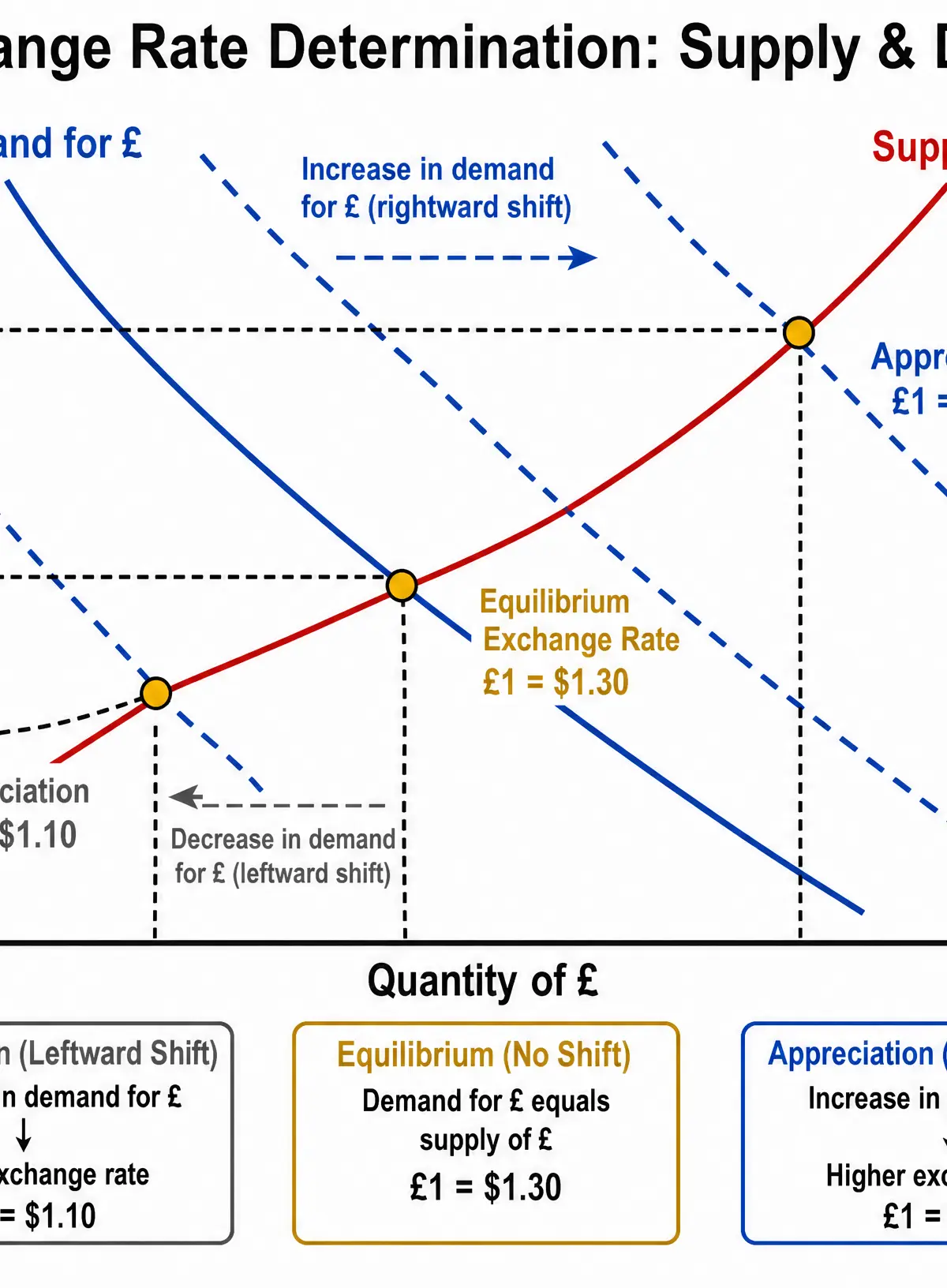
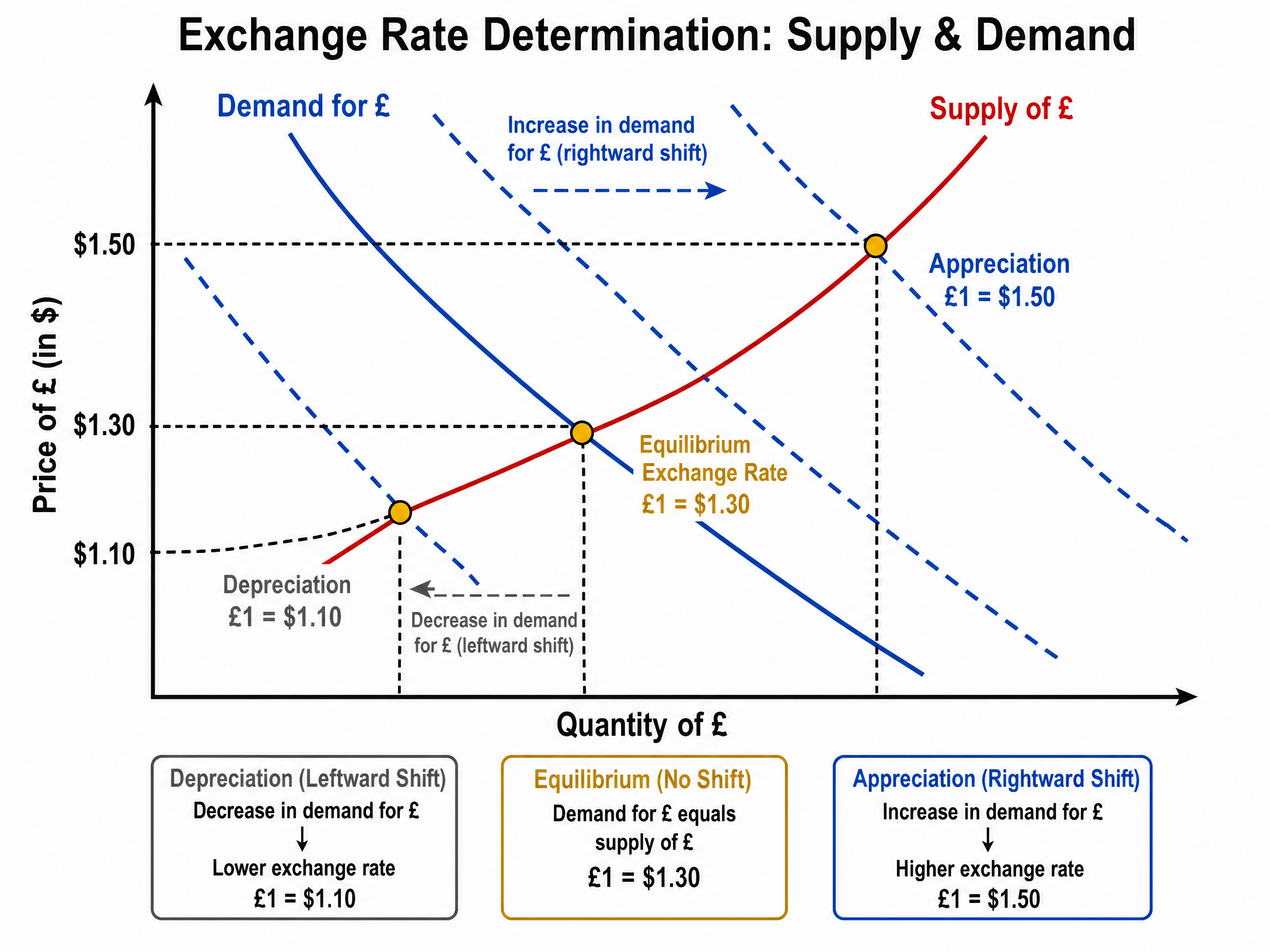
Floating Exchange Rates: In a floating system (like the UK uses for the pound sterling), the exchange rate is determined purely by the interaction of supply and demand in the foreign exchange (forex) market.
- An increase in demand for UK exports, or higher UK interest rates attracting foreign investment, shifts the demand curve to the right, leading to an appreciation of the pound.
- An increase in supply of pounds (e.g., UK citizens buying more foreign imports) shifts the supply curve to the right, causing a depreciation.
Fixed Exchange Rates: In a fixed system, a country's central bank or government pegs its currency to another major currency (like the US Dollar) or a basket of currencies. The central bank actively intervenes by buying or selling its own currency using foreign reserves to maintain the target rate.
The SPICED Effect
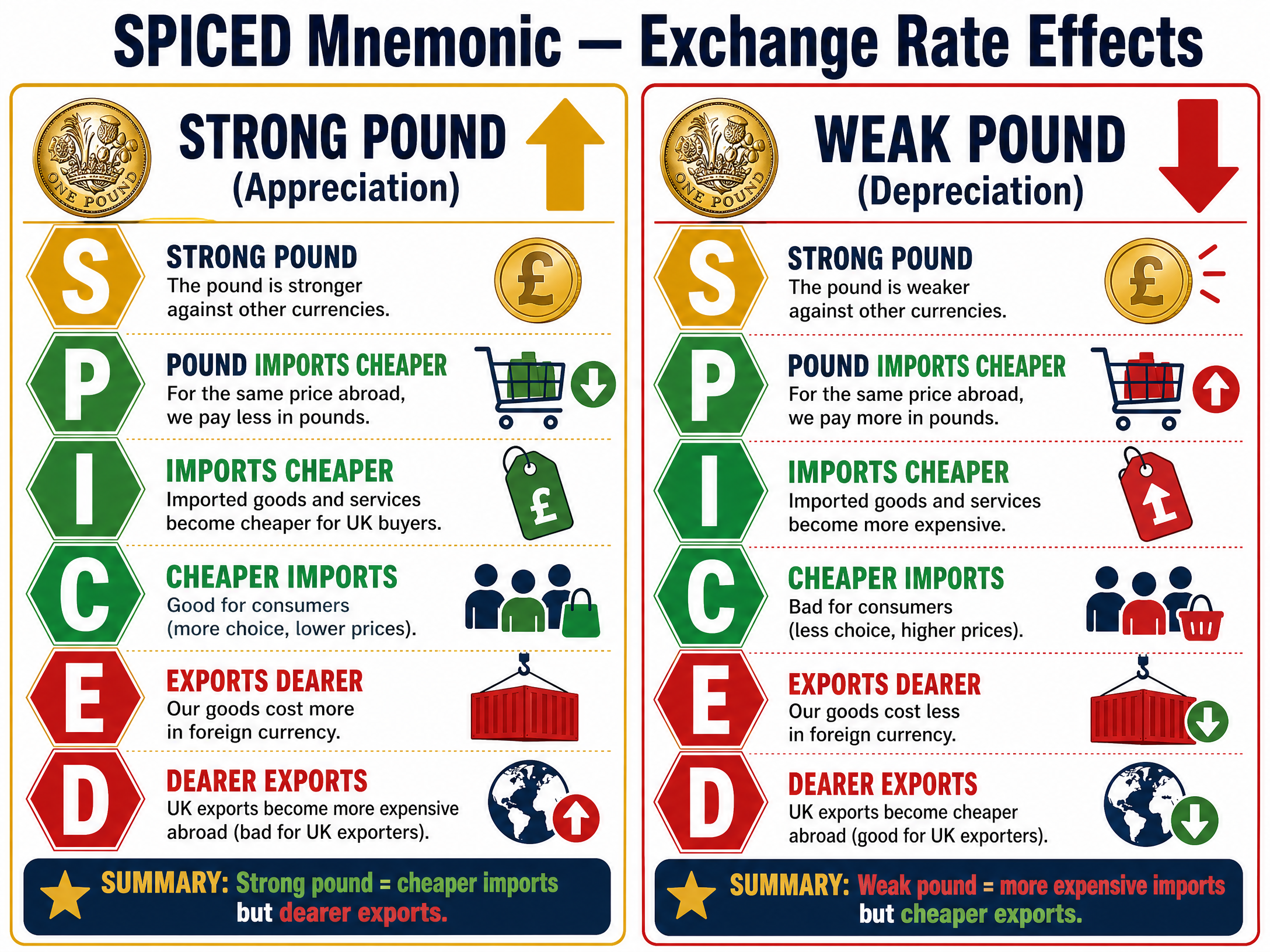
The most important analytical tool for exchange rate questions is the SPICED mnemonic: Strong Pound Imports Cheaper Exports Dearer.
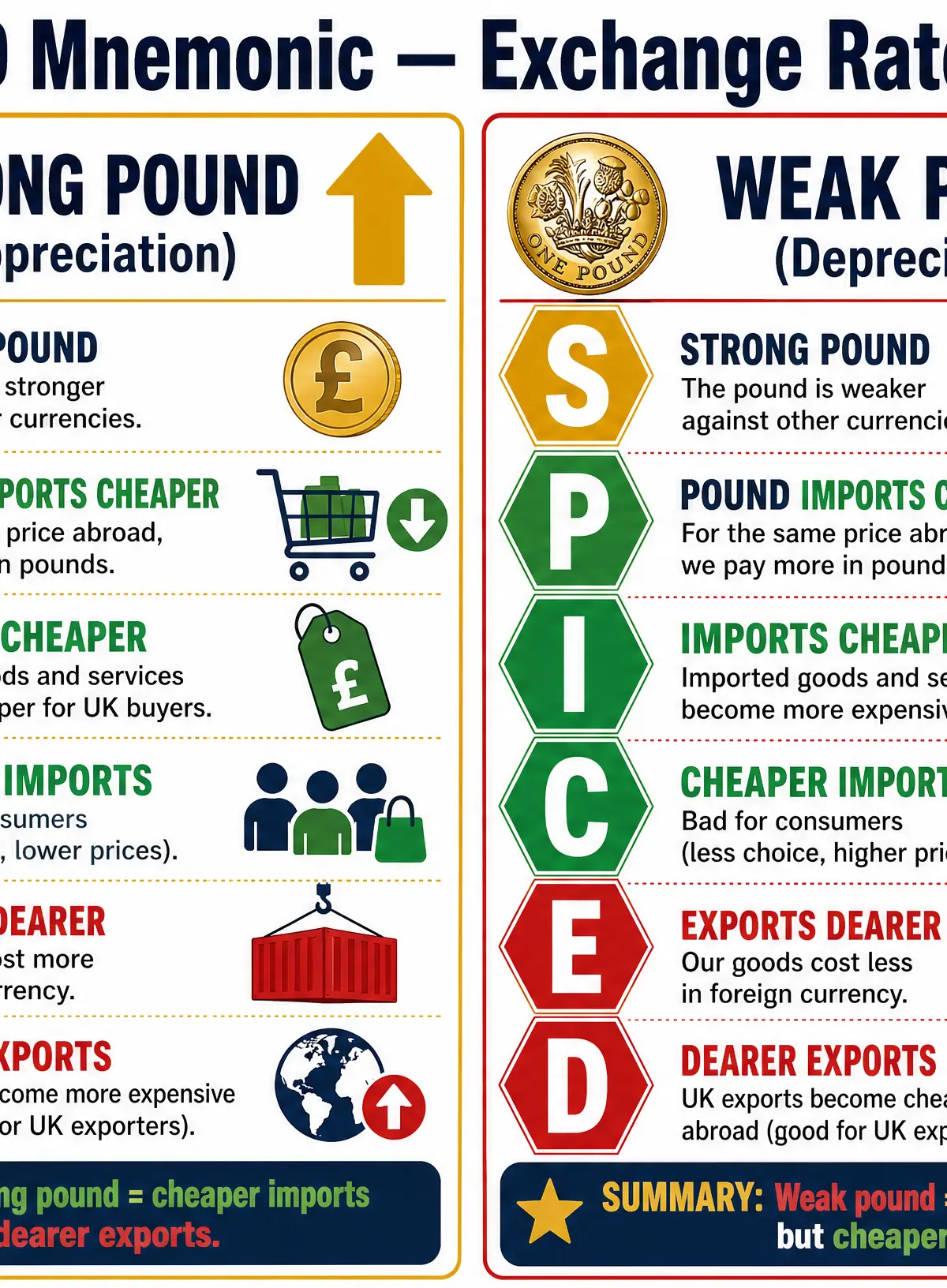
Appreciation (Strong Pound):
- Imports become cheaper: UK consumers pay less for foreign goods, which increases living standards and reduces cost-push inflation for firms buying imported raw materials.
- Exports become dearer: UK goods become more expensive for foreign buyers. This reduces international competitiveness, leading to lower export volumes and potentially causing unemployment in export-driven industries.
Depreciation (Weak Pound):
- Imports become dearer: Foreign goods cost more, which can lead to imported inflation and lower consumer purchasing power.
- Exports become cheaper: UK goods are more competitively priced abroad, boosting export demand and potentially creating jobs in domestic manufacturing.
The J-Curve Effect and the Balance of Payments
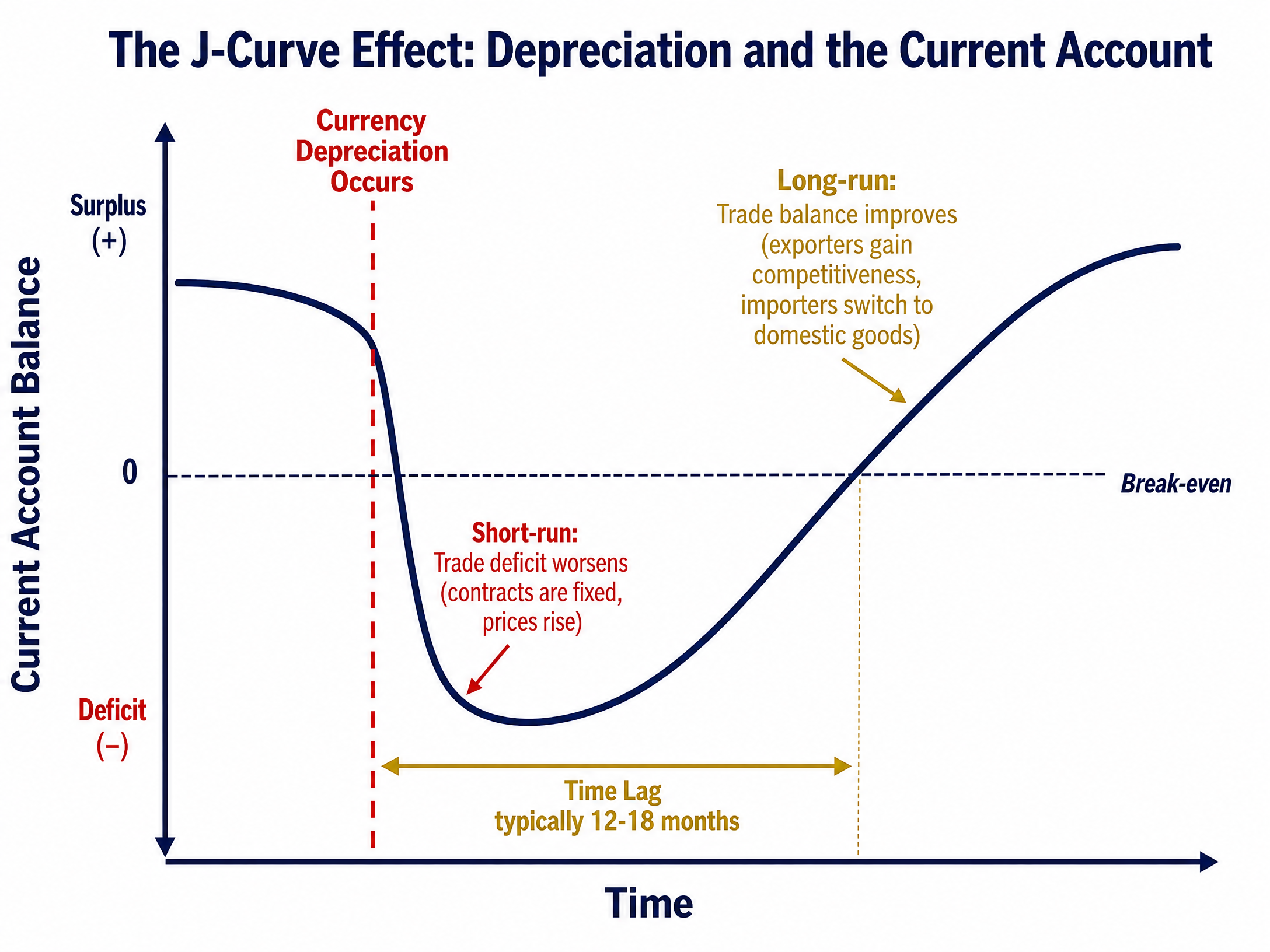
When a currency depreciates, economic theory suggests the current account deficit should improve because exports are cheaper and imports are dearer. However, this does not happen immediately.
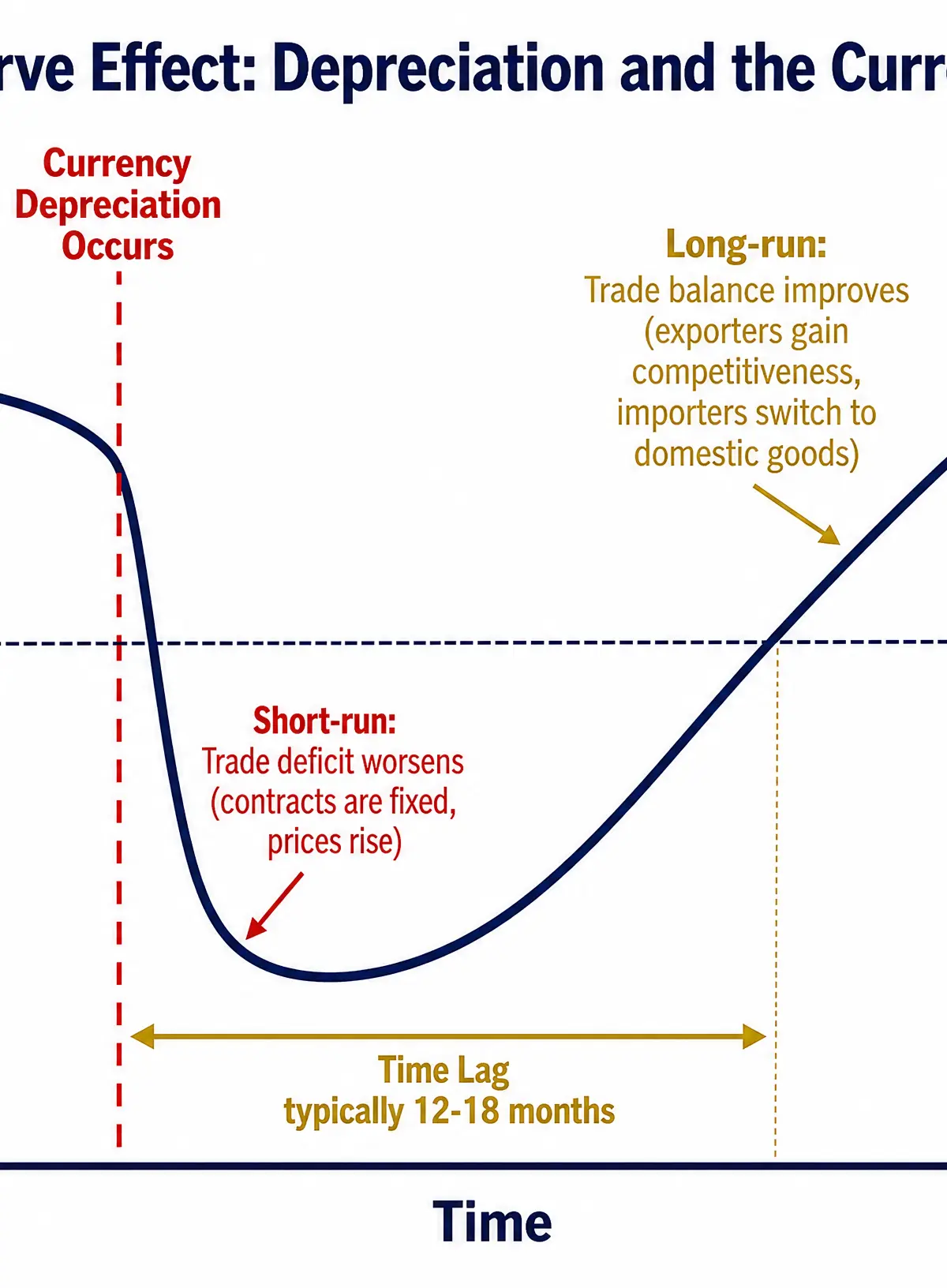
The J-Curve Effect illustrates that in the short run, a depreciation actually worsens the current account deficit. This occurs because trade contracts are often fixed in advance, and it takes time for consumers and businesses to change their buying habits. Therefore, the UK continues to buy the same volume of imports but pays more for them.
In the long run (typically 12-18 months), the deficit begins to improve as buyers adjust to the new relative prices—switching away from expensive imports towards domestic goods, while foreign buyers increase their demand for now-cheaper UK exports.
Evaluation: Price Elasticity of Demand (PED)
To achieve Level 3 (Analysis and Evaluation) marks, you must consider the PED for imports and exports (the Marshall-Lerner condition). A depreciation will only improve the current account balance if the combined price elasticity of demand for imports and exports is elastic (greater than 1). If demand is highly inelastic (e.g., the UK must import essential oil regardless of price), a weaker pound will simply increase costs without significantly changing trade volumes.
Podcast Revision
Listen to our 10-minute audio guide covering the core concepts, common mistakes, and a quick-fire recall quiz:

Visual Resources
3 diagrams and illustrations
Interactive Diagrams
1 interactive diagram to visualise key concepts
Conceptual Flow Outline
Flowchart showing the macroeconomic impacts of a currency depreciation.
Worked Examples
3 worked examples — open one to explore the question and available guidance.
Practice Questions
Test your understanding — click to reveal model answers
State one factor that could cause the demand for the UK pound to increase on the foreign exchange market. (1 mark)
Hint: Think about why foreigners would need to buy pounds.
Explain how a fall in the value of the pound might affect the rate of inflation in the UK. (4 marks)
Hint: Link the weaker pound to the cost of imported goods and raw materials.
Discuss the view that a strong pound is always beneficial for the UK economy. (9 marks)
Hint: You need a balanced argument. Use SPICED to show who benefits and who suffers.