Pearson Edexcel · GCSE · Economics
Globalisation
Globalisation is the defining economic phenomenon of our time, connecting markets, cultures, and populations worldwide. This guide covers the drivers, benefits, and costs of a more interconnected world, giving you the precise definitions and evaluation skills needed to secure top marks.
- 5 min read
- 3 worked examples
- 5 practice questions
- 6 key terms
Study Notes
Overview
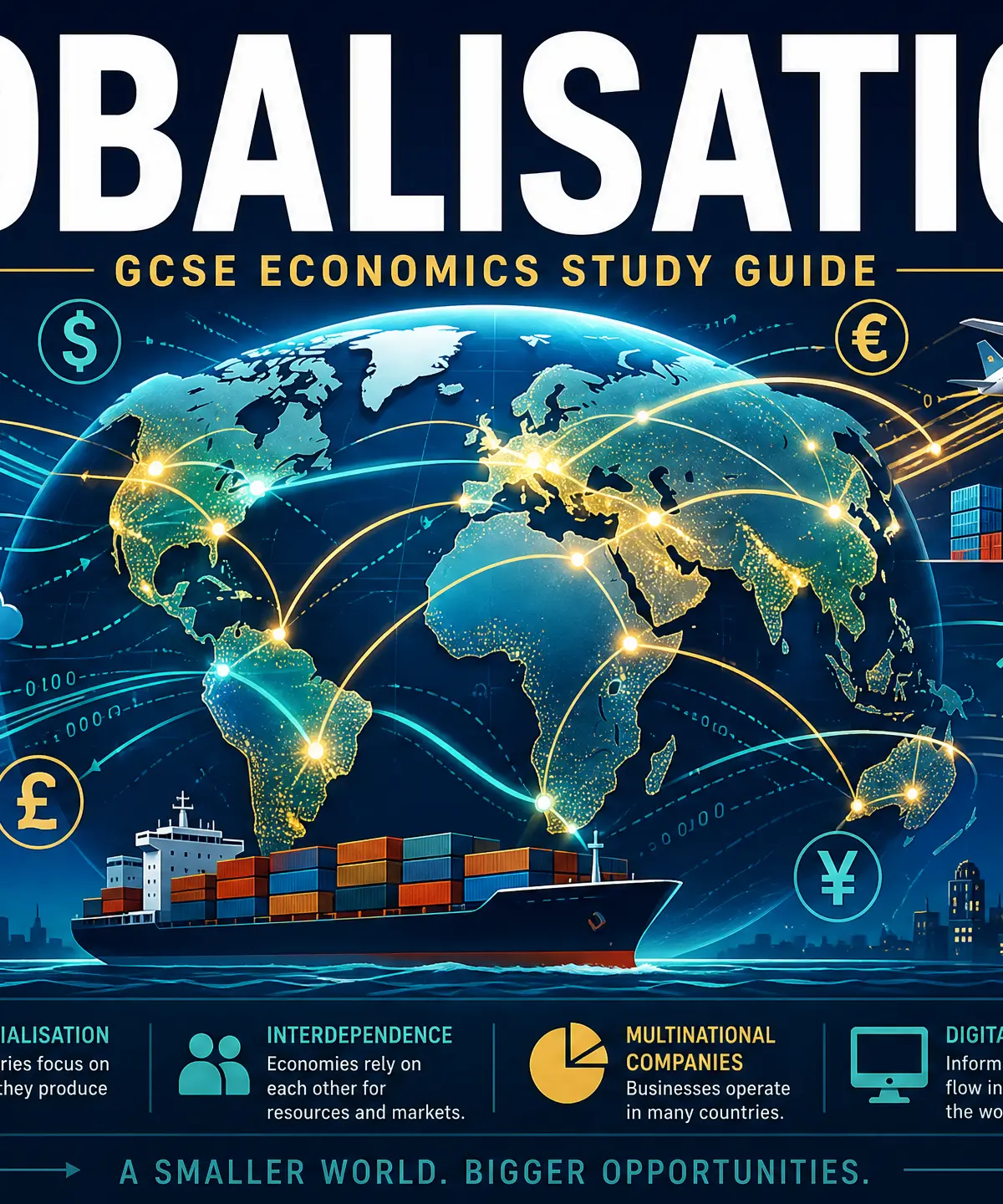
Globalisation is the process by which the world's economies, cultures, and populations have become increasingly interconnected and interdependent. It is driven by the growth in international trade, the free flow of capital, the migration of labour, and the rapid spread of technology. For GCSE Economics candidates, this topic is crucial because it acts as a synoptic link, tying together concepts like economic growth, international trade, employment, and the environment.
Examiners consistently look for two things in globalisation answers: precise definitions and balanced evaluation. You must be able to explain why the world has become more integrated and critically assess who wins and who loses from this process.
Key Drivers of Globalisation
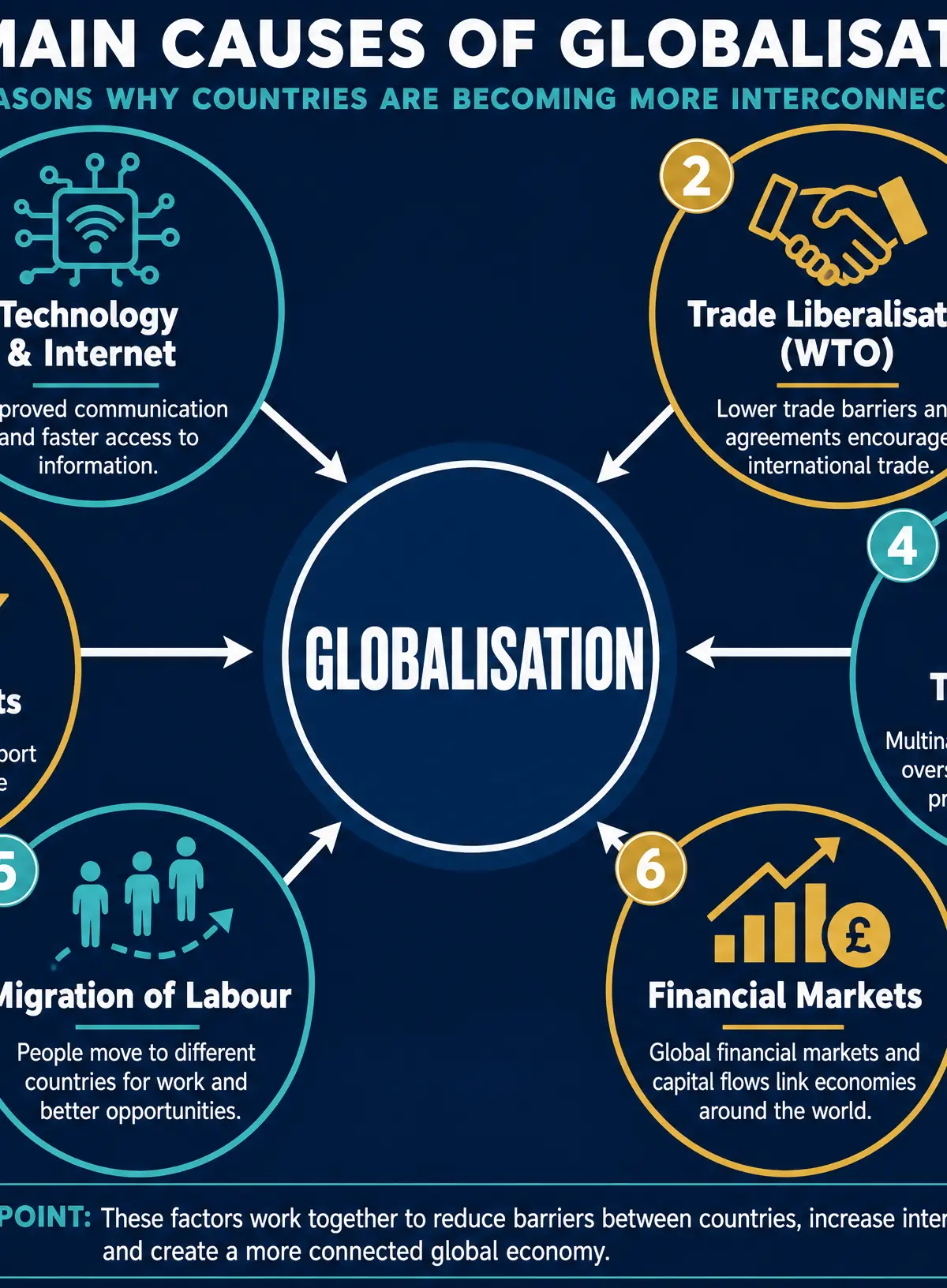
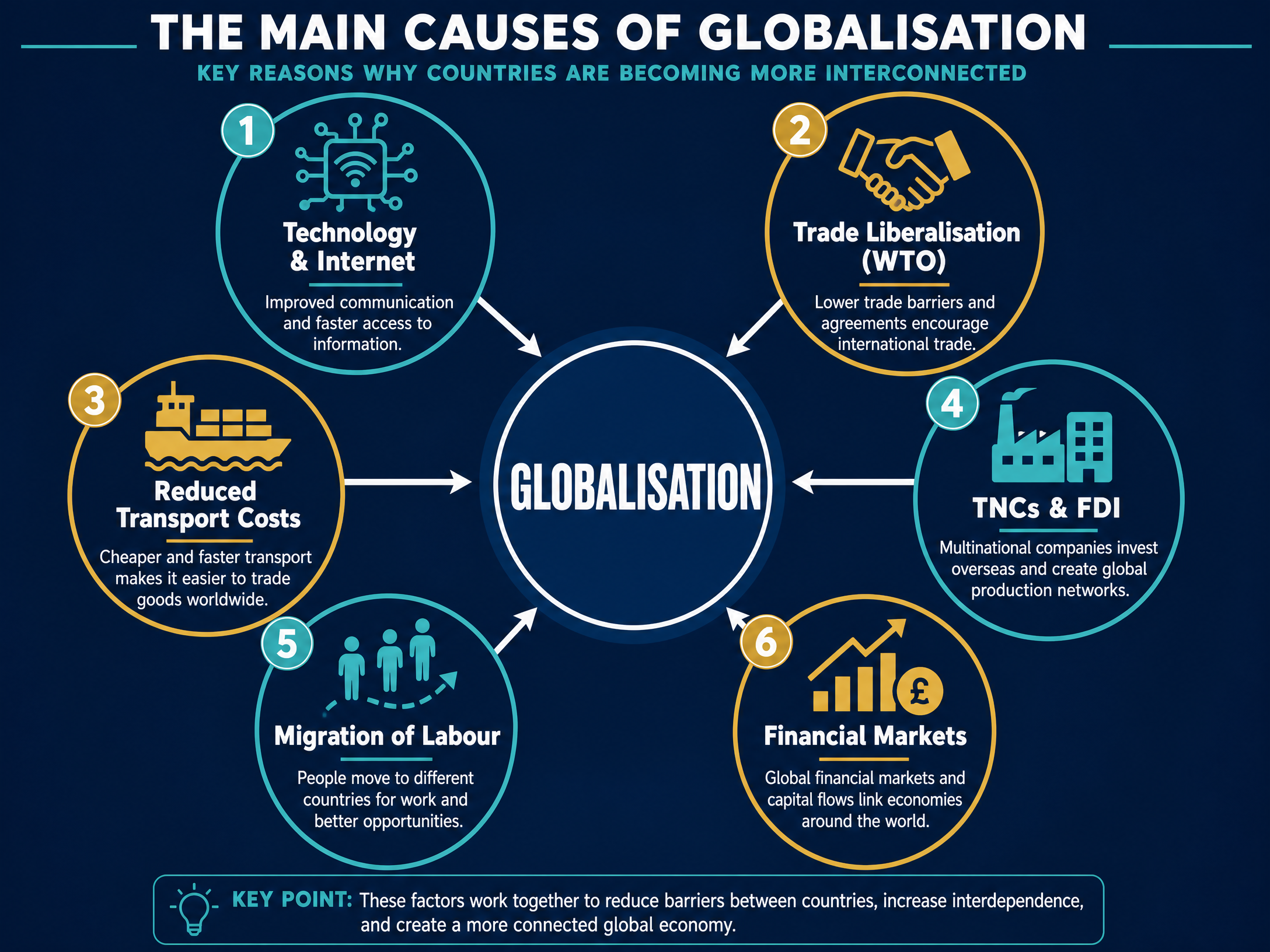
1. Technology and the Internet
The digital revolution has transformed how businesses operate. The internet has reduced the cost of communication to almost zero, allowing Transnational Corporations (TNCs) to manage complex global supply chains in real time.
2. Trade Liberalisation (The WTO)
The World Trade Organisation (WTO), established in 1995, has actively worked to reduce tariffs (taxes on imports) and quotas (limits on imports). Lower trade barriers make it cheaper to buy and sell goods internationally, significantly increasing the volume of global trade.
3. Falling Transport Costs
The invention of containerisation — standardised metal shipping containers — revolutionised the movement of goods. In real terms, the cost of shipping a container across the Atlantic plummeted between 1950 and 2000, making it economically viable to manufacture goods thousands of miles from where they are sold.
4. Transnational Corporations (TNCs)
TNCs like Apple, Toyota, and Nike operate in multiple countries to minimise costs and access new markets. They bring Foreign Direct Investment (FDI) to host nations, creating jobs and transferring technology, which further integrates the global economy.
5. Migration of Labour
The movement of people across borders for work has created a global labour market. This allows businesses to fill skills shortages and leads to the transfer of knowledge. Migrants also send remittances (money) back to their home countries, which is a major source of income for many developing economies.
6. Global Financial Markets
The deregulation of financial markets allows capital to flow freely between countries. Investors can easily buy shares or lend money overseas, funding economic growth and infrastructure projects globally.
The Impacts of Globalisation
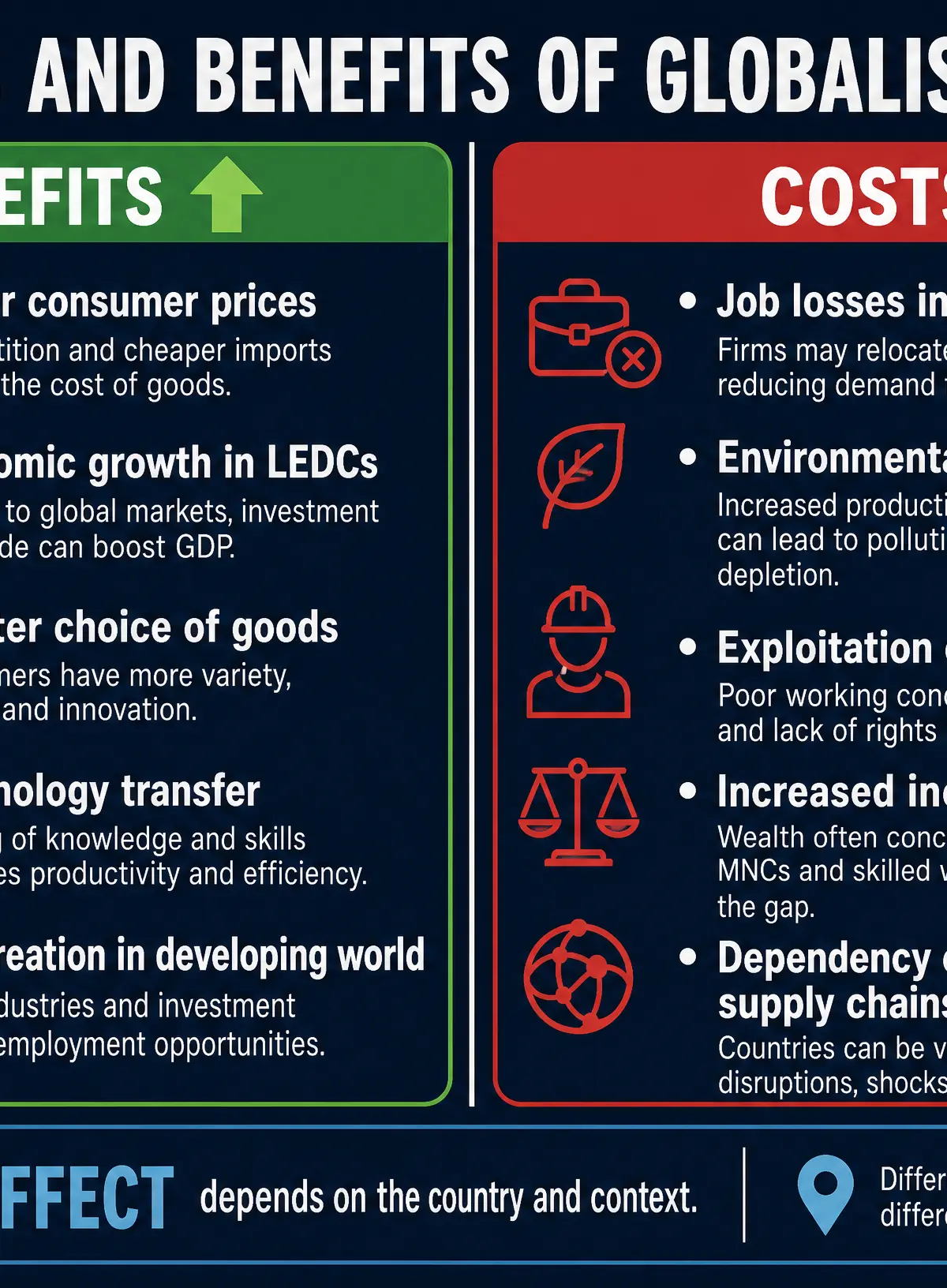
Globalisation creates winners and losers. To access the highest mark bands (Level 3/4), candidates must demonstrate an understanding of these conflicting impacts.
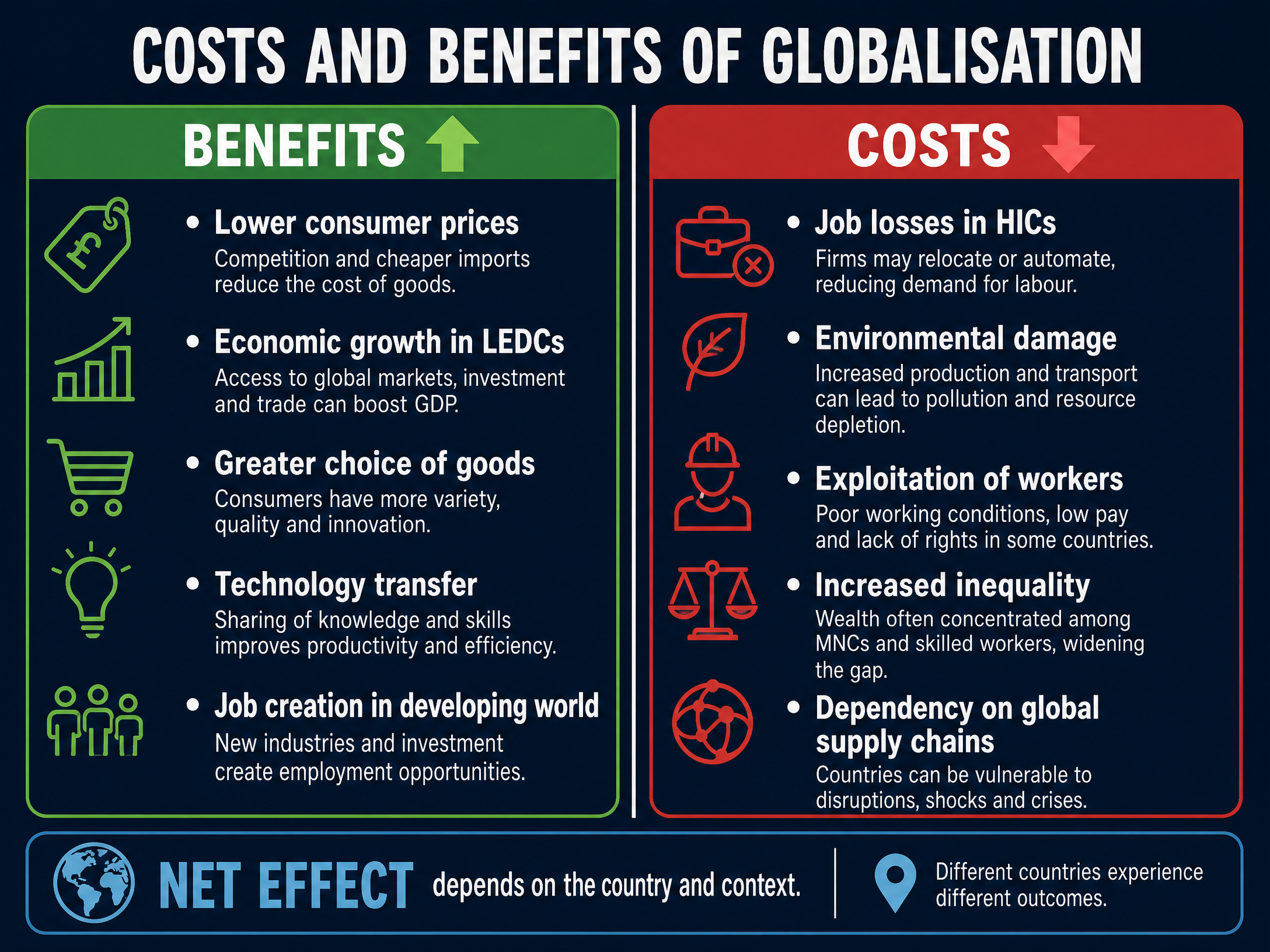
Benefits
- Lower Prices and Greater Choice: Consumers in high-income countries benefit from cheaper goods produced in lower-cost economies, increasing their purchasing power and living standards.
- Economic Growth in Developing Countries: Export-led growth has lifted hundreds of millions out of poverty in countries like China and Vietnam. China's GDP per capita grew from around 300 in 1980 to over12,000 by 2022.
- Technology Transfer: FDI from TNCs brings new technologies, skills, and management practices to developing nations, boosting their productivity.
Costs
- Structural Unemployment in High-Income Countries: As manufacturing moves to lower-cost nations, workers in traditional industries in developed countries (e.g., UK steel or textiles) may lose their jobs and struggle to find new employment.
- Environmental Damage: Increased global production and transport generate significant carbon emissions. Global shipping alone accounts for roughly 3% of global greenhouse gas emissions.
- Exploitation of Workers: In the race to attract FDI, some developing countries may maintain poor working conditions and low wages. The 2013 Rana Plaza factory collapse in Bangladesh is a tragic example of the human cost of global supply chains.
- Increased Inequality: While global poverty has fallen, the gap between the rich and poor within many countries has widened, as the benefits of globalisation often flow disproportionately to highly skilled workers and capital owners.
Listen to the Podcast
Reinforce your learning by listening to our dedicated 5-minute revision podcast on Globalisation:

Visual Resources
2 diagrams and illustrations
Interactive Diagrams
2 interactive diagrams to visualise key concepts
Conceptual Flow Outline
How Trade Liberalisation leads to Globalisation
Conceptual Flow Outline
The mechanism of Foreign Direct Investment (FDI)
Worked Examples
3 worked examples — open one to explore the question and available guidance.
Practice Questions
Test your understanding — click to reveal model answers
State two drivers of globalisation. (2 marks)
Hint: Think of the T-T-F-M-T-F mnemonic.
Explain how Transnational Corporations (TNCs) contribute to globalisation. (4 marks)
Hint: Explain what they do (operate across borders) and the impact this has (FDI, trade).
Explain why globalisation might lead to structural unemployment in developed economies. (4 marks)
Hint: Focus on the shift of manufacturing to lower-cost countries.
Evaluate the impact of globalisation on the environment. (9 marks)
Hint: You need both negative impacts (transport emissions, race to the bottom) and positive impacts (sharing green technology).
Assess the view that the benefits of globalisation outweigh the costs for developing economies. (12 marks)
Hint: Compare the economic benefits (jobs, growth) against the social/environmental costs (exploitation, pollution).