Pearson Edexcel · GCSE · Economics
Government and the economy
This topic explores how the government intervenes in the economy to achieve its four main macroeconomic objectives. It covers the tools of fiscal, monetary, and supply-side policy, helping students understand how decisions made in Westminster and the Bank of England impact our daily lives.
- 6 min read
- 3 worked examples
- 5 practice questions
- 6 key terms
Study Notes
Overview
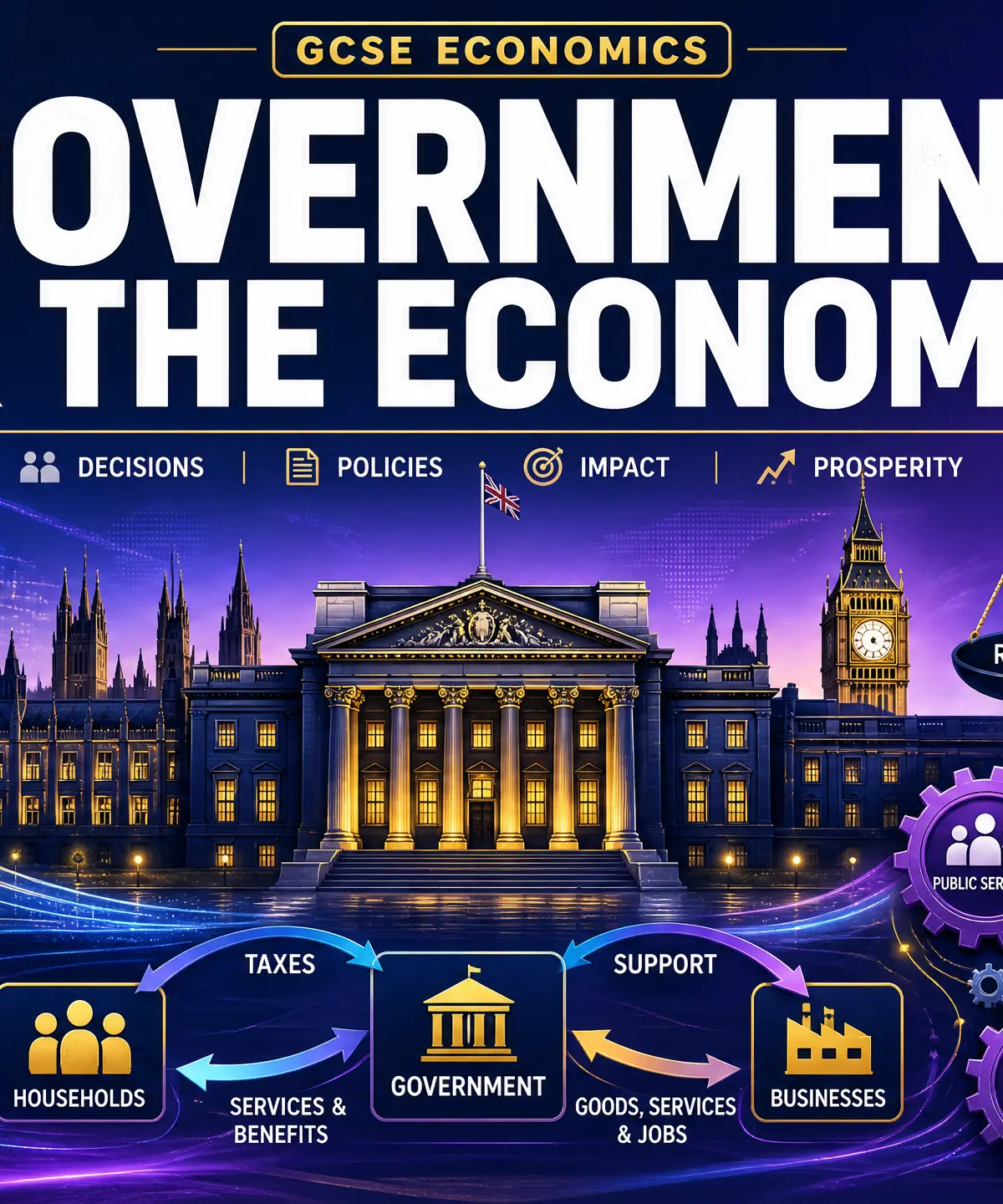
This topic is a cornerstone of GCSE Economics. It examines the fundamental role the government plays in managing the national economy. Left to its own devices, a free market can lead to unstable boom-and-bust cycles, high unemployment, and significant inequality. To counter these issues, the government steps in with specific policy tools to steer the economy towards stability and prosperity.
Examiners expect candidates to not only understand what the government's macroeconomic objectives are, but also how different policies are used to achieve them. The highest marks are awarded to students who can explain the chain of reasoning (how a policy change impacts the economy step-by-step) and evaluate the conflicts or trade-offs between different objectives.
The Four Macroeconomic Objectives
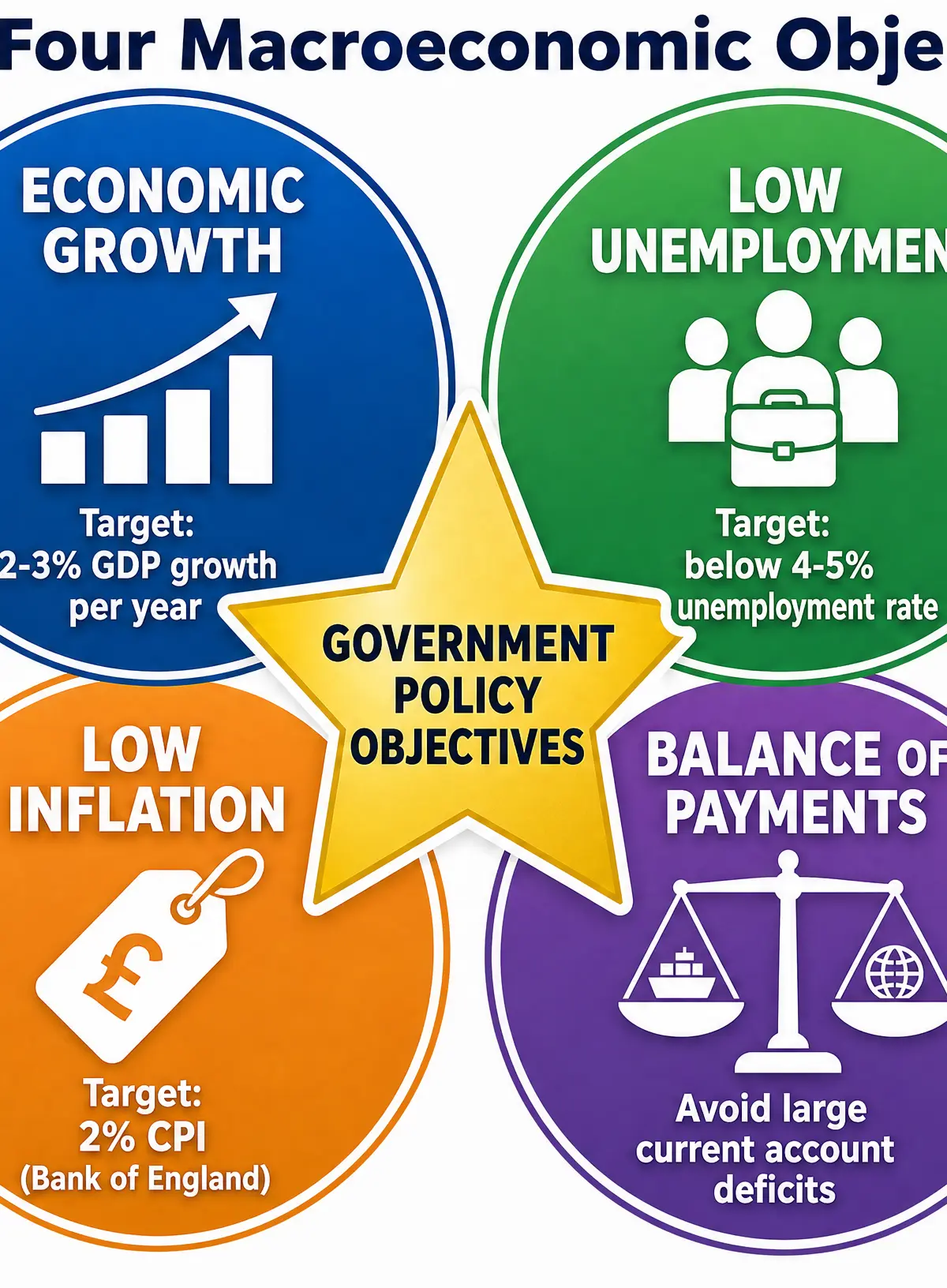
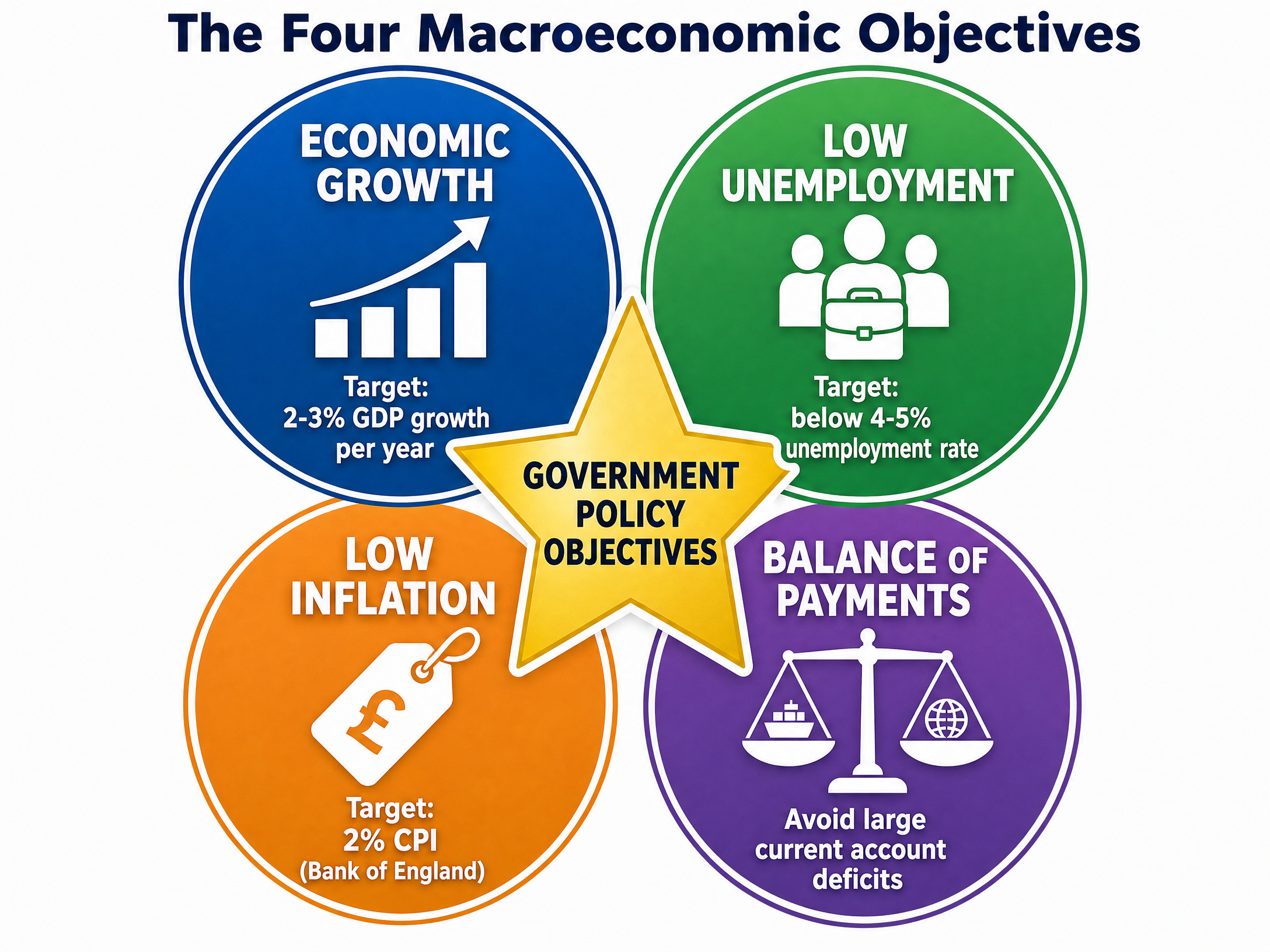
The UK government typically pursues four primary macroeconomic objectives. A useful mnemonic to remember these is G.U.I.B.:
1. Economic Growth
Target: Steady, sustainable growth of around 2-3% per year.
What it means: An increase in the total output of goods and services produced in the economy over time, measured by Gross Domestic Product (GDP).
Why it matters: Growth creates jobs, raises average incomes, improves living standards, and generates more tax revenue for the government to spend on public services like the NHS and education.
2. Low Unemployment
Target: As close to full employment as possible (typically an unemployment rate below 4-5%).
What it means: Ensuring that those who are willing and able to work can find a job. Note that 0% unemployment is impossible due to frictional unemployment (people moving between jobs).
Why it matters: High unemployment wastes human resources, lowers tax revenues, increases government spending on benefits, and causes social issues and poverty.
3. Low and Stable Inflation
Target: 2% inflation per year, measured by the Consumer Price Index (CPI).
What it means: Keeping the general increase in prices steady. The Bank of England is responsible for meeting this target.
Why it matters: High inflation reduces the purchasing power of money (real incomes fall), hurts savers, and makes UK exports less competitive internationally. However, deflation (falling prices) is also dangerous as it causes consumers to delay spending, leading to recession.
4. Balance of Payments Equilibrium
Target: Avoiding large, persistent deficits on the current account.
What it means: Balancing the value of what the UK exports against what it imports. A deficit means the UK is spending more on foreign goods and services than it is earning from selling abroad.
Why it matters: Persistent deficits can lead to a weaker currency, increased national debt, and reliance on foreign borrowing.
Policy Tools: How the Government Manages the Economy
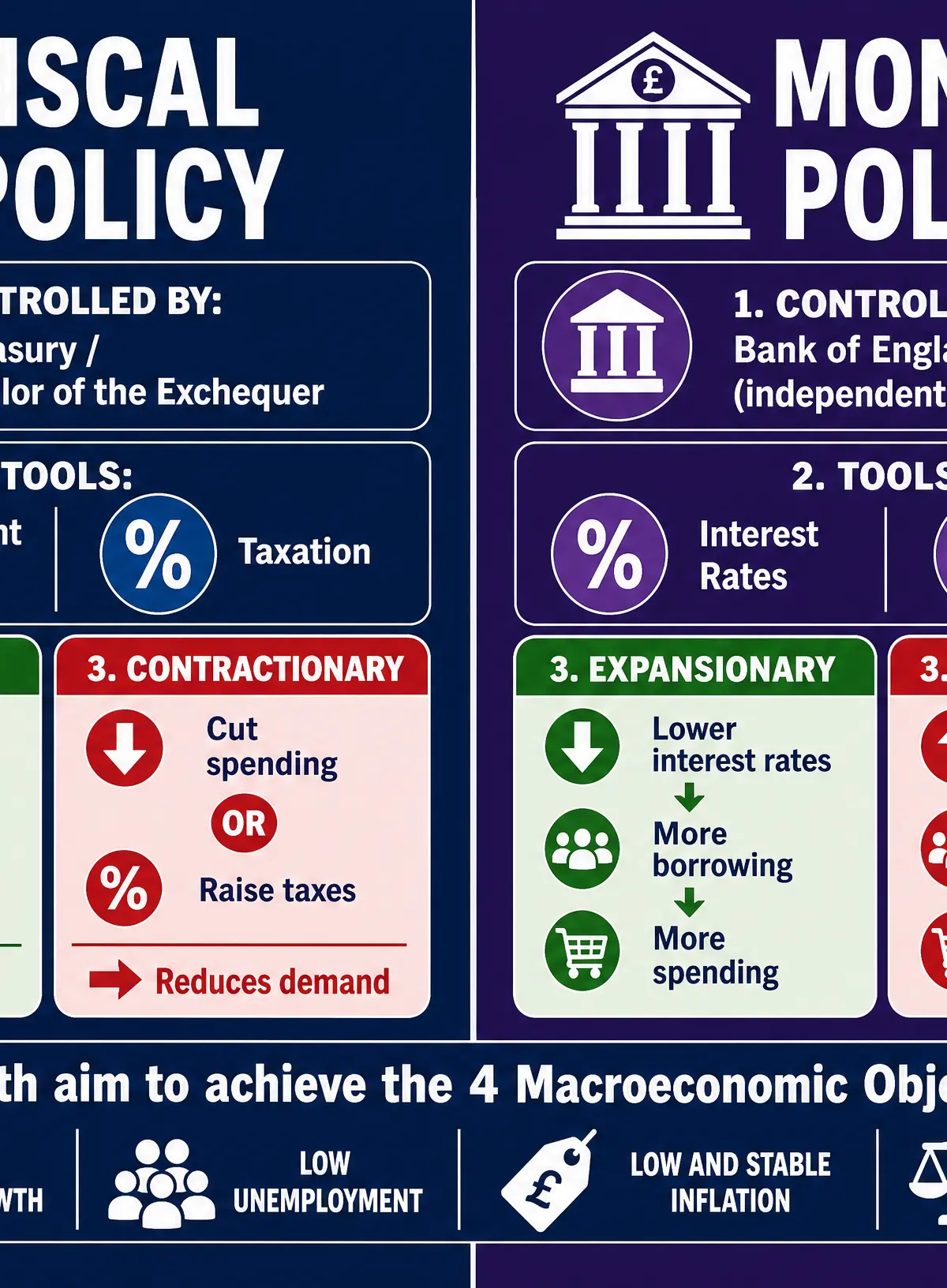
To achieve these objectives, policymakers use three main types of policy:
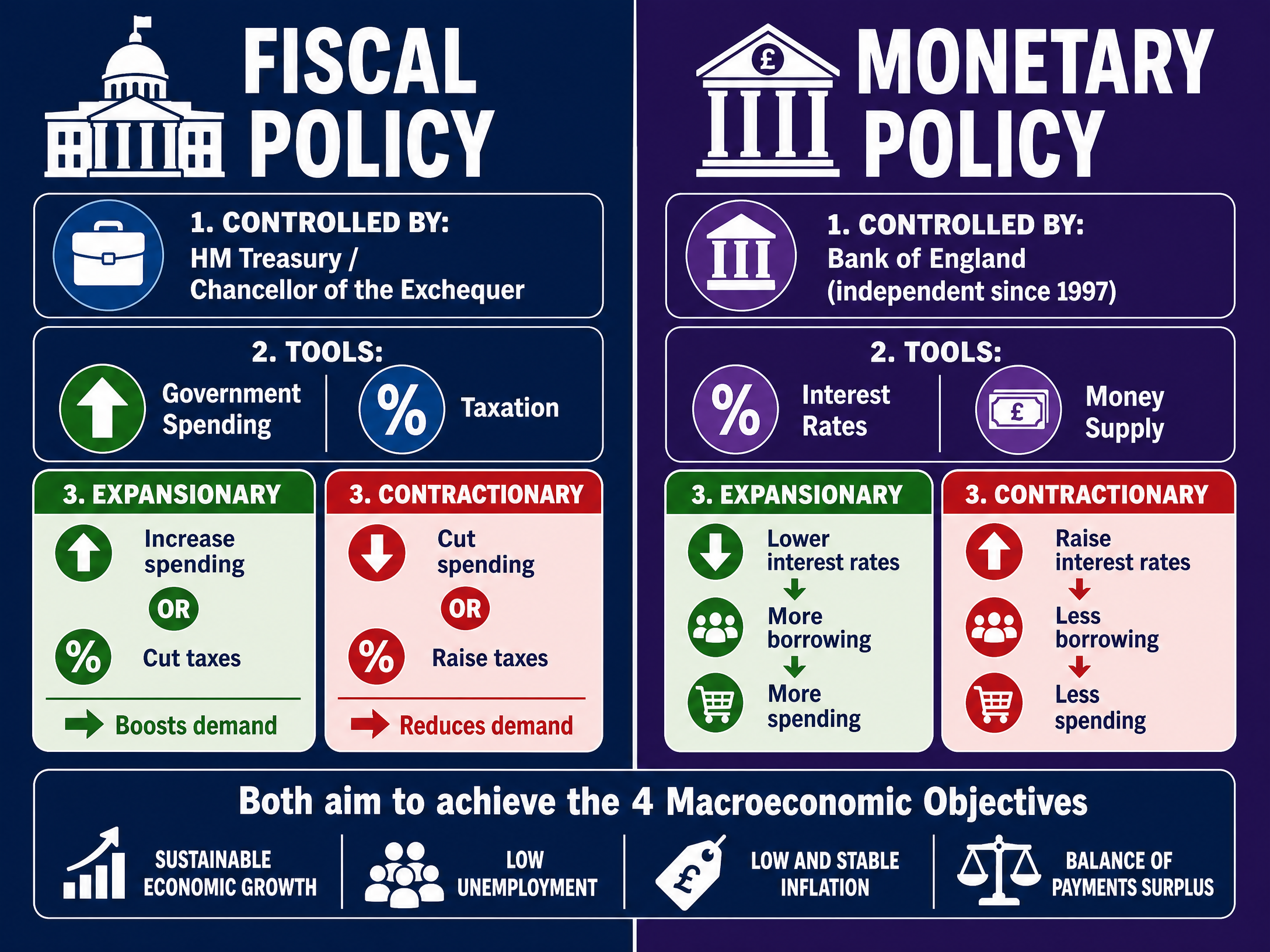
1. Fiscal Policy
Controlled by: HM Treasury (The Chancellor of the Exchequer).
Tools: Government Spending and Taxation.
- Expansionary Fiscal Policy: Increasing government spending and/or cutting taxes. This boosts Aggregate Demand (AD), creating jobs and growth, but may cause inflation.
- Contractionary Fiscal Policy: Cutting government spending and/or raising taxes. This reduces AD, cooling down inflation, but may slow growth and increase unemployment.
2. Monetary Policy
Controlled by: The Bank of England (independent from the government since 1997).
Tools: Interest Rates (the Bank Rate) and Quantitative Easing (money supply).
- Expansionary Monetary Policy: Lowering interest rates. This makes borrowing cheaper and saving less rewarding, encouraging households to spend and firms to invest, boosting AD.
- Contractionary Monetary Policy: Raising interest rates. This makes borrowing more expensive and saving more rewarding, reducing spending and investment to control inflation.
3. Supply-Side Policies
Controlled by: Various government departments.
Tools: Policies aimed at increasing the productive capacity (Aggregate Supply) of the economy over the long term.
- Examples: Investing in education and training, building new infrastructure (e.g., roads, broadband), cutting corporation tax to encourage investment, and deregulation.
- Impact: These are the only policies that can achieve economic growth without causing inflation, but they take a long time to work and are often expensive.
The Circular Flow of Income
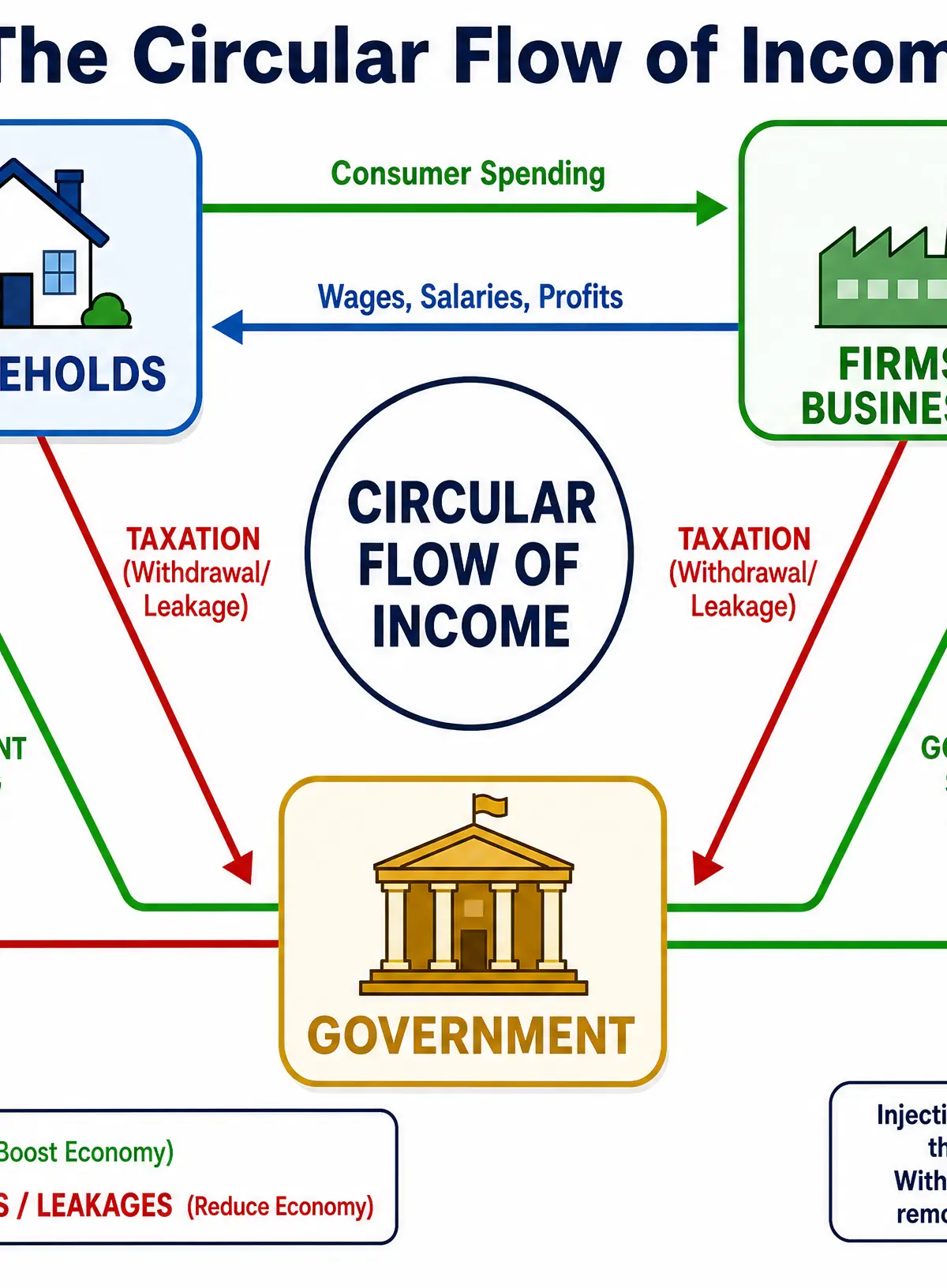
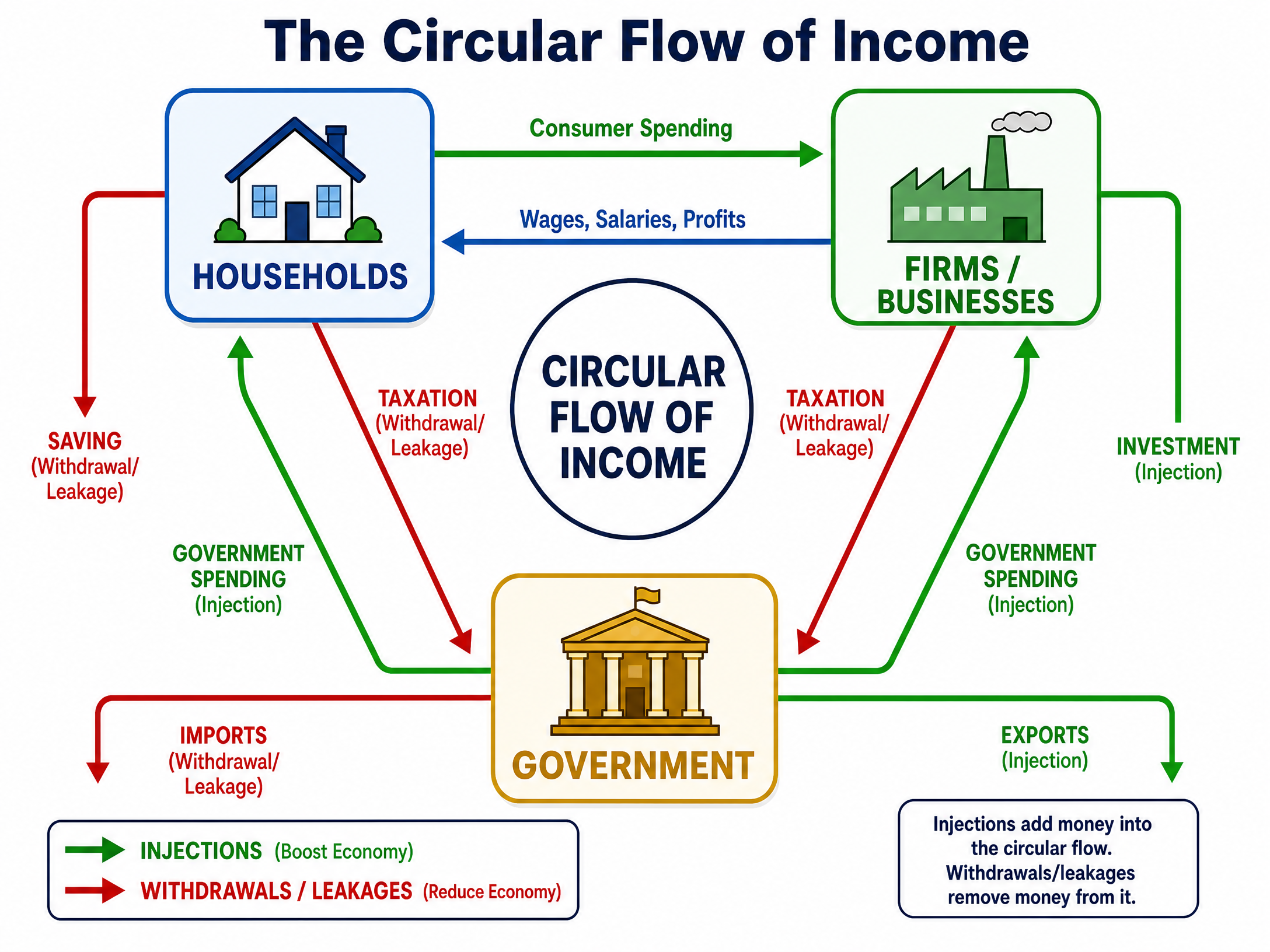
The Circular Flow of Income is a crucial model showing how money moves through the economy. It demonstrates why government intervention has such a significant impact.
- The Basic Flow: Households provide factors of production (like labour) to firms in exchange for income (wages). Households then spend this income on goods and services produced by firms.
- Withdrawals (Leakages): Money leaving the circular flow. This includes Saving (S), Taxation (T), and Imports (M).
- Injections: Money entering the circular flow. This includes Investment (I), Government Spending (G), and Exports (X).
The Golden Rule:
- If Injections > Withdrawals, the economy grows (GDP rises).
- If Withdrawals > Injections, the economy shrinks (GDP falls).
Podcast Revision Lesson
Listen to our 5-minute revision podcast covering all these key concepts, common mistakes, and a quick-fire recall quiz!

Visual Resources
3 diagrams and illustrations
Interactive Diagrams
1 interactive diagram to visualise key concepts
Conceptual Flow Outline
Chain of Reasoning: Expansionary Monetary Policy
Worked Examples
3 worked examples — open one to explore the question and available guidance.
Practice Questions
Test your understanding — click to reveal model answers
Assess the impact of an increase in the Bank of England's base interest rate on the UK economy. (9 marks)
Hint: Think about the impact on consumers with mortgages, businesses wanting to invest, and the overall effect on inflation and economic growth. Don't forget to evaluate!
Explain how a cut in income tax could lead to economic growth. (6 marks)
Hint: Use the chain of reasoning: Tax cut -> Disposable income -> Consumer spending -> Aggregate Demand -> GDP.
State two examples of supply-side policies. (2 marks)
Hint: Think about policies that improve the quality or quantity of factors of production over the long term.
Explain the difference between a budget deficit and the national debt. (4 marks)
Hint: One is an annual figure, the other is a cumulative total over many years.
Assess whether indirect taxes, such as VAT, are the fairest way for a government to raise revenue. (9 marks)
Hint: Define indirect taxes. Argue why they might be fair (everyone pays the same rate, hard to evade). Then evaluate why they might be unfair (they are regressive).