Pearson Edexcel · GCSE · Economics
Government intervention
Government intervention is a cornerstone of modern economics, exploring how and why the state steps in when free markets fail. Understanding this topic is crucial for the exam, as it bridges theoretical models with real-world policies like the National Living Wage and the NHS.
- 5 min read
- 2 worked examples
- 5 practice questions
- 6 key terms
Study Notes
Overview
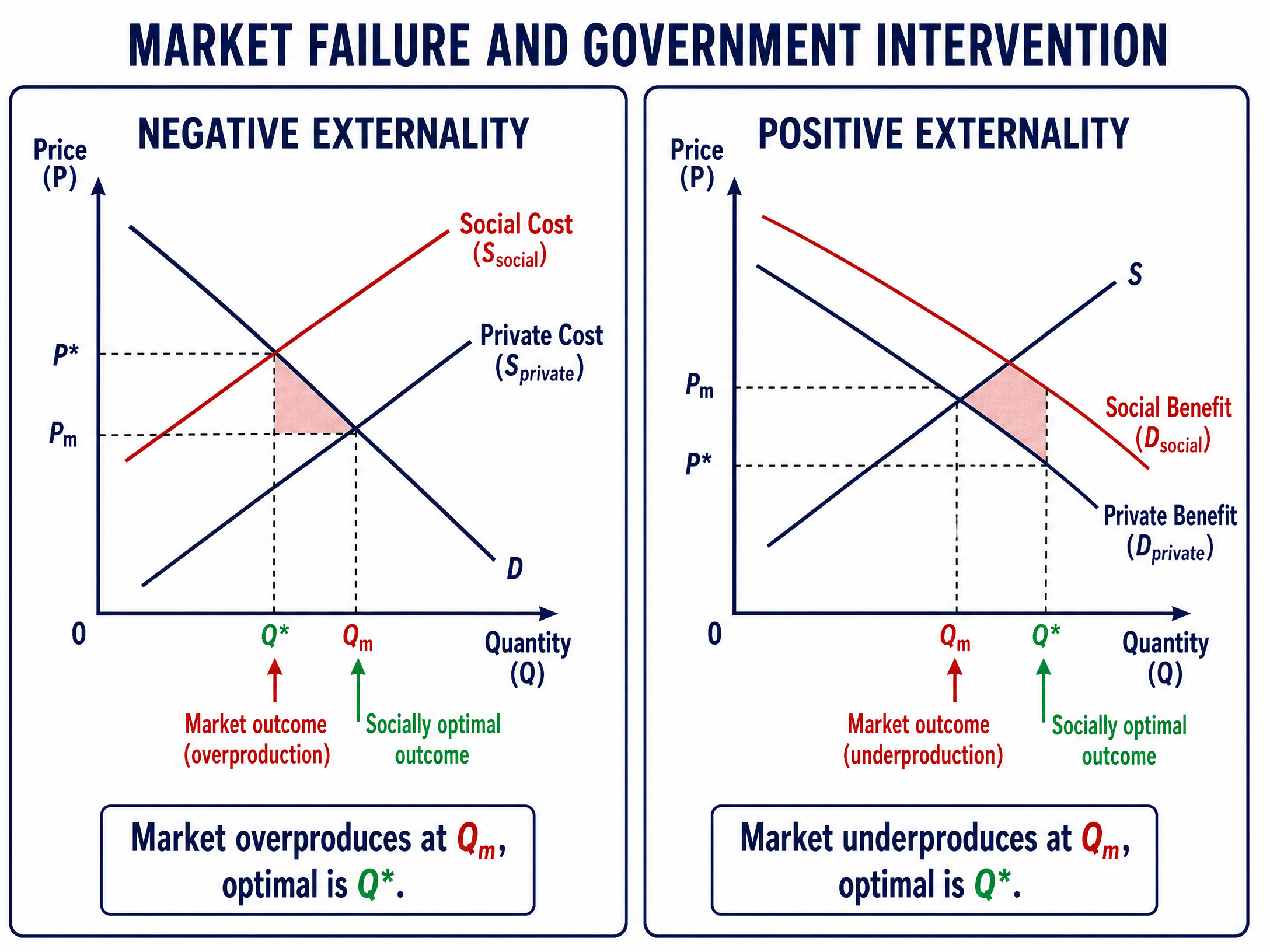
Government intervention occurs when the state gets involved in markets to correct market failure, promote equity, or achieve macroeconomic stability. In a pure free market, prices are determined solely by supply and demand. However, markets often fail to allocate resources efficiently—producing too much pollution (negative externalities) or too little education (positive externalities). Examiners expect candidates to not only identify the methods of intervention but to rigorously evaluate their effectiveness, unintended consequences, and the risk of 'government failure'.
Audio Revision: The Government Intervention Podcast
Listen to our 10-minute revision podcast covering the core concepts, common exam mistakes, and a quick-fire recall quiz.

The Six Methods of Government Intervention
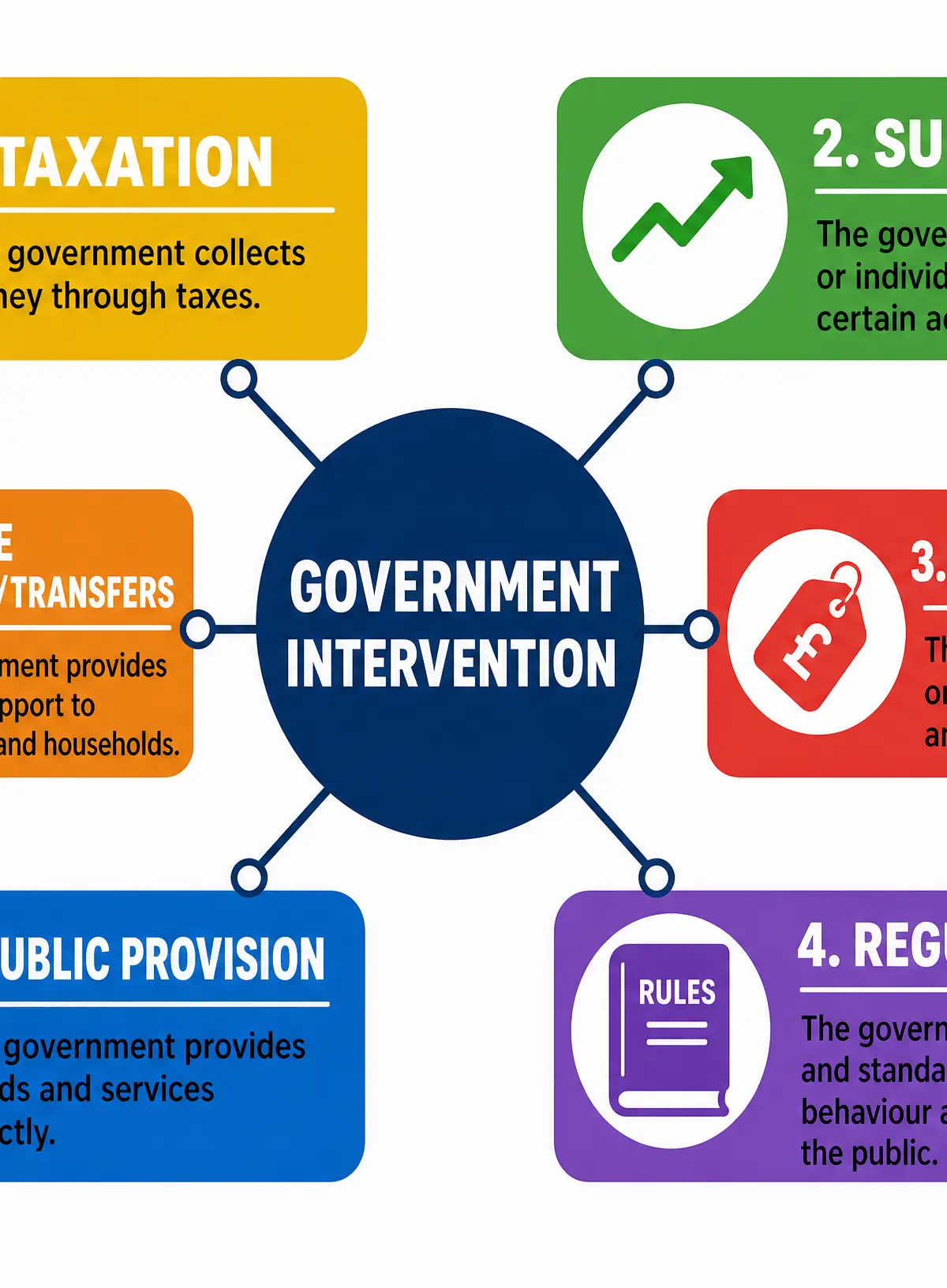
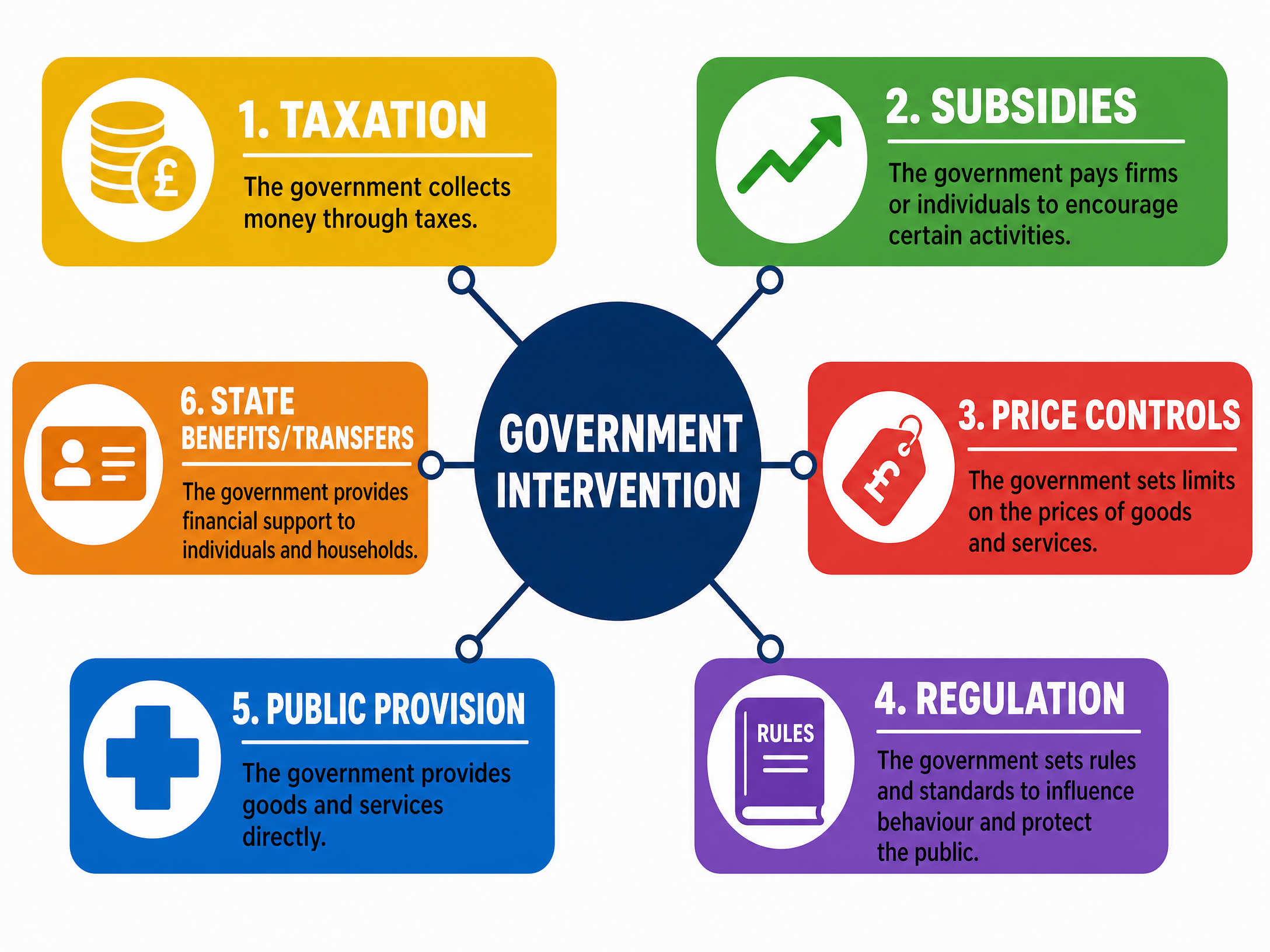
1. Indirect Taxation
Mechanism: The government levies a tax on goods with negative externalities (e.g., tobacco, alcohol, carbon emissions) to increase the cost of production. This shifts the supply curve to the left, raising the price and reducing the quantity demanded.
Key Concept: A Pigouvian tax is set equal to the marginal external cost, internalising the externality so the polluter pays.
Evaluation: Effectiveness depends on price elasticity of demand (PED). If demand is inelastic (like cigarettes), a tax raises significant revenue but may not reduce consumption drastically. It can also be regressive, hitting lower-income households harder.
2. Subsidies
Mechanism: A grant given by the government to producers to lower their costs of production and encourage increased output. It shifts the supply curve to the right, lowering prices for consumers.
Key Concept: Used for goods with positive externalities or merit goods (e.g., public transport, electric vehicles, renewable energy).
Evaluation: Subsidies carry an opportunity cost—the money could have been spent elsewhere (e.g., on healthcare). Firms may also become reliant on subsidies and become inefficient.
3. Price Controls
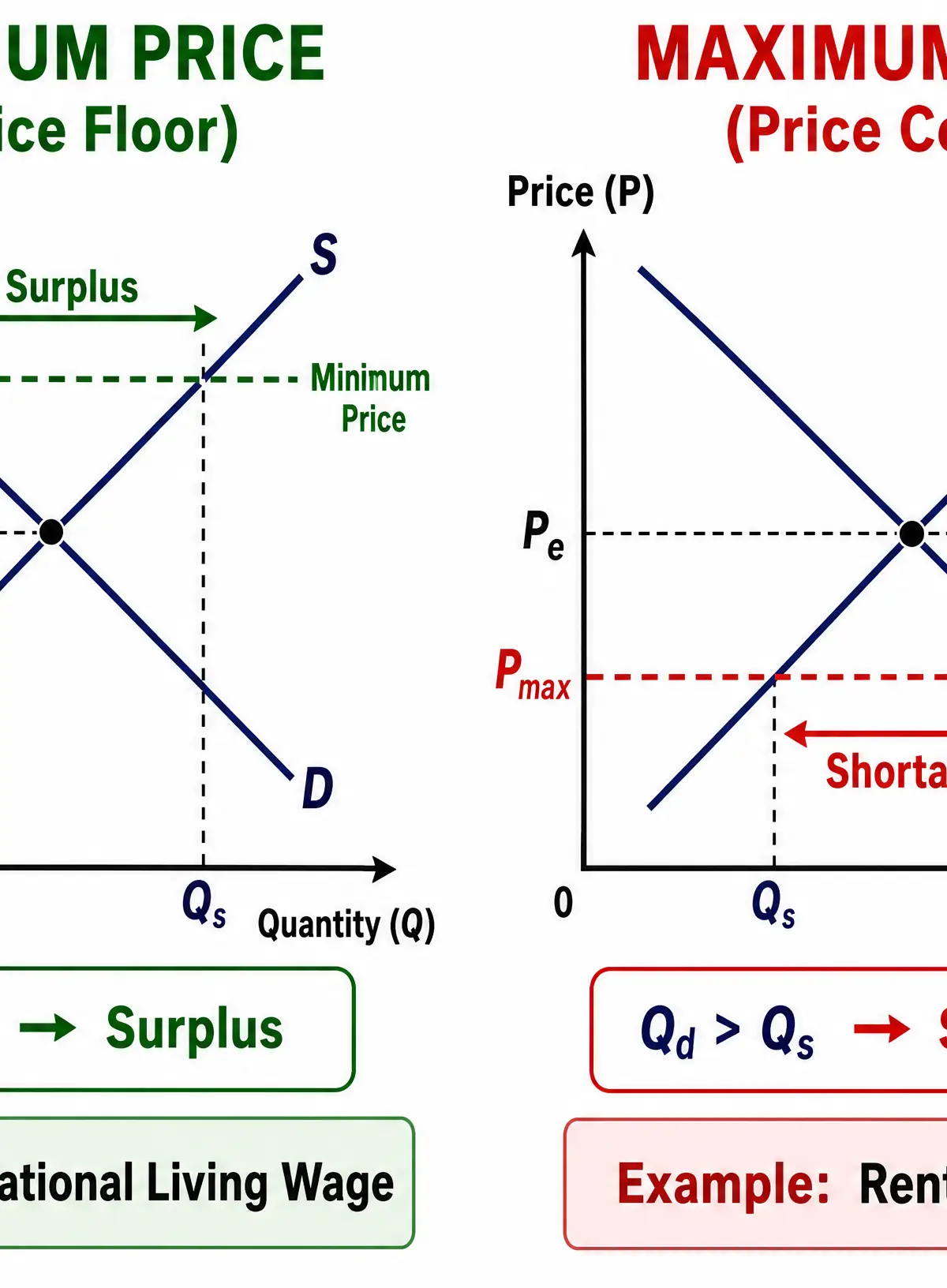
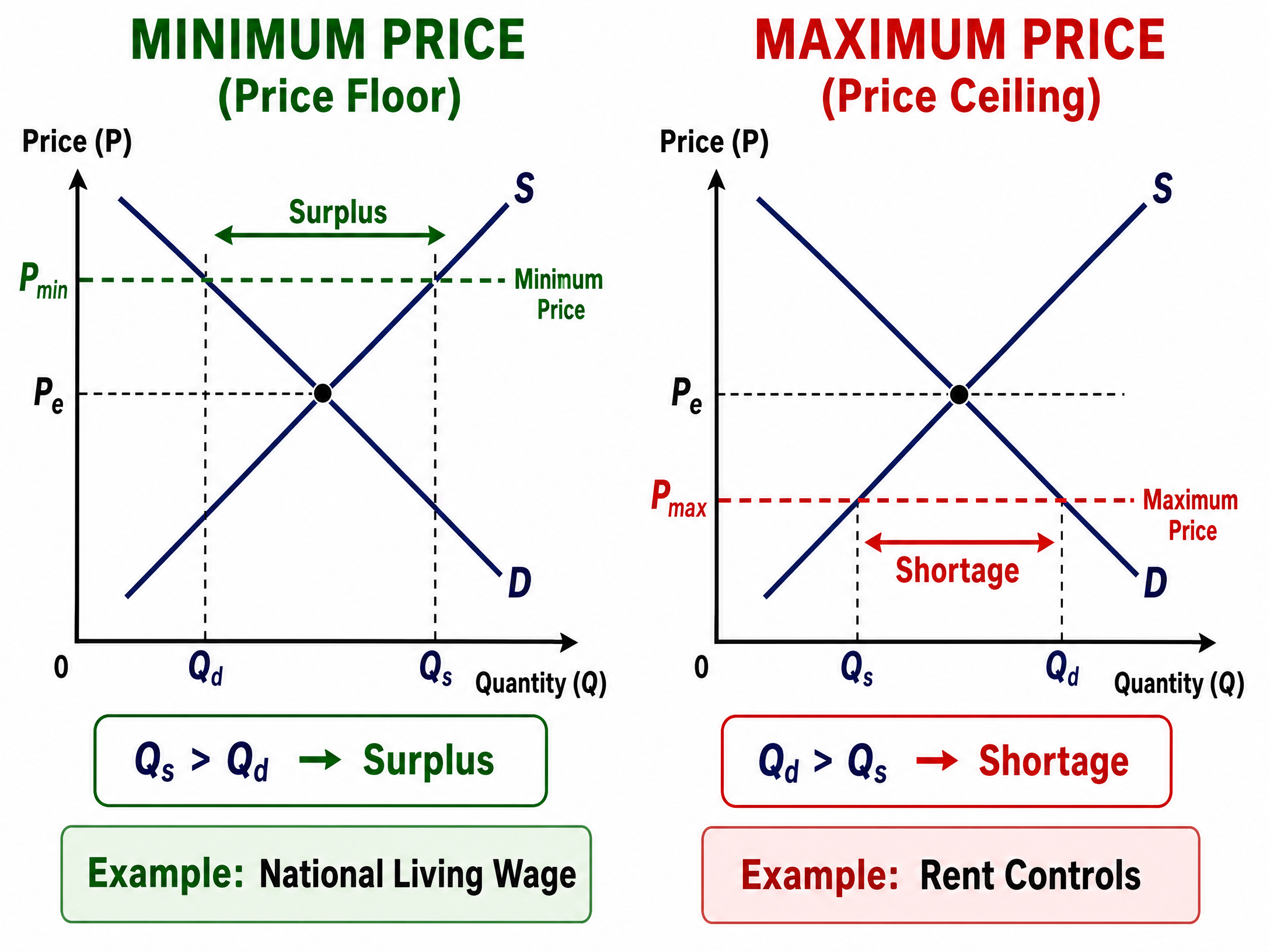
Maximum Price (Price Ceiling): A legal limit above which prices cannot rise. Set below the free market equilibrium to keep essential goods affordable (e.g., rent controls, energy price caps).
Consequence: Creates a shortage (excess demand).
Minimum Price (Price Floor): A legal limit below which prices cannot fall. Set above the free market equilibrium to ensure fair incomes for producers or workers (e.g., the National Living Wage, minimum unit pricing for alcohol).
Consequence: Creates a surplus (excess supply, or unemployment in the labour market).
4. Regulation
Mechanism: Laws and rules designed to control the behaviour of consumers and producers. Examples include bans on smoking in public places, emissions limits for cars, or age restrictions on buying alcohol.
Evaluation: Regulation is easy to understand and can directly ban harmful behaviour. However, it requires enforcement (which costs money) and can lead to the creation of shadow (black) markets.
5. Public Provision
Mechanism: The government directly provides goods and services funded through taxation, rather than leaving it to the private sector.
Key Concept: Essential for public goods (non-excludable and non-rival, like national defence and street lighting) which suffer from the free-rider problem. Also used for merit goods (like the NHS and state education) to ensure universal access regardless of income.
6. State Benefits and Transfer Payments
Mechanism: The redistribution of income through the tax and welfare system. The government collects taxes from higher earners and provides benefits (e.g., Universal Credit, State Pension) to those on lower incomes.
Evaluation: Reduces poverty and inequality, but may create a disincentive to work (the 'benefits trap').
Market Failure & Government Failure
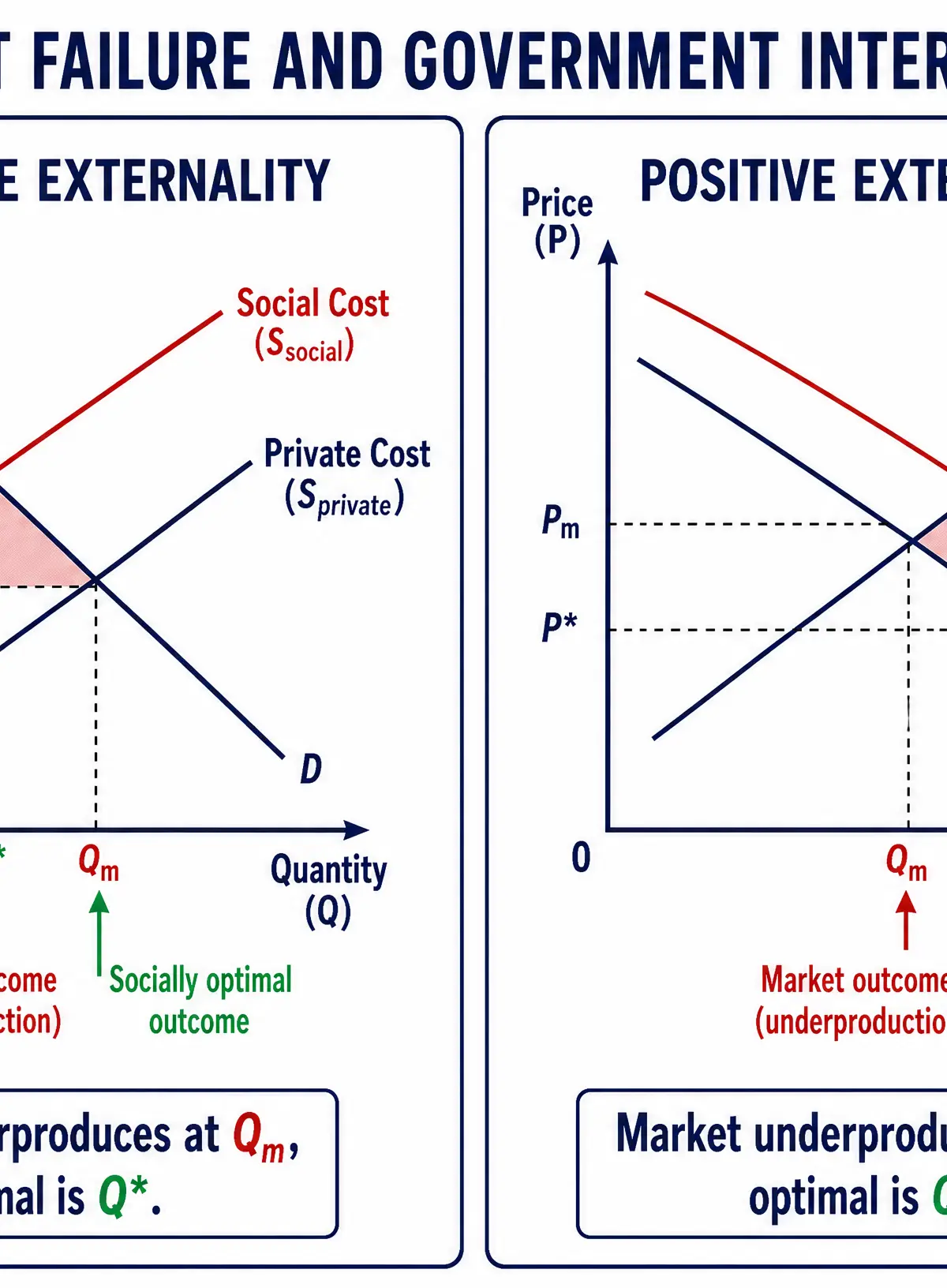
Market Failure: When the free market fails to allocate resources efficiently, leading to a net loss of social welfare.
Government Failure: When government intervention actually worsens the situation, resulting in a deeper misallocation of resources or a net welfare loss. Causes include:
- Imperfect information: The government doesn't know the exact size of the externality.
- Unintended consequences: E.g., a minimum wage causing unemployment.
- Regulatory capture: When regulatory agencies act in the interest of the firms they are supposed to regulate.
- Administrative costs: The cost of enforcing the intervention outweighs the benefits.
Worked Examples
2 worked examples — open one to explore the question and available guidance.
Practice Questions
Test your understanding — click to reveal model answers
Explain one reason why the government might provide public goods. (3 marks)
Hint: Think about the characteristics of public goods and the free-rider problem.
Discuss whether a minimum price on alcohol is the best way to reduce the negative externalities of drinking. (9 marks)
Hint: Define minimum price, explain how it works, evaluate its drawbacks, and suggest an alternative like education or taxation.
State two characteristics of a public good. (2 marks)
Hint: Think of the 'Non-Non' mnemonic.
Explain how regulation could be used to reduce carbon emissions from factories. (4 marks)
Hint: What rules could the government set, and what happens if firms break them?
Evaluate the impact of the government introducing a maximum price on rented accommodation (rent controls). (12 marks)
Hint: Draw a mental diagram. What happens when the price is forced below equilibrium? Who benefits and who loses?