Pearson Edexcel · GCSE · Economics
Government policies
Government policies are the essential tools used to steer the national economy toward growth, stability, and high employment. Mastering how fiscal, monetary, and supply-side policies work—and conflict—is crucial for securing top marks in GCSE Economics.
- 7 min read
- 3 worked examples
- 5 practice questions
- 6 key terms
Study Notes
Overview
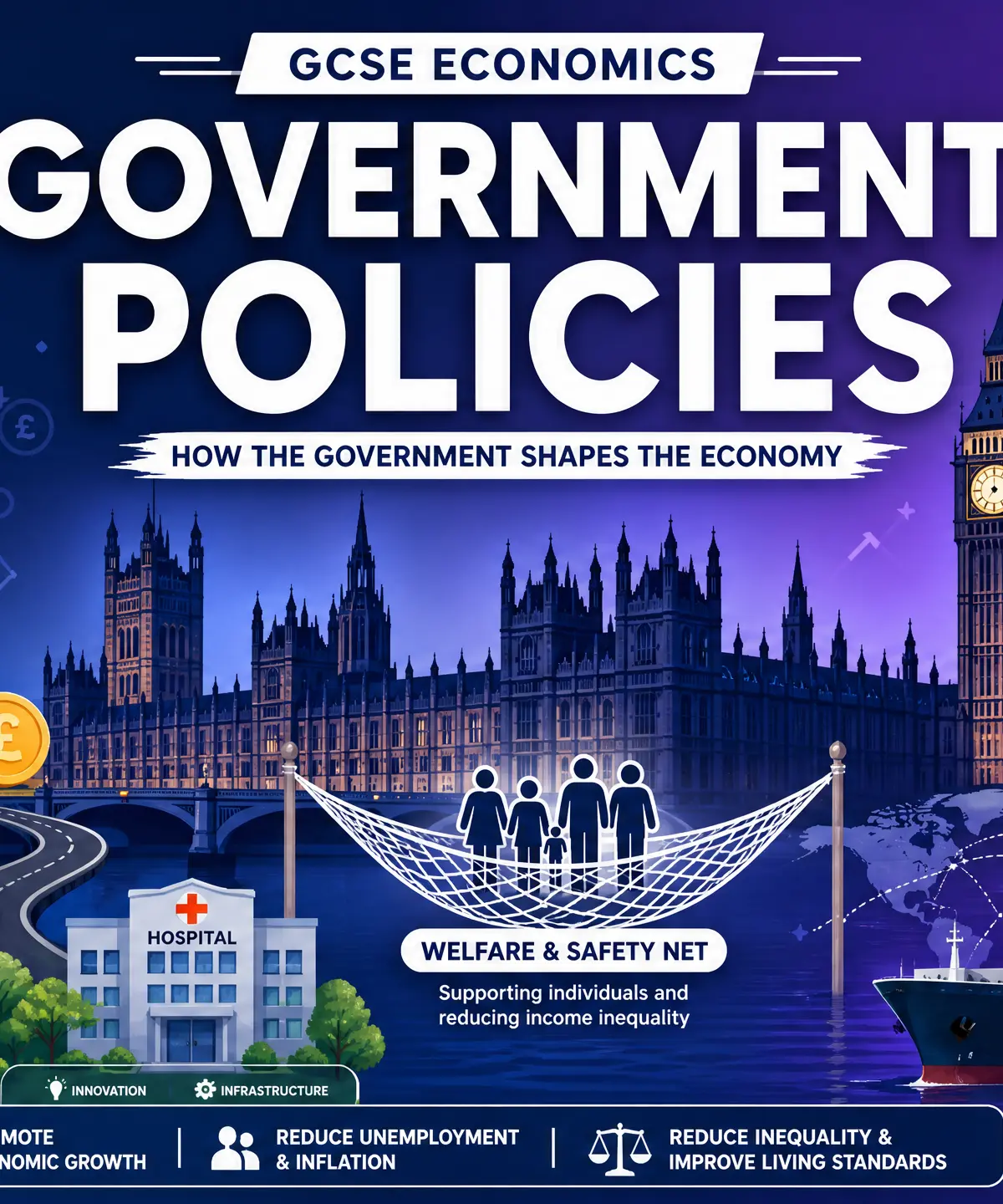
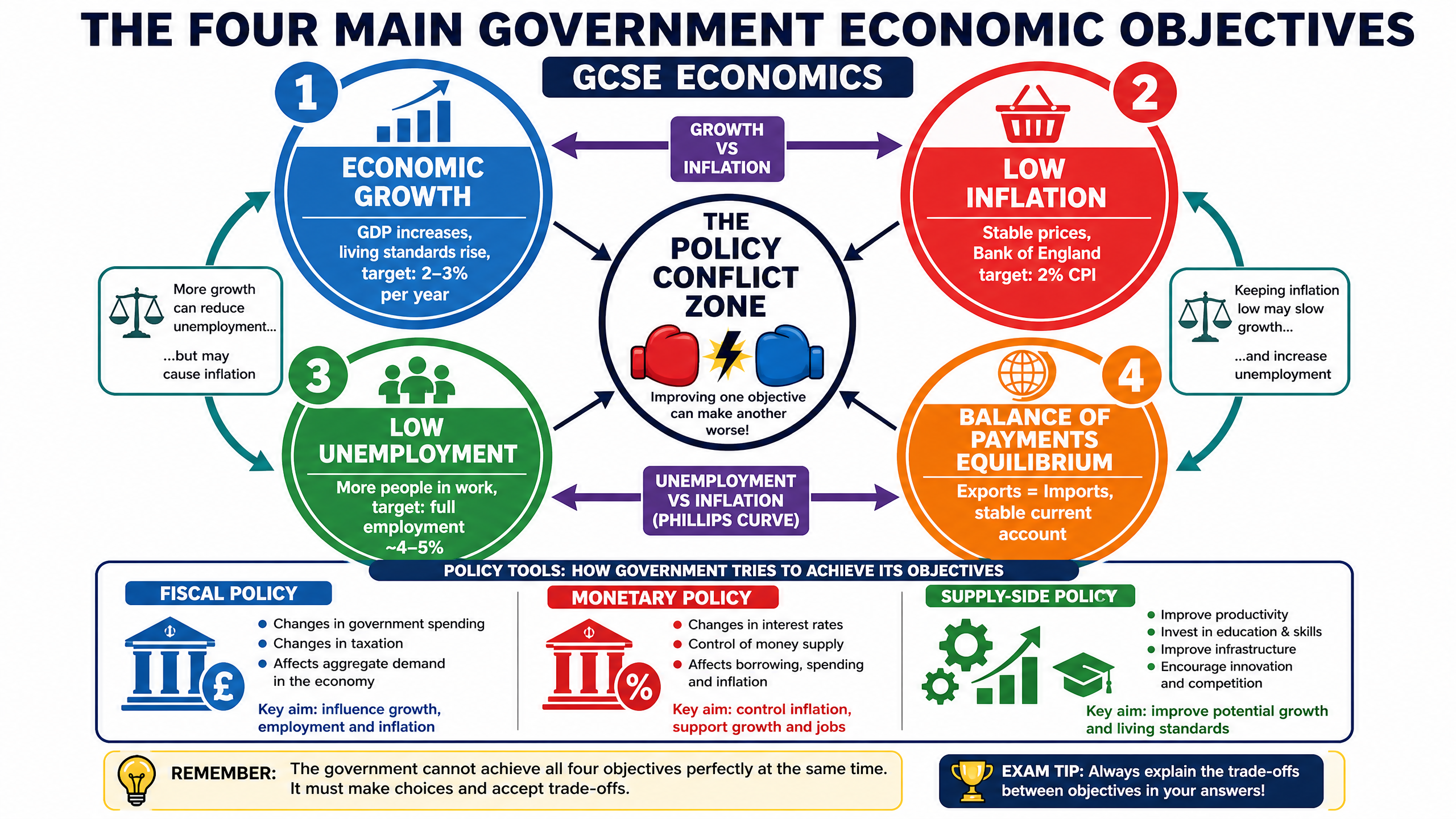
Government economic policies are the mechanisms through which the state and the central bank manage the national economy. Without intervention, free-market economies can experience severe fluctuations, leading to high unemployment during recessions or damaging inflation during booms. For your GCSE Economics exam, examiners expect you to understand the four main macroeconomic objectives: Economic Growth, Low and Stable Inflation, Low Unemployment, and a Balance of Payments Equilibrium. More importantly, you must demonstrate how the three main policy tools—Fiscal, Monetary, and Supply-Side—are deployed to achieve these targets. The hallmark of a top-tier (Level 3/4) answer is the ability to evaluate the trade-offs and conflicts between these policies, showing that an action to fix one problem often exacerbates another.
Listen to the companion podcast below for a comprehensive audio review of these concepts:

1. Macroeconomic Objectives
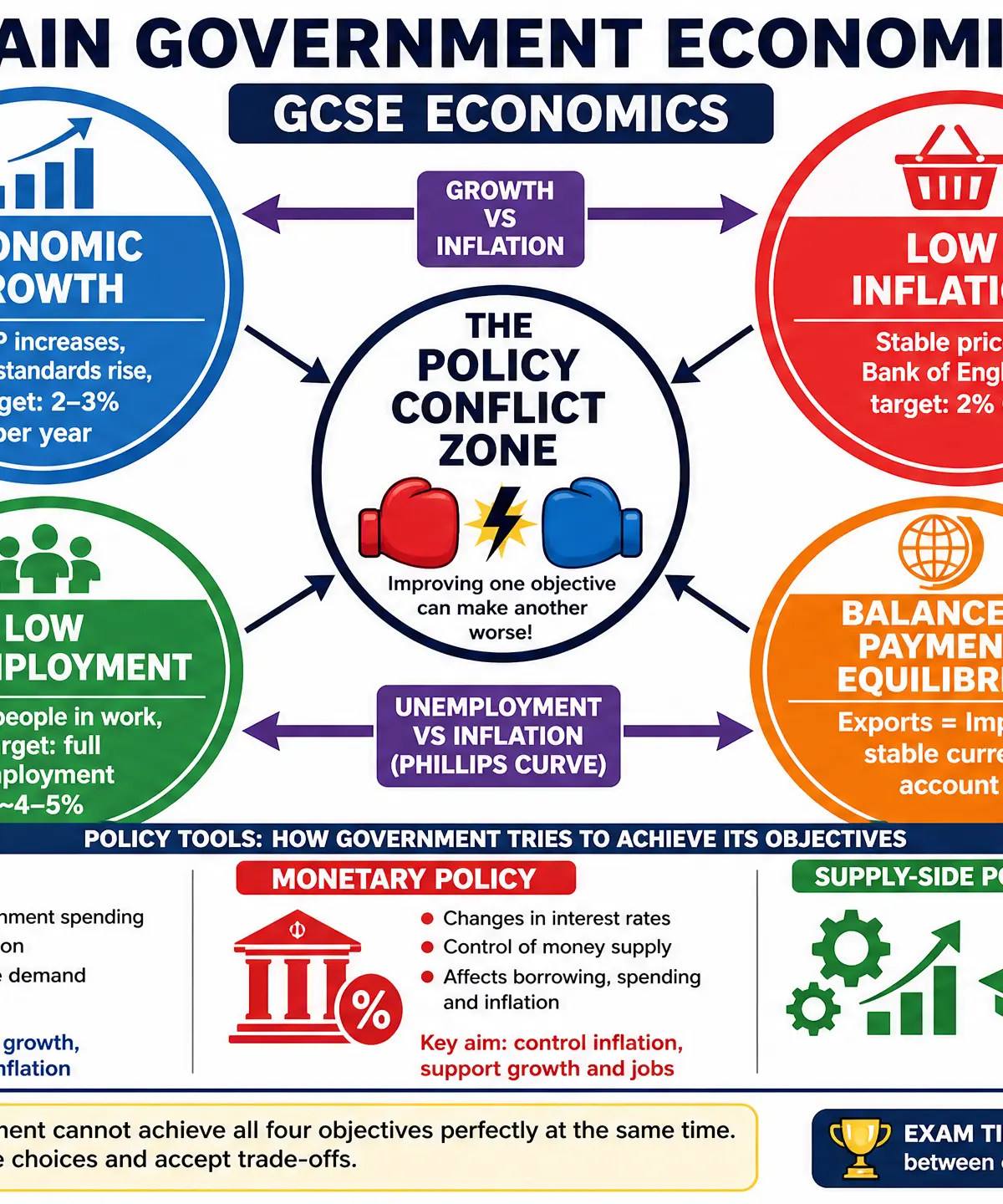
Before exploring the policies, you must know what the government is trying to achieve. Examiners frequently ask you to identify or define these targets.
Economic Growth
Definition: An increase in the productive capacity of the economy, measured by Gross Domestic Product (GDP).
Target: Steady, sustainable growth (historically around 2-3% annually).
Why it matters: Higher GDP generally leads to higher living standards, increased tax revenues, and more jobs.
Low and Stable Inflation
Definition: A sustained increase in the general price level of goods and services.
Target: The UK Government sets the Bank of England a target of 2% inflation, measured by the Consumer Price Index (CPI).
Why it matters: High inflation erodes the purchasing power of money, reduces international competitiveness, and creates uncertainty for businesses.
Low Unemployment
Definition: Minimising the number of people who are willing and able to work but cannot find a job.
Target: Full employment (which economists generally consider to be around 4-5% unemployment, allowing for natural frictional unemployment).
Why it matters: High unemployment wastes productive resources, lowers tax revenues, increases welfare spending, and causes social issues.
Balance of Payments Equilibrium
Definition: Ensuring that the value of goods and services exported roughly matches the value imported over the long term (specifically focusing on the Current Account).
Target: Avoiding large, unsustainable deficits.
Why it matters: A massive deficit means the country is living beyond its means and relying on foreign borrowing.
2. Fiscal Policy
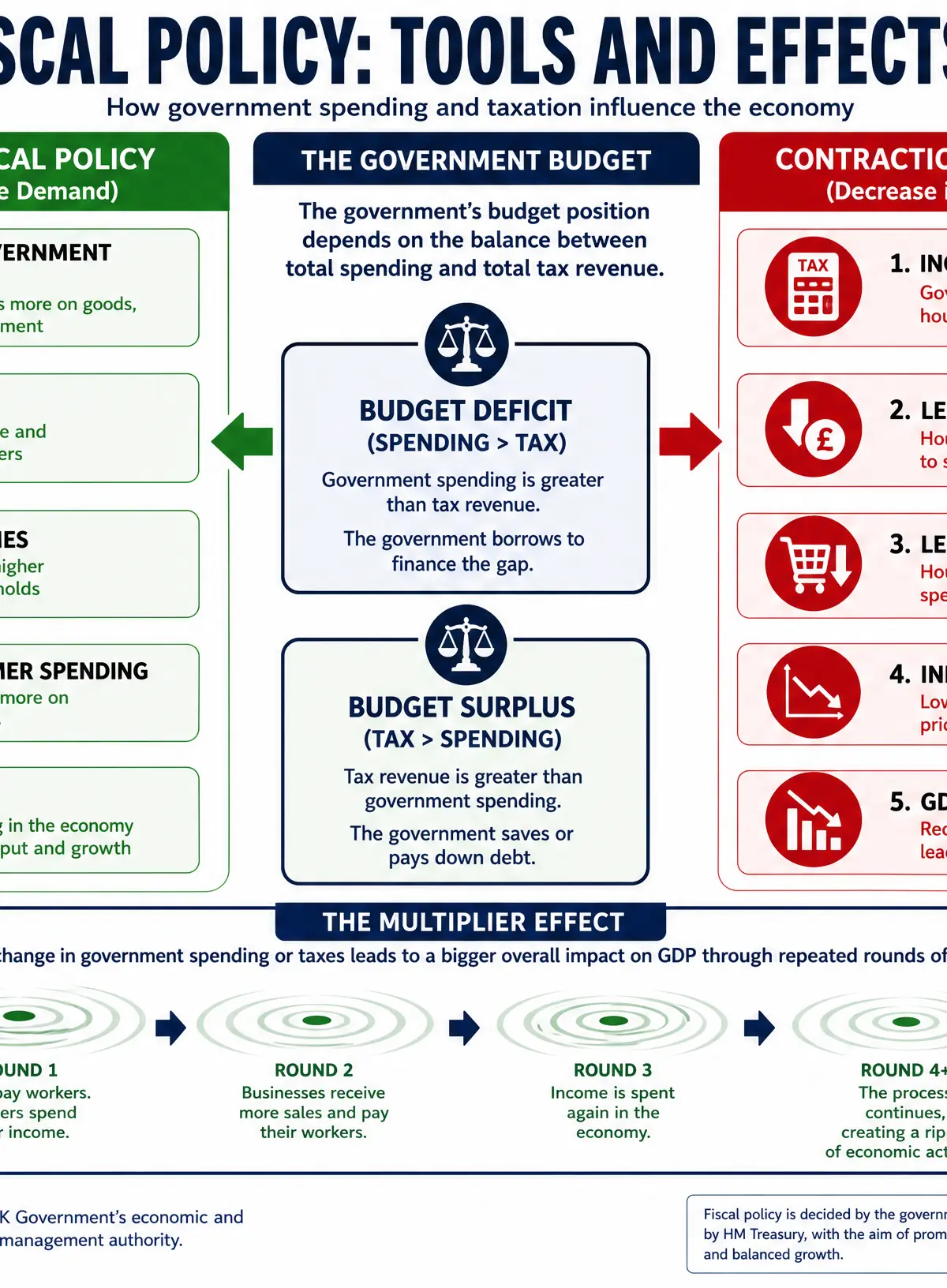
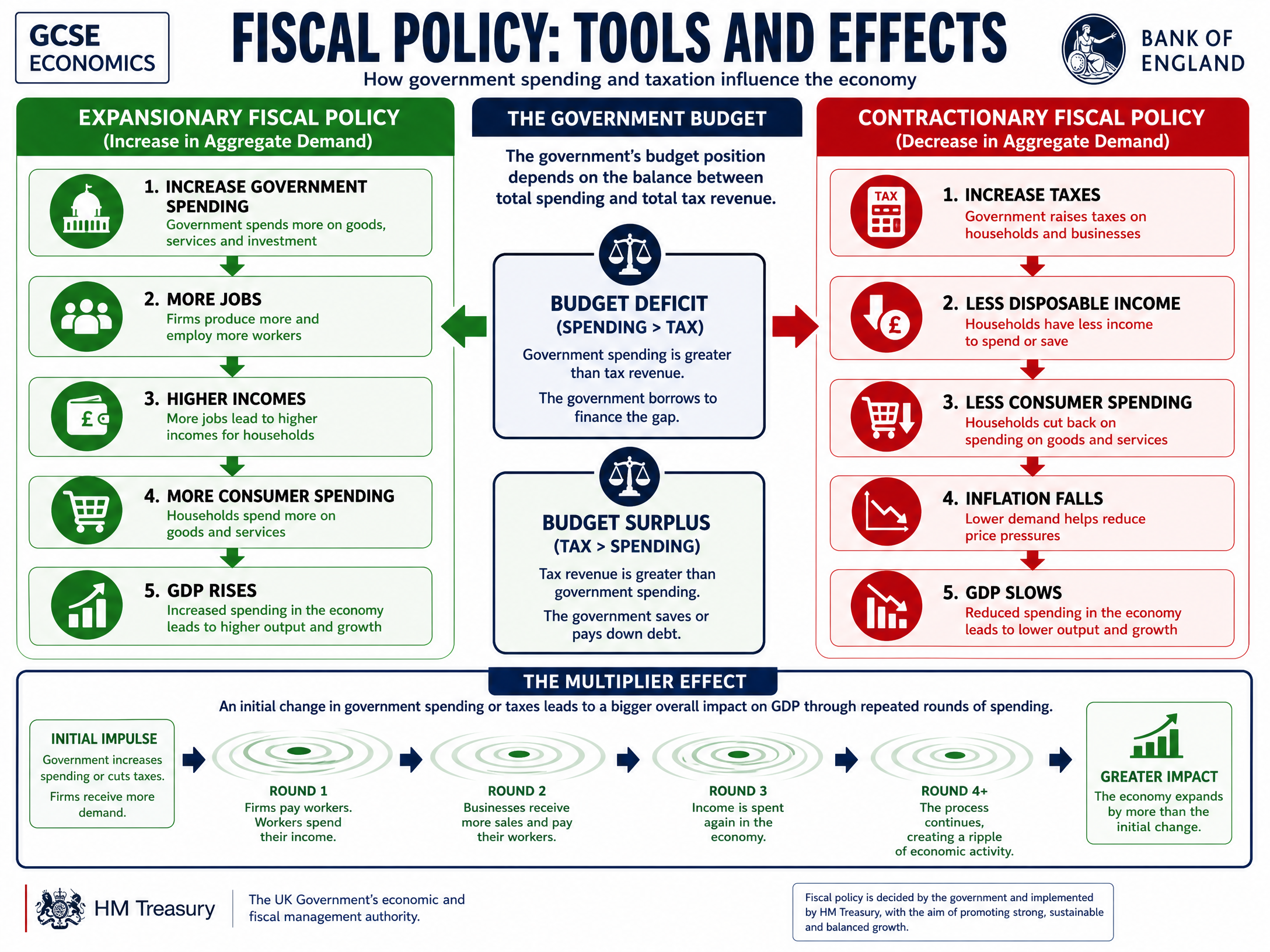
Fiscal policy involves the government changing the levels of taxation and government spending to influence Aggregate Demand (AD).
Expansionary Fiscal Policy
When is it used?: During an economic downturn or recession to boost growth and reduce unemployment.
How it works: The government increases spending (e.g., building hospitals) or decreases taxes (e.g., cutting income tax).
The Chain of Reasoning: Lower taxes → higher disposable income → increased consumer spending → firms experience higher demand → firms hire more workers → unemployment falls and GDP rises.
The Drawback: It can cause demand-pull inflation and worsen the budget deficit, adding to the national debt.
Contractionary Fiscal Policy
When is it used?: During an economic boom when inflation is rising too fast.
How it works: The government decreases spending or increases taxes.
The Chain of Reasoning: Higher taxes → lower disposable income → reduced consumer spending → firms face lower demand → price pressures ease → inflation falls.
The Drawback: It can slow economic growth and increase unemployment.
3. Monetary Policy
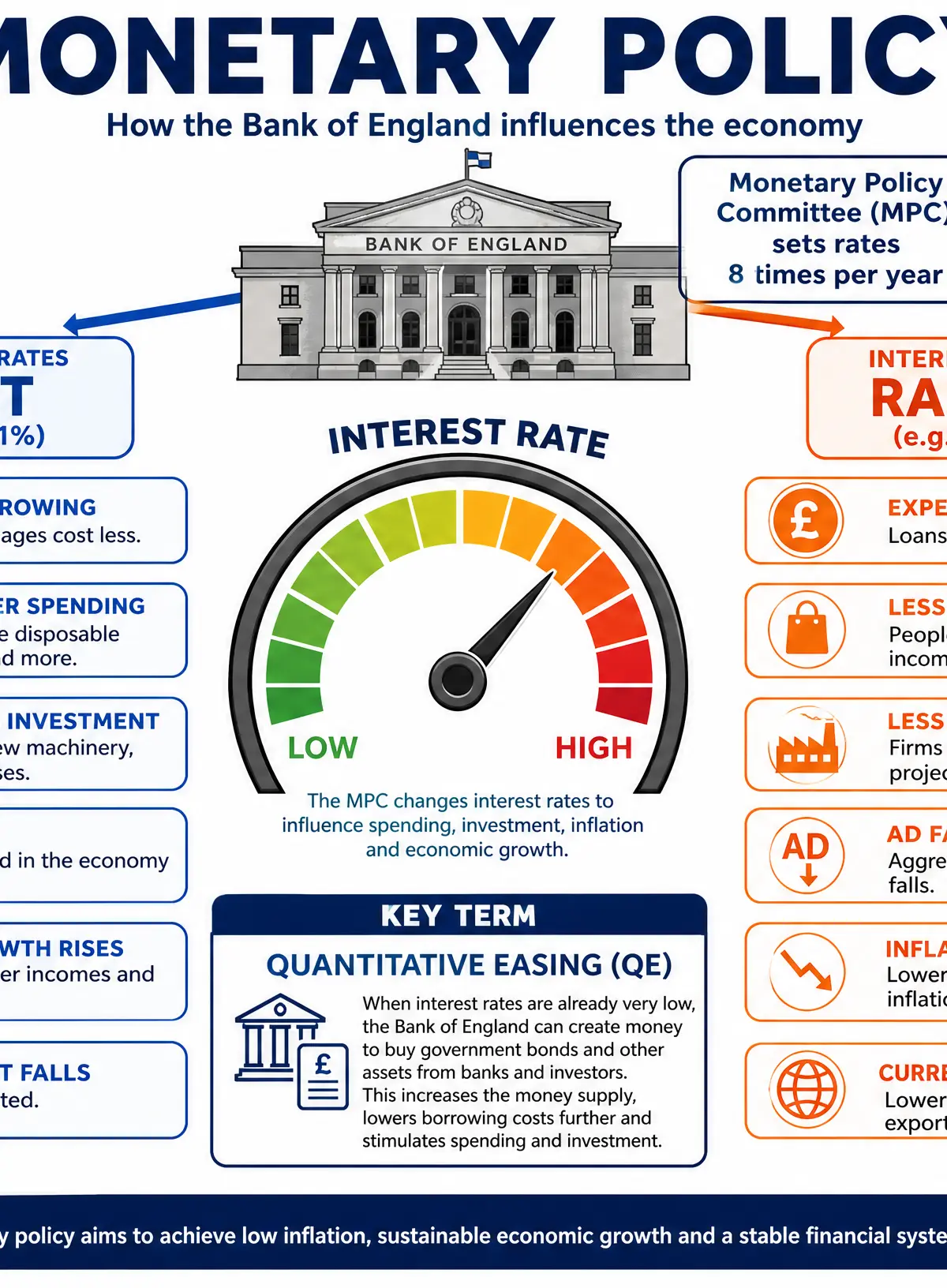
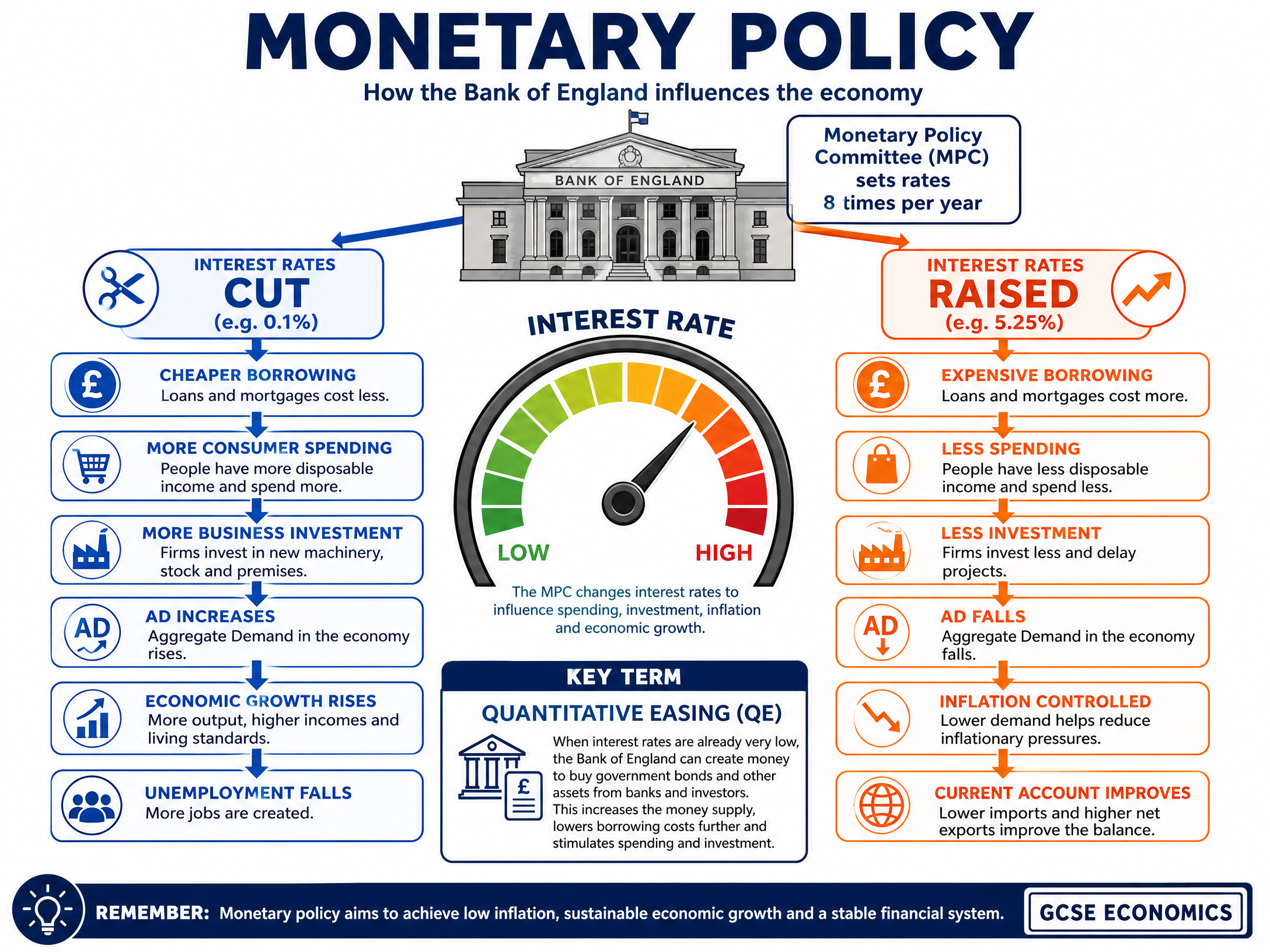
Monetary policy is controlled by the Bank of England (specifically the Monetary Policy Committee, or MPC), not the government directly. It involves changing interest rates and the money supply to influence AD and keep inflation at the 2% target.
Expansionary Monetary Policy (Cutting Interest Rates)
When is it used?: To stimulate a sluggish economy (e.g., cutting rates to 0.1% during the COVID-19 pandemic).
How it works: The MPC cuts the base interest rate.
The Chain of Reasoning: Cheaper borrowing costs → lower mortgage payments → consumers have more disposable income to spend → businesses find it cheaper to borrow for investment → AD rises → economic growth increases.
Contractionary Monetary Policy (Raising Interest Rates)
When is it used?: To combat high inflation (e.g., raising rates to 5.25% between 2021 and 2023).
How it works: The MPC raises the base interest rate.
The Chain of Reasoning: More expensive borrowing → higher mortgage payments → consumers have less disposable income → spending falls → AD falls → inflation is controlled.
4. Supply-Side Policies
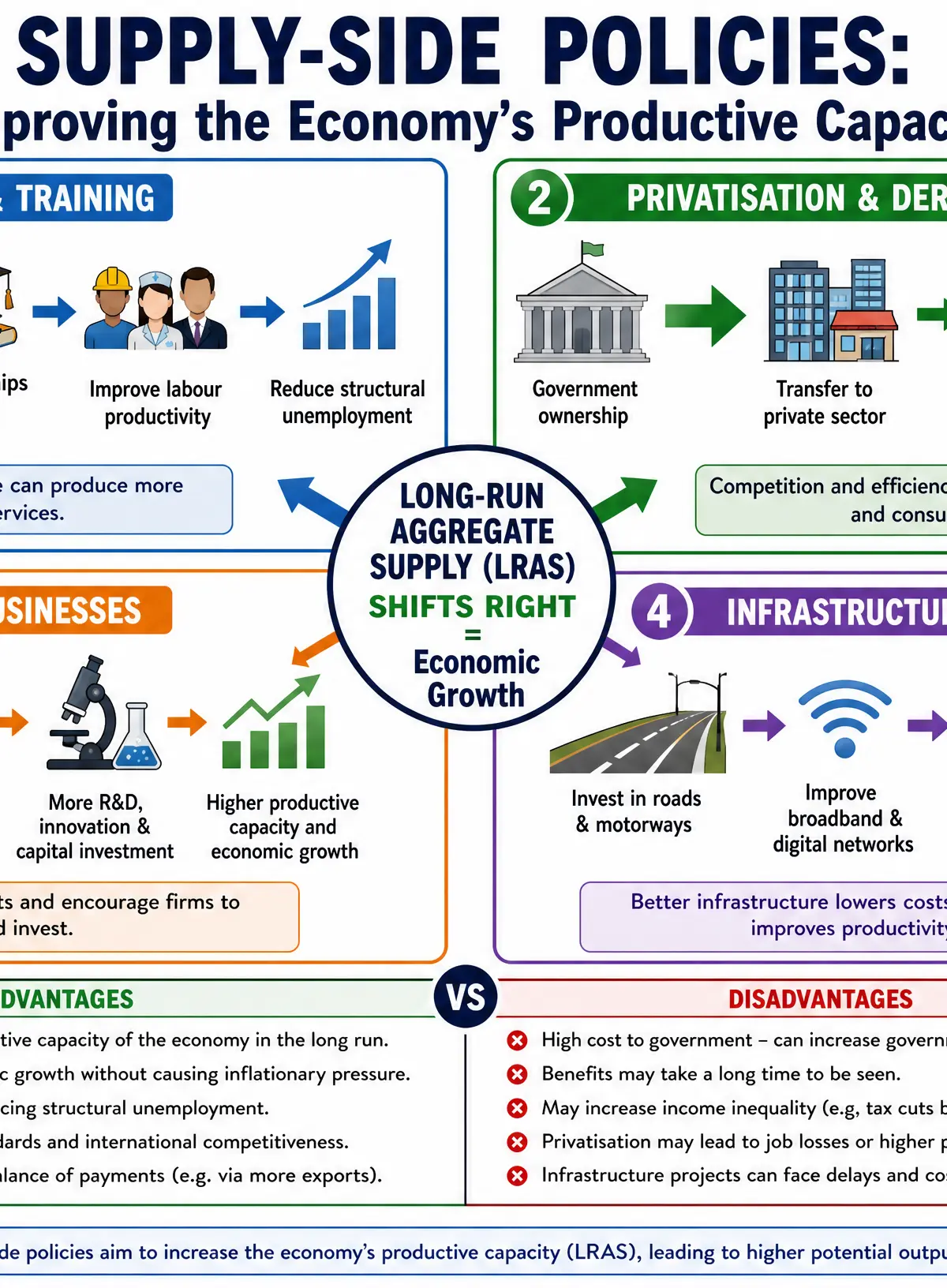
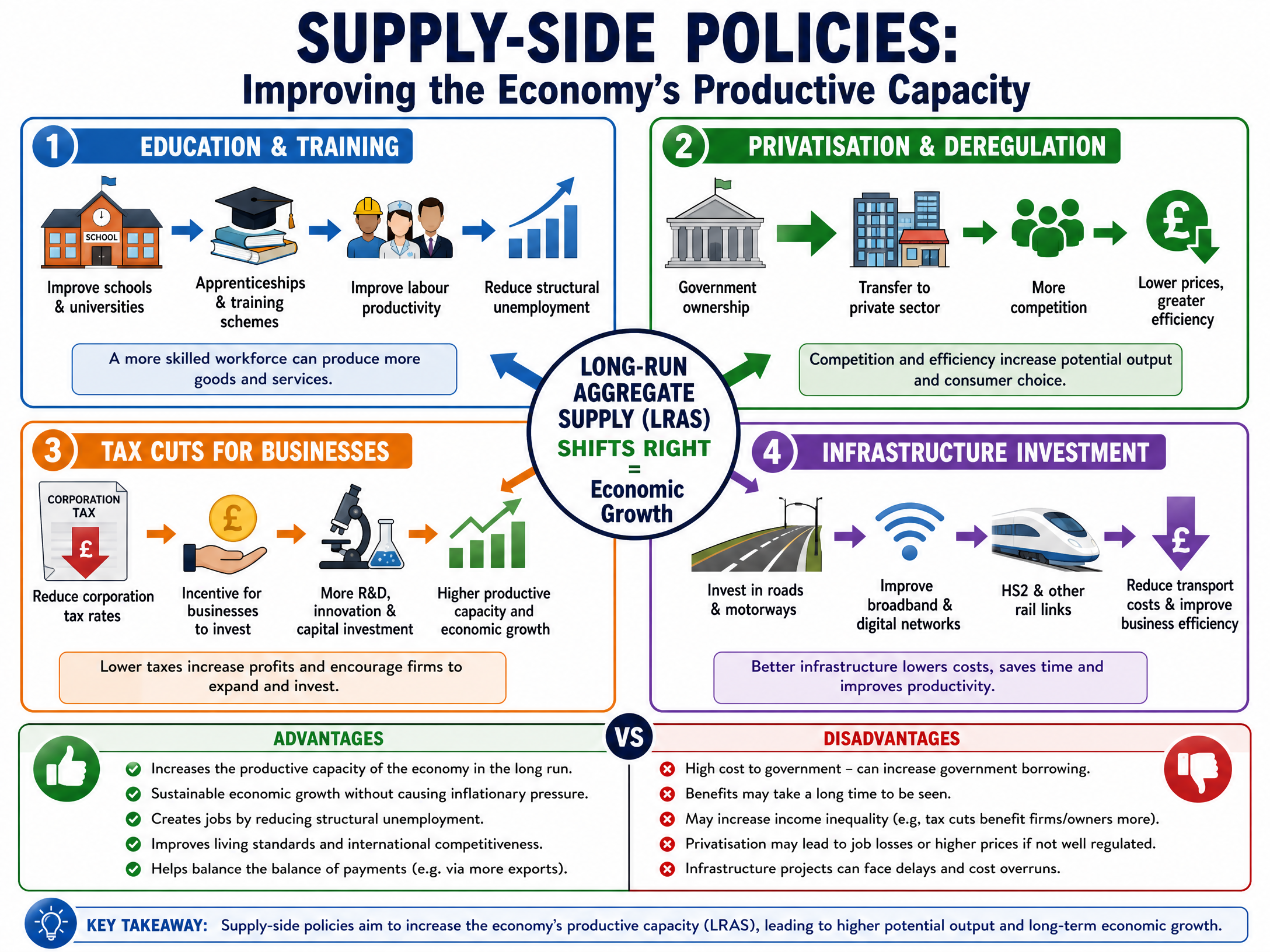
Unlike fiscal and monetary policies which manage demand, supply-side policies aim to increase the economy's productive capacity (shifting the Long-Run Aggregate Supply curve to the right).
Key Interventions
- Education and Training: Investing in schools and apprenticeships to improve workforce skills and labour productivity.
- Privatisation and Deregulation: Transferring state-owned assets to the private sector and removing red tape to increase competition and efficiency.
- Tax Incentives: Cutting corporation tax to encourage firms to invest in research, development, and new machinery.
- Infrastructure: Building new transport links (e.g., HS2) or digital networks to reduce business costs.
The Advantage: Supply-side policies are the only way to achieve economic growth without causing inflation.
The Disadvantage: They involve significant time lags. Building a new railway or educating a generation takes decades to show full economic benefits.
5. Policy Conflicts (The Evaluation Goldmine)
Examiners award the highest marks to candidates who recognize that achieving one objective often damages another.
- Growth vs. Inflation: Pumping money into the economy to boost growth often causes prices to rise (inflation).
- Unemployment vs. Inflation: As unemployment falls, workers have more bargaining power, leading to wage increases, which firms pass on as higher prices.
- Economic Growth vs. The Environment: Rapid industrial expansion can lead to pollution and resource depletion.
- Fiscal Policy vs. Future Generations: Running a budget deficit to fund expansionary fiscal policy creates national debt that future taxpayers must repay.
Visual Resources
4 diagrams and illustrations
Interactive Diagrams
1 interactive diagram to visualise key concepts
Conceptual Flow Outline
The Chain of Reasoning: Expansionary Fiscal Policy
Worked Examples
3 worked examples — open one to explore the question and available guidance.
Practice Questions
Test your understanding — click to reveal model answers
State the UK government's inflation target and identify the organization responsible for meeting it. (2 marks)
Hint: Think about the specific percentage and the central bank.
Explain one way the government could use fiscal policy to reduce a budget deficit. (3 marks)
Hint: A deficit means spending > tax. How do you reverse that?
Analyse how a successful supply-side policy, such as improved education, affects the economy. (6 marks)
Hint: Think about labour productivity and the Long-Run Aggregate Supply (LRAS) curve.
Evaluate the potential conflicts between the macroeconomic objective of economic growth and the objective of low inflation. (9 marks)
Hint: Think about what happens when an economy grows very quickly. What happens to prices?
The Bank of England decides to increase interest rates from 2% to 5%. Evaluate the likely impact of this decision on businesses and households. (12 marks)
Hint: Look at both sides: borrowers vs. savers, importers vs. exporters. What is the ultimate goal?