Pearson Edexcel · GCSE · Economics
International trade
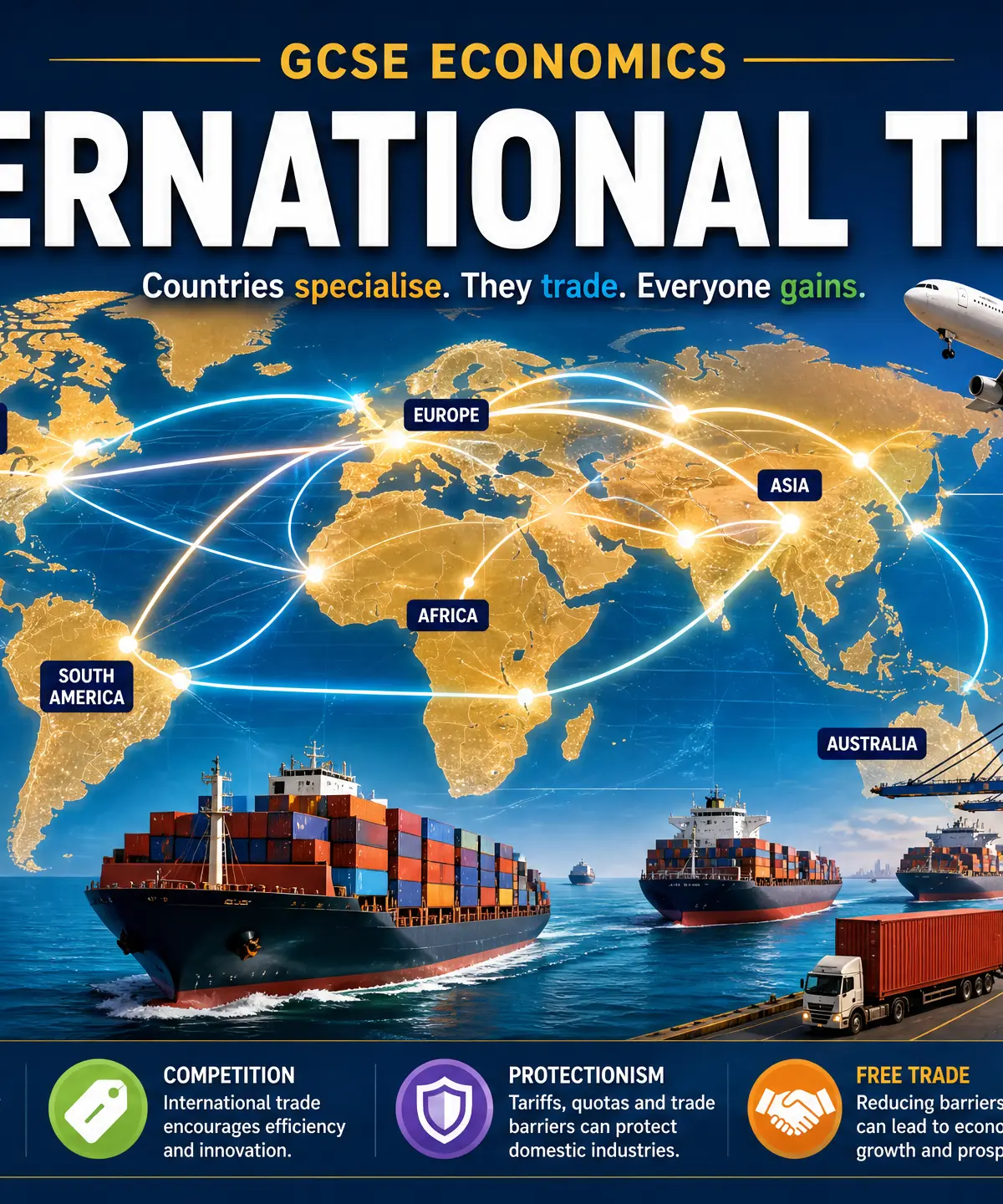
International trade connects the global economy, allowing countries to specialise in what they do best and trade for the rest. This topic is crucial for GCSE Economics as it explains the everyday movement of goods and introduces the fundamental concept of comparative advantage.
- 4 min read
- 2 worked examples
- 5 practice questions
- 6 key terms
Study Notes
Overview
International trade is the exchange of goods and services between countries. It is a fundamental concept in GCSE Economics because it explains why nations interact, how global wealth is created, and why your everyday items come from all over the world. Examiners expect candidates to understand not just the mechanics of trade, but the underlying economic theories—specifically absolute and comparative advantage—as well as the arguments for and against free trade and protectionism. You will need to evaluate these concepts using real-world examples.
Key Concepts & Developments
Why Countries Trade
The Basic Rationale: No single country possesses all the resources, skills, or climates necessary to produce everything its population needs efficiently.
What happens: Countries specialise in producing goods where they have an advantage and trade for goods they cannot produce efficiently. For example, the UK exports financial services while importing manufactured goods from China.
Specific Knowledge: Examiners look for the terms specialisation and economies of scale. Specialisation leads to lower average costs, which benefits consumers globally.
Absolute vs. Comparative Advantage
Absolute Advantage: Occurs when a country can produce more of a good than another country using the exact same amount of resources.
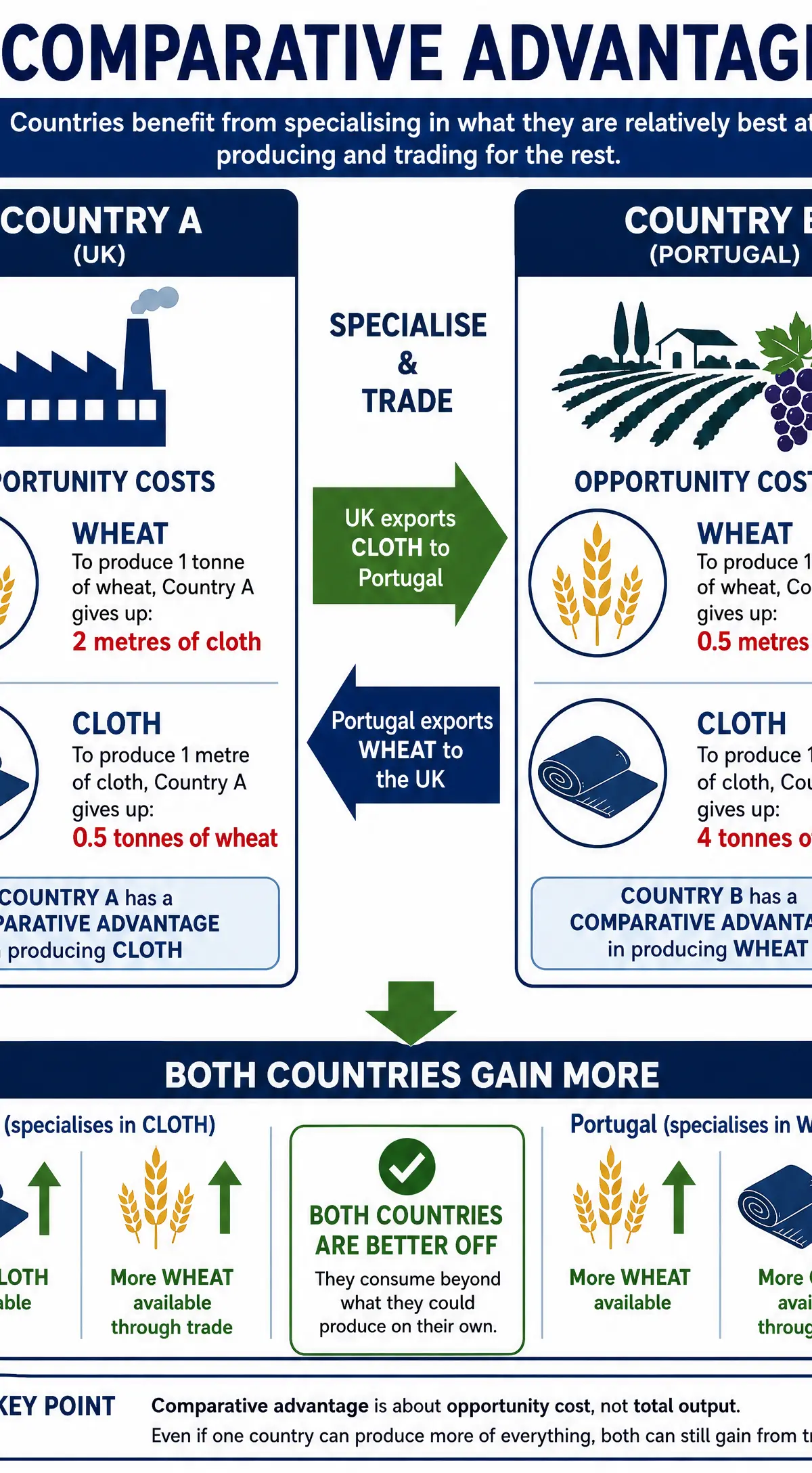
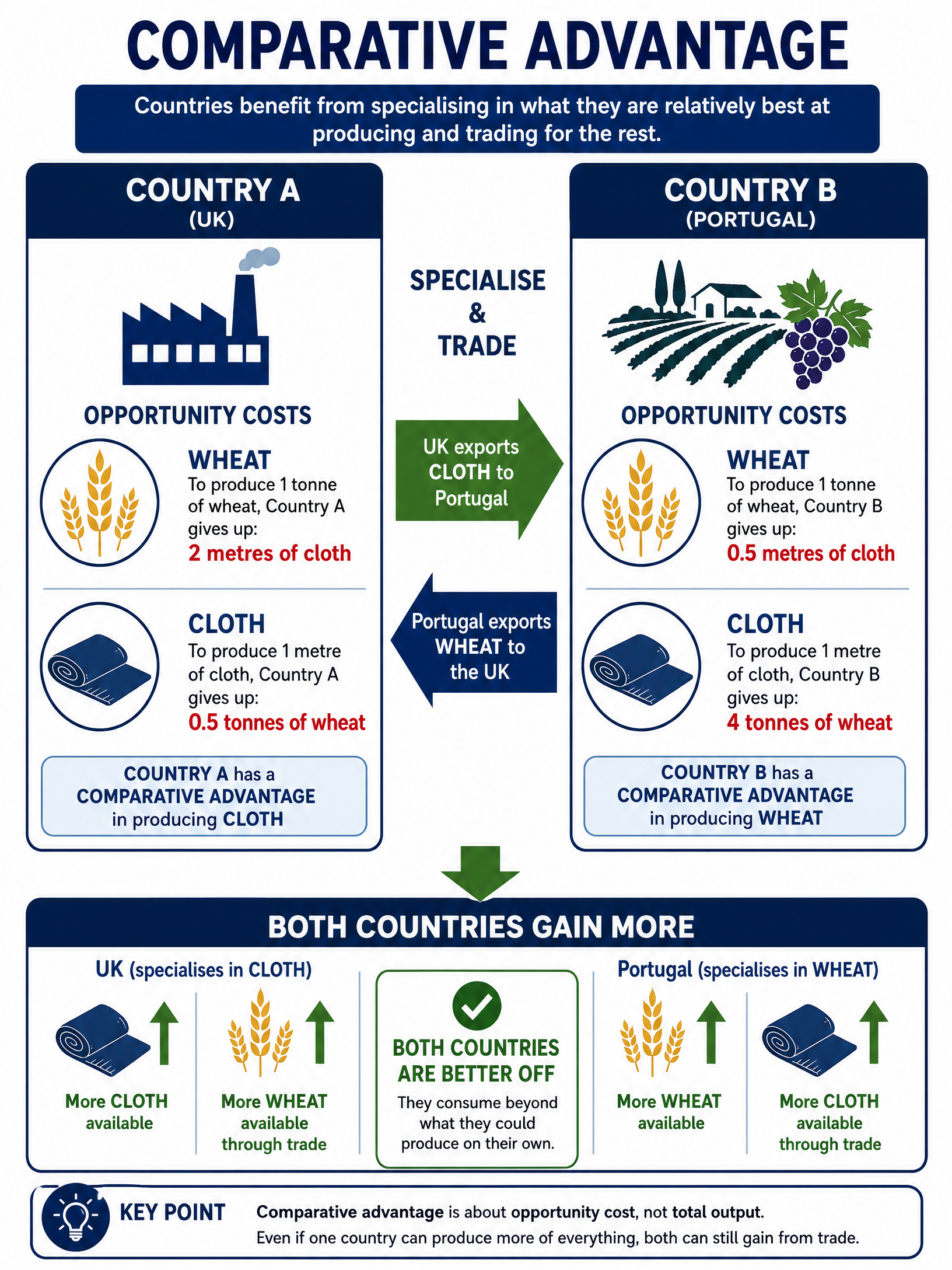
Comparative Advantage: The core theory of international trade. A country has a comparative advantage if it can produce a good at a lower opportunity cost than another country.
Specific Knowledge: You must use the phrase "opportunity cost" when explaining comparative advantage. Even if a country is worse at producing everything (no absolute advantage), it will still have a comparative advantage in the good where it is least inefficient, making trade mutually beneficial.
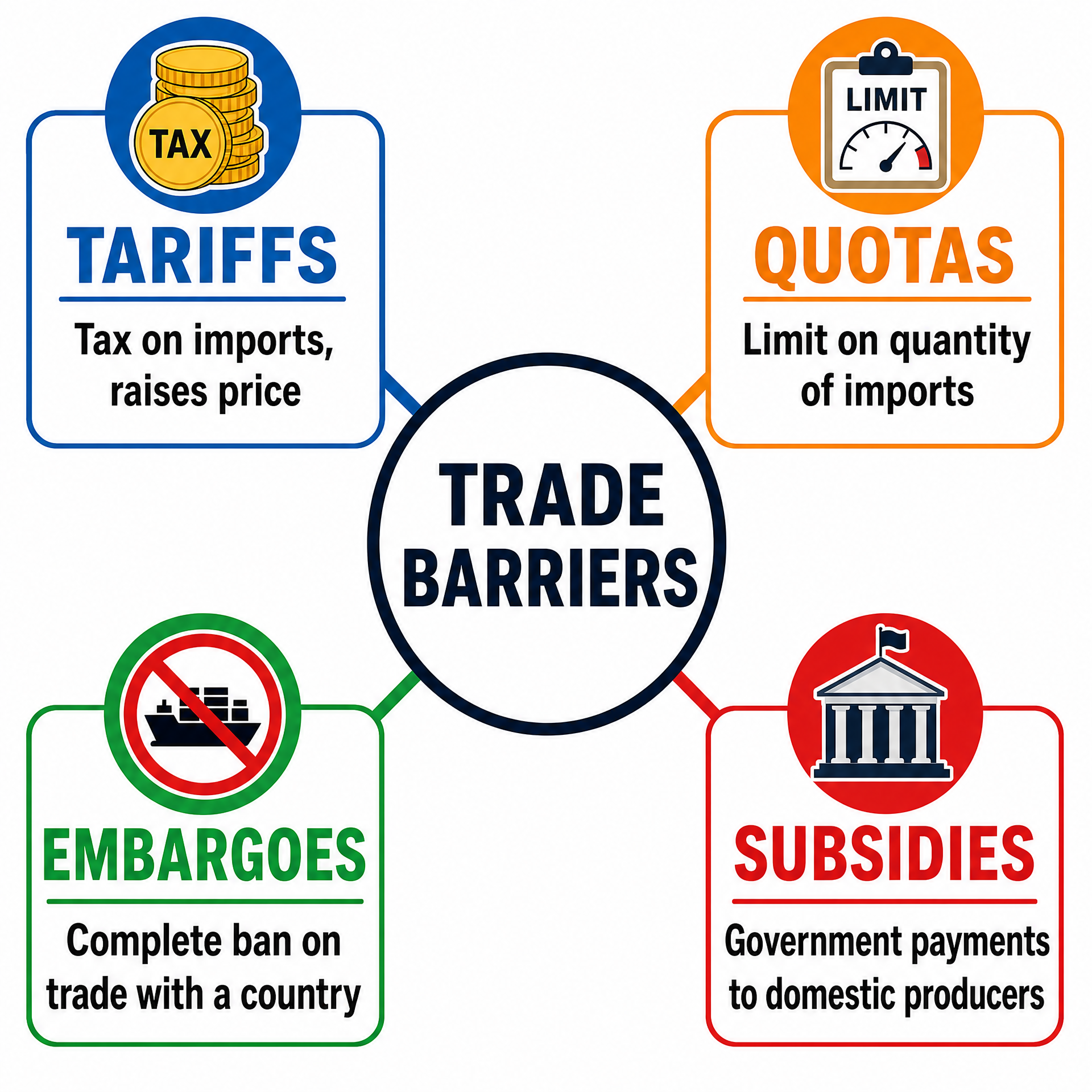
Trade Barriers (Protectionism)
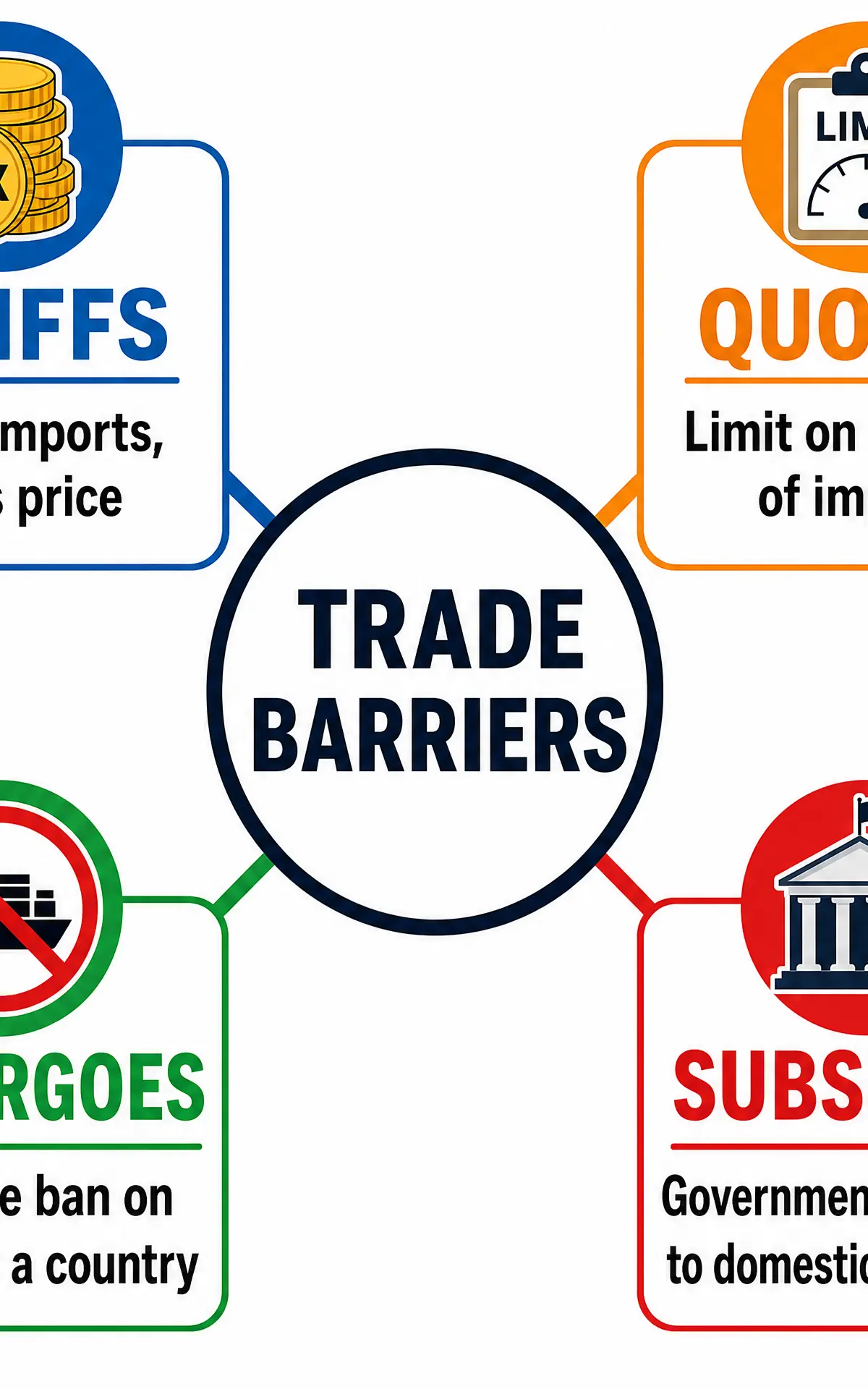
What it is: Government policies designed to restrict international trade, usually to protect domestic industries from foreign competition.
Key Types:
- Tariffs: Taxes placed on imported goods, raising their price.
- Quotas: Physical limits on the quantity of a good that can be imported.
- Subsidies: Financial support given to domestic firms to lower their costs.
- Embargoes: A complete ban on trade with a specific country.
Impact: Protectionism saves domestic jobs in the short term but leads to higher prices for consumers and risks retaliatory trade wars.
Second-Order Concepts
Causation
Why do trade deficits occur? A trade deficit (importing more than exporting) is caused by a lack of international competitiveness, a strong currency making exports expensive, or high domestic demand for foreign goods.
Consequence
The consequence of free trade is generally higher global economic growth, lower prices, and greater consumer choice. However, the consequence for uncompetitive domestic industries is often structural unemployment as factories close down.
Significance
International trade is highly significant because it links domestic macroeconomic objectives (like employment and inflation) to the global economy. A shock in one country (e.g., a supply chain disruption) quickly impacts trading partners.
Audio Resource
Listen to the GCSE Economics podcast on International Trade for a comprehensive review of these concepts, exam tips, and a quick-fire recall quiz:

Visual Resources
2 diagrams and illustrations
Interactive Diagrams
1 interactive diagram to visualise key concepts
Conceptual Flow Outline
The chain of reasoning for how a tariff works
Worked Examples
2 worked examples — open one to explore the question and available guidance.
Practice Questions
Test your understanding — click to reveal model answers
State two benefits of free trade for consumers. (2 marks)
Hint: Think about prices and what is available in the shops.
Explain how a quota restricts international trade. (3 marks)
Hint: Focus on the physical limit and how it affects supply.
Evaluate the impact of globalisation and international trade on a developing economy. (9 marks)
Hint: Look at both the economic growth benefits and the risks of exploitation or over-reliance.
Explain the difference between absolute advantage and comparative advantage. (4 marks)
Hint: One is about total resources, the other is about opportunity cost.
Explain one reason why a government might choose to subsidise domestic farmers. (3 marks)
Hint: Think about food security or competing with imports.