Pearson Edexcel · GCSE · Economics
Macroeconomic objectives
Master the four key macroeconomic objectives—Economic Growth, Low Inflation, Low Unemployment, and a Favourable Balance of Payments. This guide breaks down government policies and the crucial trade-offs examiners love to test.
- 5 min read
- 2 worked examples
- 5 practice questions
- 6 key terms
Study Notes
Overview
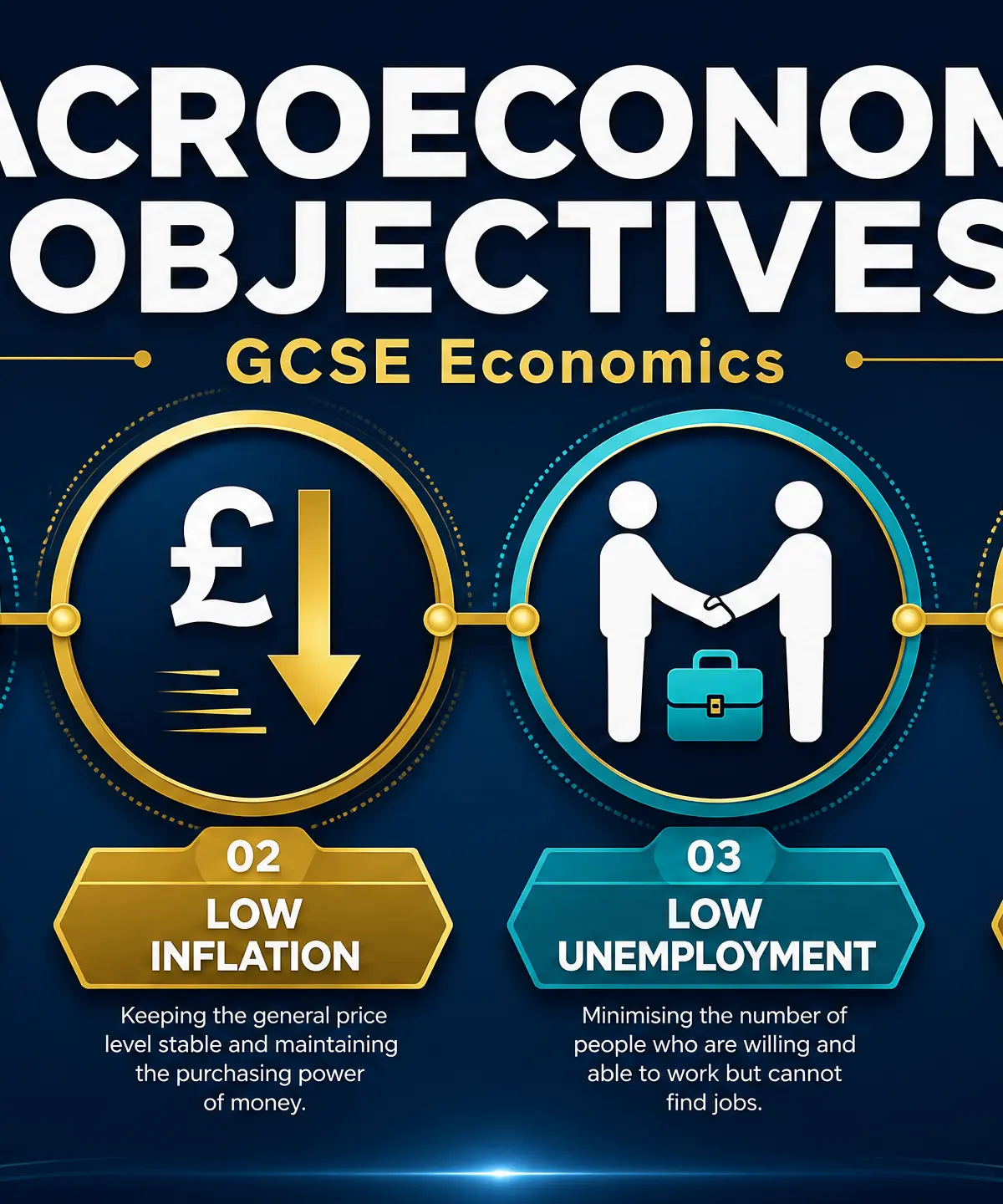
Macroeconomic objectives are the broad goals that a government aims to achieve for the national economy. At GCSE level, examiners expect candidates to confidently explain these four core objectives: sustained Economic Growth, low and stable Inflation, low Unemployment, and a favourable Balance of Payments (remembered as G-I-U-B). Historically, managing these objectives has been the central challenge for Chancellors of the Exchequer, especially because achieving one often makes another more difficult—a concept known as a policy conflict or trade-off.
In your exams, simply stating these objectives is not enough. You must understand how they are measured, why they matter to economic agents (consumers, firms, and the government), and what policies (Fiscal and Monetary) are used to achieve them. The highest marks are awarded to candidates who can evaluate the conflicts between these objectives, such as the Phillips Curve trade-off between inflation and unemployment.
The Four Macroeconomic Objectives
1. Economic Growth
Definition: An increase in the real output of an economy over time, measured by Gross Domestic Product (GDP).
Measurement: GDP represents the total value of all goods and services produced in a country in a year. The UK's long-run average growth rate is typically 2-2.5%.
Why it matters: Economic growth leads to higher living standards, increased employment, and greater tax revenues for the government, which can be spent on public services like the NHS and education.
Specific Knowledge: Examiners reward candidates who distinguish between short-run growth (using spare capacity) and long-run sustainable growth (increasing the productive capacity of the economy).
2. Low and Stable Inflation
Definition: A sustained increase in the general price level over time.
Measurement: In the UK, inflation is measured using the Consumer Price Index (CPI). The government sets the Bank of England a target of 2% CPI inflation.
Why it matters: High inflation reduces the purchasing power of money, eroding the real value of savings and wages. It also makes UK exports less internationally competitive. However, deflation (falling prices) is also harmful as it causes consumers to delay spending, potentially triggering a recession.
3. Low Unemployment
Definition: When those who are willing and able to work cannot find a job.
Measurement: Measured by the Claimant Count or the Labour Force Survey (LFS). The natural rate of unemployment in the UK is considered to be around 4-5%.
Why it matters: High unemployment wastes human resources (lost output), increases government spending on welfare benefits, and reduces tax revenues. It also causes social problems and poverty.
4. Favourable Balance of Payments
Definition: A record of all financial transactions between the UK and the rest of the world. For GCSE, the focus is on the Current Account, which includes trade in goods and services.
Measurement: A deficit occurs when the value of imports exceeds the value of exports. A surplus occurs when exports exceed imports. The UK typically runs a persistent current account deficit.
Why it matters: A large deficit may indicate that a country's goods are uncompetitive globally. However, a small deficit might simply reflect high consumer spending power buying imported goods.
Government Policies
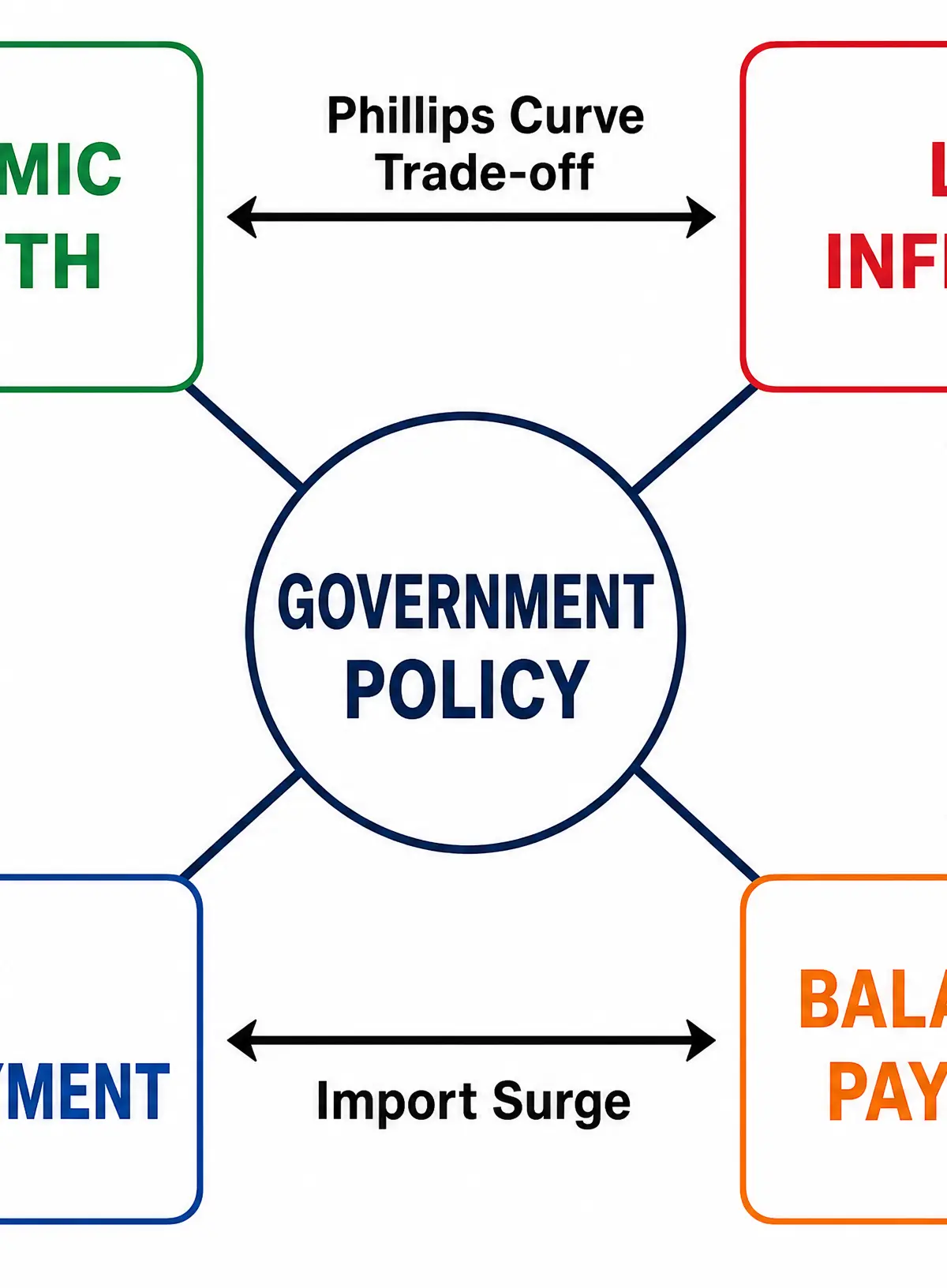
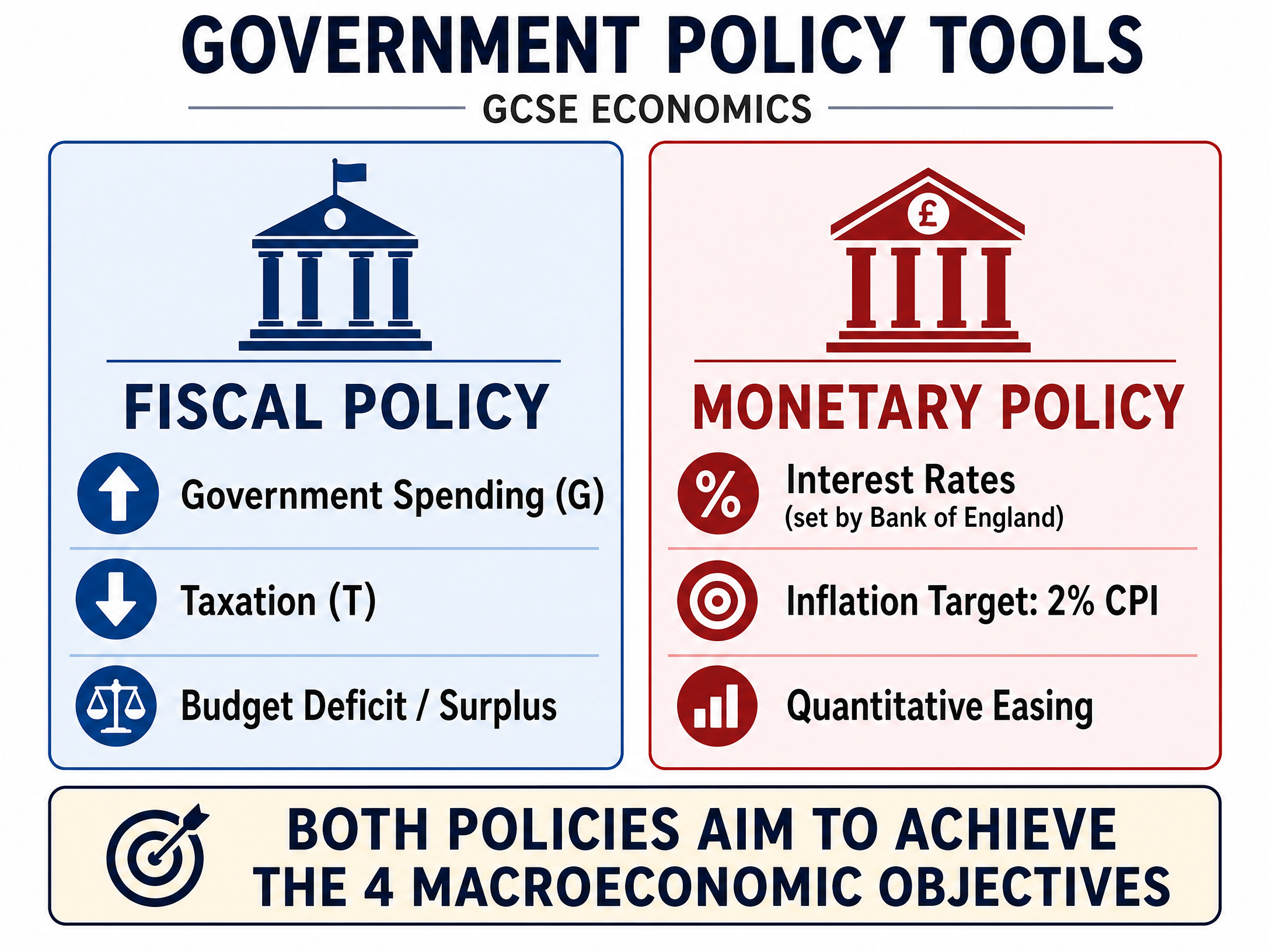
Governments use two main types of macroeconomic policy to achieve their objectives:
Fiscal Policy
Controlled by: The Government (Chancellor of the Exchequer).
Tools: Government Spending (G) and Taxation (T).
Application:
- Expansionary: Increasing spending or cutting taxes to boost aggregate demand (reduces unemployment, boosts growth).
- Contractionary: Cutting spending or raising taxes to reduce aggregate demand (controls inflation).
Monetary Policy
Controlled by: The Bank of England's Monetary Policy Committee (MPC).
Tools: Interest Rates and Quantitative Easing (QE).
Application:
- Expansionary: Cutting interest rates to make borrowing cheaper, encouraging consumption and investment.
- Contractionary: Raising interest rates to make borrowing more expensive, encouraging saving and reducing demand to control inflation.
Conflicts and Trade-offs
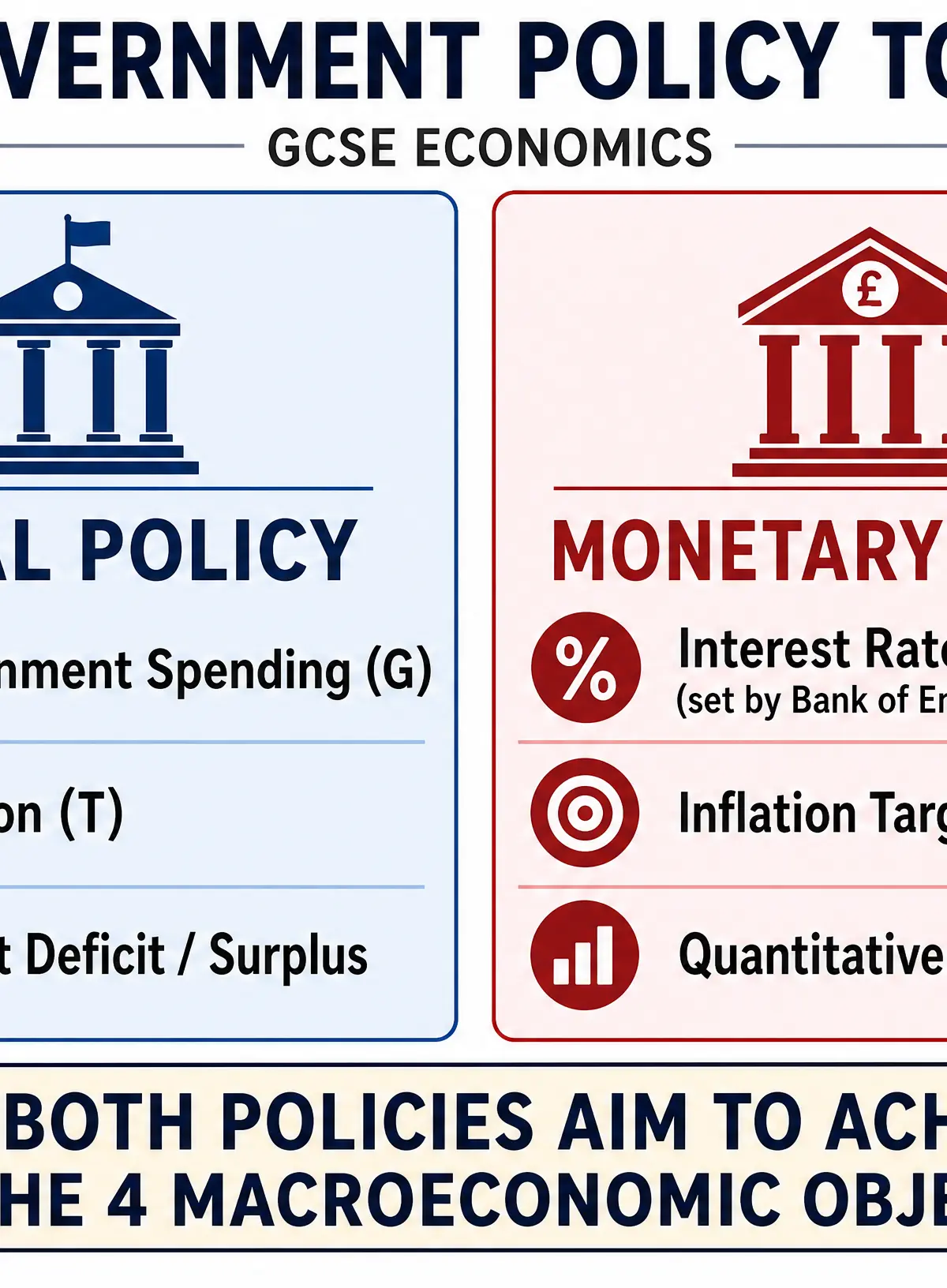
Examiners heavily reward the evaluation of policy conflicts. The most common is the Phillips Curve trade-off: attempting to reduce unemployment through expansionary policy often leads to higher inflation. Conversely, using contractionary policy to bring down inflation will likely slow economic growth and increase unemployment. Top-band answers always acknowledge these trade-offs.
Worked Examples
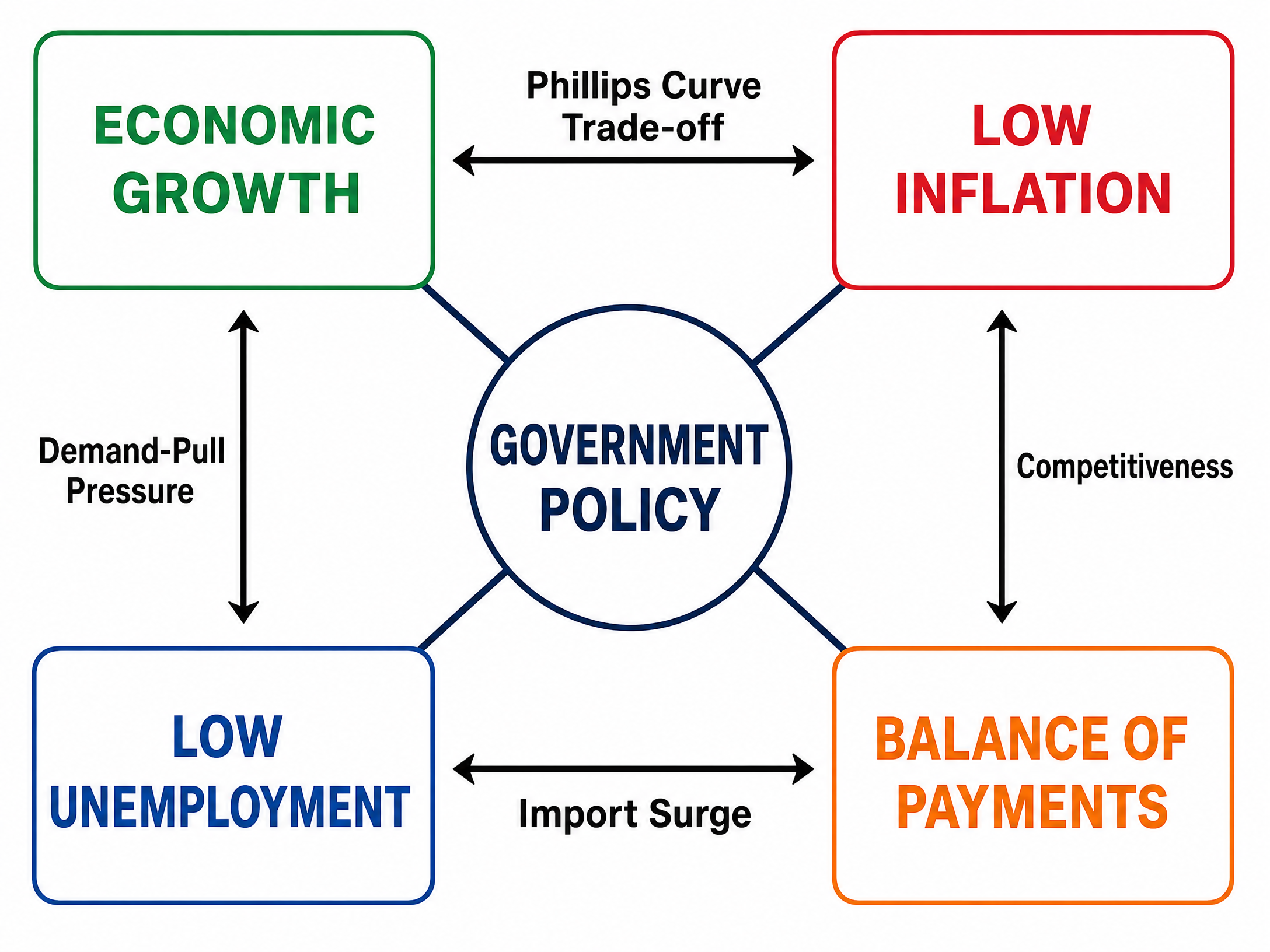
2 worked examples — open one to explore the question and available guidance.
Practice Questions
Test your understanding — click to reveal model answers
State the UK government's target for inflation. (1 mark)
Hint: Think of a low, single-digit number.
Explain one reason why a government aims for low unemployment. (3 marks)
Hint: Think about the impact on government finances (taxes and spending).
Explain how expansionary fiscal policy can be used to increase economic growth. (4 marks)
Hint: What are the two tools of fiscal policy? How do they affect aggregate demand?
Assess the consequences of a high rate of inflation for an economy. (9 marks)
Hint: Discuss both the negative impacts (purchasing power, exports) and any potential mitigating factors.
Evaluate whether monetary policy is the most effective way to reduce inflation. (12 marks)
Hint: Compare interest rates with fiscal policy. What are the limitations of raising interest rates?