Pearson Edexcel · GCSE · Economics
Production
Production is the engine of the economy, transforming raw materials and human effort into the goods and services we consume daily. Mastering the factors of production and sectors of industry is essential for understanding how businesses operate, grow, and adapt in a changing global landscape.
- 5 min read
- 3 worked examples
- 5 practice questions
- 6 key terms
Study Notes
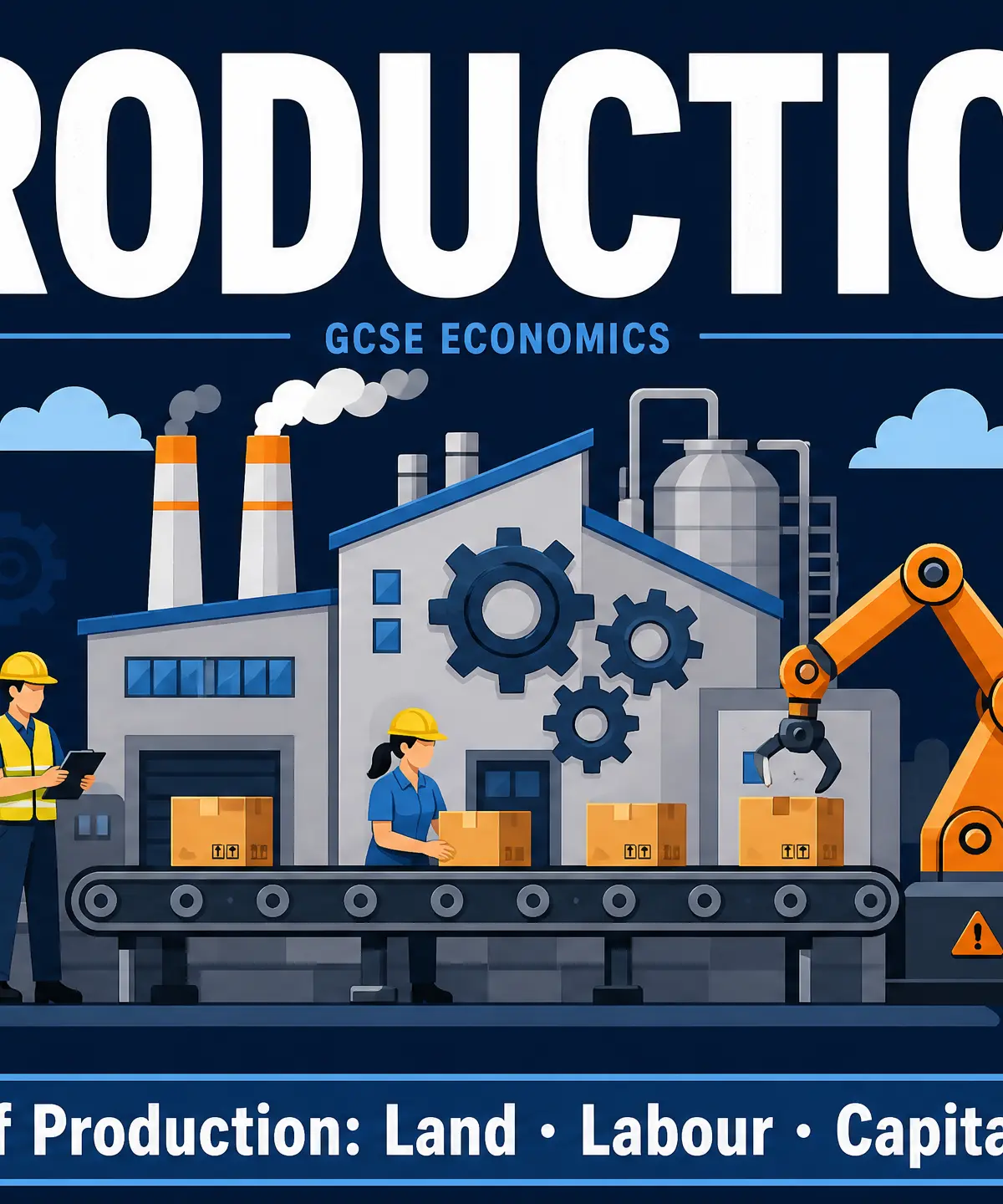
Overview
Production is the fundamental economic process of combining inputs (resources) to create outputs (goods and services) that satisfy human wants and needs. In your GCSE Economics exam, examiners expect you to understand not just what production is, but how it happens through the four Factors of Production. You will also need to demonstrate knowledge of the different sectors of the economy (Primary, Secondary, and Tertiary) and understand how economies change over time, such as the UK's shift from manufacturing to services (deindustrialisation). This topic links heavily to business costs, productivity, and economic growth, making it a cornerstone of the specification.
Listen to the revision podcast below for a comprehensive overview of this topic, complete with a quick-fire recall quiz!

The Factors of Production
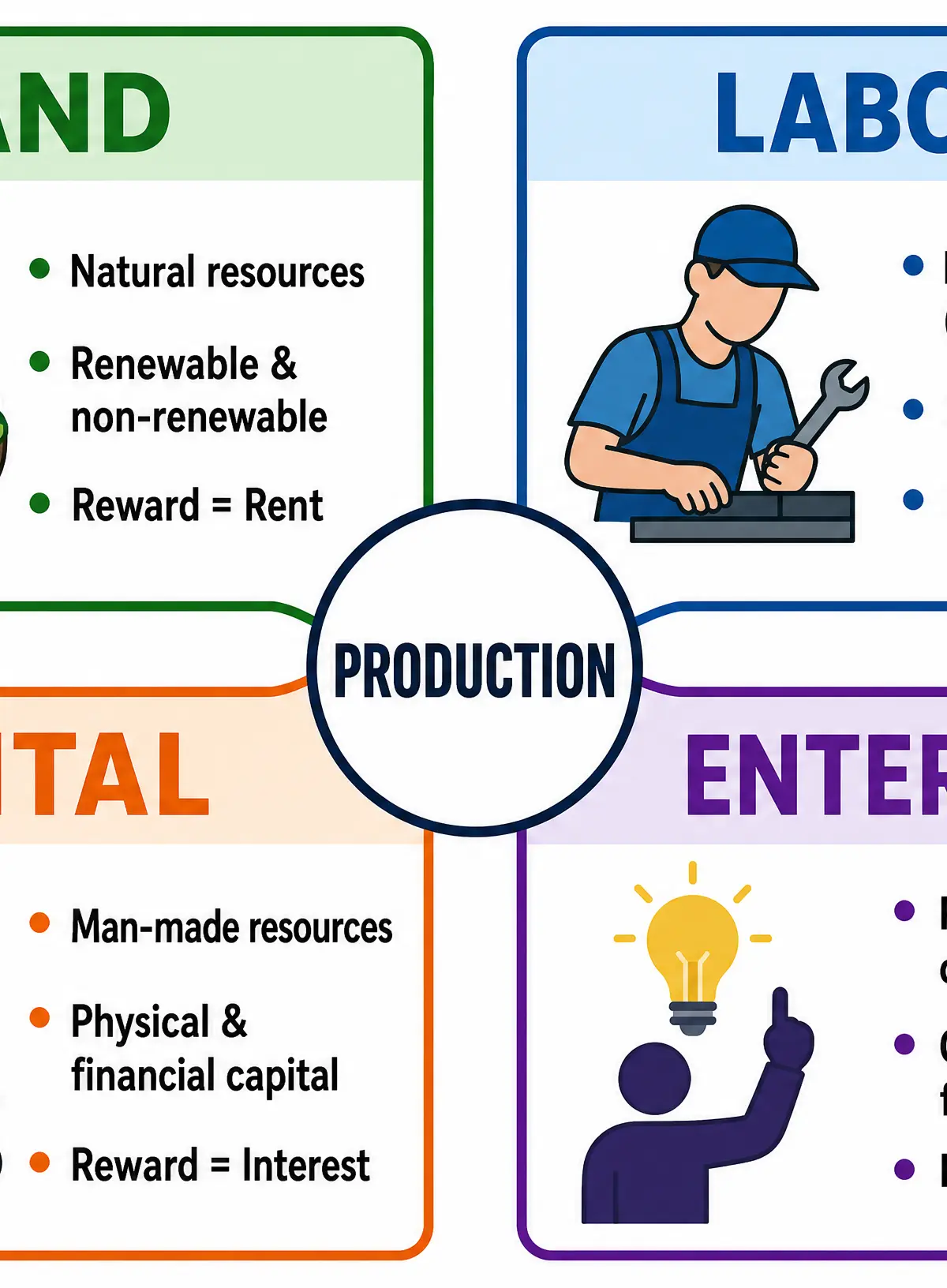
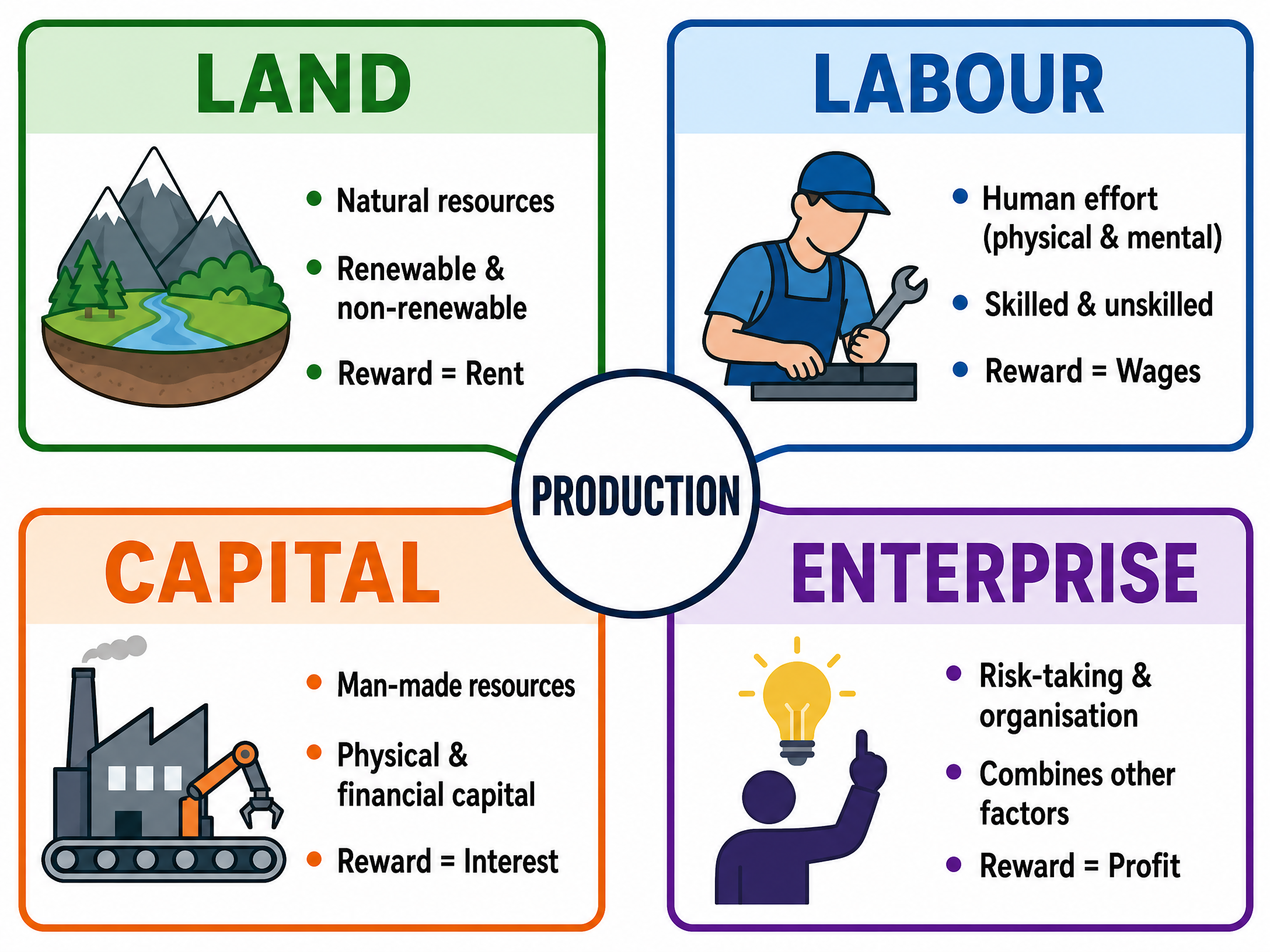
To produce anything, a business needs resources. Economists categorise these into four groups, known as the Factors of Production. You must know these inside out.
Land
Definition: All natural resources provided by nature that are used in the production process.
Key Knowledge: This is not just physical space. It includes minerals (coal, gold), oil and gas, water, forests, and even the sea. Land can be renewable (like wind power or sustainably managed forests) or non-renewable (like crude oil).
Reward: The reward for land is Rent.
Labour
Definition: The human effort—both physical and mental—used in the production of goods and services.
Key Knowledge: Labour includes everyone from a factory assembly worker to a neurosurgeon. The quality of labour can be improved through education and training, which is known as investing in human capital.
Reward: The reward for labour is Wages (or salaries).
Capital
Definition: Man-made resources used to produce other goods and services.
Key Knowledge: Crucial Exam Tip: In economics, capital does NOT mean money! It refers to physical items like machinery, factories, computers, vehicles, and tools.
Reward: The reward for capital is Interest.
Enterprise
Definition: The willingness to take risks and the ability to organise the other three factors of production.
Key Knowledge: The entrepreneur is the individual who spots a gap in the market, gathers the land, labour, and capital, and combines them to create a product. Without enterprise, the other factors remain idle.
Reward: The reward for enterprise is Profit (though the risk is making a loss).
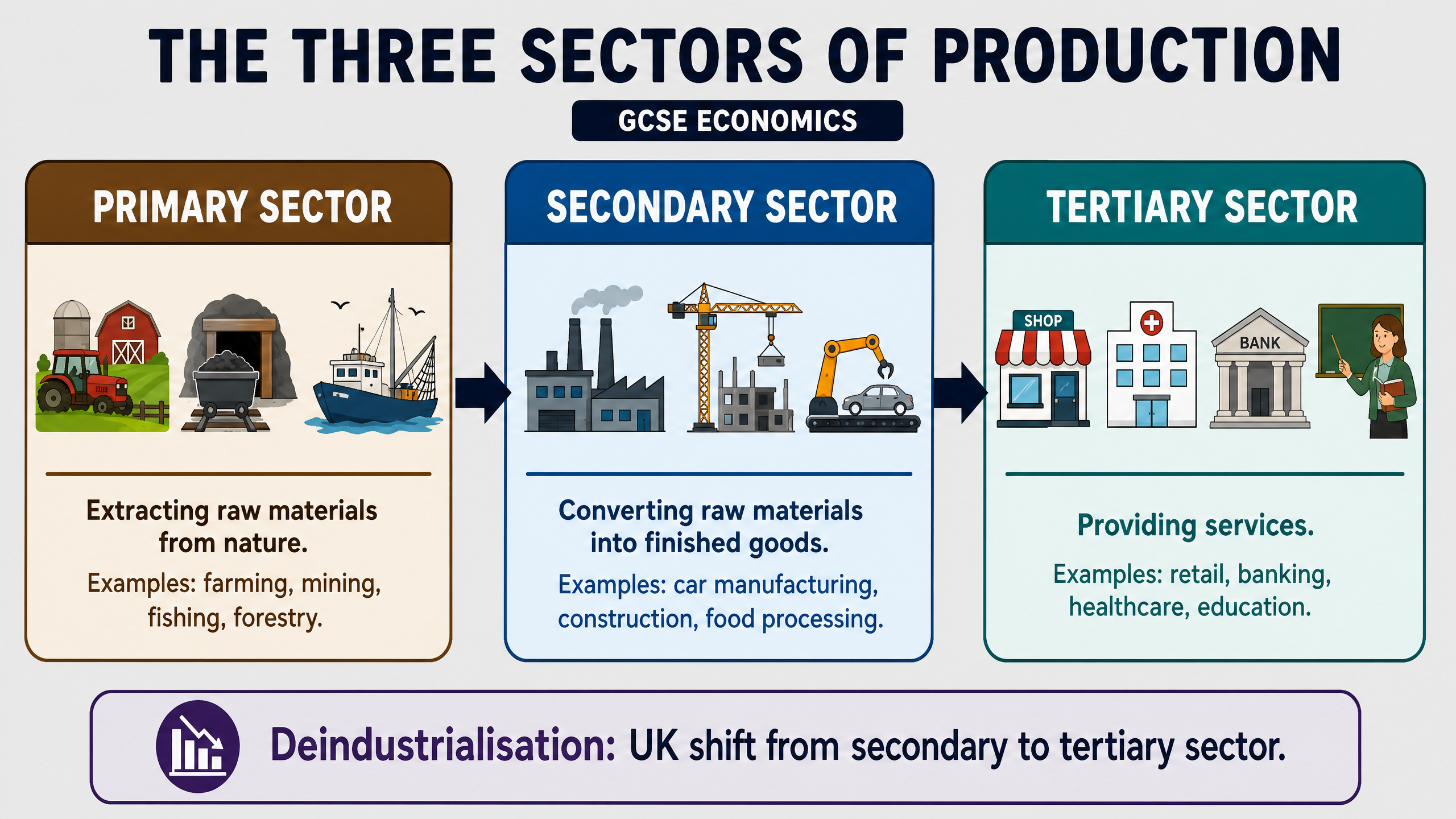
The Sectors of Production
Economies are divided into sectors based on the type of production taking place.
Primary Sector
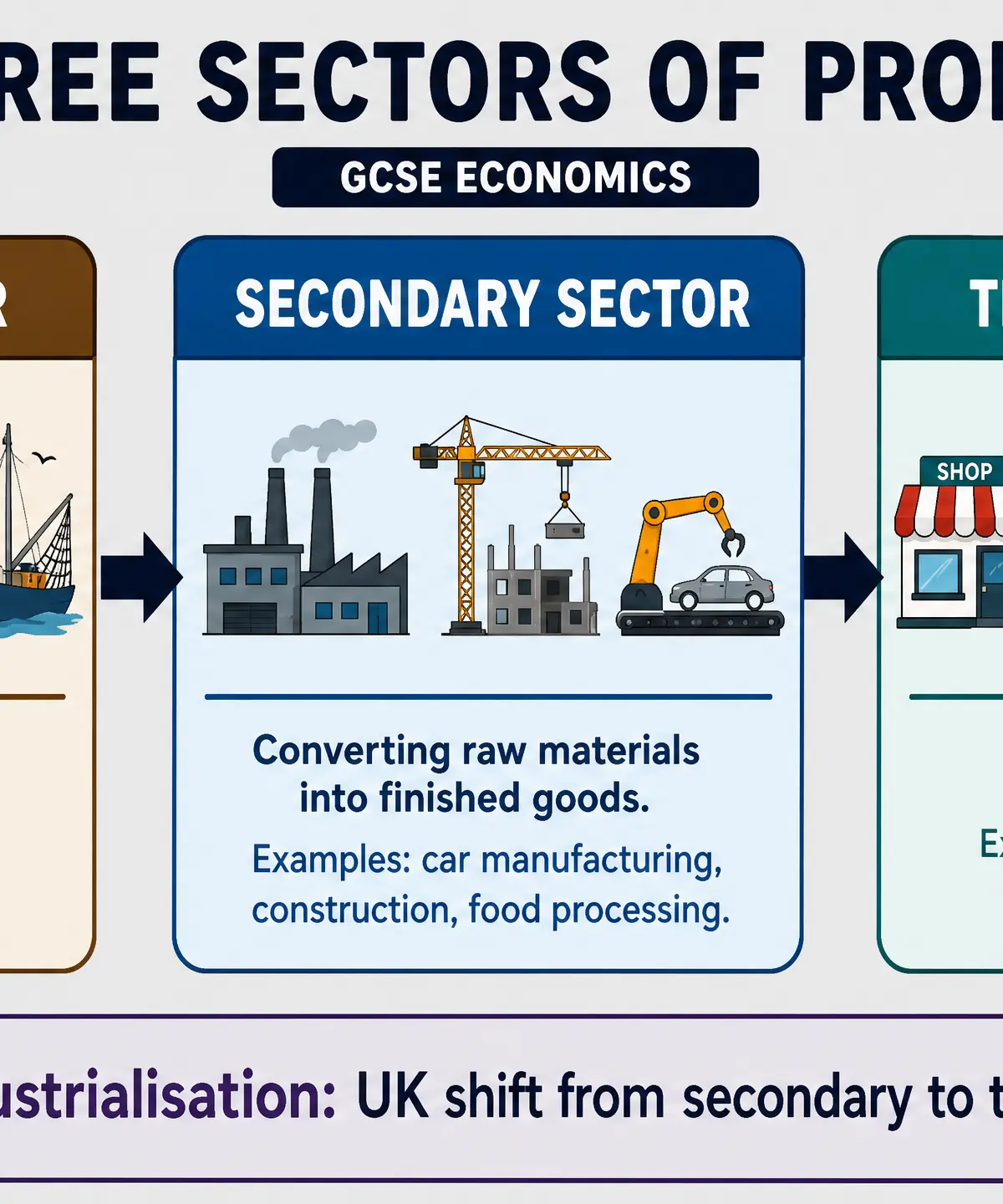
Role: Extraction of raw materials directly from the earth or sea.
Examples: Farming (agriculture), fishing, mining, forestry, and oil extraction.
Impact: Developing economies often have a large primary sector. As economies develop, this sector typically shrinks as a percentage of total employment.
Secondary Sector
Role: Manufacturing and construction. Converting raw materials into finished or semi-finished goods.
Examples: Car manufacturing, house building, food processing, steel production, and clothing manufacturing.
Impact: The process of an economy moving away from manufacturing is called deindustrialisation. The UK has experienced significant deindustrialisation since the 1970s.
Tertiary Sector
Role: The provision of services.
Examples: Retail (shops), banking, healthcare, education, transport, and tourism.
Impact: In advanced economies like the UK, the tertiary sector dominates, accounting for roughly 80% of GDP and employment.
Productivity
Definition: Productivity measures the efficiency of production. It is the amount of output produced per unit of input.
Labour Productivity: The most common measure, calculated as total output divided by the number of workers (or hours worked).
Why it matters: Higher productivity lowers the cost per unit for a business. This allows firms to reduce prices (becoming more competitive) or increase profit margins. For a country, rising productivity is the main driver of economic growth and higher living standards.
Visual Resources
2 diagrams and illustrations
Interactive Diagrams
1 interactive diagram to visualise key concepts
Conceptual Flow Outline
The Chain of Production
Worked Examples
3 worked examples — open one to explore the question and available guidance.
Practice Questions
Test your understanding — click to reveal model answers
State the reward for the factor of production 'Enterprise'.
Hint: What does a business owner hope to make?
Explain the difference between the secondary sector and the tertiary sector, giving an example of each. (4 marks)
Hint: Define both sectors and provide a specific industry for each.
A bakery invests in new automated ovens that bake bread 50% faster. Analyse how this investment in capital might affect the bakery's profits. (6 marks)
Hint: Think about the impact on labour productivity, average costs, and how that translates to profit margins.
Define the term 'human capital'. (2 marks)
Hint: What do education and training give to workers?
Explain how an increase in the minimum wage might affect a firm's demand for capital goods. (4 marks)
Hint: If labour becomes more expensive, what might a firm replace it with?