Pearson Edexcel · GCSE · Economics
Relationships between objectives and policies
This topic is the ultimate test of your economic thinking: how governments balance competing goals like growth, low inflation, and high employment. Mastering these trade-offs is essential for unlocking the highest marks in your GCSE Economics exams.
- 6 min read
- 2 worked examples
- 2 practice questions
- 6 key terms
Study Notes
Overview
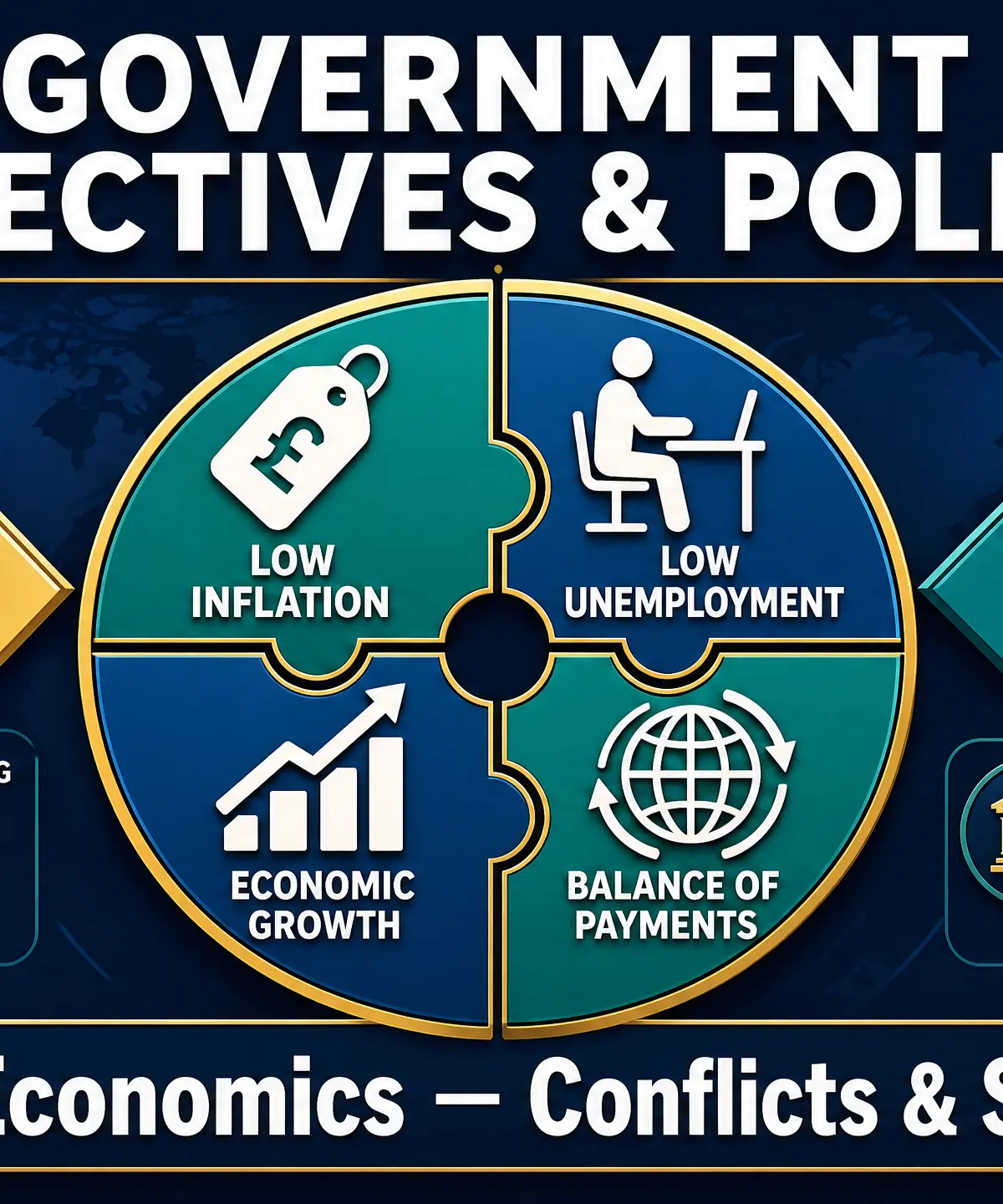
This study guide explores the critical relationships between government economic objectives and the policies used to achieve them. For GCSE Economics, examiners are not just looking for definitions; they want to see your ability to analyze trade-offs, conflicts, and synergies. When a government uses fiscal or monetary policy to hit one target (like economic growth), it often makes another target (like low inflation) harder to achieve. Understanding these dynamics—and being able to evaluate policy effectiveness using real-world examples and concepts like time lags—is the key to reaching the top mark bands.
The Podcast
Listen to our exclusive 10-minute revision podcast, covering all the key concepts, common mistakes, and a quick-fire quiz to test your knowledge.

The Core Objectives
Governments generally pursue four main macroeconomic objectives simultaneously:
- Low and Stable Inflation: Typically targeted at around 2% (CPI) in the UK.
- Low Unemployment: Ensuring as many people as possible who are willing and able to work have jobs.
- Economic Growth: A steady increase in real GDP, improving living standards.
- Favourable Balance of Payments: Ensuring the value of exports is roughly balanced with the value of imports.
Policy Instruments
To achieve these objectives, governments and central banks use two main demand-side policies:
Fiscal Policy
Controlled by the government, this involves changes to taxation and government spending.
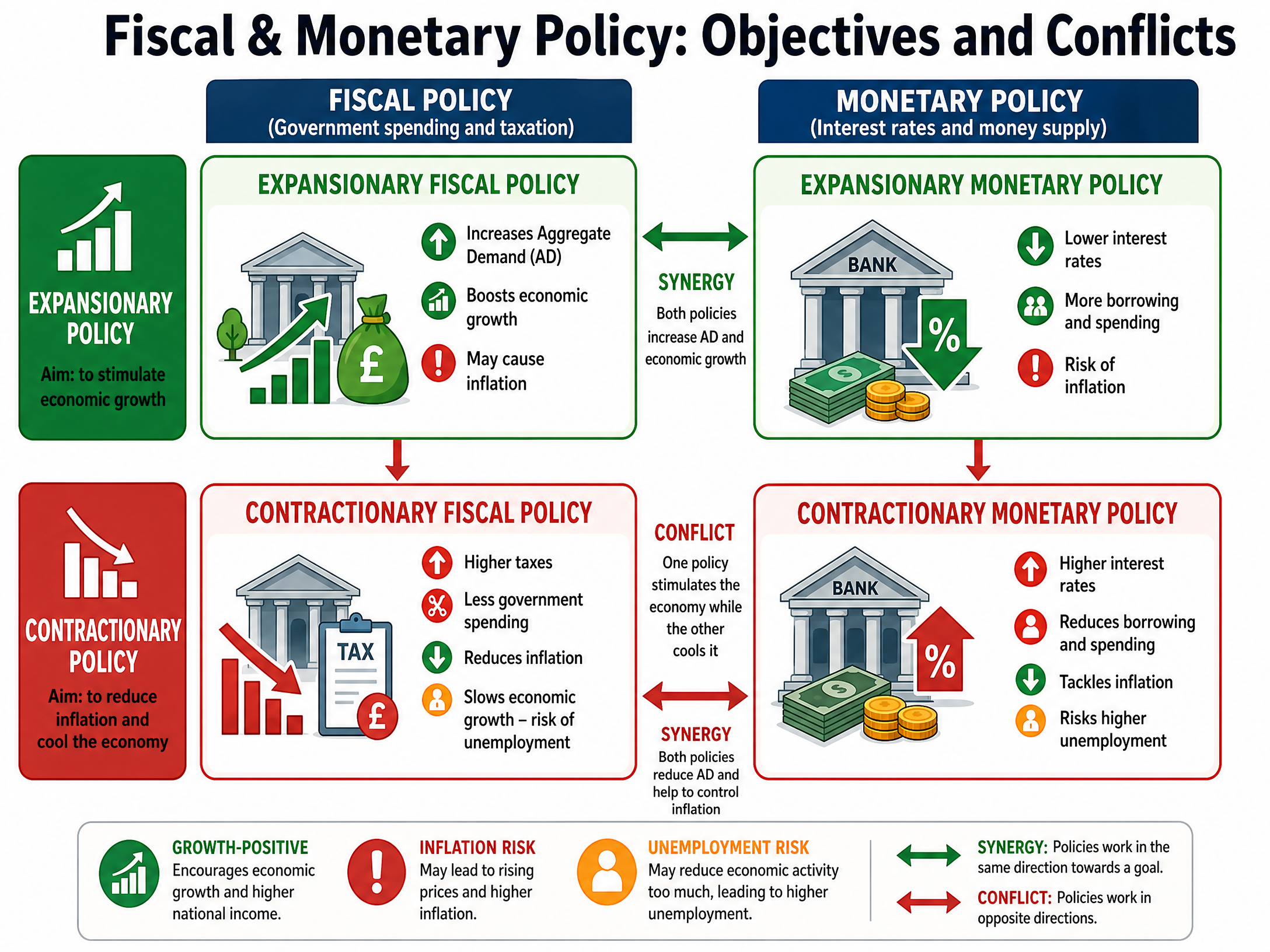
- Expansionary Fiscal Policy: Lower taxes and/or higher spending. Aimed at boosting aggregate demand (AD), stimulating growth, and reducing unemployment.
- Contractionary Fiscal Policy: Higher taxes and/or lower spending. Aimed at reducing AD to control inflation or reduce a budget deficit.
Monetary Policy
Controlled by the central bank (e.g., the Bank of England), this involves changes to interest rates and the money supply.
- Expansionary Monetary Policy: Lower interest rates. Makes borrowing cheaper, encouraging spending and investment to boost growth.
- Contractionary Monetary Policy: Higher interest rates. Makes borrowing more expensive, reducing spending to cool down inflation.
Policy Conflicts
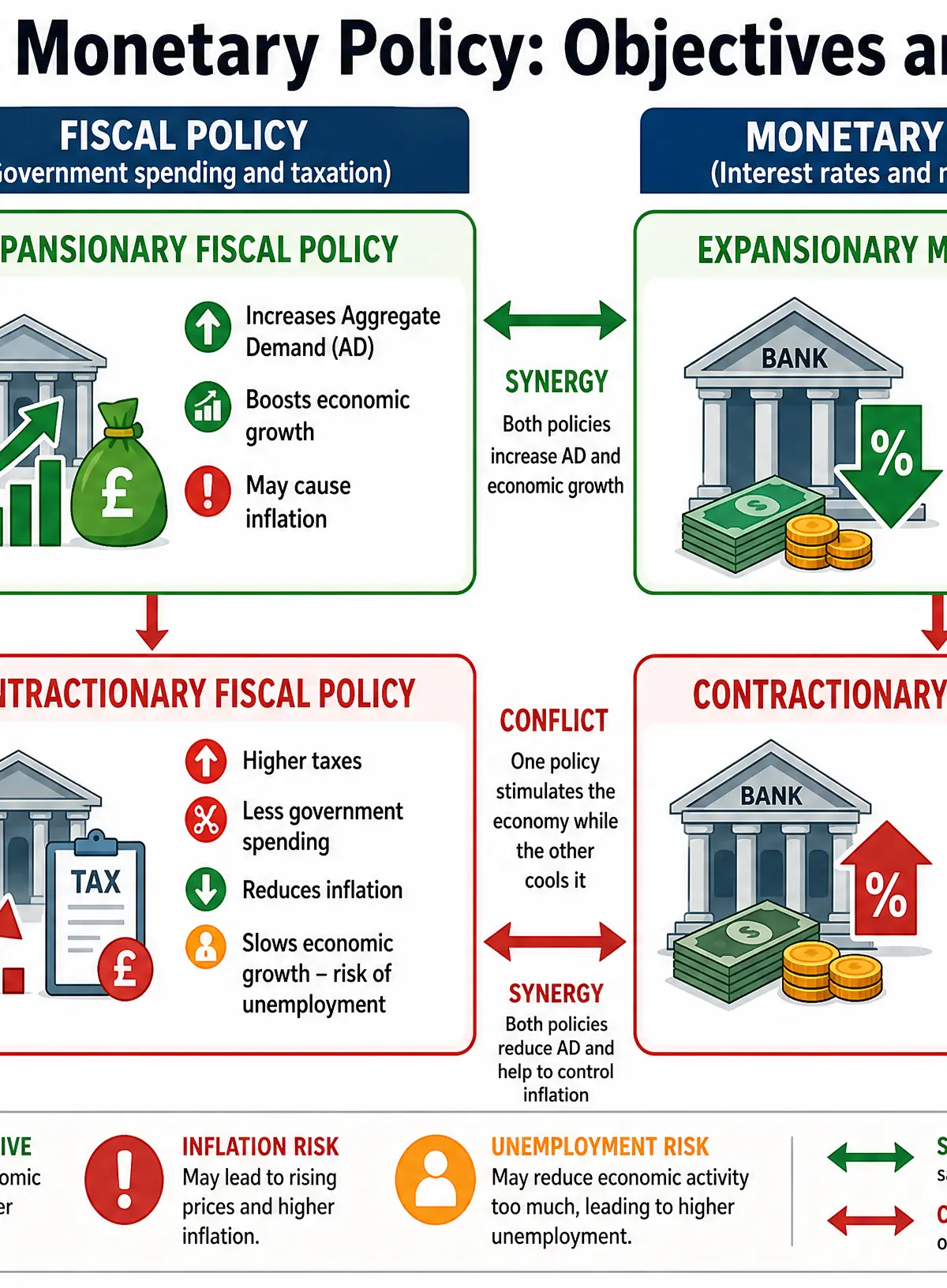
The central challenge in macroeconomic management is that achieving one objective often conflicts with another. Examiners frequently test your understanding of these conflicts.
1. Economic Growth vs. Low Inflation
This is the most common conflict. If the government uses expansionary policies (e.g., cutting interest rates or increasing spending) to stimulate economic growth, aggregate demand increases. If the economy is close to full capacity, this extra demand pushes up prices, leading to demand-pull inflation.
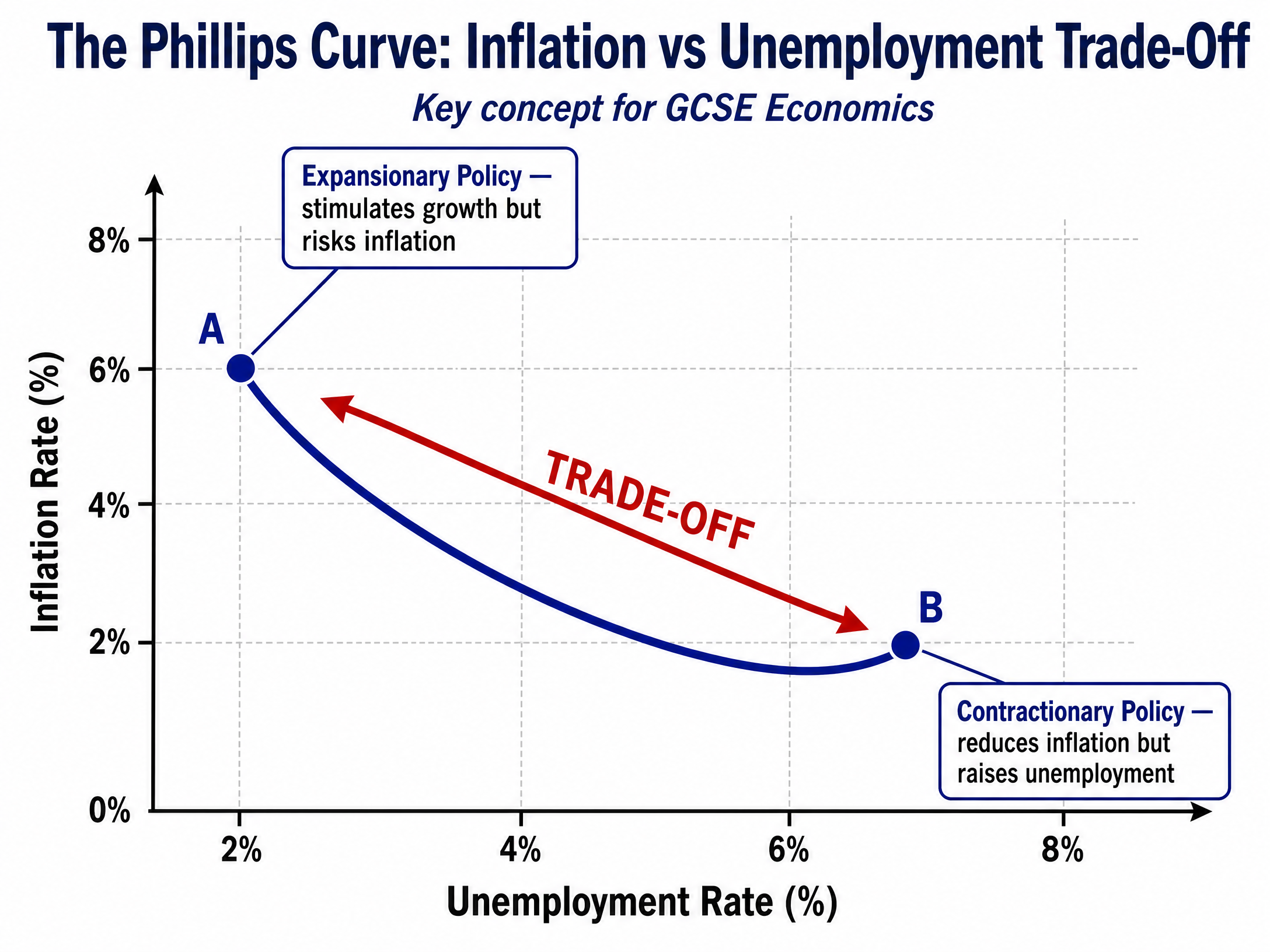
2. Low Unemployment vs. Low Inflation (The Phillips Curve)
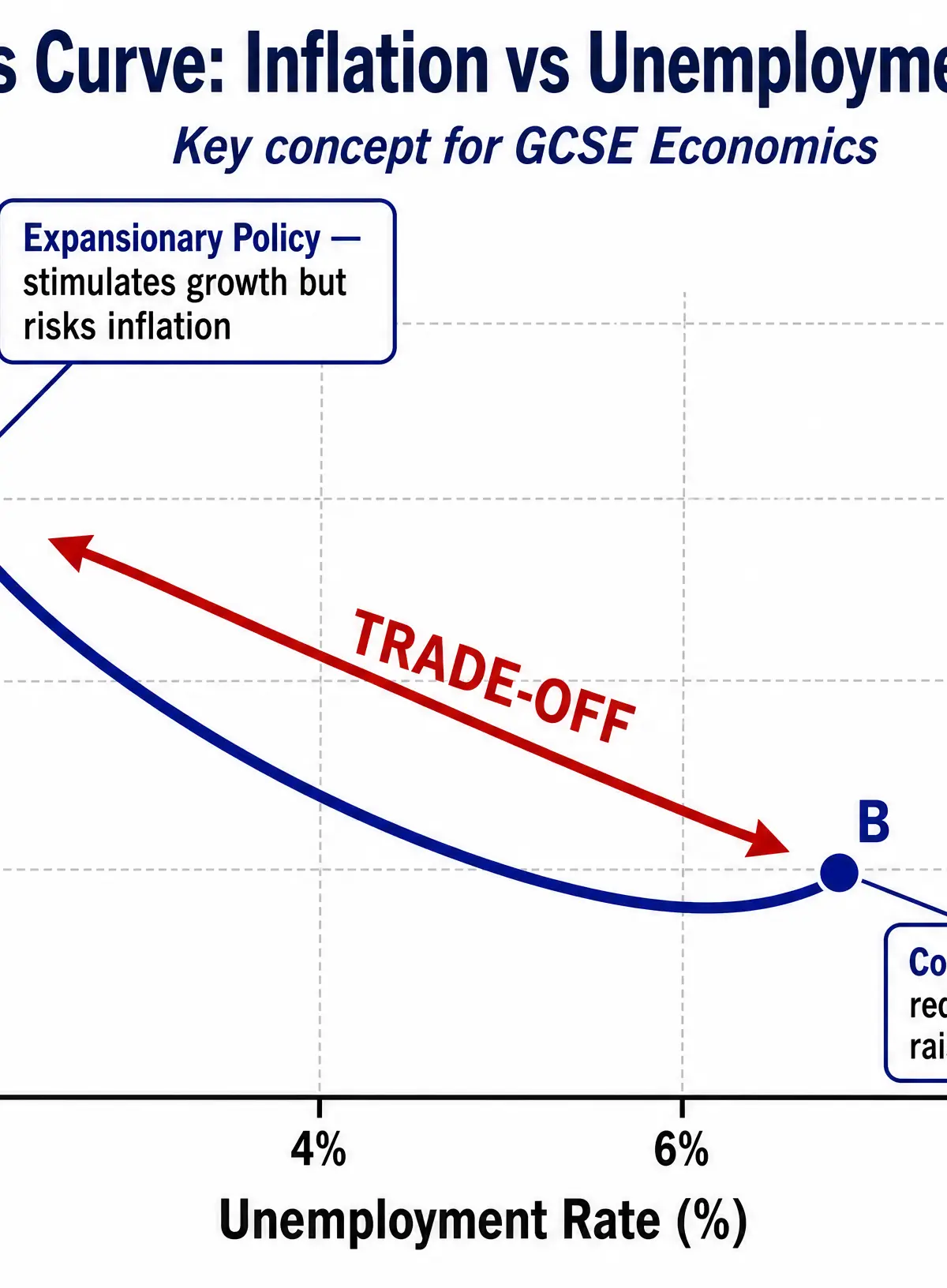
As unemployment falls, the labour market tightens. Firms have to offer higher wages to attract workers. These higher costs are passed on to consumers as higher prices (cost-push inflation). Conversely, if the government uses contractionary policy to reduce inflation, it slows the economy down, leading to job losses and higher unemployment.
3. Economic Growth vs. Balance of Payments
When the economy grows rapidly, consumers have higher incomes. In the UK, a significant portion of this extra income is spent on imported goods. This surge in imports can worsen the current account deficit on the balance of payments.
Policy Synergies
Not all objectives conflict. Sometimes, achieving one objective helps achieve another. This is called a synergy.
1. Economic Growth and Low Unemployment
These two objectives almost always work together. As the economy grows and firms produce more output, they need to hire more workers, thus reducing unemployment.
2. The Role of Supply-Side Policies
Supply-side policies (e.g., education, training, deregulation, infrastructure investment) aim to increase the productive capacity of the economy (shifting aggregate supply to the right).
Examiner Tip: Supply-side policies are the "magic bullet" in evaluation questions because they can achieve multiple objectives simultaneously. By increasing capacity, they allow for economic growth and lower unemployment without causing inflation, resolving the classic demand-side conflicts.
Evaluating Policy Effectiveness
To secure Level 3 and Level 4 marks, you must evaluate how effective these policies are in reality. Key evaluative points include:
- Time Lags: Monetary policy changes (like interest rate cuts) can take 12-24 months to fully impact the economy. Fiscal policy takes time to legislate and implement. By the time a policy takes effect, the economic situation may have changed.
- Ceteris Paribus: The assumption that "all other things remain equal." In reality, external shocks (like a global pandemic or an energy crisis) can undermine domestic policies.
- Magnitude of the Change: A small change in interest rates (e.g., 0.25%) might not be enough to change consumer behaviour if confidence is very low.
- Consumer and Business Confidence: Expansionary policy won't work if people are too scared about the future to spend or invest.
Visual Resources
2 diagrams and illustrations
Interactive Diagrams
1 interactive diagram to visualise key concepts
Conceptual Flow Outline
Flowchart showing the transmission mechanism, synergies, and conflicts of Expansionary Fiscal Policy.
Worked Examples
2 worked examples — open one to explore the question and available guidance.
Practice Questions
Test your understanding — click to reveal model answers
Explain one reason why a government might choose not to use expansionary fiscal policy during a period of high unemployment. (4 marks)
Hint: Think about the conflicts. What negative side effect does expansionary fiscal policy have?
Discuss whether monetary policy is the most effective way to resolve a conflict between economic growth and inflation. (9 marks)
Hint: You need to explain how monetary policy works to control inflation, its drawbacks (it hurts growth), and suggest an alternative (supply-side policies).