Pearson Edexcel · GCSE · Economics
The economic problem
The economic problem is the fundamental issue that drives all economic decision-making: how to allocate scarce resources to satisfy unlimited human wants. Understanding this core concept is essential, as it underpins every topic in GCSE Economics and explains why individuals, businesses, and governments must constantly make choices.
- 4 min read
- 3 worked examples
- 5 practice questions
- 6 key terms
Study Notes
Overview
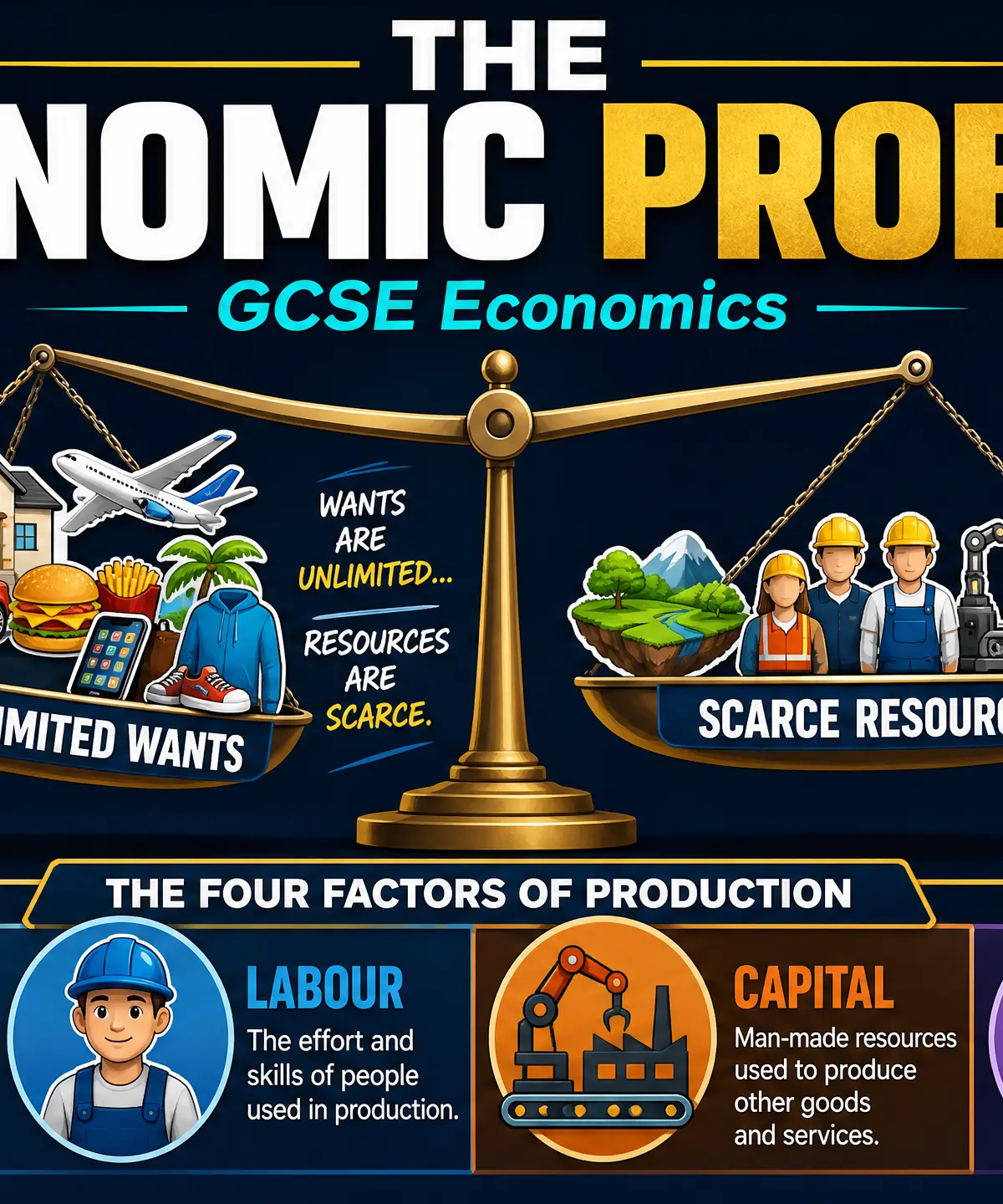
The economic problem is the foundation of all economics. It arises from a fundamental tension: human wants are infinite, but the resources available to satisfy those wants (the factors of production) are finite. This creates scarcity. Because we cannot have everything we want, we are forced to make choices. Every time a choice is made, something else is given up. This is known as opportunity cost.
Examiners expect candidates to clearly distinguish between 'needs' (essential for survival, like water) and 'wants' (desires, like a new smartphone), and to explicitly link the concept of scarcity to the necessity of choice.
The Fundamental Concepts
Scarcity
Definition: The basic economic problem that arises because human wants are unlimited but the resources available to satisfy those wants are finite.
Why it matters: Scarcity is the reason economics exists. Without scarcity, there would be no need to make choices about resource allocation. Examiners frequently test your ability to define scarcity accurately — you must mention both the unlimited wants and finite resources to secure full marks.
Needs vs Wants
Needs: Goods or services essential for human survival (e.g., food, water, basic clothing, shelter).
Wants: Goods or services that people desire but are not essential for survival (e.g., designer clothes, holidays, gaming consoles).
Impact: While needs are limited, wants are infinite. As soon as one want is satisfied, another arises.
The Factors of Production
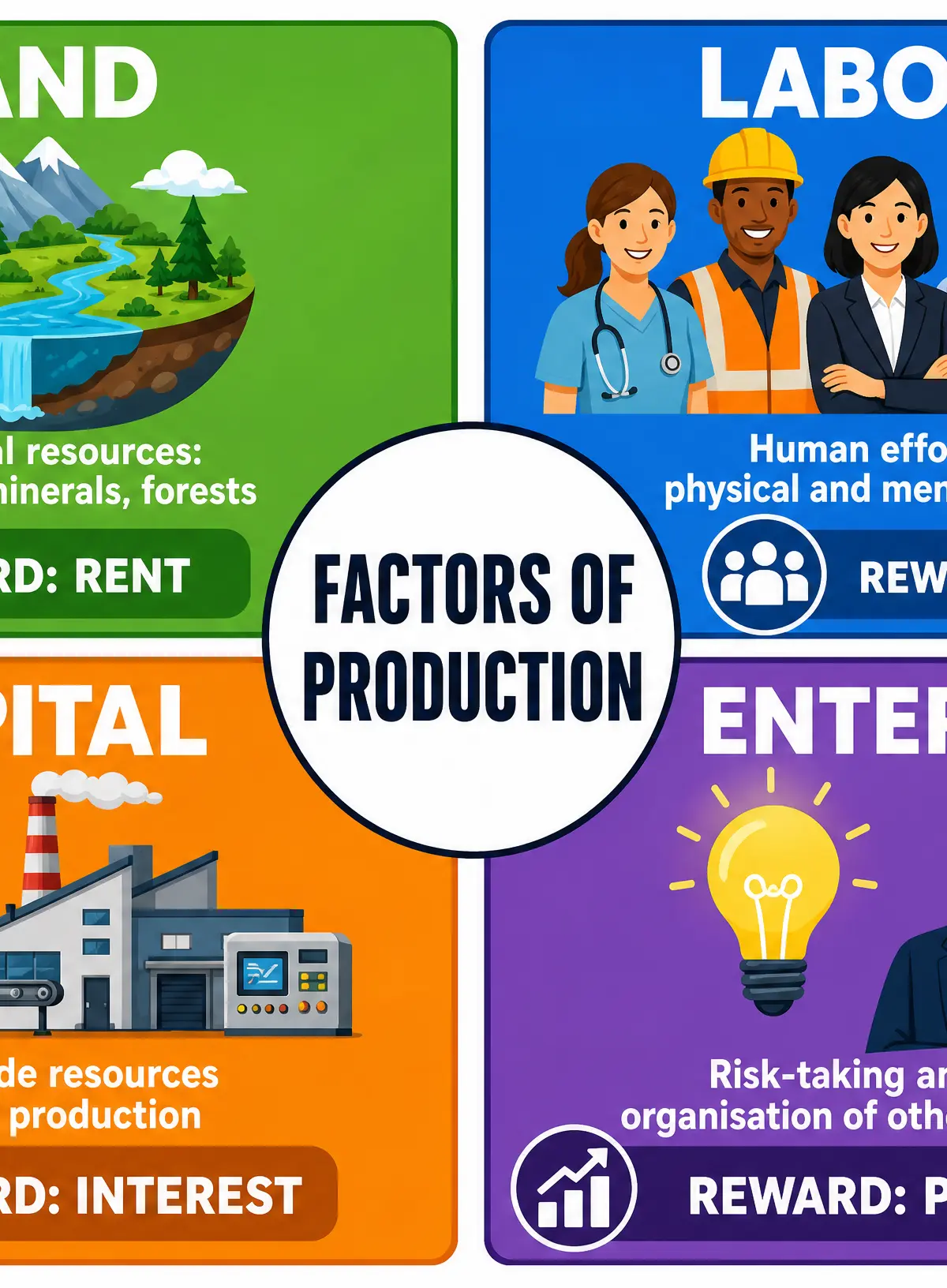
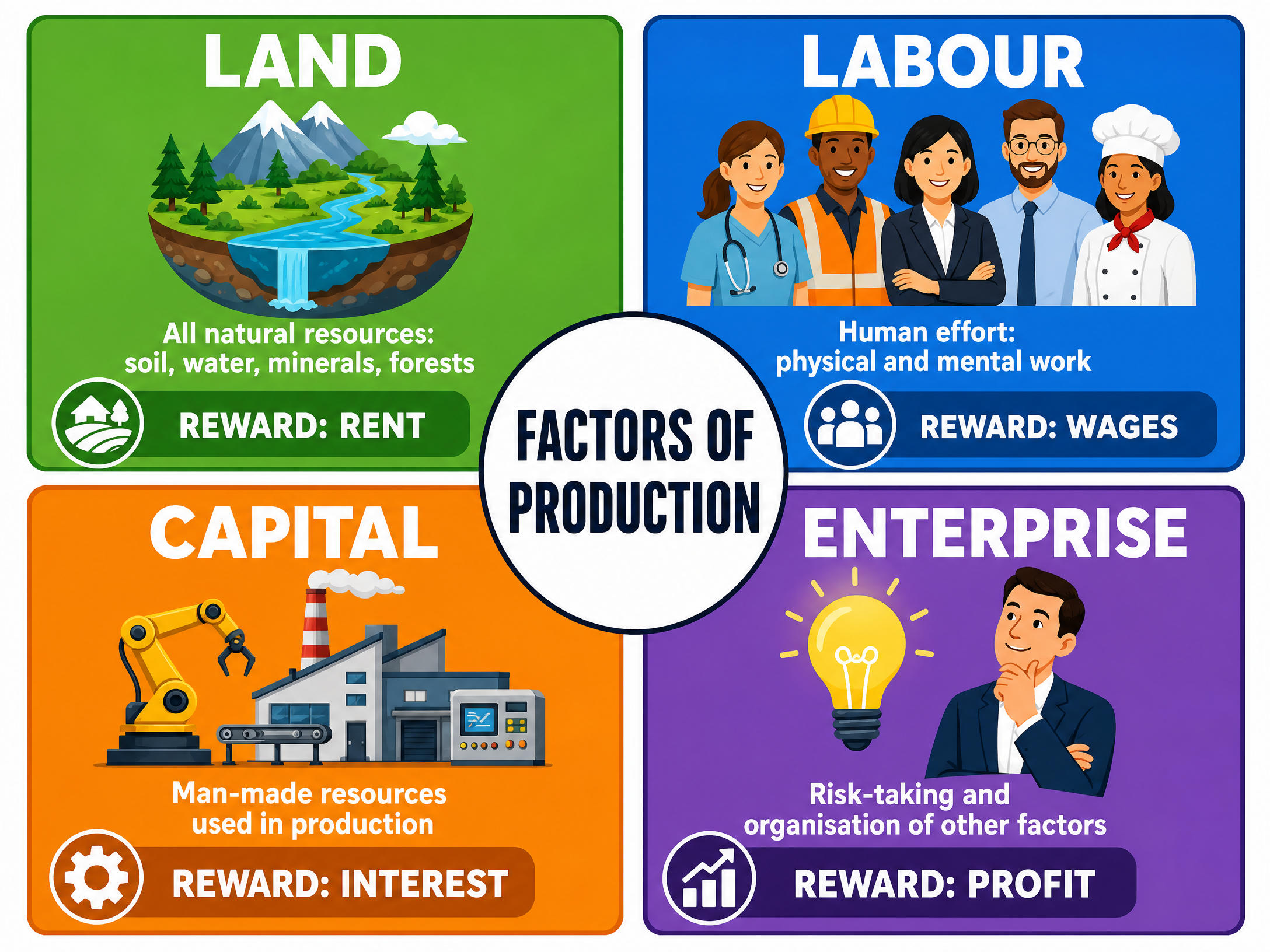
To produce the goods and services that satisfy our wants, economies use resources. These are categorised into the four Factors of Production.
1. Land
Role: All natural resources provided by the earth.
Examples: Agricultural soil, forests, oceans, minerals, oil, gas.
Reward: Rent.
2. Labour
Role: The human effort — both physical and mental — used in the production of goods and services.
Examples: A factory worker, a teacher, a surgeon, a software developer.
Reward: Wages (or salaries).
3. Capital
Role: Man-made resources used to produce other goods and services.
Examples: Machinery, factory buildings, computers, tools, delivery vehicles.
Examiner Tip: Never confuse economic capital with money/financial capital!
Reward: Interest.
4. Enterprise
Role: The willingness to take risks and the organisation of the other three factors of production to create a good or service.
Examples: Entrepreneurs like Richard Branson or a local bakery owner.
Reward: Profit.
Opportunity Cost
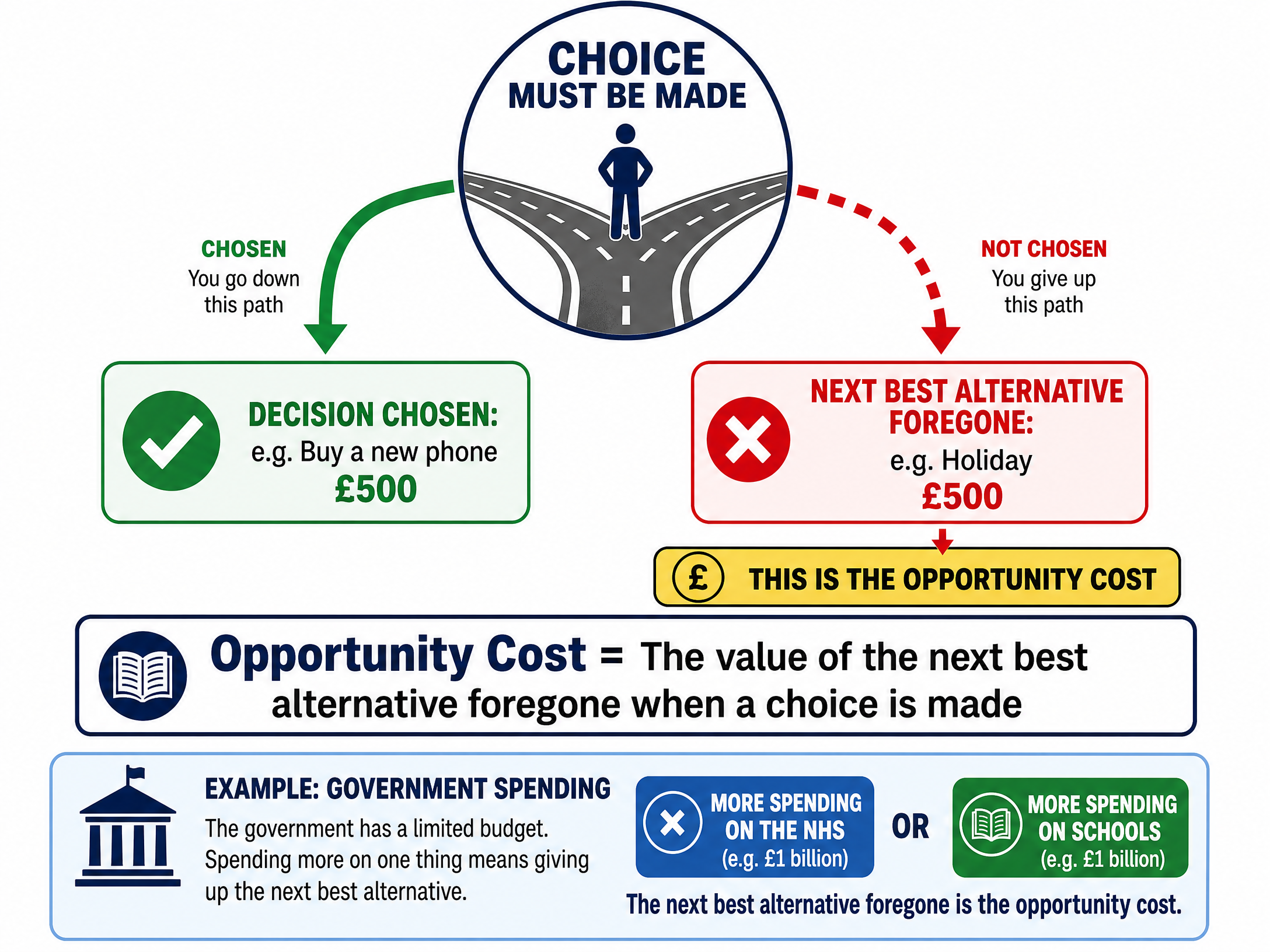
Because resources are scarce, choices must be made. Every choice involves an opportunity cost.
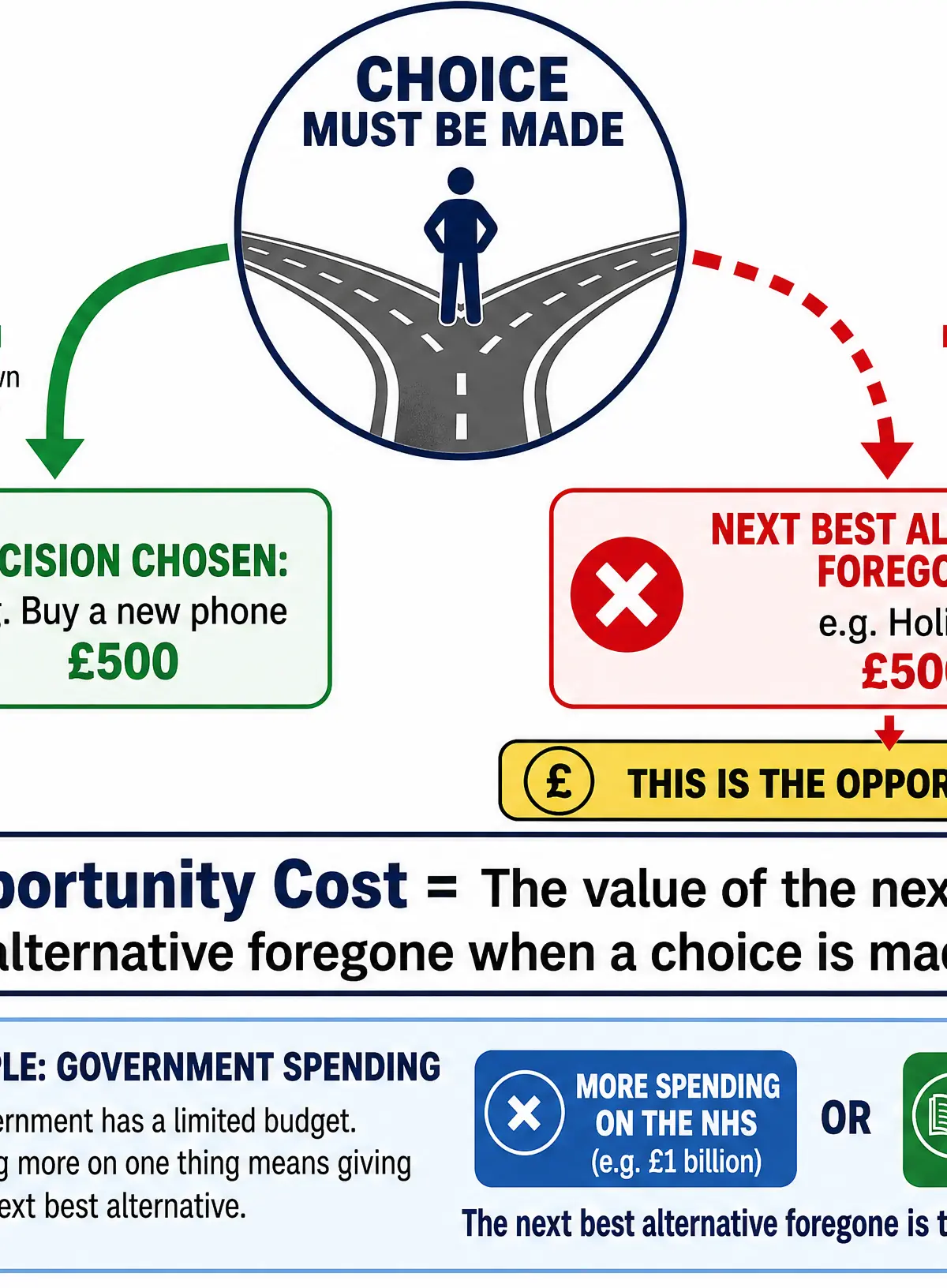
Definition: The value of the next best alternative foregone when a choice is made.
Application: Opportunity cost applies to all economic agents:
- Individuals: Choosing to spend £50 on a concert ticket means the opportunity cost is the new video game you could have bought instead.
- Businesses: Choosing to invest in a new marketing campaign means the opportunity cost is the new machinery that could have been purchased.
- Governments: Choosing to spend £1 billion on the NHS means the opportunity cost is the new schools that could have been built with that money.
Audio Revision
Listen to our comprehensive 8-minute revision podcast covering all the essential concepts of The Economic Problem.

Visual Resources
2 diagrams and illustrations
Interactive Diagrams
1 interactive diagram to visualise key concepts
Conceptual Flow Outline
Flowchart showing the logical progression from Scarcity to Opportunity Cost
Worked Examples
3 worked examples — open one to explore the question and available guidance.
Practice Questions
Test your understanding — click to reveal model answers
Identify two factors of production and state the reward for each. (4 marks)
Hint: Remember the acronym LLCE and RWIP.
A student has £20 and decides to buy a revision guide instead of going to the cinema. Explain the opportunity cost of this decision. (3 marks)
Hint: Define opportunity cost and apply it directly to the scenario.
Explain why capital is considered a scarce resource. (3 marks)
Hint: Think about what capital actually is in economics, and why we can't have an infinite amount of it.
State which factor of production involves taking risks to organise production. (1 mark)
Hint: Which factor brings the other three together?
Assess the importance of opportunity cost for a business deciding whether to expand its factory. (9 marks)
Hint: Define opportunity cost, apply it to the business, explain why considering it leads to better decisions, and evaluate if other factors might also be important.