Pearson Edexcel · GCSE · Economics
The global economy
The global economy is the interconnected system of international trade, finance, and production that shapes the modern world. Understanding it is crucial for explaining everything from the price of consumer goods to the impact of international organisations on national economies.
- 4 min read
- 3 worked examples
- 5 practice questions
- 6 key terms
Study Notes
Overview
The global economy refers to the interconnected system of trade, finance, and production that links the nations of the world. For GCSE Economics, this topic is vital because it explains how countries interact, why they trade, and the impacts of globalisation. Examiners expect candidates to understand key concepts like comparative advantage, exchange rates, and protectionism, and to evaluate the role of international organisations such as the WTO and the IMF. Strong answers will use real-world examples, such as the US-China trade war or Brexit, to illustrate economic theories.
Podcast Episode
Listen to our comprehensive 12-minute revision podcast covering all the key concepts in this topic:

Key Concepts & Theories
International Trade and Specialisation
Definition: The exchange of goods and services between countries.
Why it matters: Countries trade because no single nation can efficiently produce everything its population needs. By specialising in goods where they have an advantage, countries can increase total global output and living standards.
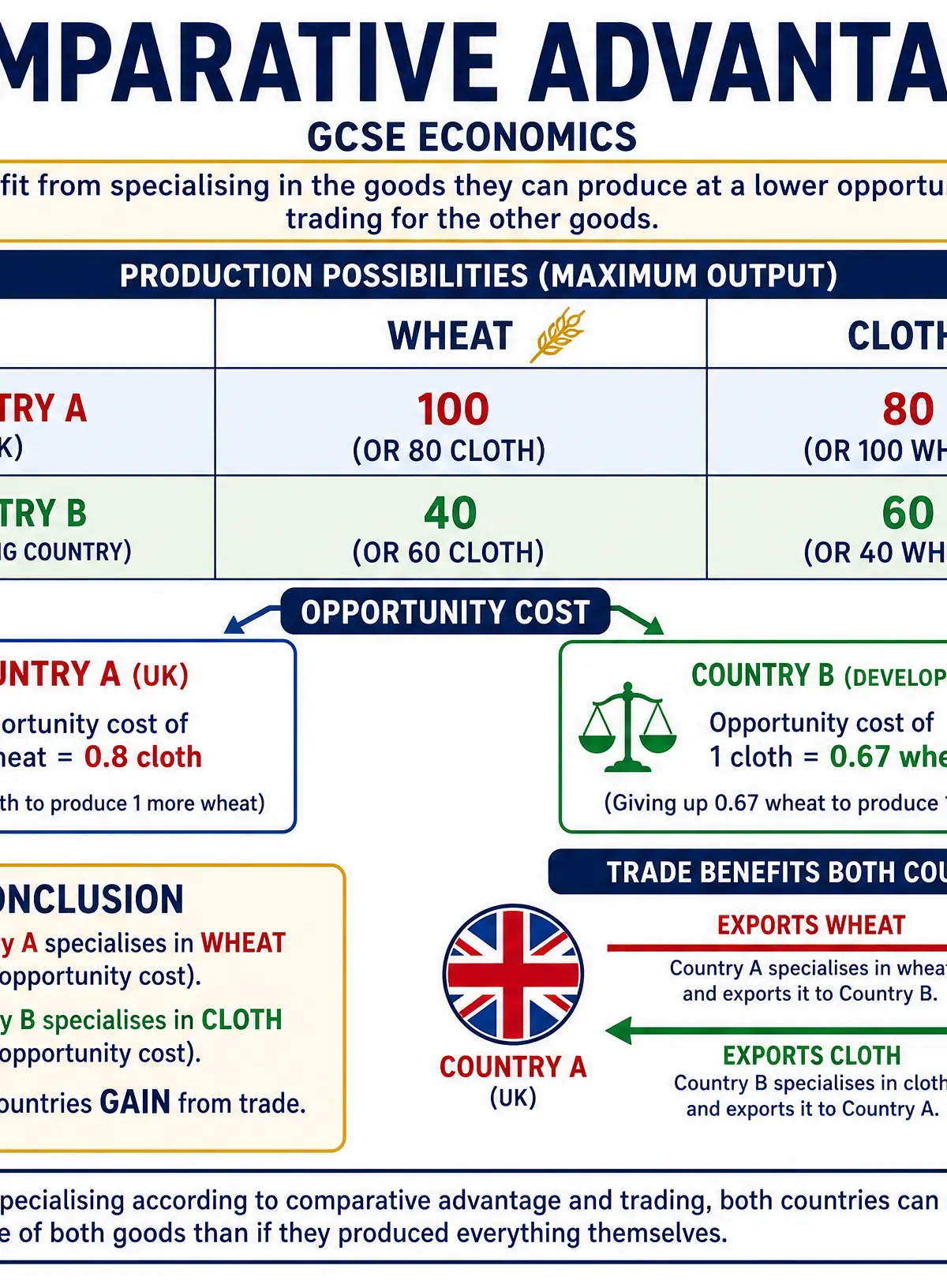
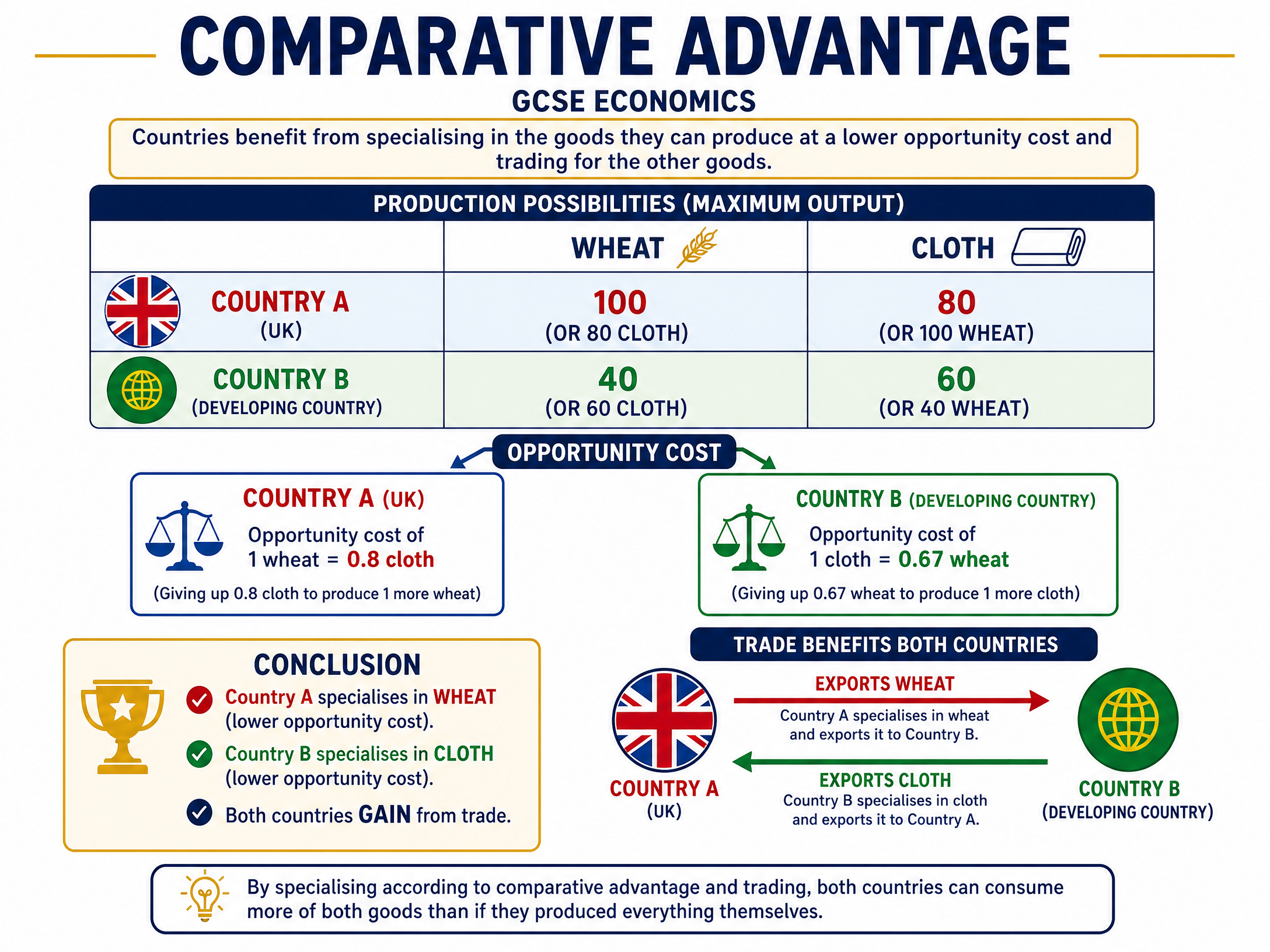
Specific Knowledge: Candidates must understand both absolute advantage (being able to produce more of a good with the same resources) and comparative advantage (producing a good at a lower opportunity cost).
Globalisation
Definition: The increasing integration and interdependence of the world's economies, cultures, and populations.
Why it matters: Globalisation has transformed the global economy since the 1990s. It is driven by improvements in transport (e.g., containerisation), communication (the internet), and the growth of multinational corporations (MNCs).
Specific Knowledge:
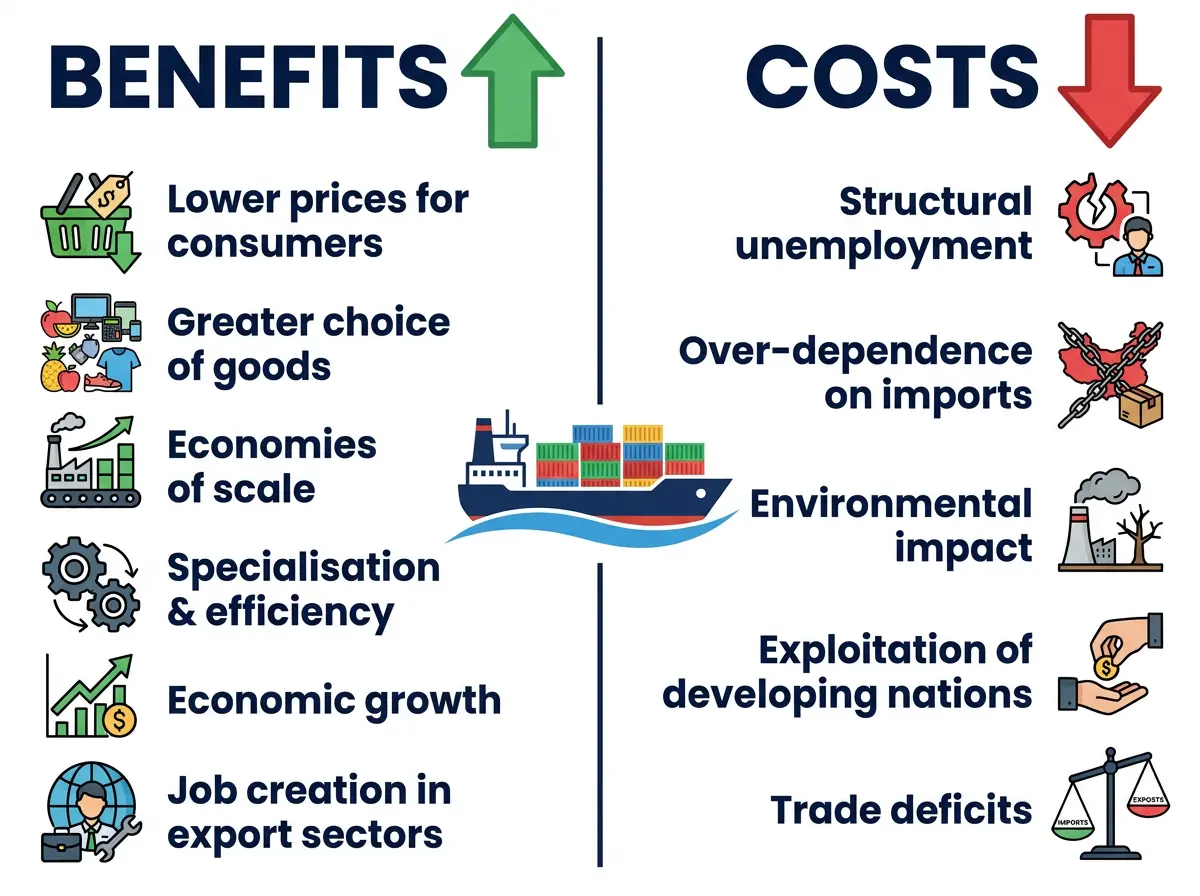
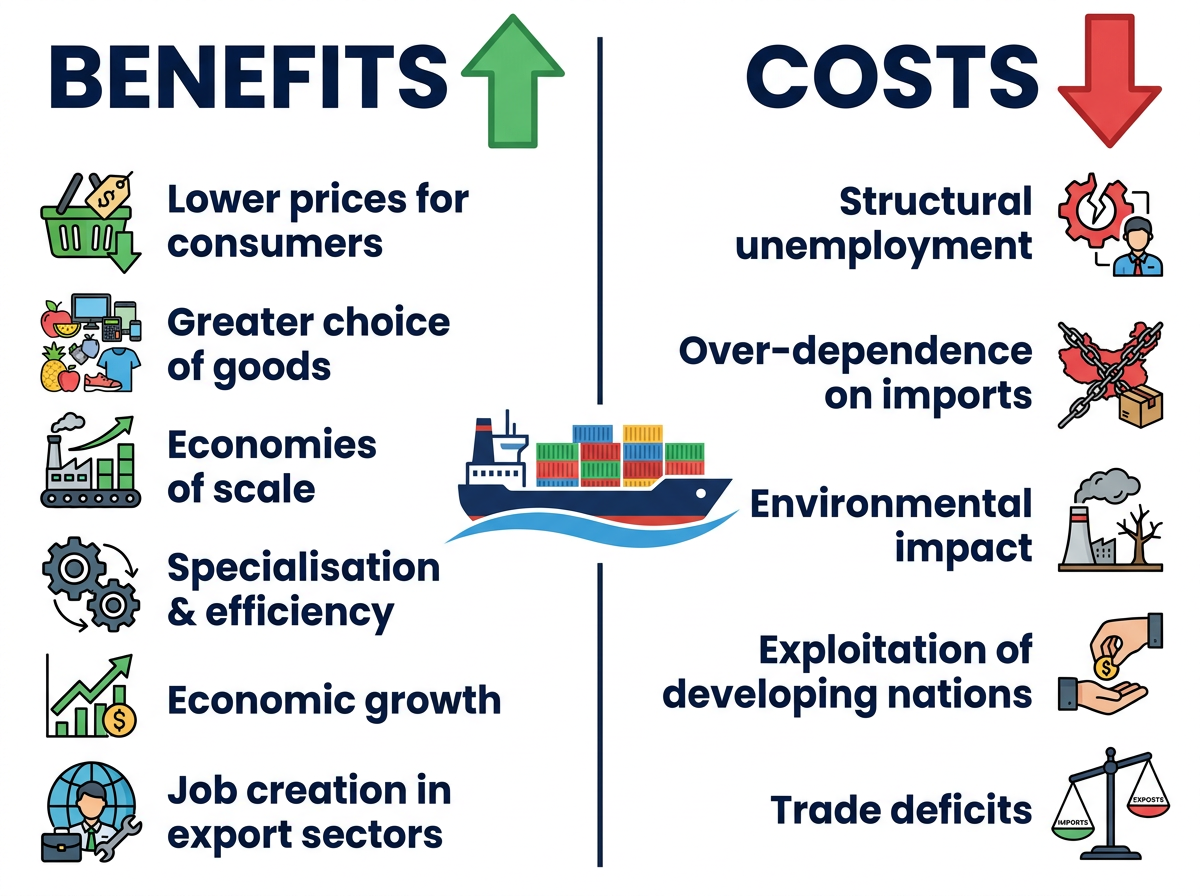
- Benefits: Lower prices, greater choice, economies of scale, and economic growth in developing nations.
- Costs: Structural unemployment in developed nations, environmental degradation, and exploitation of workers.
Protectionism
Definition: Government policies that restrict international trade to help domestic industries.
Why it matters: Despite the benefits of free trade, governments often intervene to protect jobs, shield infant industries, or correct trade deficits.
Specific Knowledge: The main methods are:
- Tariffs: Taxes on imports.
- Quotas: Physical limits on the volume of imports.
- Embargoes: Complete bans on trade.
Exchange Rates
Definition: The price of one currency in terms of another.
Why it matters: Exchange rates determine the price of exports and imports.
Specific Knowledge: Use the acronym SPICED (Strong Pound Imports Cheap Exports Dear) and WPIDEC (Weak Pound Imports Dear Exports Cheap). A depreciation of the pound makes UK exports cheaper and more competitive, but increases the cost of imported goods.
Key International Organisations
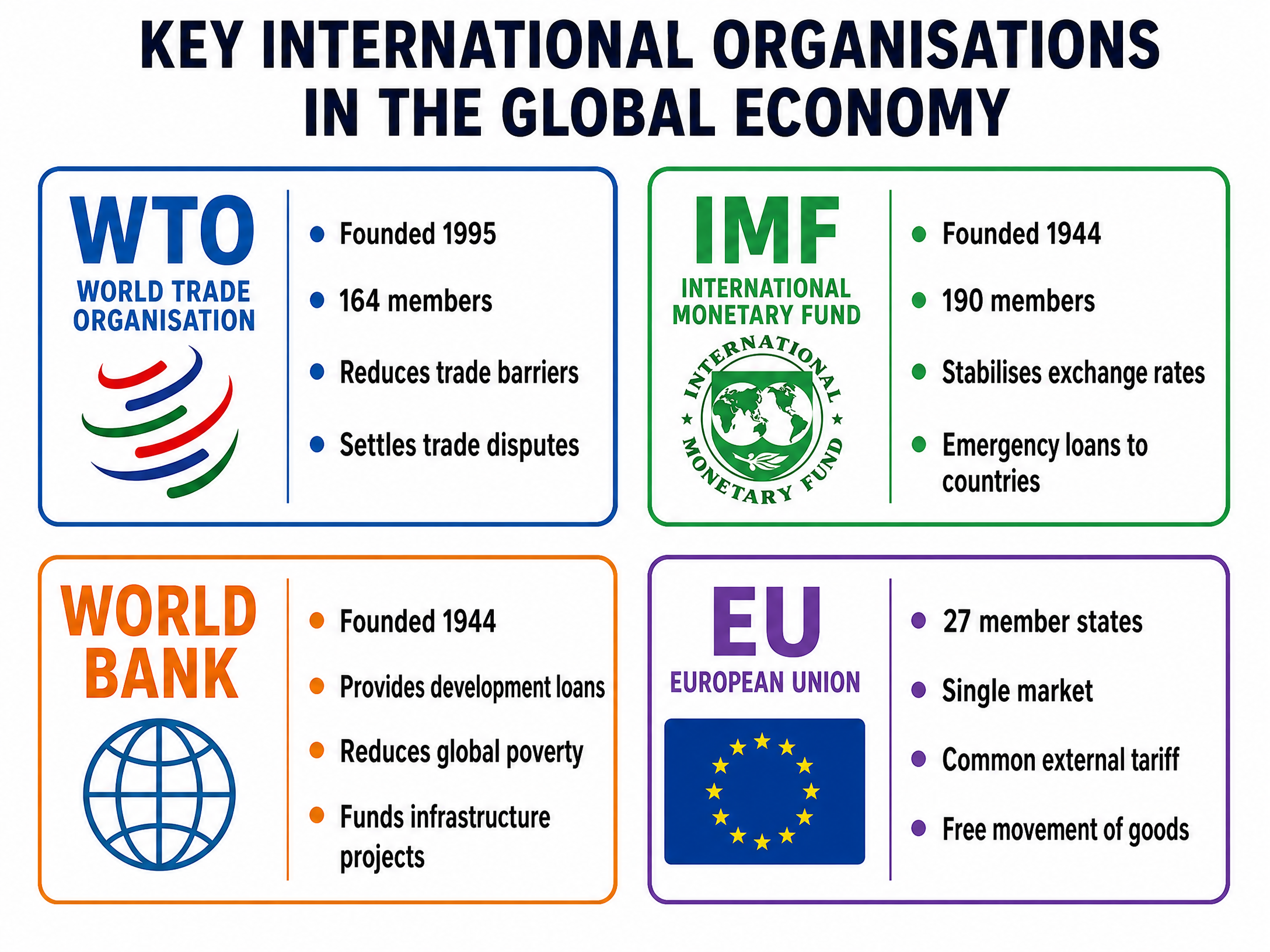
World Trade Organisation (WTO)
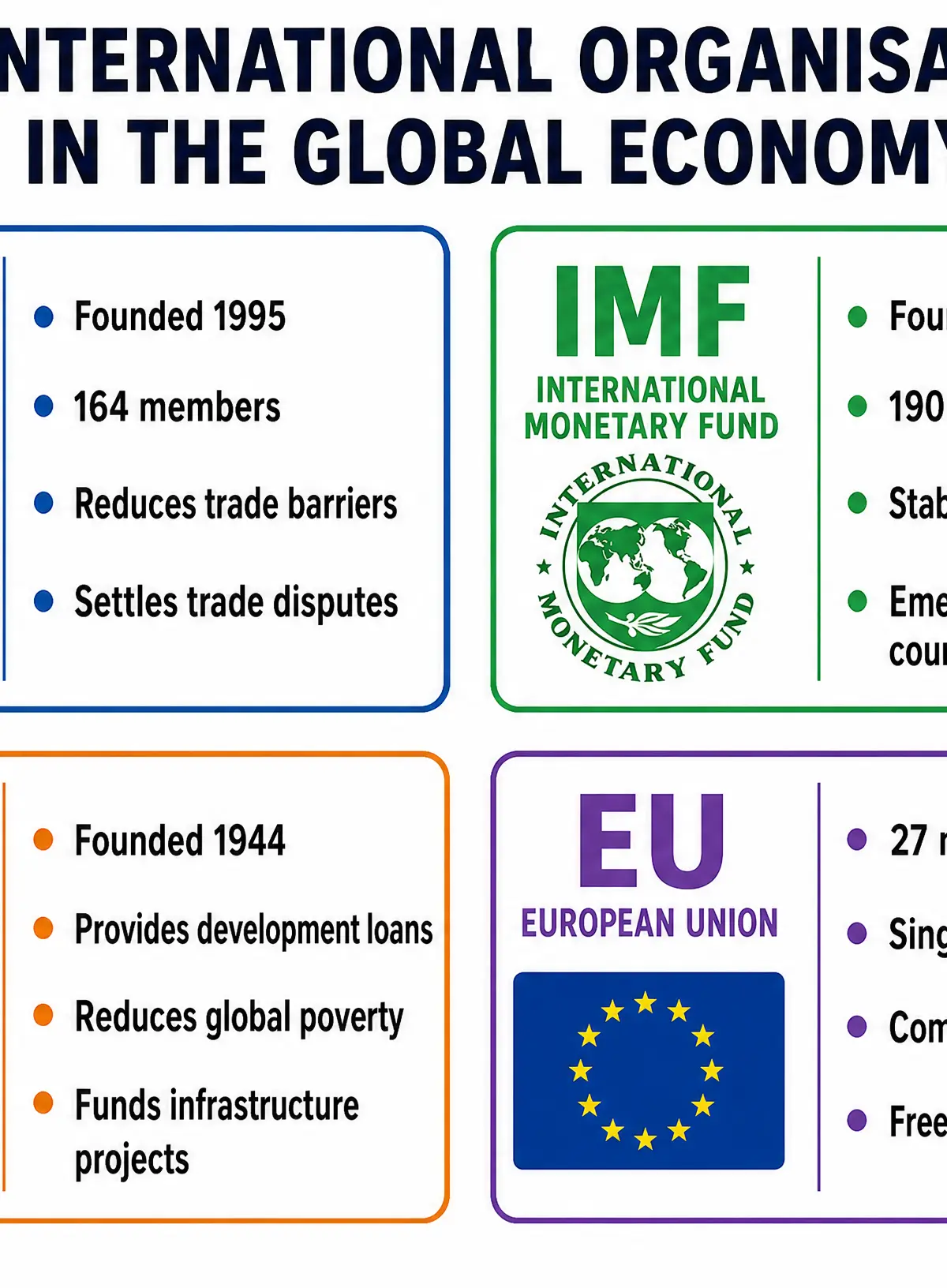
Role: Promotes free trade and settles trade disputes.
Specific Knowledge: Founded in 1995, 164 members. It acts as the global referee for international trade.
International Monetary Fund (IMF)
Role: Ensures the stability of the international monetary system.
Specific Knowledge: Founded in 1944, 190 members. Provides emergency loans to countries facing balance of payments crises (e.g., Greece in 2010).
World Bank
Role: Provides long-term loans and grants to developing countries.
Specific Knowledge: Focuses on reducing poverty and funding infrastructure projects like schools and hospitals.
European Union (EU)
Role: An economic and political union operating a single market.
Specific Knowledge: 27 member states. Features free movement of goods, services, capital, and labour, and a common external tariff.
Visual Resources
3 diagrams and illustrations
Interactive Diagrams
1 interactive diagram to visualise key concepts
Conceptual Flow Outline
Chain of reasoning: The impact of a tariff
Worked Examples
3 worked examples — open one to explore the question and available guidance.
Practice Questions
Test your understanding — click to reveal model answers
Define the term 'quota'. (2 marks)
Hint: Think about physical limits.
Explain how the World Trade Organisation (WTO) promotes free trade. (4 marks)
Hint: Think about agreements and disputes.
Evaluate the impact of a significant appreciation of the pound sterling on the UK economy. (12 marks)
Hint: Use SPICED. Consider impacts on the current account, inflation, and economic growth.
Explain the concept of comparative advantage. (4 marks)
Hint: Focus on opportunity cost.
Assess the reasons why a government might choose to protect its domestic industries. (9 marks)
Hint: Think about jobs, new industries, and trade deficits.