Pearson Edexcel · GCSE · Economics
The labour market
The labour market is the engine of the economy, determining wages, employment, and living standards. Understanding it is crucial for explaining everything from the gender pay gap to the impact of immigration, making it a highly examinable and real-world relevant topic.
- 5 min read
- 3 worked examples
- 5 practice questions
- 6 key terms
Study Notes
Overview

The labour market is a fundamental component of any economy. It is a factor market where the services of workers (labour) are bought and sold. In this market, firms are the buyers (demanding labour to produce goods and services) and individuals are the sellers (supplying their time and skills). Understanding the labour market is critical because it explains how wages are determined, why some people earn more than others, and how government interventions like the National Minimum Wage affect employment. Examiners expect candidates to clearly distinguish between the demand and supply of labour, use accurately labelled diagrams, and evaluate the impacts of trade unions and minimum wages on different economic agents.
The Demand for Labour
Derived Demand
The most important concept to grasp is that the demand for labour is a derived demand. Firms do not demand labour for its own sake; they demand it because it is required to produce goods and services that consumers want to buy. If the demand for electric vehicles increases, the demand for workers who manufacture them will also increase.
Factors Shifting the Demand Curve
- Demand for the final product: As explained above (derived demand).
- Labour productivity: If workers become more productive (e.g., through better training or technology), they generate more revenue for the firm, shifting the demand curve to the right.
- Price of capital: If machinery (a substitute for labour) becomes cheaper, firms may replace workers with machines, shifting the demand for labour to the left.
The Supply of Labour
Individual vs. Market Supply
The supply of labour is the number of workers willing and able to work at a given wage rate. The market supply curve generally slopes upwards: as wage rates increase, more people are willing to enter the labour market or work longer hours.
Factors Shifting the Supply Curve
- Size of the working population: Influenced by birth rates, retirement ages, and migration.
- Migration: An influx of working-age immigrants shifts the supply curve to the right, increasing the available workforce.
- Non-monetary factors: Workers consider job satisfaction, working conditions, flexible hours, and career progression. Improvements in these areas can increase supply even if wages remain constant.
- Education and training: Increases the supply of skilled labour in specific markets.
Wage Determination
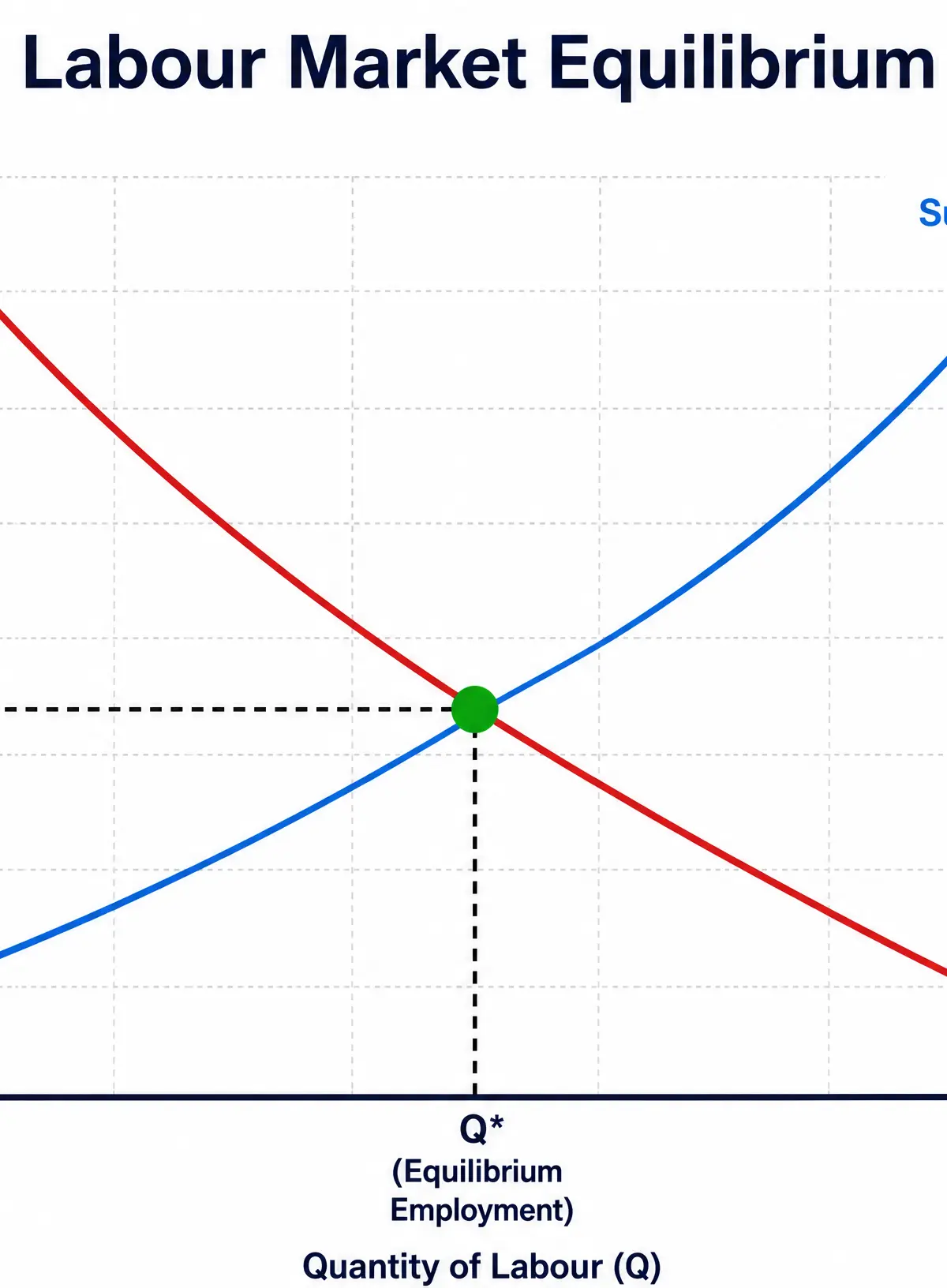
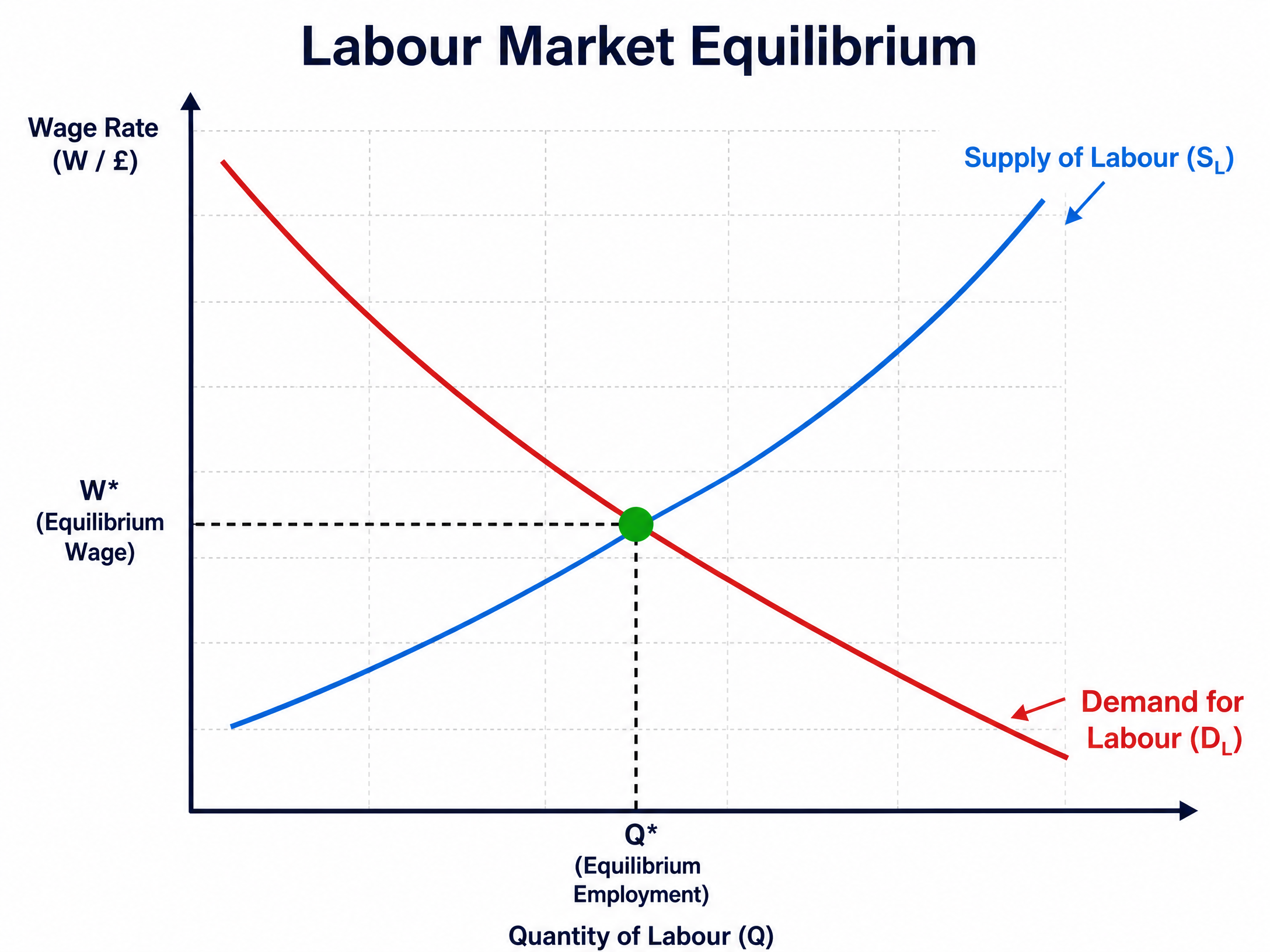
In a free market, the wage rate is determined by the intersection of the demand for labour and the supply of labour. This creates an equilibrium wage ($W^$) and an equilibrium quantity of employment ($Q^$).
If the demand for labour increases, the demand curve shifts to the right, leading to a higher equilibrium wage and higher employment. Conversely, an increase in the supply of labour shifts the supply curve to the right, leading to a lower equilibrium wage but higher employment.
Trade Unions
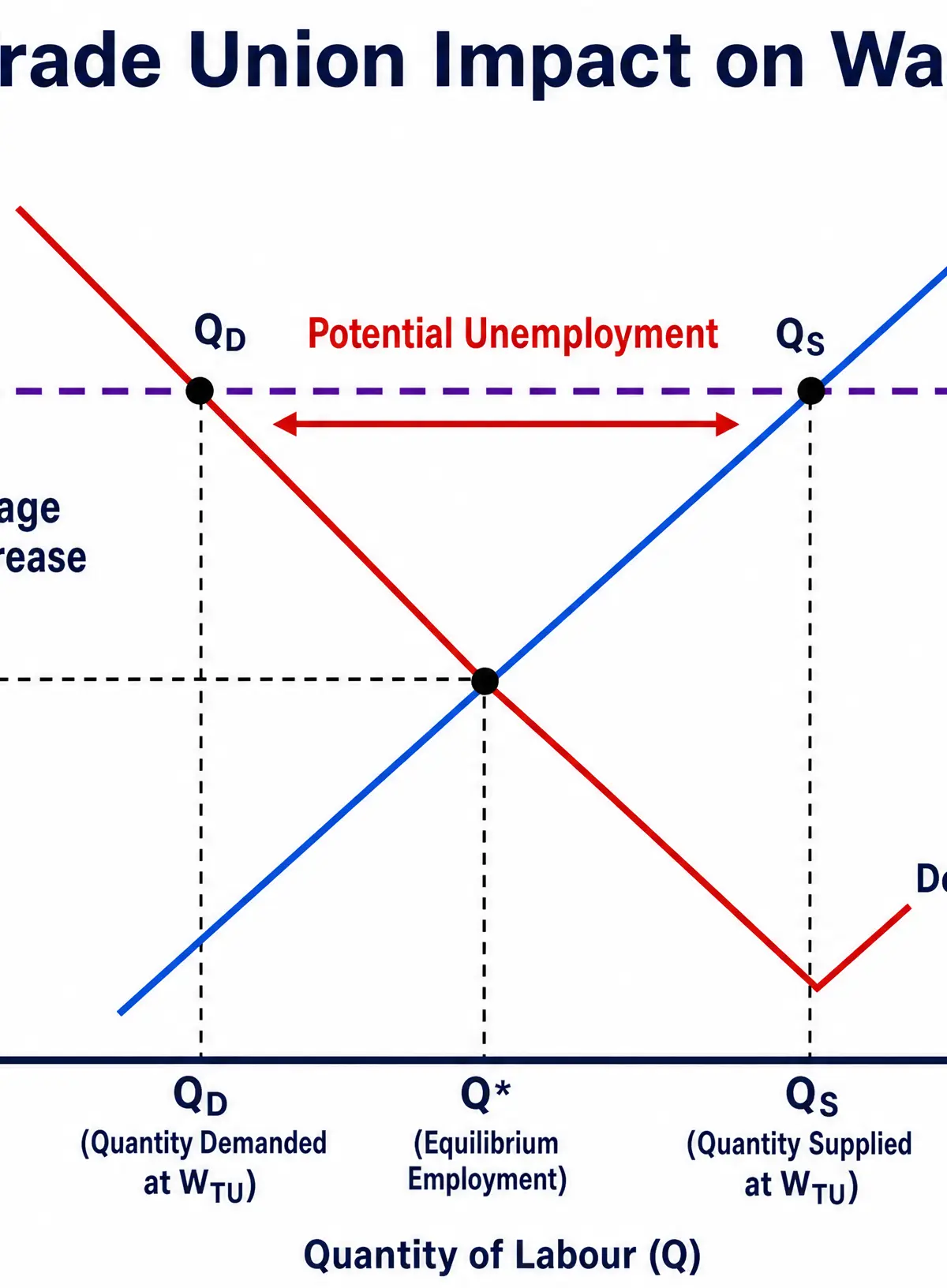
A trade union is an organisation that represents workers' interests, primarily negotiating for higher wages and better working conditions through collective bargaining.
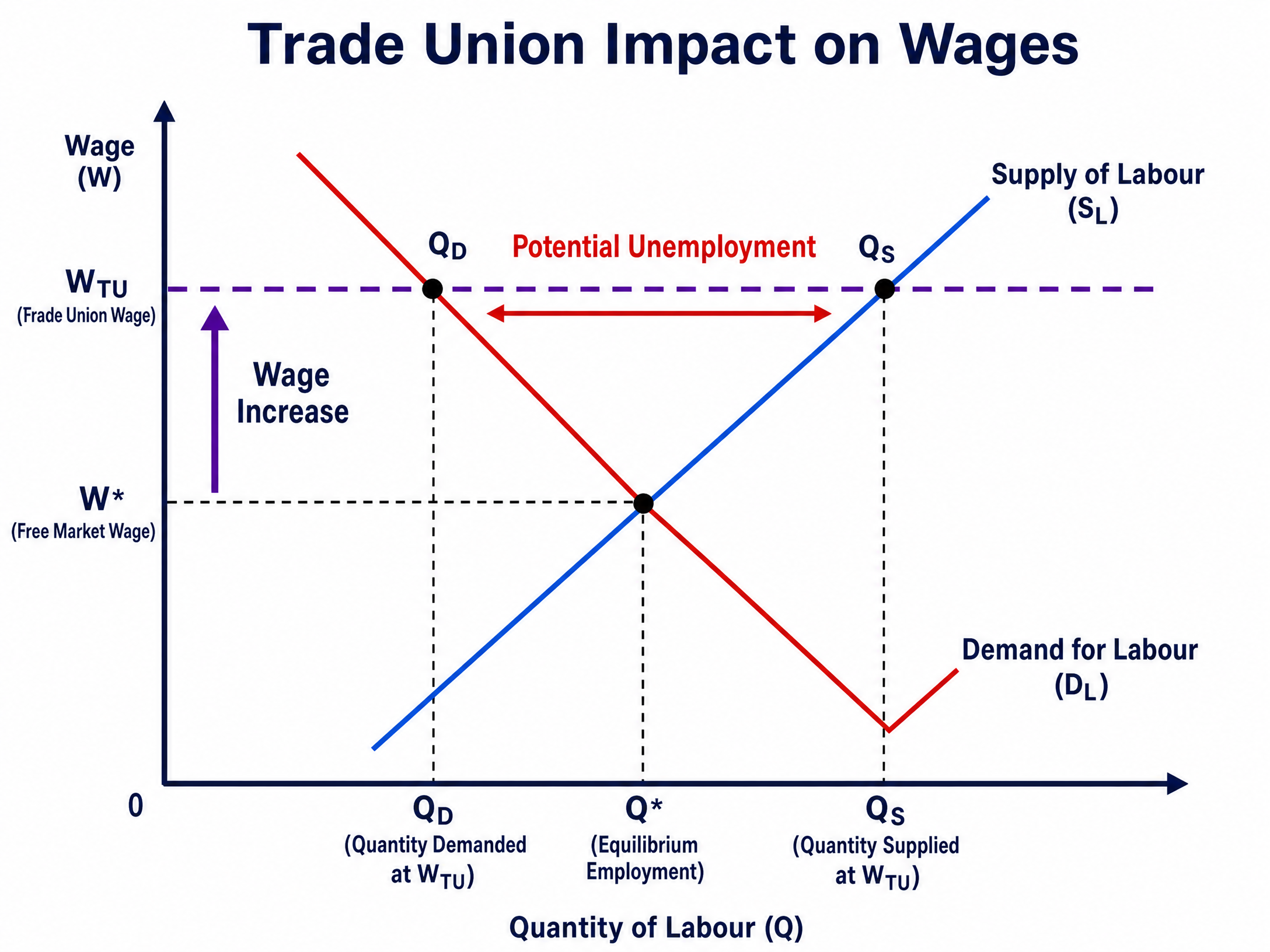
If a trade union successfully negotiates a wage rate (W_{TU}) above the free market equilibrium, it acts as a wage floor. At this higher wage, firms demand fewer workers (Q_D), but more workers are willing to supply their labour (Q_S). The gap between Q_S and Q_D represents potential unemployment. While workers who keep their jobs benefit from higher wages, others may lose their jobs or fail to find employment.
The National Minimum Wage (NMW)
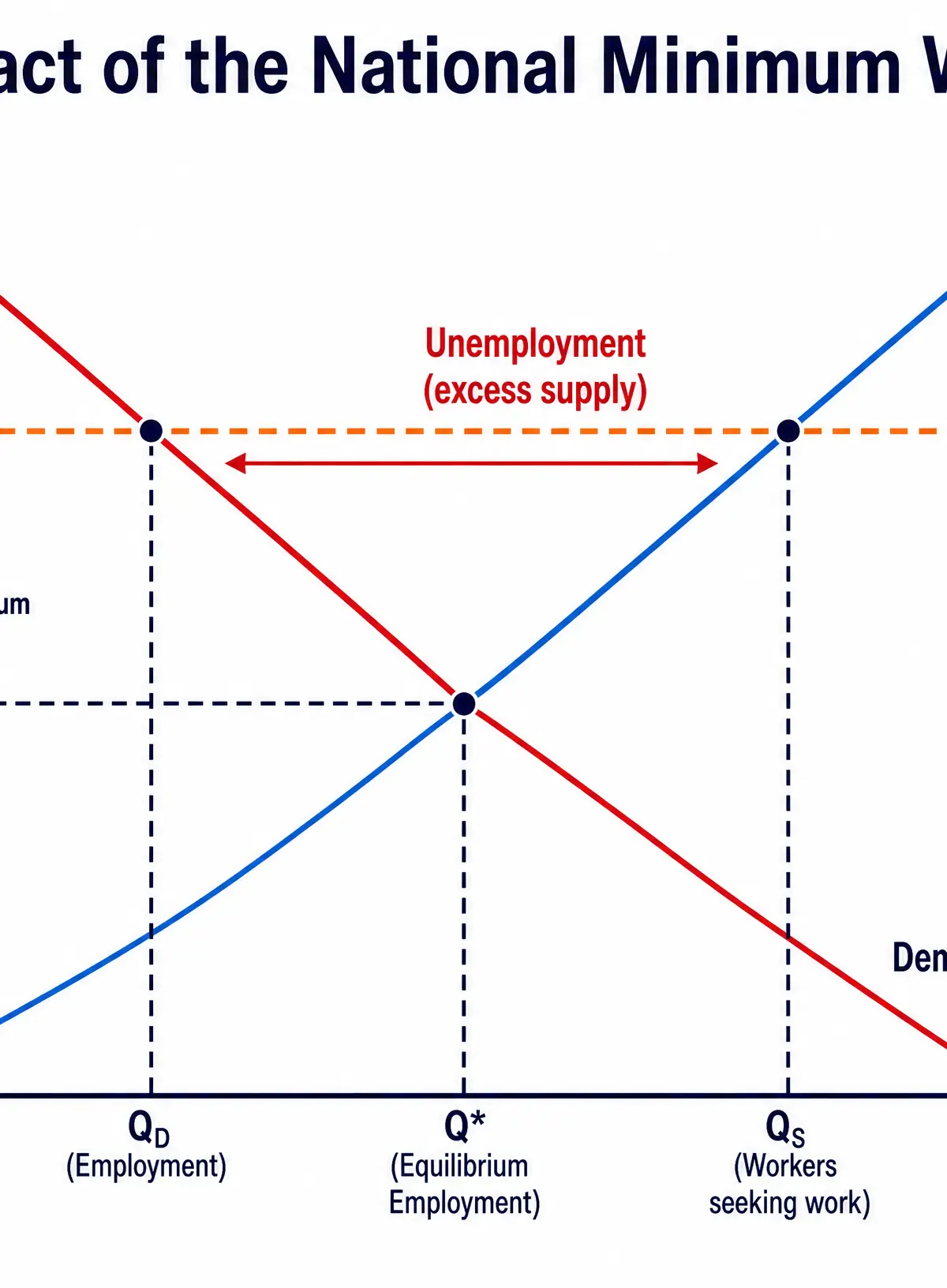
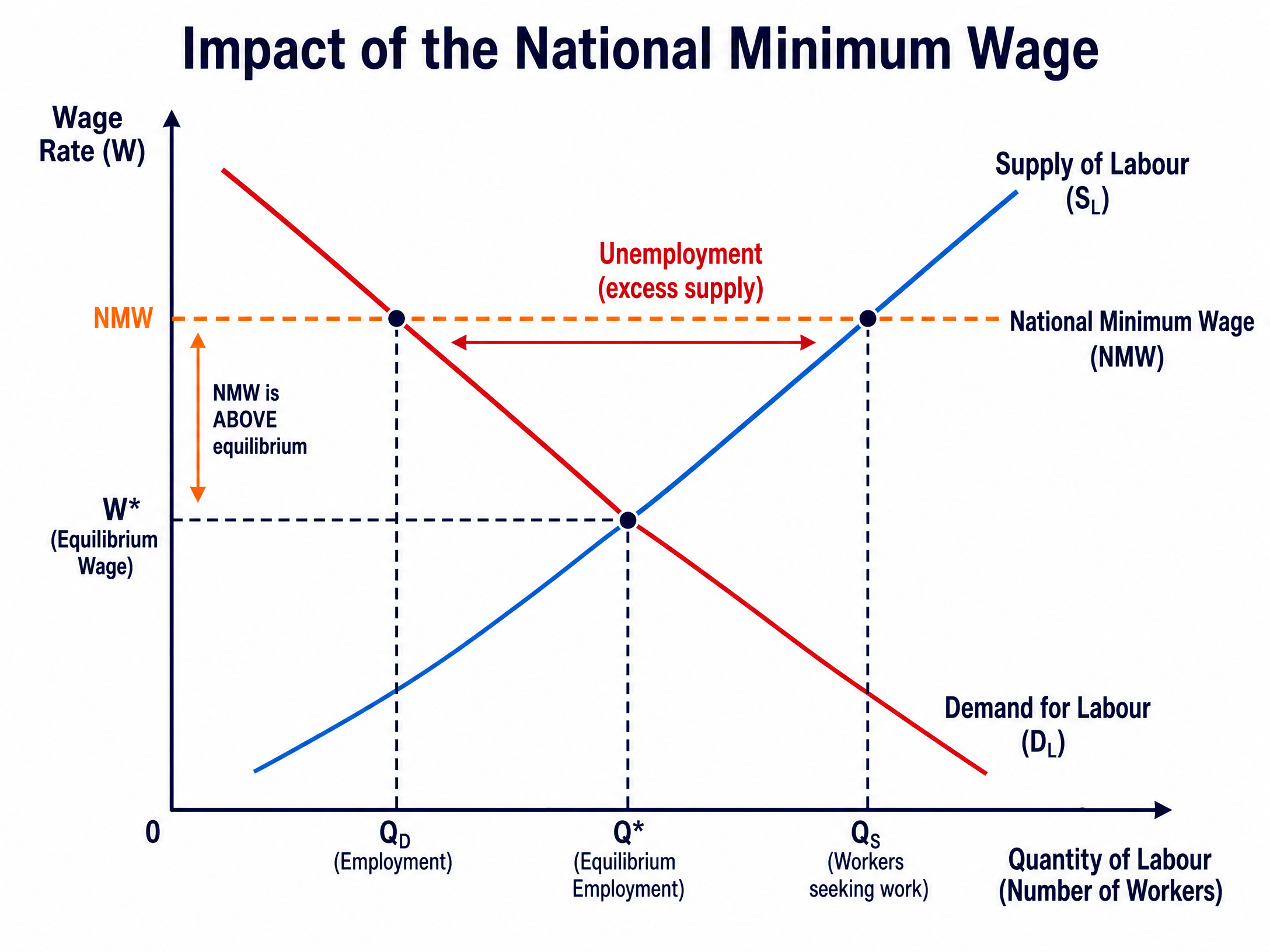
The National Minimum Wage is a legal minimum hourly rate of pay set by the government. To be effective (binding), it must be set above the free market equilibrium wage.
Benefits:
- Increases income for low-paid workers, reducing poverty and inequality.
- Can increase motivation and productivity (efficiency wage theory).
- Reduces exploitation by employers with market power (monopsonies).
Drawbacks:
- Increases costs for firms, which may lead to higher prices (inflation).
- Can cause unemployment if firms reduce their workforce to cut costs.
- May lead to reduced hours or loss of non-monetary benefits for workers.

Visual Resources
3 diagrams and illustrations
Interactive Diagrams
1 interactive diagram to visualise key concepts
Conceptual Flow Outline
Flowchart illustrating Derived Demand
Worked Examples
3 worked examples — open one to explore the question and available guidance.
Practice Questions
Test your understanding — click to reveal model answers
State two non-monetary factors that might encourage a worker to supply their labour to a specific firm. (2 marks)
Hint: Think about what matters to you in a job besides the pay cheque.
Explain how an increase in labour productivity affects the demand for labour. (4 marks)
Hint: If a worker produces more per hour, what happens to their value to the firm?
Assess the likely impact of a strong trade union on the wages and employment levels in the nursing profession. (9 marks)
Hint: Apply the general theory of trade unions specifically to nurses. Use a diagram in your answer.
Explain what is meant by 'derived demand' in relation to the labour market. (3 marks)
Hint: Why does a builder get hired? Is it because the boss just wants a builder, or because someone wants a house built?
Discuss whether the government should increase the National Minimum Wage. (12 marks)
Hint: Structure this as: Benefits of an increase, Drawbacks of an increase, and a final Judgement.