Pearson Edexcel · GCSE · Economics
The mixed economy
The mixed economy is the real-world compromise between free markets and state control. By combining the profit motive of the private sector with the social welfare goals of the public sector, it forms the basis of almost all modern global economies, including the UK.
- 5 min read
- 3 worked examples
- 5 practice questions
- 6 key terms
Study Notes
Overview
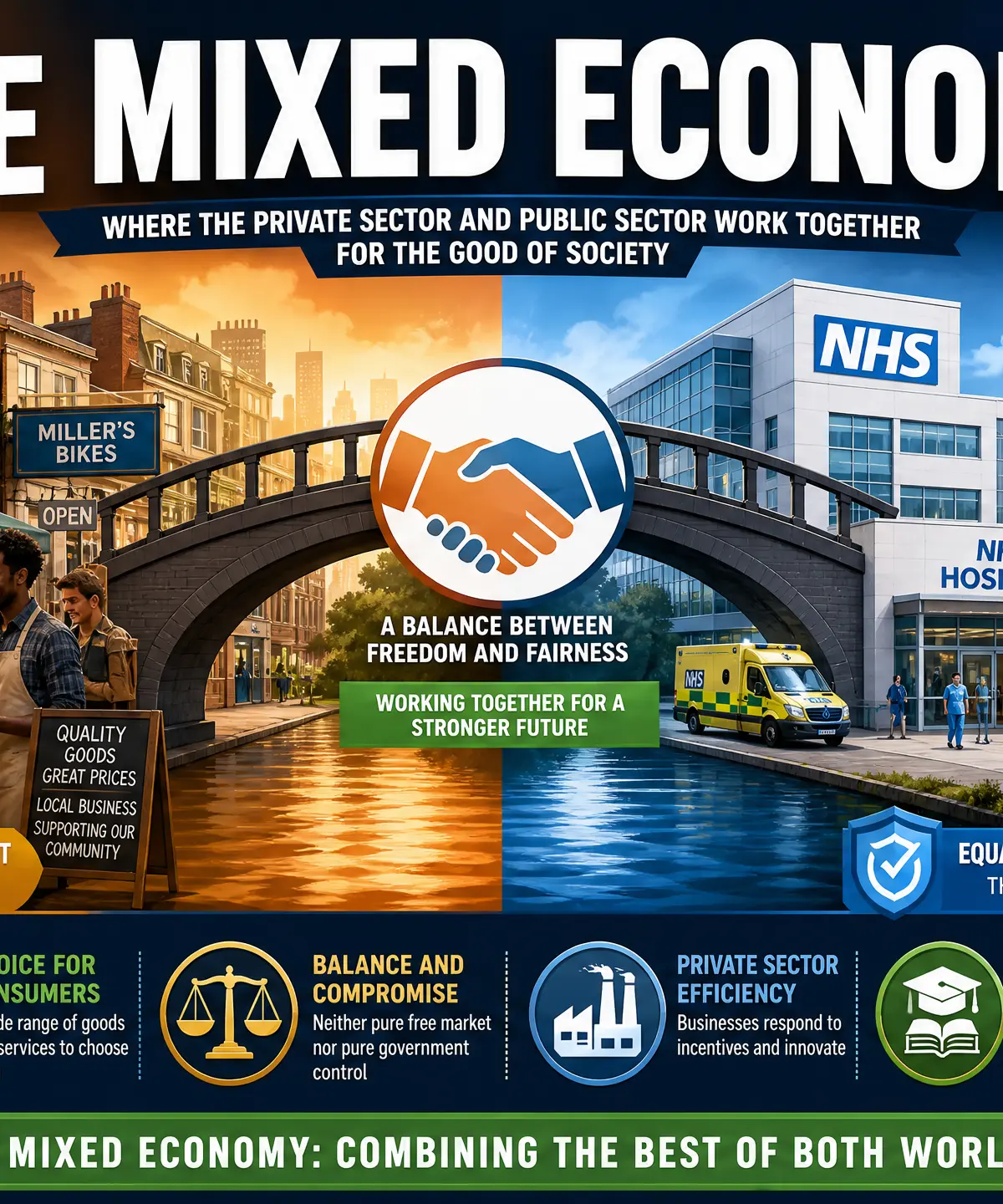
The mixed economy is arguably the most important foundational concept in modern economics because it describes the reality of the world we live in. While pure free markets and pure command economies exist only in theory or rare historical examples, the mixed economy is the system adopted by almost every nation today, including the UK, USA, and France. For your GCSE exam, examiners expect you to clearly distinguish between the roles of the private and public sectors, and crucially, to evaluate why the government must intervene to correct market failures.
The Economic Spectrum
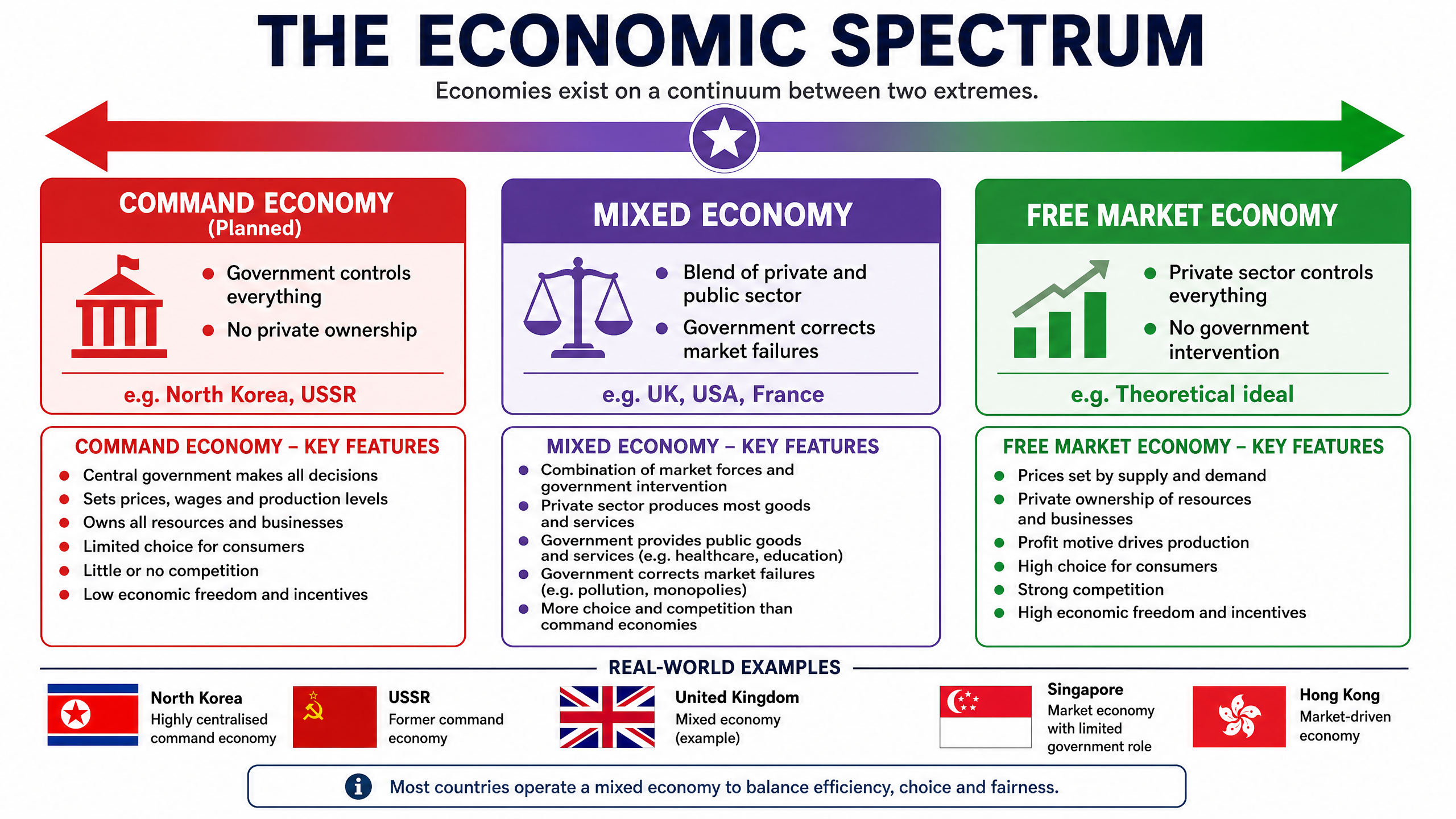
To understand a mixed economy, you must understand the extremes it sits between:
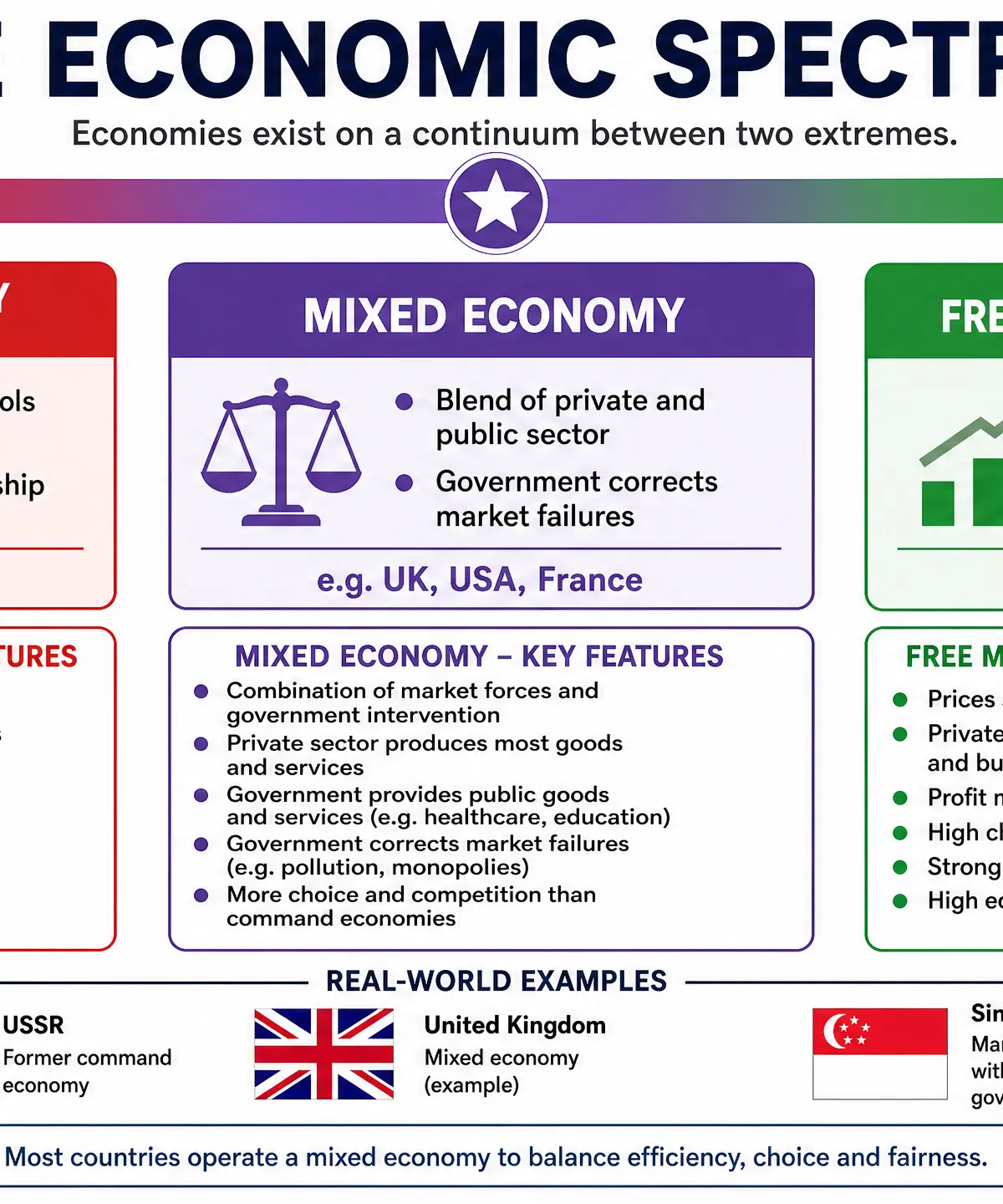
The Free Market Economy
Key Features: Resources are allocated entirely by the price mechanism (supply and demand). The private sector owns all resources and businesses are driven purely by the profit motive.
Why it matters: It promotes efficiency, innovation, and consumer choice. However, it leads to severe inequality and fails to provide public goods like national defence.
The Command (Planned) Economy
Key Features: The state (government) owns all resources and makes all decisions about what to produce, how to produce it, and who receives it. Examples include the former Soviet Union and modern-day North Korea.
Why it matters: It can theoretically eliminate inequality and direct resources to essential needs, but in practice, it suffers from massive inefficiencies, lack of innovation, and restricted consumer choice.
The Mixed Economy
Key Features: A combination of the above. The private sector allocates most resources through the market, but the government intervenes to provide public/merit goods and correct market failures.
The Two Key Players
The Private Sector
Role: Businesses and individuals operating to make a profit.
Key Actions: They respond to consumer demand, compete to lower prices and improve quality, and take risks to innovate.
Impact: Drives economic growth, wealth creation, and efficiency.
The Public Sector
Role: The government and state-funded organisations (e.g., the NHS, state schools).
Key Actions: They provide services based on social need rather than profit, funded through taxation.
Impact: Ensures a safety net, reduces inequality, and provides essential services the market ignores.
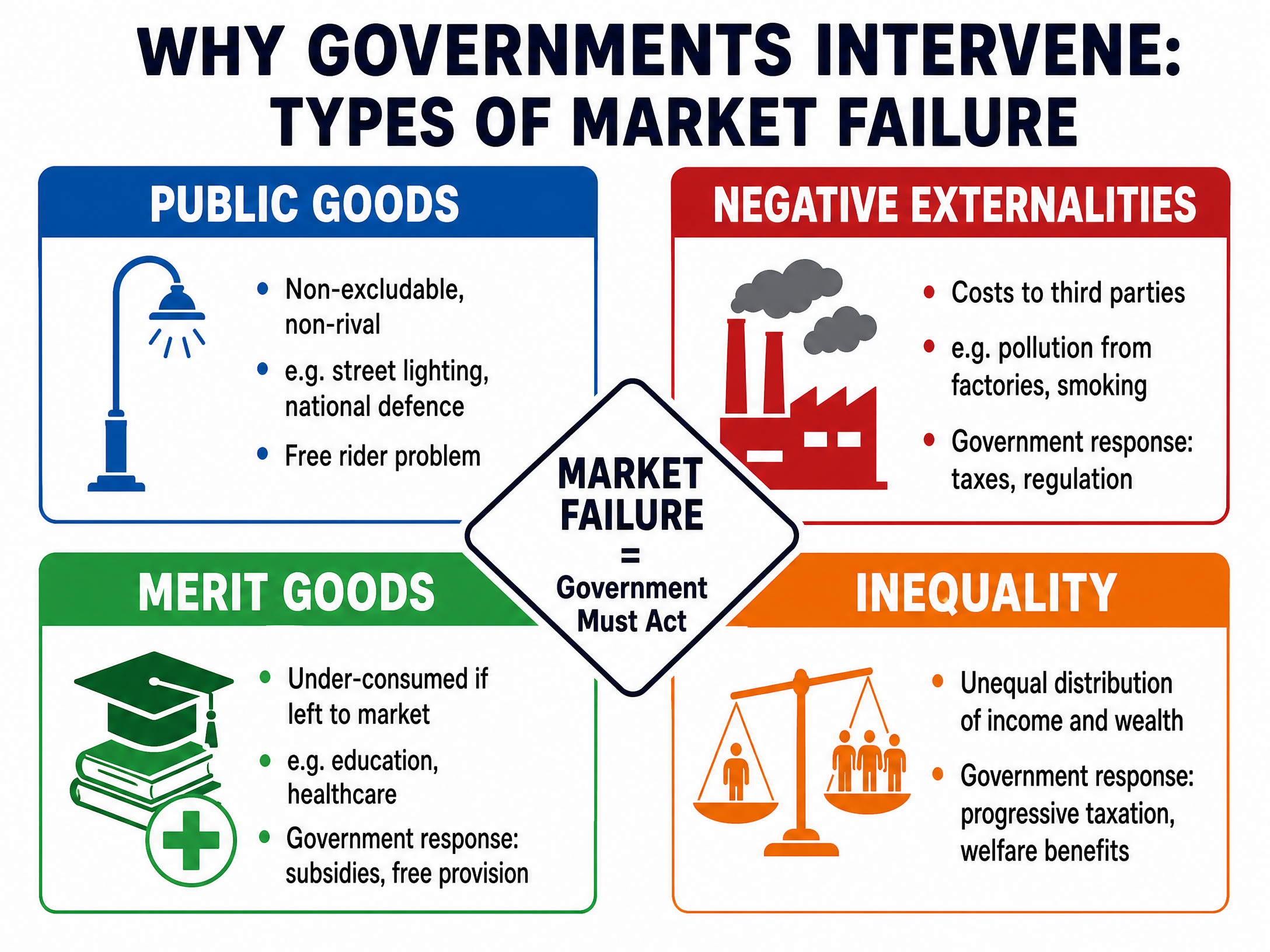
Why Governments Intervene (Market Failure)
Examiners love questions on government intervention. You must know these four reasons:
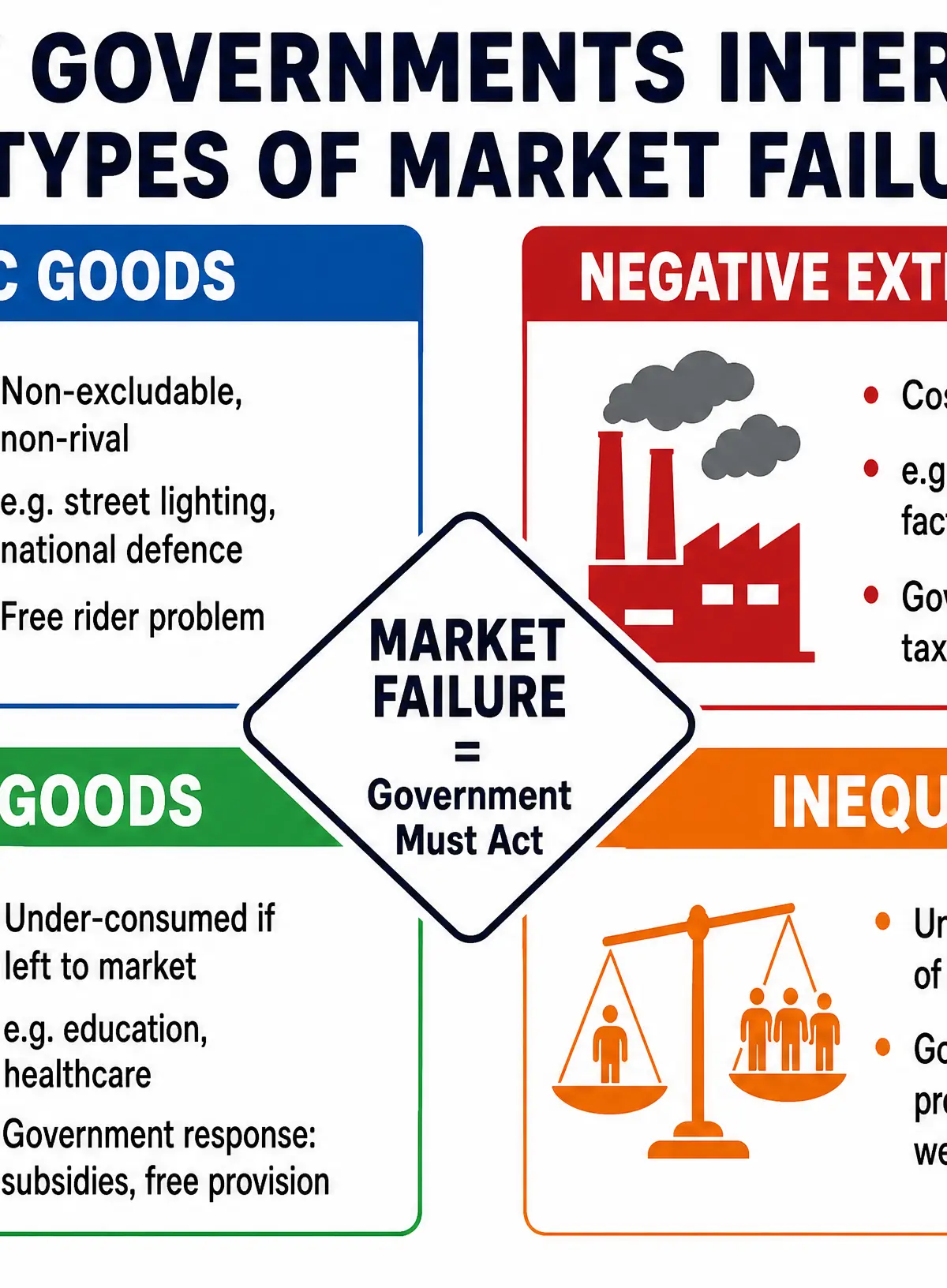
1. Public Goods
These are non-excludable (you can't stop people using them) and non-rival (one person's use doesn't diminish another's). E.g., street lighting. The private sector won't provide them due to the 'free rider' problem, so the government must.
2. Merit Goods
Goods that benefit society but would be under-consumed in a free market because people underestimate their long-term benefits or can't afford them. E.g., education, healthcare. The government subsidises or provides these free at the point of use.
3. Negative Externalities
When production or consumption harms third parties. E.g., factory pollution. The government intervenes with taxes or regulation to reduce these.
4. Inequality
Free markets reward those with skills or wealth, leaving the vulnerable behind. The government intervenes through progressive taxation and welfare benefits to redistribute income.
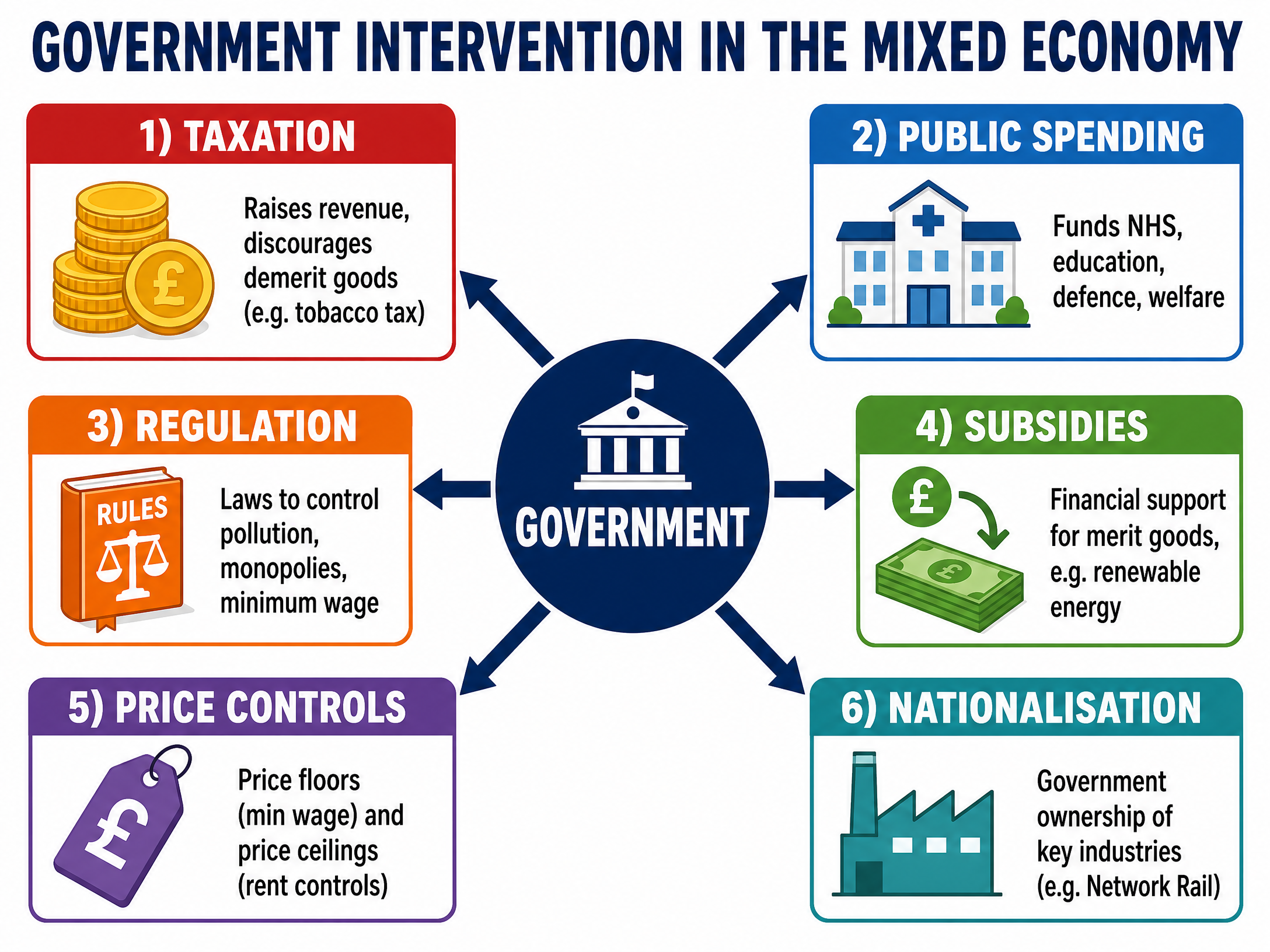
Methods of Government Intervention
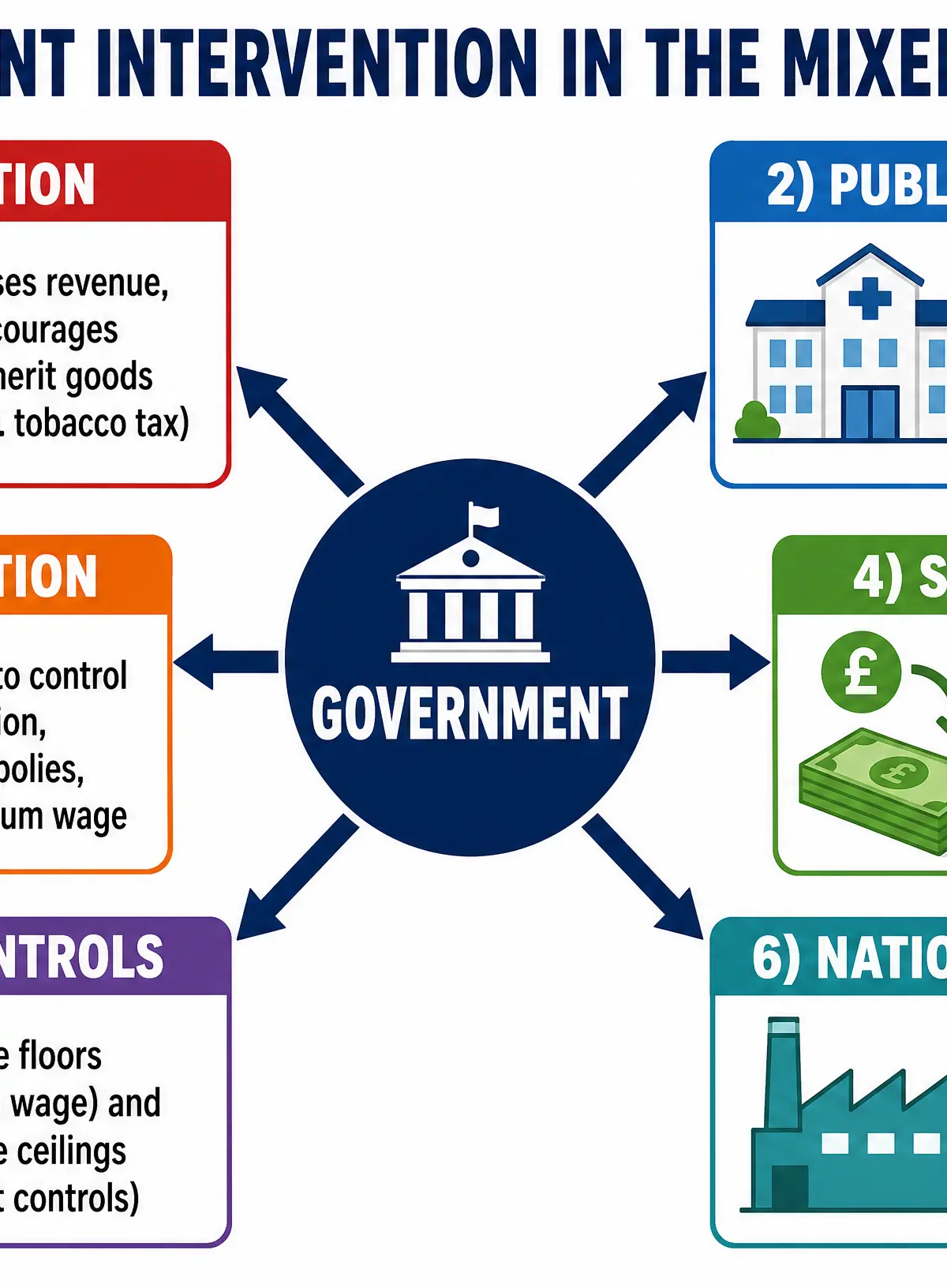
When a question asks how the government intervenes, use these specific methods:
- Taxation: To raise revenue and discourage demerit goods (e.g., tobacco tax).
- Subsidies: Financial support to encourage production of merit goods (e.g., renewable energy grants).
- Regulation: Laws to control behaviour (e.g., minimum wage, environmental limits).
- Public Provision: Direct supply of goods/services (e.g., the NHS).
Audio Revision
Listen to our 10-minute deep dive on the mixed economy, covering core concepts, real-world examples, and exam technique:

Visual Resources
3 diagrams and illustrations
Interactive Diagrams
1 interactive diagram to visualise key concepts
Conceptual Flow Outline
The dual structure of a mixed economy
Worked Examples
3 worked examples — open one to explore the question and available guidance.
Practice Questions
Test your understanding — click to reveal model answers
Define the term 'merit good'. (2 marks)
Hint: Think about why the government provides education.
Explain one reason why the government provides public goods such as street lighting. (3 marks)
Hint: Use the term 'free rider problem'.
Discuss the advantages and disadvantages of the private sector providing healthcare instead of the public sector. (9 marks)
Hint: Consider efficiency vs equality.
Explain how the government might intervene to reduce a negative externality like pollution. (6 marks)
Hint: Think about two different methods: financial and legal.
State two ways a mixed economy differs from a command economy. (2 marks)
Hint: Think about who owns the businesses.