Economic Growth Revision Notes

    Subject: Economics | Level: GCSE | Exam Board: OCR

    This study guide provides a comprehensive overview of Economic Growth for OCR GCSE Economics. It is designed to be exam-focused, helping students understand key concepts, develop analytical skills, and secure maximum marks by mastering the content and exam techniques required by examiners.

    Revision Notes & Key Concepts

    ![Header image for OCR GCSE Economics: Economic Growth](https://xnnrgnazirrqvdgfhvou.supabase.co/storage/v1/object/public/study-guide-assets/guide_ed32bf64-2b45-426d-9042-aba304406620/header_image.png) ## Overview Economic growth is a central concept in macroeconomics and a recurring topic in the OCR J205 Component 02 exam. It refers to the increase in the production of goods and services in an economy over a specific period. For examiners, a candidate's ability to precisely define and measure growth, analyse its causes and consequences, and evaluate its overall impact is critical. This guide will cover the essential definitions, such as Gross Domestic Product (GDP) and GDP per capita, the distinction between real and nominal values, and the analytical frameworks of Aggregate Demand (AD) and Aggregate Supply (AS). By mastering this topic, candidates can build a strong foundation for understanding related concepts like inflation, unemployment, and government policy, thereby enhancing their ability to construct well-supported arguments in the exam. ![Listen to our podcast on Economic Growth](https://xnnrgnazirrqvdgfhvou.supabase.co/storage/v1/object/public/study-guide-assets/guide_ed32bf64-2b45-426d-9042-aba304406620/economic_growth_podcast.wav) ## Measuring Economic Growth ### Gross Domestic Product (GDP) **What it is**: GDP is the total monetary value of all final goods and services produced within a country's borders in a specific time period, typically a year or a quarter. It is the most common measure of a country's economic output. **Why it matters**: Examiners expect candidates to know that GDP is a key indicator of economic health. An increase in GDP signifies economic growth, while a decrease indicates economic contraction (recession). **Specific Knowledge**: Candidates must be able to distinguish between **Nominal GDP**, which is measured at current market prices, and **Real GDP**, which is adjusted for inflation. Real GDP provides a more accurate picture of an economy's growth. For example, if Nominal GDP grows by 5% but inflation is 3%, Real GDP has only grown by 2%. ![Understanding GDP Calculation Methods](https://xnnrgnazirrqvdgfhvou.supabase.co/storage/v1/object/public/study-guide-assets/guide_ed32bf64-2b45-426d-9042-aba304406620/gdp_calculation_diagram.png) ### GDP per Capita **What it is**: GDP per capita is the total GDP of a country divided by its population. It represents the average economic output per person. **Why it matters**: This is a crucial measure for assessing a country's standard of living. While a country's total GDP might be high, a large population could mean that the average income and living standards are relatively low. Examiners award credit for candidates who use GDP per capita to make nuanced arguments about living standards. ## Causes of Economic Growth Economic growth can be driven by factors affecting either aggregate demand (short-run growth) or aggregate supply (long-run growth). ![AD/AS Diagram: Short-Run & Long-Run Economic Growth](https://xnnrgnazirrqvdgfhvou.supabase.co/storage/v1/object/public/study-guide-assets/guide_ed32bf64-2b45-426d-9042-aba304406620/ad_as_growth_diagram.png) ### Short-Run Growth (Increase in Aggregate Demand) **What it is**: This occurs when there is an increase in any of the components of Aggregate Demand (AD = C + I + G + (X-M)). This type of growth uses up spare capacity in the economy. **Causes**: - **Increased Consumption (C)**: Lower interest rates, higher consumer confidence, or tax cuts can lead to more household spending. - **Increased Investment (I)**: Lower interest rates or positive business expectations can encourage firms to invest in new capital. - **Increased Government Spending (G)**: The government might increase spending on infrastructure, healthcare, or education. - **Increased Net Exports (X-M)**: A weaker exchange rate or strong growth in other countries can boost export demand. ### Long-Run Growth (Increase in Aggregate Supply) **What it is**: This involves an increase in the economy's productive potential, represented by an outward shift of the Long-Run Aggregate Supply (LRAS) curve. **Causes**: - **Increase in the Quantity of Factors of Production**: More labour (e.g., through immigration), more capital (through investment), or the discovery of new natural resources. - **Increase in the Quality of Factors of Production**: A better-educated and skilled workforce, or technological advancements that improve productivity. ![Causes and Consequences of Economic Growth](https://xnnrgnazirrqvdgfhvou.supabase.co/storage/v1/object/public/study-guide-assets/guide_ed32bf64-2b45-426d-9042-aba304406620/growth_causes_consequences.png) ## Consequences of Economic Growth Candidates must be able to evaluate both the benefits and costs of economic growth. ### Benefits - **Higher Living Standards**: Increased real GDP per capita allows people to afford more goods and services, improving their quality of life. - **Increased Employment**: As firms produce more, they typically need to hire more workers, reducing unemployment. - **Fiscal Dividend**: Higher incomes and profits lead to greater tax revenues for the government, which can be used to fund public services or reduce national debt. ### Costs - **Inflationary Pressure**: If AD grows faster than AS, it can lead to demand-pull inflation. - **Income and Wealth Inequality**: The benefits of growth may not be distributed evenly, potentially widening the gap between the rich and the poor. - **Environmental Costs**: Increased production can lead to negative externalities such as pollution, resource depletion, and climate change.

    Revision Podcast Transcript

    ECONOMIC GROWTH PODCAST SCRIPT - 10 MINUTES Female Voice - Warm, Conversational, Engaging Educator Tone [INTRO - 1 MINUTE] Hello and welcome to GCSE Economics Essentials! I'm your host, and today we're diving into one of the most important topics in your OCR Economics exam: Economic Growth. Now, you've probably heard politicians and news reporters talking about GDP figures and growth rates, but what does this actually mean? And more importantly, how do you answer exam questions on this topic to pick up those crucial marks? Over the next ten minutes, we're going to break down everything you need to know about economic growth. We'll cover the key definitions that examiners expect you to know word-perfect, explore what causes growth and what happens as a result, and I'll share some insider tips on how to avoid the most common mistakes that cost students marks. So grab your notes, get comfortable, and let's get started! [CORE CONCEPTS - 5 MINUTES] First things first: what exactly is economic growth? In your exam, you need to define it precisely. Economic growth is the increase in the real value of goods and services produced in an economy over time. It's measured by the percentage change in real Gross Domestic Product, or real GDP. Now, let's unpack that definition because every word matters. GDP is the total value of all final goods and services produced within a country in a given time period, usually a year. When we say "real" GDP, we mean GDP that's been adjusted for inflation. This is crucial because if prices double but output stays the same, we haven't actually grown the economy, we've just experienced inflation. Here's a key distinction that trips up a lot of students: GDP versus GDP per capita. GDP measures the total output of the economy, but GDP per capita divides that figure by the population. So if GDP grows by 3% but the population also grows by 3%, GDP per capita hasn't changed at all, which means the average person isn't any better off. Examiners love testing this distinction, so make sure you're crystal clear on when to use each measure. Now, how do we measure GDP? There are actually three different methods, and they should all give you the same answer. The output method adds up the value of all goods and services produced. The income method adds up all the incomes earned by factors of production: wages, profits, rent, and interest. And the expenditure method uses the formula C plus I plus G plus X minus M. That's consumption by households, plus investment by businesses, plus government spending, plus exports minus imports. Let's talk about what causes economic growth. In the short run, growth comes from increases in aggregate demand. That means more spending in the economy, whether it's consumers buying more, businesses investing more, the government spending more, or foreign buyers purchasing more of our exports. You'll see this on an AD-AS diagram as the aggregate demand curve shifting to the right. But here's where it gets interesting: long-run economic growth is different. Long-run growth comes from increases in productive capacity, which means the economy's ability to produce more goods and services. This happens when we increase the quantity or quality of our factors of production. Think about it: more workers, better-trained workers, more machinery, better technology, more natural resources. All of these shift the long-run aggregate supply curve to the right, increasing potential output. A really important concept here is the distinction between actual growth and potential growth. Actual growth is what's happening to real GDP right now. Potential growth is the increase in what the economy could produce if all resources were fully employed. You can have actual growth without potential growth if the economy is just using spare capacity, but sustainable long-term growth requires increases in productive capacity. Now, what are the consequences of economic growth? This is where you need to think like an economist and consider both benefits and costs. On the benefits side, economic growth typically leads to higher living standards. When real GDP per capita rises, people can afford more goods and services, which improves quality of life. Growth also tends to create more employment opportunities as businesses expand. And here's something students often forget: growth generates higher tax revenues for the government without raising tax rates, because people are earning more and spending more. That means the government can afford better public services like healthcare and education. But, and this is a big but, economic growth isn't all positive. Rapid growth can cause demand-pull inflation if aggregate demand rises faster than aggregate supply. Growth can also lead to greater income inequality if the benefits aren't distributed evenly. Some people get much richer while others are left behind. And then there are the environmental costs: more production often means more pollution, more resource depletion, and greater carbon emissions. This raises questions about sustainability. Can we keep growing forever on a planet with finite resources? [EXAM TIPS & COMMON MISTAKES - 2 MINUTES] Right, let's talk exam technique. One of the biggest mistakes students make is confusing a fall in the rate of growth with negative growth. Listen carefully: if the economy grows by 3% one year and 2% the next year, it's still growing! The rate has slowed down, but GDP is still increasing. Negative growth, which we call a recession, only happens when GDP actually falls. Another common error is forgetting to adjust for population when discussing living standards. If the question asks about living standards or quality of life, you must use GDP per capita, not just GDP. Examiners will not give you full marks if you ignore this distinction. When you're answering calculation questions, always show your working. The mark scheme often awards marks for method even if your final answer is wrong. For percentage change, the formula is: new value minus old value, divided by old value, times 100. Write it out clearly. For longer analysis and evaluation questions, remember your assessment objectives. AO1 is knowledge: define your terms precisely. AO2 is application: use the context from the question. AO3 is analysis: explain cause and effect with logical chains of reasoning. Use phrases like "this leads to" and "as a result" to show you're analyzing, not just describing. And here's a top tip for evaluation questions: always consider trade-offs. Economic growth might increase living standards, but it might also increase inequality or environmental damage. The best answers weigh up these competing factors and reach a supported judgment. Don't just list points; compare them and say which matters more in the specific context of the question. [QUICK-FIRE RECALL QUIZ - 1 MINUTE] Okay, let's test your knowledge with a quick-fire recall quiz. I'll ask a question, pause for a moment, then give you the answer. Question 1: What does GDP stand for? [Pause] Answer: Gross Domestic Product. Question 2: What's the difference between real GDP and nominal GDP? [Pause] Answer: Real GDP is adjusted for inflation; nominal GDP is not. Question 3: What formula represents the expenditure method of calculating GDP? [Pause] Answer: C plus I plus G plus X minus M. Question 4: What shifts the long-run aggregate supply curve to the right? [Pause] Answer: Increases in the quantity or quality of factors of production. Question 5: Name two benefits and two costs of economic growth. [Pause] Answer: Benefits: higher living standards, more employment. Costs: inflation, environmental damage. How did you do? If you got them all, brilliant! If not, go back and review those concepts. [SUMMARY & SIGN-OFF - 1 MINUTE] Let's wrap up. Today we've covered the essential knowledge you need for economic growth: the precise definitions of GDP and real GDP, the three methods of measuring GDP, the distinction between short-run and long-run growth, and the causes and consequences of growth including both benefits and costs. Remember, in your exam, examiners are looking for precise economic terminology, clear chains of reasoning, and balanced evaluation that considers trade-offs. Always adjust for population when discussing living standards, always show your working in calculations, and always link your analysis back to the specific context in the question. Economic growth is a core topic in OCR GCSE Economics, and it links to so many other areas: inflation, unemployment, government policy, international trade. Master this topic, and you'll find the rest of the course much easier to understand. Thanks for listening to GCSE Economics Essentials. Keep practicing those exam questions, and I'll see you next time. Good luck with your revision!

    Key Terms & Definitions

    Economic Growth
    The increase in the real value of goods and services produced in an economy over time, measured by the percentage change in real GDP.
    Gross Domestic Product (GDP)
    The total value of all final goods and services produced within a country in a given time period.
    Real GDP
    GDP adjusted for inflation. It measures the actual volume of output.
    GDP per Capita
    Total GDP divided by the population. It is a measure of the average income per person.
    Recession
    A period of negative economic growth, technically defined as two consecutive quarters of falling real GDP.
    Productive Potential
    The maximum output that an economy can produce if all its resources are fully and efficiently employed.

    Worked Examples

    Practice Questions

    Economic Growth

    OCR
    GCSE
    Economics

    This study guide provides a comprehensive overview of Economic Growth for OCR GCSE Economics. It is designed to be exam-focused, helping students understand key concepts, develop analytical skills, and secure maximum marks by mastering the content and exam techniques required by examiners.

    5
    Min Read
    3
    Examples
    5
    Questions
    6
    Key Terms
    🎙 Podcast Episode
    Economic Growth
    0:00-0:00

    Study Notes

    Header image for OCR GCSE Economics: Economic Growth

    Overview

    Economic growth is a central concept in macroeconomics and a recurring topic in the OCR J205 Component 02 exam. It refers to the increase in the production of goods and services in an economy over a specific period. For examiners, a candidate's ability to precisely define and measure growth, analyse its causes and consequences, and evaluate its overall impact is critical. This guide will cover the essential definitions, such as Gross Domestic Product (GDP) and GDP per capita, the distinction between real and nominal values, and the analytical frameworks of Aggregate Demand (AD) and Aggregate Supply (AS). By mastering this topic, candidates can build a strong foundation for understanding related concepts like inflation, unemployment, and government policy, thereby enhancing their ability to construct well-supported arguments in the exam.

    Listen to our podcast on Economic Growth

    Measuring Economic Growth

    Gross Domestic Product (GDP)

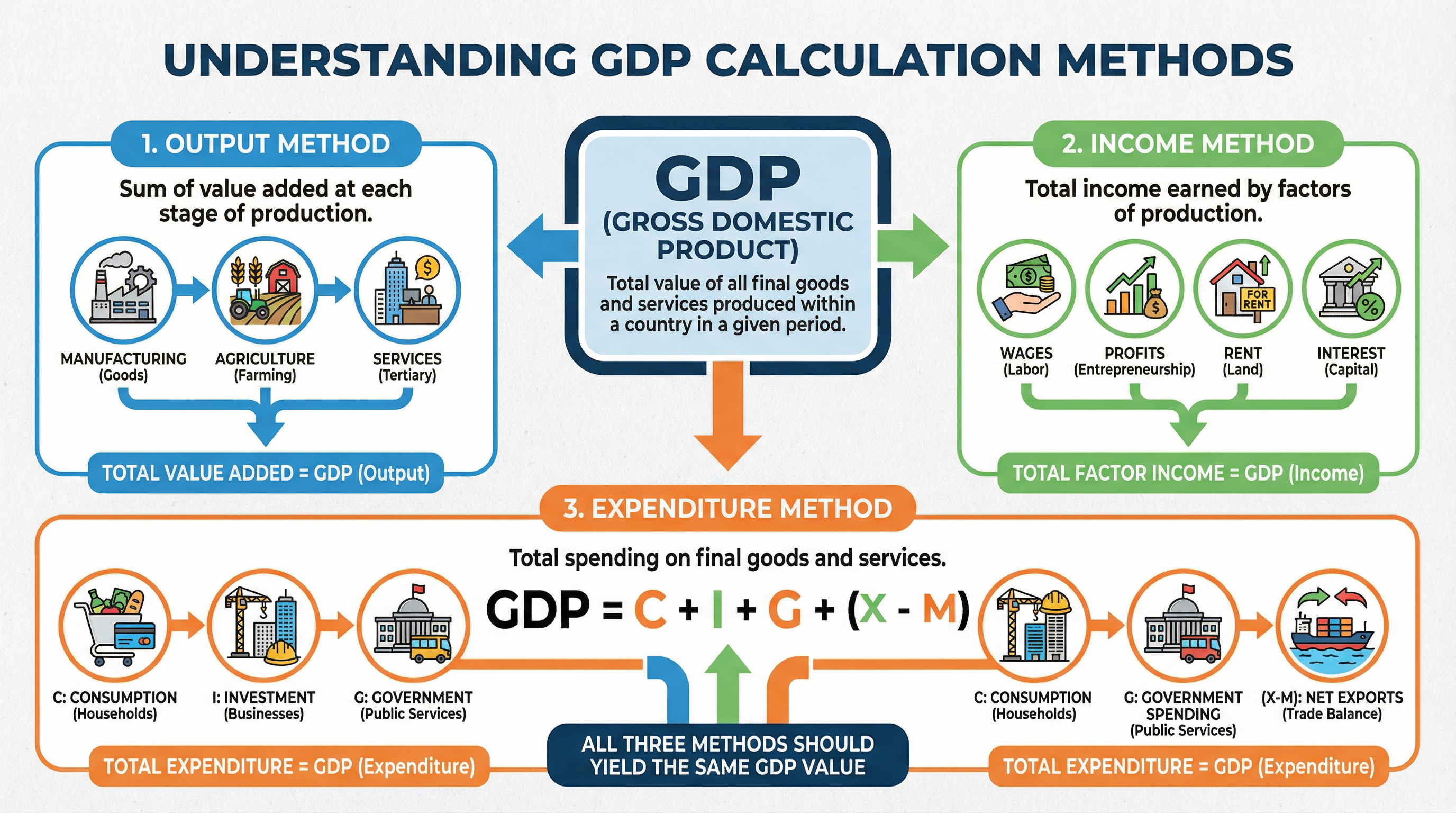
    What it is: GDP is the total monetary value of all final goods and services produced within a country's borders in a specific time period, typically a year or a quarter. It is the most common measure of a country's economic output.

    Why it matters: Examiners expect candidates to know that GDP is a key indicator of economic health. An increase in GDP signifies economic growth, while a decrease indicates economic contraction (recession).

    Specific Knowledge: Candidates must be able to distinguish between Nominal GDP, which is measured at current market prices, and Real GDP, which is adjusted for inflation. Real GDP provides a more accurate picture of an economy's growth. For example, if Nominal GDP grows by 5% but inflation is 3%, Real GDP has only grown by 2%.
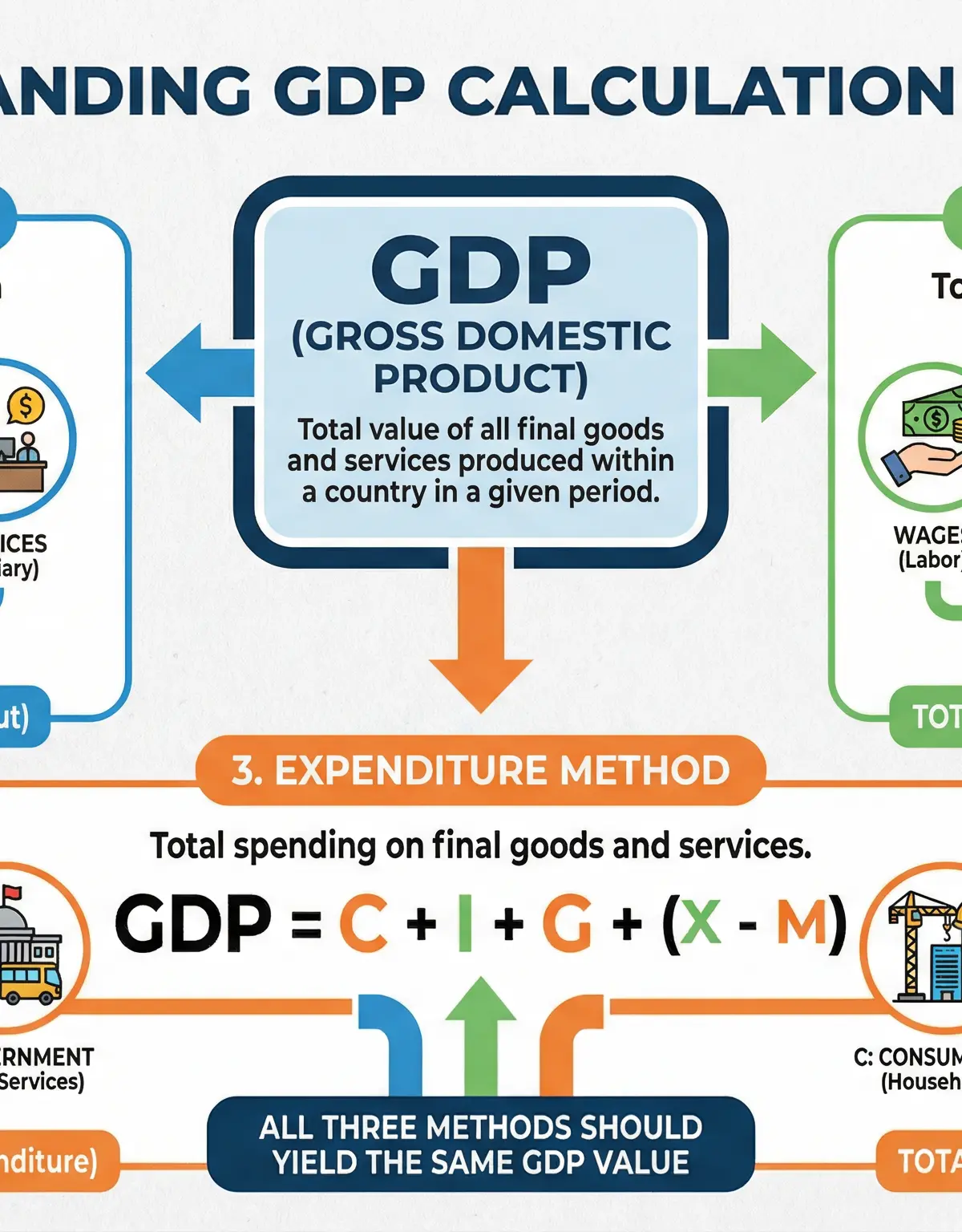
    Understanding GDP Calculation Methods

    GDP per Capita

    What it is: GDP per capita is the total GDP of a country divided by its population. It represents the average economic output per person.

    Why it matters: This is a crucial measure for assessing a country's standard of living. While a country's total GDP might be high, a large population could mean that the average income and living standards are relatively low. Examiners award credit for candidates who use GDP per capita to make nuanced arguments about living standards.

    Causes of Economic Growth

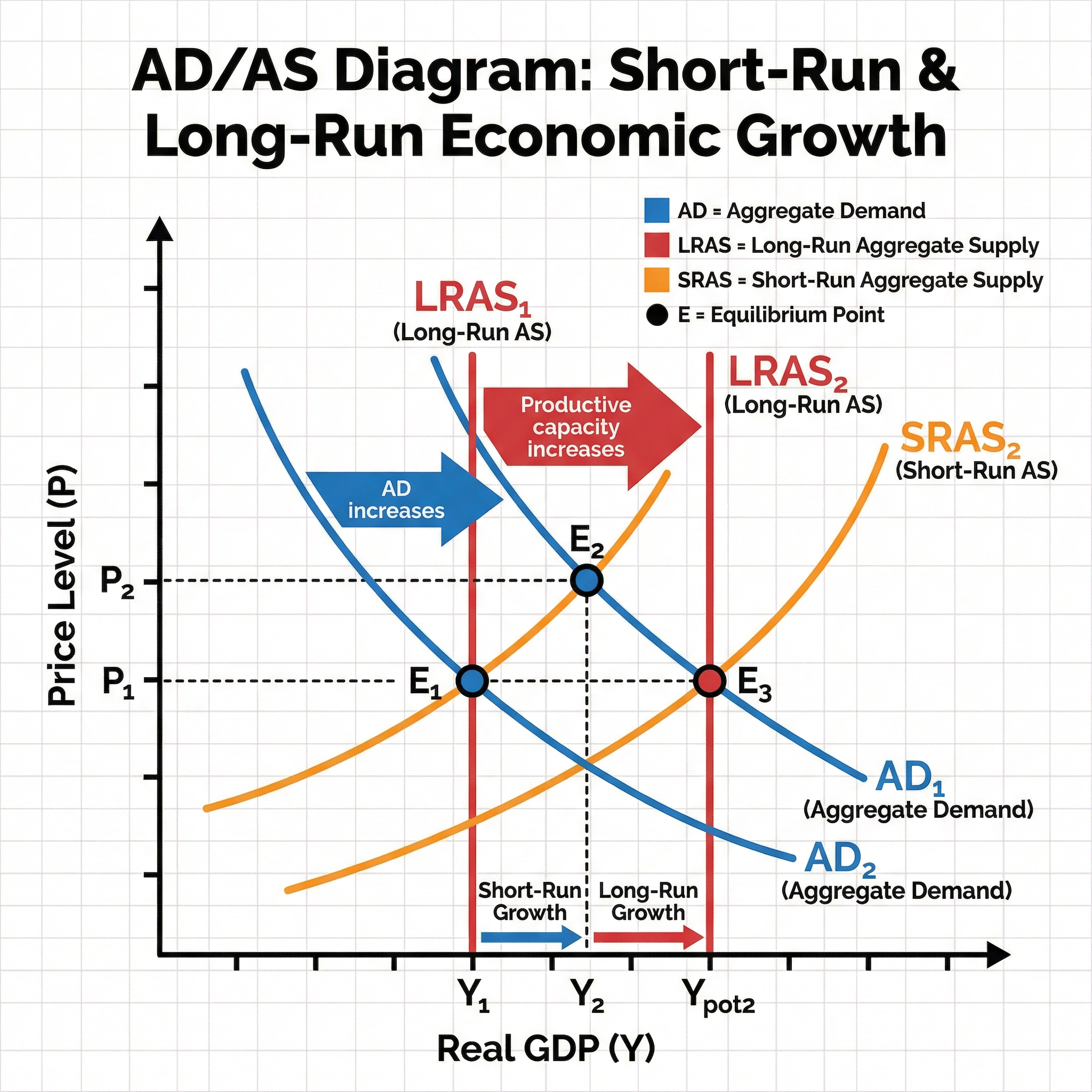
    Economic growth can be driven by factors affecting either aggregate demand (short-run growth) or aggregate supply (long-run growth).
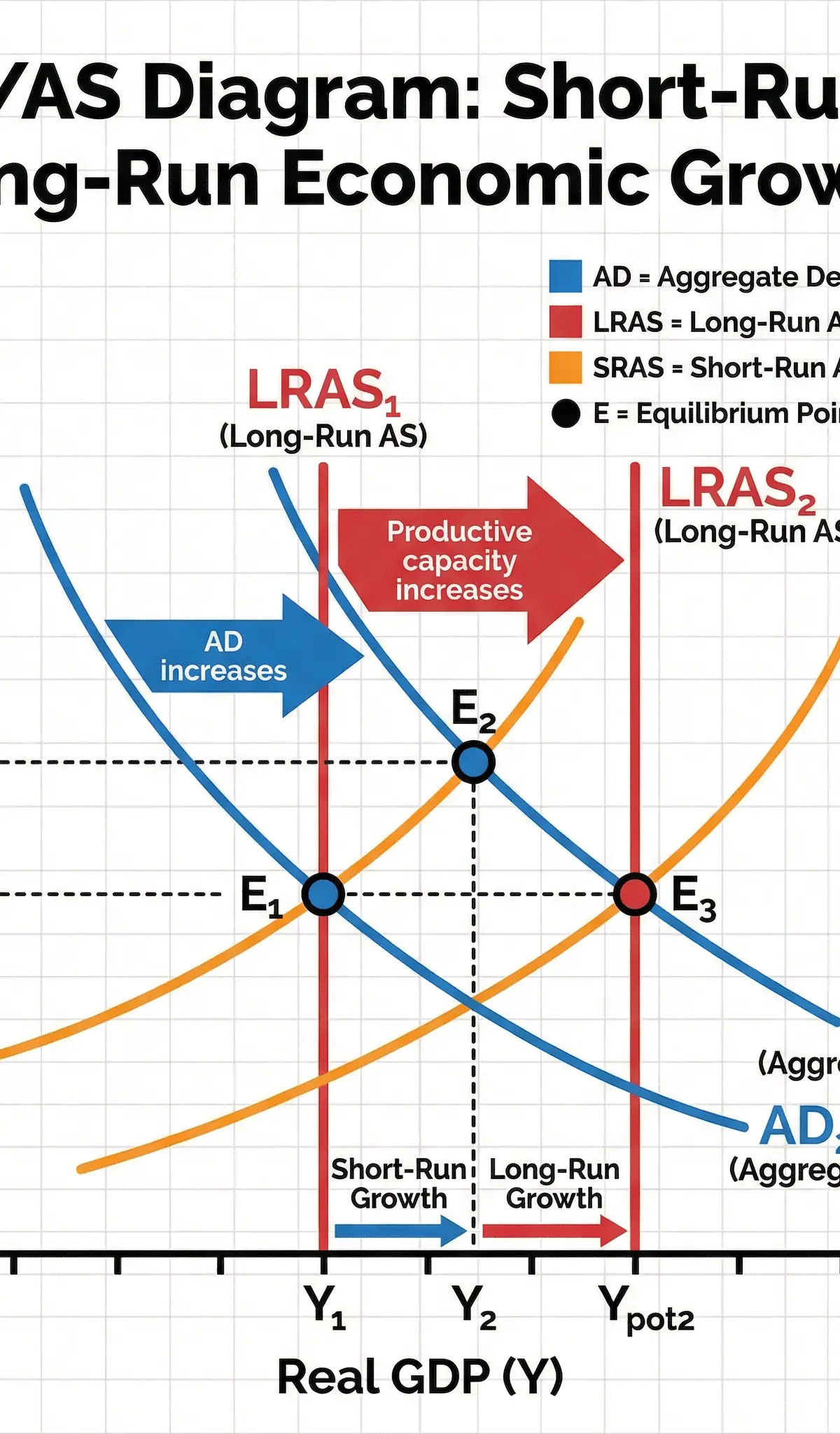
    AD/AS Diagram: Short-Run & Long-Run Economic Growth

    Short-Run Growth (Increase in Aggregate Demand)

    What it is: This occurs when there is an increase in any of the components of Aggregate Demand (AD = C + I + G + (X-M)). This type of growth uses up spare capacity in the economy.

    Causes:

    • Increased Consumption (C): Lower interest rates, higher consumer confidence, or tax cuts can lead to more household spending.
    • Increased Investment (I): Lower interest rates or positive business expectations can encourage firms to invest in new capital.
    • Increased Government Spending (G): The government might increase spending on infrastructure, healthcare, or education.
    • Increased Net Exports (X-M): A weaker exchange rate or strong growth in other countries can boost export demand.

    Long-Run Growth (Increase in Aggregate Supply)

    What it is: This involves an increase in the economy's productive potential, represented by an outward shift of the Long-Run Aggregate Supply (LRAS) curve.

    Causes:

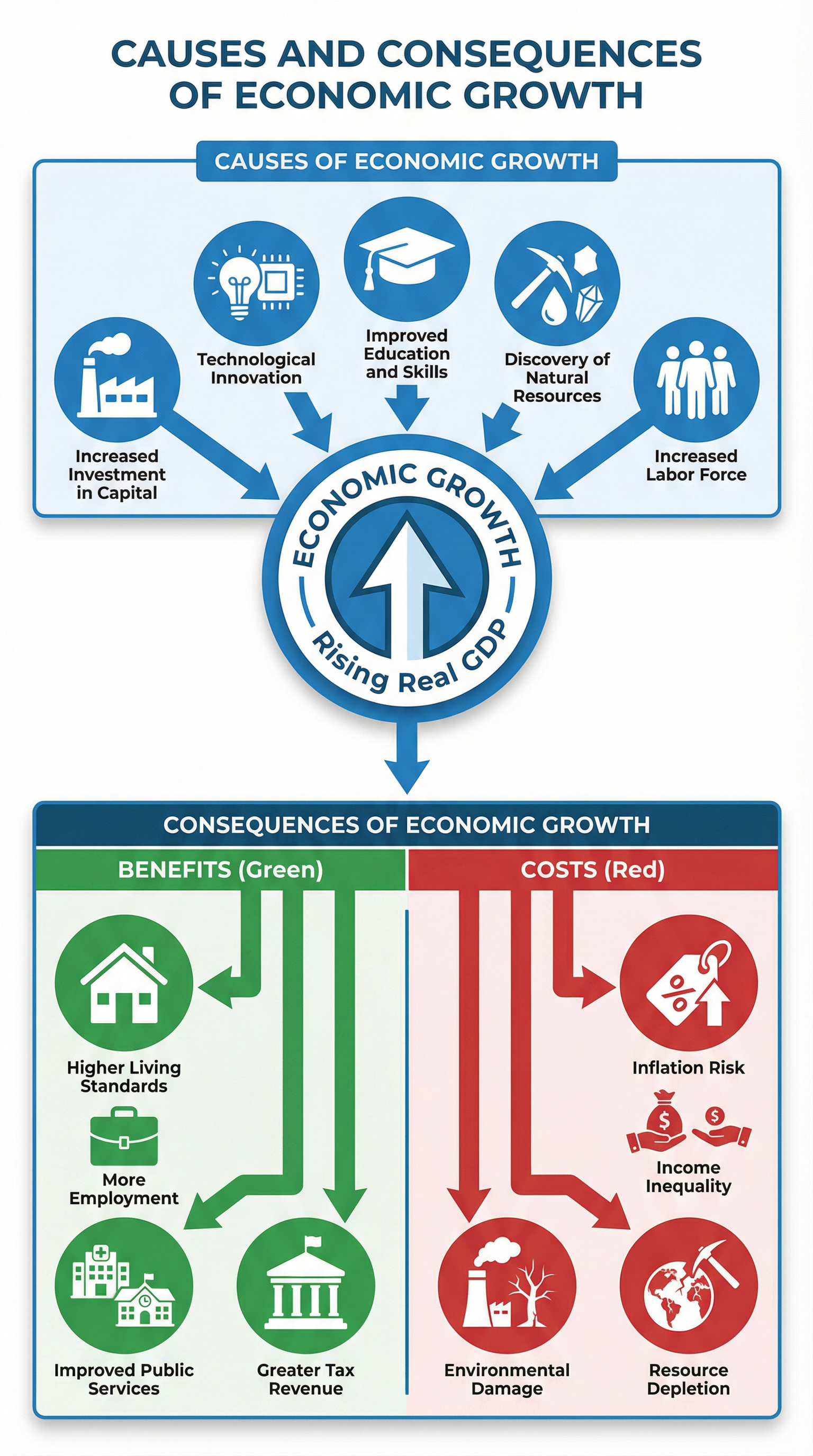
    • Increase in the Quantity of Factors of Production: More labour (e.g., through immigration), more capital (through investment), or the discovery of new natural resources.
    • Increase in the Quality of Factors of Production: A better-educated and skilled workforce, or technological advancements that improve productivity.
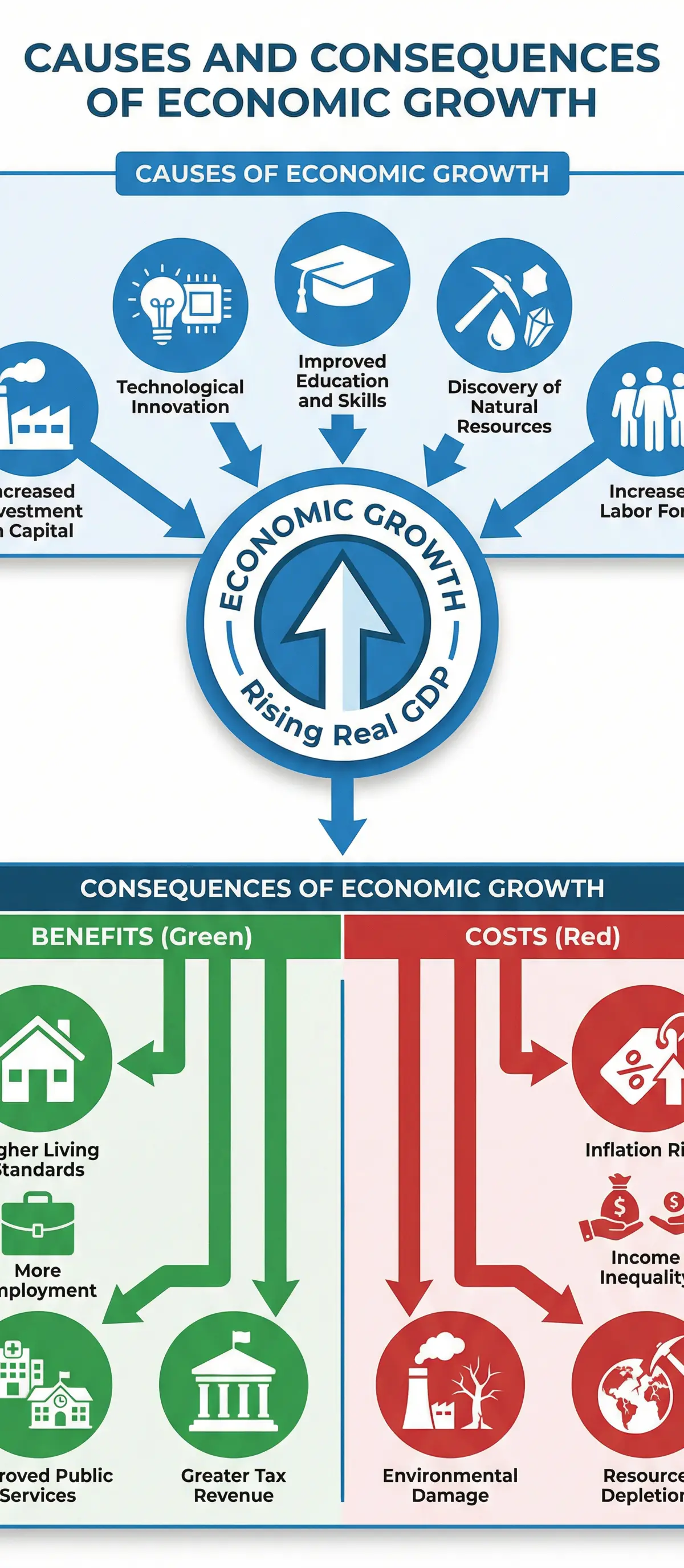
    Causes and Consequences of Economic Growth

    Consequences of Economic Growth

    Candidates must be able to evaluate both the benefits and costs of economic growth.

    Benefits

    • Higher Living Standards: Increased real GDP per capita allows people to afford more goods and services, improving their quality of life.
    • Increased Employment: As firms produce more, they typically need to hire more workers, reducing unemployment.
    • Fiscal Dividend: Higher incomes and profits lead to greater tax revenues for the government, which can be used to fund public services or reduce national debt.

    Costs

    • Inflationary Pressure: If AD grows faster than AS, it can lead to demand-pull inflation.
    • Income and Wealth Inequality: The benefits of growth may not be distributed evenly, potentially widening the gap between the rich and the poor.
    • Environmental Costs: Increased production can lead to negative externalities such as pollution, resource depletion, and climate change.

    Visual Resources

    3 diagrams and illustrations
    Understanding GDP Calculation Methods
    Understanding GDP Calculation Methods
    AD/AS Diagram: Short-Run & Long-Run Economic Growth
    AD/AS Diagram: Short-Run & Long-Run Economic Growth
    Causes and Consequences of Economic Growth
    Causes and Consequences of Economic Growth

    Interactive Diagrams

    1 interactive diagram to visualise key concepts

    Flowchart showing how investment leads to both short-run and long-run economic growth.

    Worked Examples

    3 detailed examples with solutions and examiner commentary

    Practice Questions

    Test your understanding — click to reveal model answers

    Q1

    Explain two potential causes of long-run economic growth. (6 marks)

    6 marks
    standard

    Hint: Think about factors that increase the economy's productive potential (shifting the LRAS curve).

    Q2

    Analyse the impact of a significant fall in consumer confidence on economic growth. (6 marks)

    6 marks
    standard

    Hint: Consider which component of Aggregate Demand is affected and what the immediate consequences are.

    Q3

    Evaluate the view that economic growth is always beneficial for an economy. (12 marks)

    12 marks
    challenging

    Hint: This is an evaluation question. You must consider both the benefits and the costs (drawbacks) of economic growth to provide a balanced answer.

    Q4

    A country's GDP is £500bn and its population is 50 million. Calculate the GDP per capita. (2 marks)

    2 marks
    standard

    Hint: Remember the formula for GDP per capita.

    Q5

    Explain the difference between actual growth and potential growth. (4 marks)

    4 marks
    standard

    Hint: Think about the Production Possibility Frontier (PPF) or the AD/AS model.

    Explore this topic further

    View Topic PageAll Economics Topics

    Key Terms

    Essential vocabulary to know