AQA · A-Level · English Language
Course version: 7702 · Version from Sept 2017
Children’s language development: different genres of speech and writing
Children encounter and produce many genres of speech and writing, and their control of genre develops alongside their language.
Checked against the AQA 7702 specification (opens in a new tab) on .
- Point 3 of 5
- 3 key terms
Study notes
From the checked teaching notes for this specification point.
The idea
Children encounter and produce many genres of speech and writing, and their control of genre develops alongside their language. Genres are recurring text types shaped by purpose, audience and context: spoken genres include narratives, instructions, arguments, jokes and classroom talk; written genres include stories, recounts, reports, letters, lists and persuasive texts. Each genre has characteristic structural and linguistic features, such as narrative past tense and temporal connectives, or instructional imperatives and sequenced steps. Children move from approximating a genre to controlling its conventions, and they switch between speech and writing according to situation. Analysis means identifying the genre, describing its conventions and judging how securely the child handles them.
What earns the marks
- Names the genre accurately and justifies the label with reference to purpose, audience and context.
- Identifies structural conventions such as orientation, complication and resolution in narrative, or sequenced steps in instruction.
- Comments on linguistic features typical of the genre, for example imperative verbs in instructions or past-tense verbs in recounts.
- Compares spoken and written versions of a genre, noting differences in formality, planning and audience awareness.
- Assesses how securely the child controls the genre, using evidence of conventional and unconventional choices.
- Explains how genre knowledge interacts with the child’s phonological, lexical, semantic, grammatical and pragmatic development.
Common mistakes and how to put them right
Labelling a text by topic rather than by purpose and structure.
Put it right by identifying the genre from its function and conventions.
Assuming all writing is more formal than all speech.
Put it right by comparing actual examples and noting context-dependent variation.
Listing features without judging control.
Put it right by evaluating how far the child meets the genre’s conventions and where they depart.
Exam tips
- State the genre and its purpose in one sentence before analysing features, so every point has a clear frame.
- Quote briefly from the text to evidence each convention, keeping quotations short and purposeful.
- When comparing speech and writing, organise points by feature rather than describing each text separately.
Try the lesson
The start of the Children’s language development: different genres of speech and writing lesson, made from checked teaching notes for this specification point.
Have a go first
A child is asked to write a recount of a school trip. Which feature would most clearly demonstrate their developing understanding of this specific written genre?
Listen
Children encounter and produce many genres of speech and writing, and their control of genre develops alongside their language. Genres are recurring text types shaped by purpose, audience and context: spoken genres include narratives, instructions, arguments, jokes and classroom talk; written genres include stories, recounts, reports, letters, lists and persuasive texts. Each genre has characteristic structural and linguistic features, such as narrative past tense and temporal connectives, or instructional imperatives and sequenced steps. Children move from approximating a genre to controlling its conventions, and they switch between speech and writing according to situation. Analysis means identifying the genre, describing its conventions and judging how securely the child handles them. A strong answer earns marks for these points. Names the genre accurately and justifies the label with reference to purpose, audience and context. Identifies structural conventions such as orientation, complication and resolution in narrative, or sequenced steps in instruction. Comments on linguistic features typical of the genre, for example imperative verbs in instructions or past-tense verbs in recounts. Compares spoken and written versions of a genre, noting differences in formality, planning and audience awareness. A common slip: Labelling a text by topic rather than by purpose and structure. Instead, identifying the genre from its function and conventions. Exam tip: State the genre and its purpose in one sentence before analysing features, so every point has a clear frame.
See it
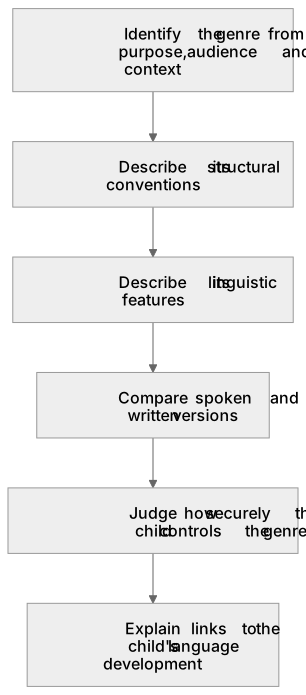
Put it in order
Put these steps in the order they happen.
- 1. Describe its linguistic features
- 2. Describe its structural conventions
- 3. Identify the genre from purpose, audience and context
- 4. Explain links to the child's language development
- 5. Judge how securely the child controls the genre
- 6. Compare spoken and written versions
Key words
Say what each word means before you turn the card.
Genre as purpose-driven text type
Try answering aloud or in your head before turning the card.
Speech and writing as different modes
Try answering aloud or in your head before turning the card.
Conventions and audience awareness
Try answering aloud or in your head before turning the card.
See every definition
- Genre as purpose-driven text type
- A recurring text type shaped by purpose, audience and context, such as narratives, instructions, arguments, jokes and classroom talk in speech, or stories, recounts, reports, letters, lists and persuasive texts in writing.
- Speech and writing as different modes
- Children switch between speech and writing according to situation, and comparing spoken and written versions of a genre shows differences in formality, planning and audience awareness.
- Conventions and audience awareness
- Each genre has characteristic structural and linguistic features, such as narrative past tense and temporal connectives, or instructional imperatives and sequenced steps, and children move from approximating a genre to controlling its conventions.
Label the diagram
Some boxes have lost their names. Pick the right name for each number.
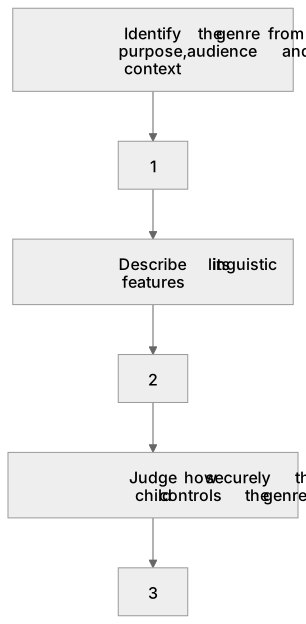
1Box 1
2Box 2
3Box 3
There is more to this lesson
The full lesson goes on to check your understanding and help you earn the marks. Create a free account to carry on, with your progress saved.
A week of Premium from your first lesson · Then the free plan continues · No card, no charge
Test your understanding of Children’s language development: different genres of speech and writing
Active recall beats re-reading. Take an instant quiz now to test what you’ve learned and lock it into long-term memory.
A week of Premium from your first lesson · Then the free plan continues · No card, no charge