AQA · A-Level · English Language
Course version: 7702 · Version from Sept 2017
Phonological, pragmatic, lexical, semantic and grammatical development
Full specification wording
Children’s language development: phonological, pragmatic, lexical, semantic and grammatical development
Children’s language development is studied across five interlocking levels.
Checked against the AQA 7702 specification (opens in a new tab) on .
- Point 2 of 5
- 4 key terms
Study notes
From the checked teaching notes for this specification point.
The idea
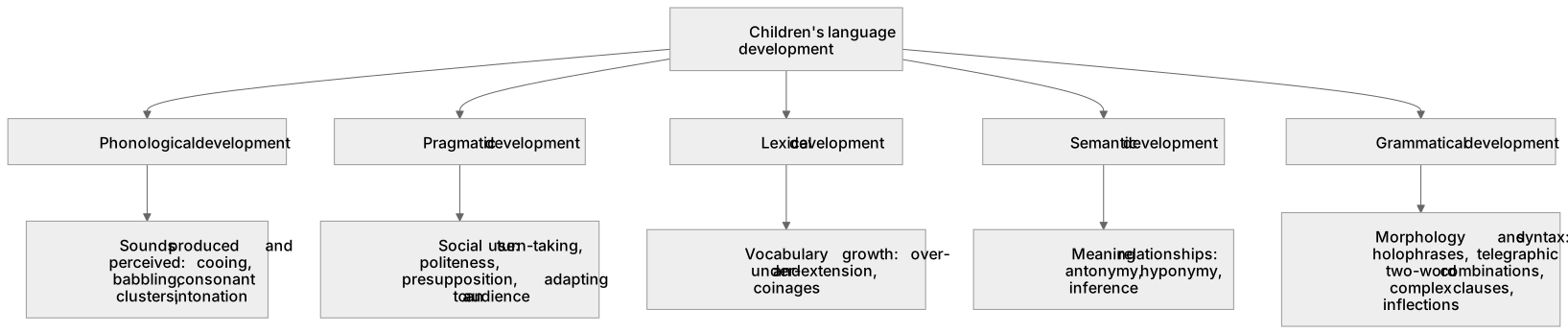
Children’s language development is studied across five interlocking levels. Phonological development covers the sounds a child can produce and perceive, from early cooing and babbling through to mastering consonant clusters and intonation. Pragmatic development concerns using language socially: turn-taking, politeness, presupposition and adapting to an audience. Lexical development is vocabulary growth, including over- and under-extension and coinages. Semantic development is learning meaning relationships such as antonymy, hyponymy and inference. Grammatical development traces morphology and syntax, from one-word holophrases through telegraphic two-word combinations to complex clauses and inflections. Analysing authentic child data means identifying which level a feature belongs to and explaining what it shows about the child’s stage.
What earns the marks
- Accurately labels a feature by level, for example over-extension as lexical, omission of past-tense -ed as grammatical, or rising intonation for a question as phonological.
- Explains what a feature reveals about the child’s stage or rule system rather than merely naming it, for example ‘goed’ shows overgeneralisation of the regular past-tense rule.
- Uses transcribed child data as evidence, quoting the utterance and linking it to a level and a developmental claim.
- Distinguishes levels that overlap, for example treating a coinage as lexical creativity while noting its morphological structure.
- Applies relevant terminology precisely, such as phoneme, holophrase, over-extension, under-extension, morpheme, utterance and turn-taking.
- Compares a child’s output with adult norms to judge what has and has not yet been acquired.
Common mistakes and how to put them right
Treating every error as random rather than rule-governed.
Put it right by showing the systematic pattern behind forms such as ‘runned’ or ‘foots’.
Confusing lexical and semantic development.
Put it right by separating vocabulary size and word choice from meaning relations and inference.
Describing a feature without linking it to a level or stage.
Put it right by naming the level and explaining the developmental significance.
Exam tips
- Anchor each analytical point to a short quotation from the data so the level and stage are evidenced, not asserted.
- Use the five levels as a checklist when planning, then select the two or three most productive features rather than listing all five superficially.
- Define terminology briefly on first use so precise terms such as holophrase or over-extension demonstrate understanding.
Try the lesson
The start of the Children’s language development: phonological, pragmatic, lexical, semantic and grammatical development lesson, made from checked teaching notes for this specification point.
Have a go first
Which term describes a child's growing ability to produce and combine the speech sounds of their language?
Listen
Children’s language development is studied across five interlocking levels. Phonological development covers the sounds a child can produce and perceive, from early cooing and babbling through to mastering consonant clusters and intonation. Pragmatic development concerns using language socially: turn-taking, politeness, presupposition and adapting to an audience. Lexical development is vocabulary growth, including over- and under-extension and coinages. Semantic development is learning meaning relationships such as antonymy, hyponymy and inference. Grammatical development traces morphology and syntax, from one-word holophrases through telegraphic two-word combinations to complex clauses and inflections. Analysing authentic child data means identifying which level a feature belongs to and explaining what it shows about the child’s stage. A strong answer earns marks for these points. Accurately labels a feature by level, for example over-extension as lexical, omission of past-tense -ed as grammatical, or rising intonation for a question as phonological. Explains what a feature reveals about the child’s stage or rule system rather than merely naming it, for example ‘goed’ shows overgeneralisation of the regular past-tense rule. Uses transcribed child data as evidence, quoting the utterance and linking it to a level and a developmental claim. Distinguishes levels that overlap, for example treating a coinage as lexical creativity while noting its morphological structure. A common slip: Treating every error as random rather than rule-governed. Instead, showing the systematic pattern behind forms such as ‘runned’ or ‘foots’. Exam tip: Anchor each analytical point to a short quotation from the data so the level and stage are evidenced, not asserted.
See it
Key words
Say what each word means before you turn the card.
Rule-governed development
Try answering aloud or in your head before turning the card.
Interlocking language levels
Try answering aloud or in your head before turning the card.
Evidence from transcribed child data
Try answering aloud or in your head before turning the card.
Stages and sequences of acquisition
Try answering aloud or in your head before turning the card.
See every definition
- Rule-governed development
- Errors are not random but show the systematic pattern behind forms such as 'runned' or 'foots'.
- Interlocking language levels
- Development is studied across phonological, pragmatic, lexical, semantic and grammatical levels, which can overlap.
- Evidence from transcribed child data
- Analysing authentic child data means quoting the utterance and linking it to a level and a developmental claim.
- Stages and sequences of acquisition
- Development traces morphology and syntax from one-word holophrases through telegraphic two-word combinations to complex clauses and inflections.
Label the diagram
Some boxes have lost their names. Pick the right name for each number.
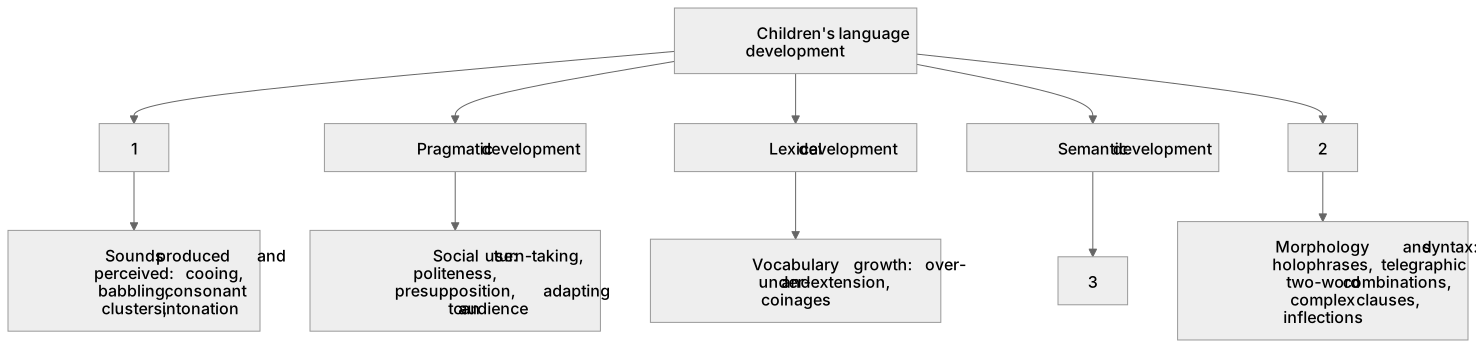
1Box 1
2Box 2
3Box 3
There is more to this lesson
The full lesson goes on to check your understanding and help you earn the marks. Create a free account to carry on, with your progress saved.
A week of Premium from your first lesson · Then the free plan continues · No card, no charge
Test your understanding of Children’s language development: phonological, pragmatic, lexical, semantic and grammatical development
Active recall beats re-reading. Take an instant quiz now to test what you’ve learned and lock it into long-term memory.
A week of Premium from your first lesson · Then the free plan continues · No card, no charge