AQA · A-Level · English Language
Course version: 7702 · Version from Sept 2017
Students will explore how texts are produced to convey views and opinions…
Full specification wording
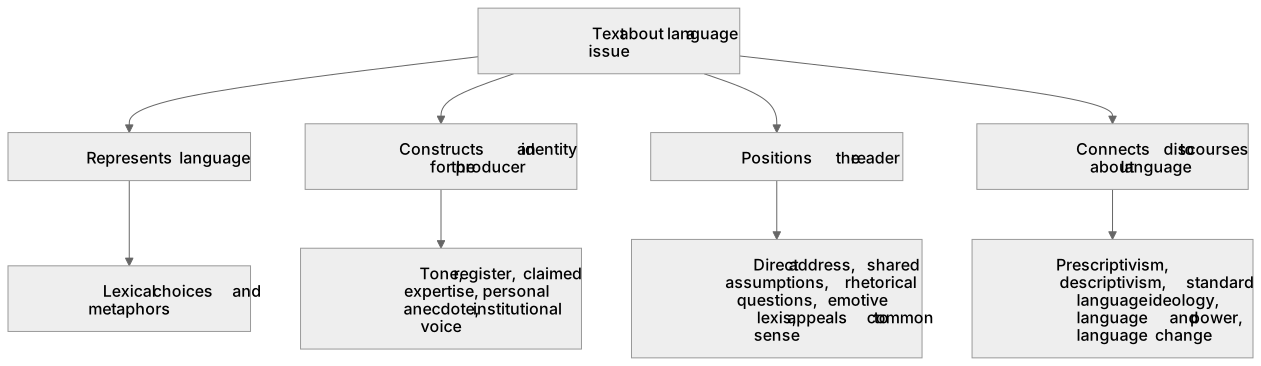
Language discourses: Students will explore how texts are produced to convey views and opinions about language issues. They will explore how texts: represent language; construct an identity for the producer; position the reader and seek to influence them; are connected to discourses about language.
This topic asks you to analyse how writers and speakers convey views about language, such as whether texting harms literacy or whether regional accents face prejudice.
Checked against the AQA 7702 specification (opens in a new tab) on .
- Point 2 of 2
- 4 key terms
Study notes
From the checked teaching notes for this specification point.
The idea
This topic asks you to analyse how writers and speakers convey views about language, such as whether texting harms literacy or whether regional accents face prejudice. Take a newspaper opinion piece arguing that slang damages Standard English. You would examine how it represents language (perhaps as a threat or as creative change), how the producer constructs an identity (as an authority, a concerned parent, a linguist), how it positions the reader (assuming agreement, using inclusive pronouns, appealing to fear or pride), and how it connects to wider discourses, such as prescriptivism versus descriptivism or debates about social mobility. The skill is close linguistic analysis of representation, identity, audience positioning and discourse, supported by precise quotation and terminology.
What earns the marks
- Identify and illustrate how a text represents language, for example as a resource, a threat, a skill or a marker of identity, using specific lexical choices and metaphors.
- Analyse how the producer constructs an identity through tone, register, claimed expertise, personal anecdote or institutional voice, and how that identity supports the argument.
- Explain how the text positions the reader, for example through direct address, shared assumptions, rhetorical questions, emotive lexis or appeals to common sense, and how this seeks to influence opinion.
- Link the text to named discourses about language, such as prescriptivism, descriptivism, standard language ideology, language and power, or language change, showing how the text takes a stance within them.
- Support analysis with accurate quotation and appropriate terminology, and comment on how linguistic and structural choices work together to convey a viewpoint.
Common mistakes and how to put them right
Describing what the text says about language without analysing how language choices construct that view.
Put it right by quoting a specific choice and explaining its effect on representation or positioning.
Treating the producer's identity as simply the named author rather than as a constructed persona.
Put it right by examining the voice, stance and assumed authority created by the language.
Identifying a discourse by label only, such as 'prescriptivism', without showing how the text engages with it.
Put it right by linking a quoted choice to a specific belief or debate within that discourse.
Exam tips
- Annotate texts for representation, producer identity, reader positioning and discourse before writing, so your analysis covers all four elements.
- Use short embedded quotations and name the linguistic feature, then explain its effect on the reader's view of the language issue.
- Refer to discourses precisely, for example standard language ideology or language and identity, and show how the text aligns with or challenges them.
Try the lesson
The start of the Language discourses: Students will explore how texts are produced to convey views and opinions about language issues. They will explore how texts: represent language; construct an identity for the producer; position the reader and seek to influence them; are connected to discourses about language. lesson, made from checked teaching notes for this specification point.
Have a go first
Which term describes the way a text presents language itself, for example as a threat or as a resource?
Listen
This topic asks you to analyse how writers and speakers convey views about language, such as whether texting harms literacy or whether regional accents face prejudice. Take a newspaper opinion piece arguing that slang damages Standard English. You would examine how it represents language (perhaps as a threat or as creative change), how the producer constructs an identity (as an authority, a concerned parent, a linguist), how it positions the reader (assuming agreement, using inclusive pronouns, appealing to fear or pride), and how it connects to wider discourses, such as prescriptivism versus descriptivism or debates about social mobility. The skill is close linguistic analysis of representation, identity, audience positioning and discourse, supported by precise quotation and terminology. A strong answer earns marks for these points. Identify and illustrate how a text represents language, for example as a resource, a threat, a skill or a marker of identity, using specific lexical choices and metaphors. Analyse how the producer constructs an identity through tone, register, claimed expertise, personal anecdote or institutional voice, and how that identity supports the argument. Explain how the text positions the reader, for example through direct address, shared assumptions, rhetorical questions, emotive lexis or appeals to common sense, and how this seeks to influence opinion. Link the text to named discourses about language, such as prescriptivism, descriptivism, standard language ideology, language and power, or language change, showing how the text takes a stance within them. A common slip: Describing what the text says about language without analysing how language choices construct that view. Instead, quoting a specific choice and explaining its effect on representation or positioning. Exam tip: Annotate texts for representation, producer identity, reader positioning and discourse before writing, so your analysis covers all four elements.
See it
Key words
Say what each word means before you turn the card.
Representation of language and language users
Try answering aloud or in your head before turning the card.
Construction of authorial identity and stance
Try answering aloud or in your head before turning the card.
Reader positioning and persuasion
Try answering aloud or in your head before turning the card.
Language discourses and ideological debate
Try answering aloud or in your head before turning the card.
See every definition
- Representation of language and language users
- How texts portray language, for example as a resource, a threat, a skill or a marker of identity, through specific lexical choices and metaphors.
- Construction of authorial identity and stance
- How the producer builds an identity through tone, register, claimed expertise, personal anecdote or institutional voice, and how that identity supports the argument.
- Reader positioning and persuasion
- How the text positions the reader through direct address, shared assumptions, rhetorical questions, emotive lexis or appeals to common sense, seeking to influence opinion.
- Language discourses and ideological debate
- Wider debates about language, such as prescriptivism, descriptivism, standard language ideology, language and power, or language change, within which a text takes a stance.
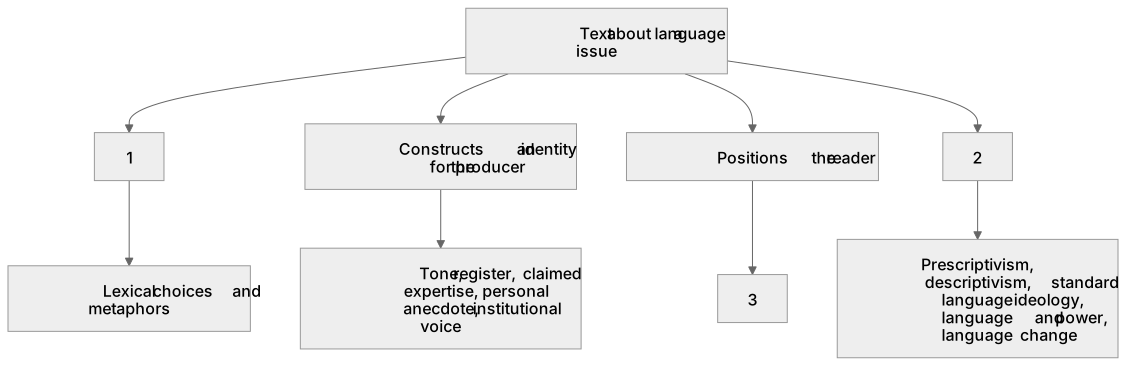
Label the diagram
Some boxes have lost their names. Pick the right name for each number.
1Box 1
2Box 2
3Box 3
There is more to this lesson
The full lesson goes on to check your understanding and help you earn the marks. Create a free account to carry on, with your progress saved.
A week of Premium from your first lesson · Then the free plan continues · No card, no charge
Test your understanding of Language discourses: Students will explore how texts are produced to convey views and opinions about language issues. They will explore how texts: represent language; construct an identity for the producer; position the reader and seek to influence them; are connected to discourses about language.
Active recall beats re-reading. Take an instant quiz now to test what you’ve learned and lock it into long-term memory.
A week of Premium from your first lesson · Then the free plan continues · No card, no charge