AQA · A-Level · English Language
Course version: 7702 · Version from Sept 2017
Students will study a range of texts that convey attitudes to language…
Full specification wording
Language discourses: Students will study a range of texts that convey attitudes to language diversity and change. The texts studied will include those written for non-specialist audiences.
This guidance explains how to study public discussion about language diversity and change.
Checked against the AQA 7702 specification (opens in a new tab) on .
- Point 1 of 2
- 4 key terms
Study notes
From the checked teaching notes for this specification point.
The idea
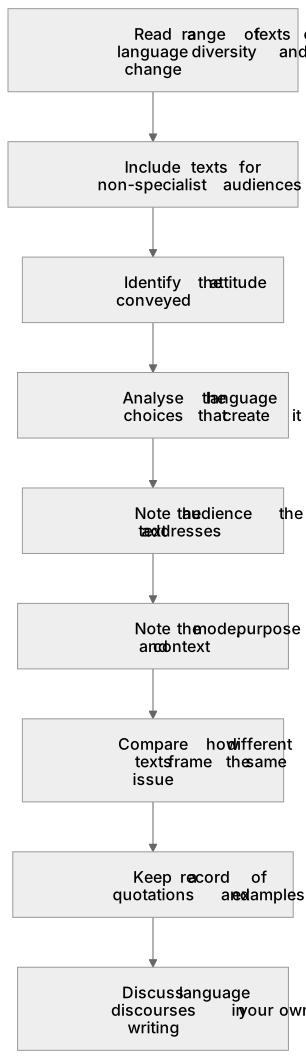
This guidance explains how to study public discussion about language diversity and change. You need to read a range of texts that express attitudes, not just describe linguistic facts. The texts must include material written for non-specialist audiences, such as newspaper articles, blogs, radio phone-in transcripts or campaign leaflets. As you read, identify the attitude being conveyed, the language choices that create it, and the audience the text addresses. For example, a tabloid article may use emotive metaphors to present dialect change as decline, while a blog may celebrate new varieties. Compare how different texts frame the same issue. Note the mode, purpose and context of each text. Keep a record of quotations and examples so you can analyse how attitudes are constructed. This reading prepares you to discuss language discourses in your own writing.
Common mistakes and how to put them right
Studying only academic linguistics texts and ignoring non-specialist material.
Put it right: Deliberately collect newspaper articles, blogs, broadcasts and other texts aimed at general readers or listeners.
Describing what a text says about language without identifying the attitude it conveys.
Put it right: For each text, state the attitude in a sentence and then point to the specific language choices that create it.
Treating all non-specialist texts as equally reliable or neutral.
Put it right: Analyse the purpose, audience and stance of each text, and consider how the writer positions the reader.
Assuming 'language discourses' means only debates about correctness.
Put it right: Include texts about diversity, such as attitudes to regional accents, multilingualism or new varieties of English.
Exam tips
- Build a comparison grid for each text: audience, purpose, attitude, key linguistic features and representative examples.
- Practise writing a short analysis of one non-specialist text, focusing on how word choice and metaphor convey an attitude.
- When revising, group texts by attitude, such as celebratory, anxious or prescriptive, so you can compare discourses quickly.
Try the lesson
The start of the Language discourses: Students will study a range of texts that convey attitudes to language diversity and change. The texts studied will include those written for non-specialist audiences. lesson, made from checked teaching notes for this specification point.
Have a go first
A student is selecting texts for the language discourses topic. Which choice best meets the requirement to include texts for non-specialist audiences?
Listen
This guidance explains how to study public discussion about language diversity and change. You need to read a range of texts that express attitudes, not just describe linguistic facts. The texts must include material written for non-specialist audiences, such as newspaper articles, blogs, radio phone-in transcripts or campaign leaflets. As you read, identify the attitude being conveyed, the language choices that create it, and the audience the text addresses. For example, a tabloid article may use emotive metaphors to present dialect change as decline, while a blog may celebrate new varieties. Compare how different texts frame the same issue. Note the mode, purpose and context of each text. Keep a record of quotations and examples so you can analyse how attitudes are constructed. This reading prepares you to discuss language discourses in your own writing. A common slip: Studying only academic linguistics texts and ignoring non-specialist material. Instead, deliberately collect newspaper articles, blogs, broadcasts and other texts aimed at general readers or listeners. Exam tip: Build a comparison grid for each text: audience, purpose, attitude, key linguistic features and representative examples.
See it
Key words
Say what each word means before you turn the card.
Attitudes to language diversity and change
Try answering aloud or in your head before turning the card.
Non-specialist audiences
Try answering aloud or in your head before turning the card.
Language discourses
Try answering aloud or in your head before turning the card.
Analysis of stance and positioning
Try answering aloud or in your head before turning the card.
See every definition
- Attitudes to language diversity and change
- The views expressed in texts about language diversity and change, which students study across a range of texts rather than describing linguistic facts.
- Non-specialist audiences
- General readers or listeners addressed by material such as newspaper articles, blogs, radio phone-in transcripts or campaign leaflets.
- Language discourses
- Public discussion about language diversity and change, which reading texts that express attitudes prepares students to discuss in their own writing.
- Analysis of stance and positioning
- Identifying the attitude a text conveys, the language choices that create it, and how the writer positions the reader.
Label the diagram
Some boxes have lost their names. Pick the right name for each number.
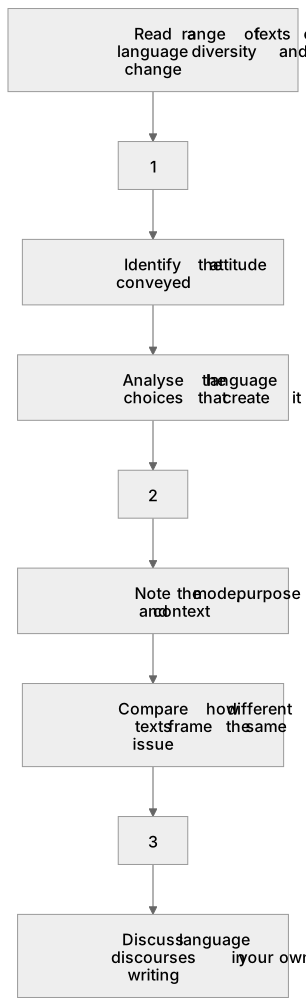
1Box 1
2Box 2
3Box 3
There is more to this lesson
The full lesson goes on to check your understanding and help you earn the marks. Create a free account to carry on, with your progress saved.
A week of Premium from your first lesson · Then the free plan continues · No card, no charge
Test your understanding of Language discourses: Students will study a range of texts that convey attitudes to language diversity and change. The texts studied will include those written for non-specialist audiences.
Active recall beats re-reading. Take an instant quiz now to test what you’ve learned and lock it into long-term memory.
A week of Premium from your first lesson · Then the free plan continues · No card, no charge