AQA · A-Level · English Language
Course version: 7702 · Version from Sept 2017
Exploration will include methods of language analysis, how identity is…
Full specification wording
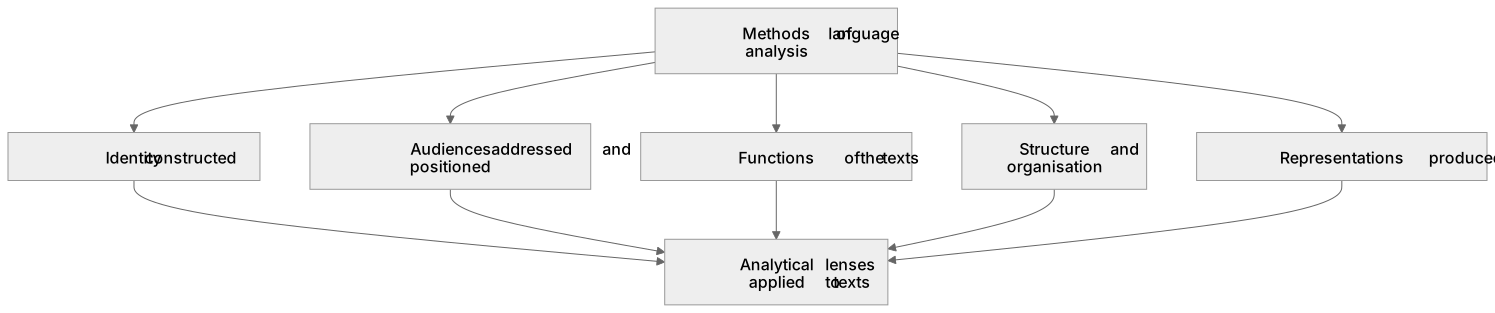
Language diversity and change: Exploration will include methods of language analysis, how identity is constructed, how audiences are addressed and positioned, the functions of the texts, the structure and organisation of the texts, and how representations are produced.
This statement outlines the analytical lenses applied to texts.
Checked against the AQA 7702 specification (opens in a new tab) on .
- Point 3 of 3
- 4 key terms
Study notes
From the checked teaching notes for this specification point.
The idea
This statement outlines the analytical lenses applied to texts. Methods of language analysis form your specification toolkit: phonetics, phonology and prosodics, graphology, lexis and semantics, grammar including morphology, pragmatics, and discourse. Identity is constructed when creators select forms projecting a persona or stance, like an author choosing inclusive pronouns. Audiences are addressed via direct address or imperatives, and positioned through presuppositions or evaluative lexis. Functions concern purpose: to inform, persuade or entertain. Structure covers genre conventions, sequencing and layout. Representations emerge when repeated linguistic patterns construct a specific version of people or events.
What earns the marks
- Identifies and names specific methods of language analysis across phonetics, phonology and prosodics, graphology, lexis and semantics, grammar including morphology, pragmatics, and discourse, using accurate terminology.
- Explains how particular choices construct a writer's or speaker's identity, such as expertise, solidarity or authority.
- Analyses how an audience is addressed through direct address, modality or register, and positioned through implied shared values.
- Relates the text's function to its context and genre, showing how purpose shapes language choices.
- Examines structure and organisation, including sequencing, paragraphing, openings, closings and genre conventions.
- Explains how repeated patterns of representation construct a particular version of people, groups or events.
Common mistakes and how to put them right
Listing language features without linking them to identity, audience, function, structure or representation.
Put it right by pairing every feature with an effect and a contextual reason.
Treating audience as a single fixed group.
Put it right by distinguishing intended, actual and ideal readers or listeners and showing how the text signals each.
Describing representation as simply what the text is about.
Put it right by showing how specific repeated choices construct a particular angle on the topic.
Exam tips
- Plan each analytical paragraph around one lens, then connect it to at least one other lens so coverage is integrated rather than listed.
- Quote briefly and precisely, then spend most words explaining how the choice works in context.
- Use the text's genre and production context to justify claims about function, audience and representation.
Try the lesson
The start of the Language diversity and change: Exploration will include methods of language analysis, how identity is constructed, how audiences are addressed and positioned, the functions of the texts, the structure and organisation of the texts, and how representations are produced. lesson, made from checked teaching notes for this specification point.
Have a go first
Which term refers to the ways in which a text's language choices construct a particular version of people, events or ideas?
Listen
This statement outlines the analytical lenses applied to texts. Methods of language analysis form your specification toolkit: phonetics, phonology and prosodics, graphology, lexis and semantics, grammar including morphology, pragmatics, and discourse. Identity is constructed when creators select forms projecting a persona or stance, like an author choosing inclusive pronouns. Audiences are addressed via direct address or imperatives, and positioned through presuppositions or evaluative lexis. Functions concern purpose: to inform, persuade or entertain. Structure covers genre conventions, sequencing and layout. Representations emerge when repeated linguistic patterns construct a specific version of people or events. A strong answer earns marks for these points. Identifies and names specific methods of language analysis across phonetics, phonology and prosodics, graphology, lexis and semantics, grammar including morphology, pragmatics, and discourse, using accurate terminology. Explains how particular choices construct a writer's or speaker's identity, such as expertise, solidarity or authority. Analyses how an audience is addressed through direct address, modality or register, and positioned through implied shared values. Relates the text's function to its context and genre, showing how purpose shapes language choices. A common slip: Listing language features without linking them to identity, audience, function, structure or representation. Instead, pairing every feature with an effect and a contextual reason. Exam tip: Plan each analytical paragraph around one lens, then connect it to at least one other lens so coverage is integrated rather than listed.
See it
Key words
Say what each word means before you turn the card.
Methods of language analysis
Try answering aloud or in your head before turning the card.
Identity
Try answering aloud or in your head before turning the card.
Audiences
Try answering aloud or in your head before turning the card.
Representations
Try answering aloud or in your head before turning the card.
See every definition
- Methods of language analysis
- The specification toolkit comprising phonetics, phonology and prosodics, graphology, lexis and semantics, grammar including morphology, pragmatics, and discourse.
- Identity
- Constructed when creators select forms projecting a persona or stance, like an author choosing inclusive pronouns.
- Audiences
- Addressed via direct address or imperatives, and positioned through presuppositions or evaluative lexis.
- Representations
- Emerge when repeated linguistic patterns construct a specific version of people or events.
Label the diagram
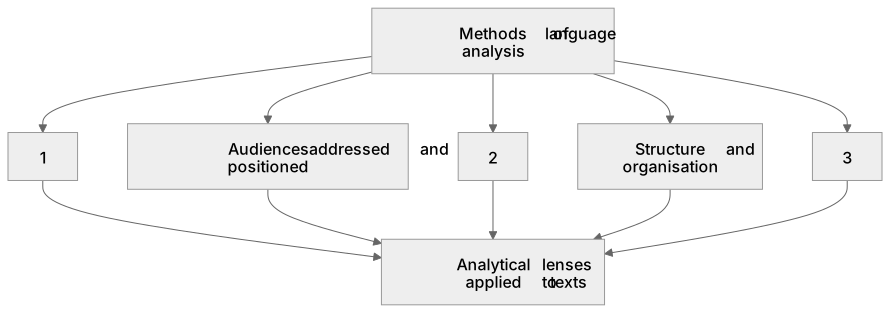
Some boxes have lost their names. Pick the right name for each number.
1Box 1
2Box 2
3Box 3
There is more to this lesson
The full lesson goes on to check your understanding and help you earn the marks. Create a free account to carry on, with your progress saved.
A week of Premium from your first lesson · Then the free plan continues · No card, no charge
Test your understanding of Language diversity and change: Exploration will include methods of language analysis, how identity is constructed, how audiences are addressed and positioned, the functions of the texts, the structure and organisation of the texts, and how representations are produced.
Active recall beats re-reading. Take an instant quiz now to test what you’ve learned and lock it into long-term memory.
A week of Premium from your first lesson · Then the free plan continues · No card, no charge