AQA · A-Level · English Language
Course version: 7702 · Version from Sept 2017
When analysing texts and data, students should explore: how language…
Full specification wording
Language diversity and change: When analysing texts and data, students should explore: how language varies because of personal, social, geographical and temporal contexts; why language varies and changes, developing critical knowledge and understanding of different views and explanations; attitudes to language variation and change; the use of language according to audience, purpose, genre and mode; how language is used to enact relationships.
This statement asks you to explain variation and change, not merely spot it.
Checked against the AQA 7702 specification (opens in a new tab) on .
- Point 2 of 3
- 3 key terms
Study notes
From the checked teaching notes for this specification point.
The idea
This statement asks you to explain variation and change, not merely spot it. For any text or data set, you should identify how personal identity, social group, geographical location and time period shape language choices. You then need to explain why those patterns exist, comparing different views and explanations, such as contact, prestige, identity marking or technological influence, and judging how convincing each is. You should also examine attitudes to variation and change, including prescriptive and descriptive positions, and show how audience, purpose, genre and mode constrain language. Finally, you should analyse how language enacts relationships, for example through terms of address, politeness strategies, turn-taking or pronoun choice. Strong analysis links a specific feature to a specific contextual cause or effect.
What earns the marks
- Explains variation by reference to personal, social, geographical and temporal context, using evidence from the text rather than assertion.
- Evaluates competing explanations for why language changes, such as language contact, social prestige, identity performance or technological innovation.
- Analyses attitudes to variation and change, distinguishing descriptive observation from prescriptive judgement.
- Shows how audience, purpose, genre and mode shape lexical, grammatical and discourse choices in a text.
- Examines how language enacts relationships through address terms, politeness, stance, turn-taking or pronoun use.
- Synthesises textual evidence with research findings to build a reasoned argument about diversity or change.
Common mistakes and how to put them right
Describing a feature without explaining its cause or effect.
Put it right by adding a 'because' or 'so that' clause linking feature to context.
Treating all language change as decline.
Put it right by evaluating prescriptive and descriptive views and considering evidence for both.
Ignoring mode when comparing texts.
Put it right by noting how speech, writing and electronic communication afford different choices.
Exam tips
- Anchor every analytical claim to a short quotation or data item, then explain the contextual reason for that choice.
- Use comparative connectives such as 'whereas', 'similarly' and 'in contrast' to structure arguments about variation.
- Reserve time to evaluate attitudes and explanations, since description alone will not reach the higher levels.
Try the lesson
The start of the Language diversity and change: When analysing texts and data, students should explore: how language varies because of personal, social, geographical and temporal contexts; why language varies and changes, developing critical knowledge and understanding of different views and explanations; attitudes to language variation and change; the use of language according to audience, purpose, genre and mode; how language is used to enact relationships. lesson, made from checked teaching notes for this specification point.
Have a go first
A speaker says 'Give us a hand with this' to a close friend but 'Could you possibly assist me with this?' to a senior manager. Which concept best explains this difference?
Listen
This statement asks you to explain variation and change, not merely spot it. For any text or data set, you should identify how personal identity, social group, geographical location and time period shape language choices. You then need to explain why those patterns exist, comparing different views and explanations, such as contact, prestige, identity marking or technological influence, and judging how convincing each is. You should also examine attitudes to variation and change, including prescriptive and descriptive positions, and show how audience, purpose, genre and mode constrain language. Finally, you should analyse how language enacts relationships, for example through terms of address, politeness strategies, turn-taking or pronoun choice. Strong analysis links a specific feature to a specific contextual cause or effect. A strong answer earns marks for these points. Explains variation by reference to personal, social, geographical and temporal context, using evidence from the text rather than assertion. Evaluates competing explanations for why language changes, such as language contact, social prestige, identity performance or technological innovation. Analyses attitudes to variation and change, distinguishing descriptive observation from prescriptive judgement. Shows how audience, purpose, genre and mode shape lexical, grammatical and discourse choices in a text. A common slip: Describing a feature without explaining its cause or effect. Instead, adding a 'because' or 'so that' clause linking feature to context. Exam tip: Anchor every analytical claim to a short quotation or data item, then explain the contextual reason for that choice.
See it
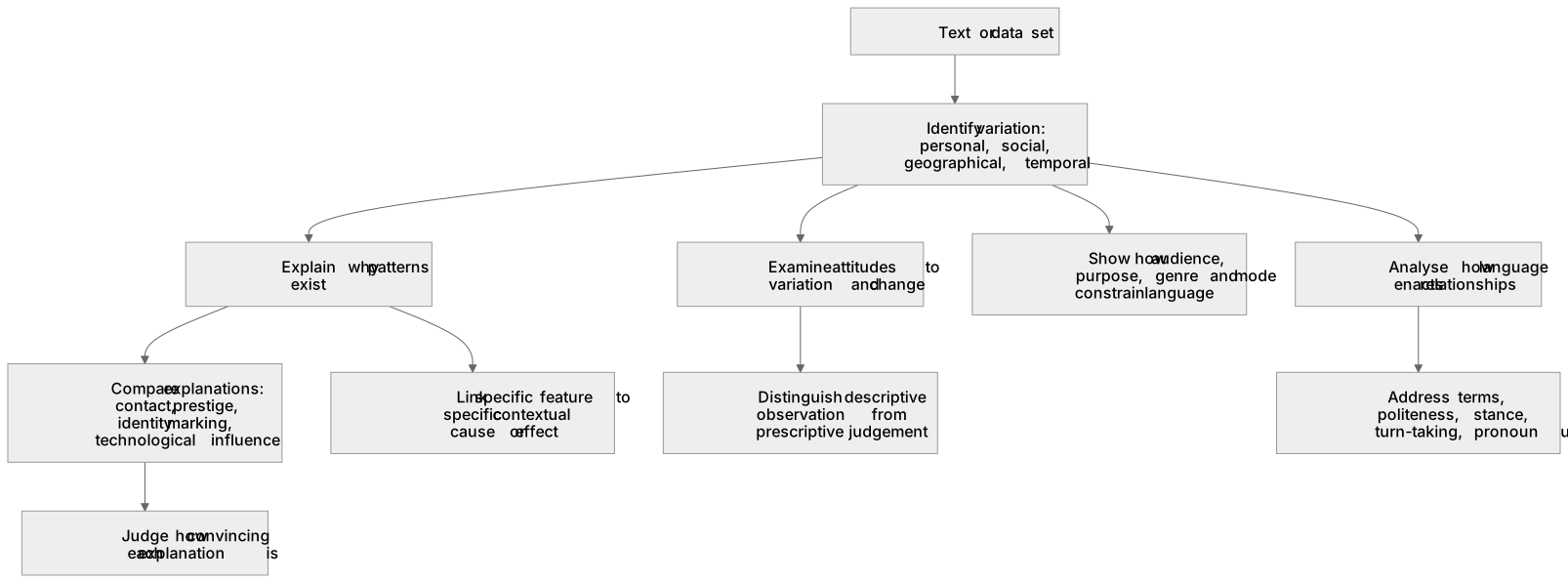
Key words
Say what each word means before you turn the card.
Context and language variation
Try answering aloud or in your head before turning the card.
Causes and explanations of change
Try answering aloud or in your head before turning the card.
Attitudes and prescriptivism
Try answering aloud or in your head before turning the card.
See every definition
- Context and language variation
- Language varies because of personal, social, geographical and temporal contexts, and analysis should explain how these contexts shape language choices.
- Causes and explanations of change
- Explanations for why language varies and changes include contact, prestige, identity marking or technological influence, and each should be judged for how convincing it is.
- Attitudes and prescriptivism
- Attitudes to variation and change include prescriptive and descriptive positions, and analysis should distinguish descriptive observation from prescriptive judgement.
Label the diagram
Some boxes have lost their names. Pick the right name for each number.
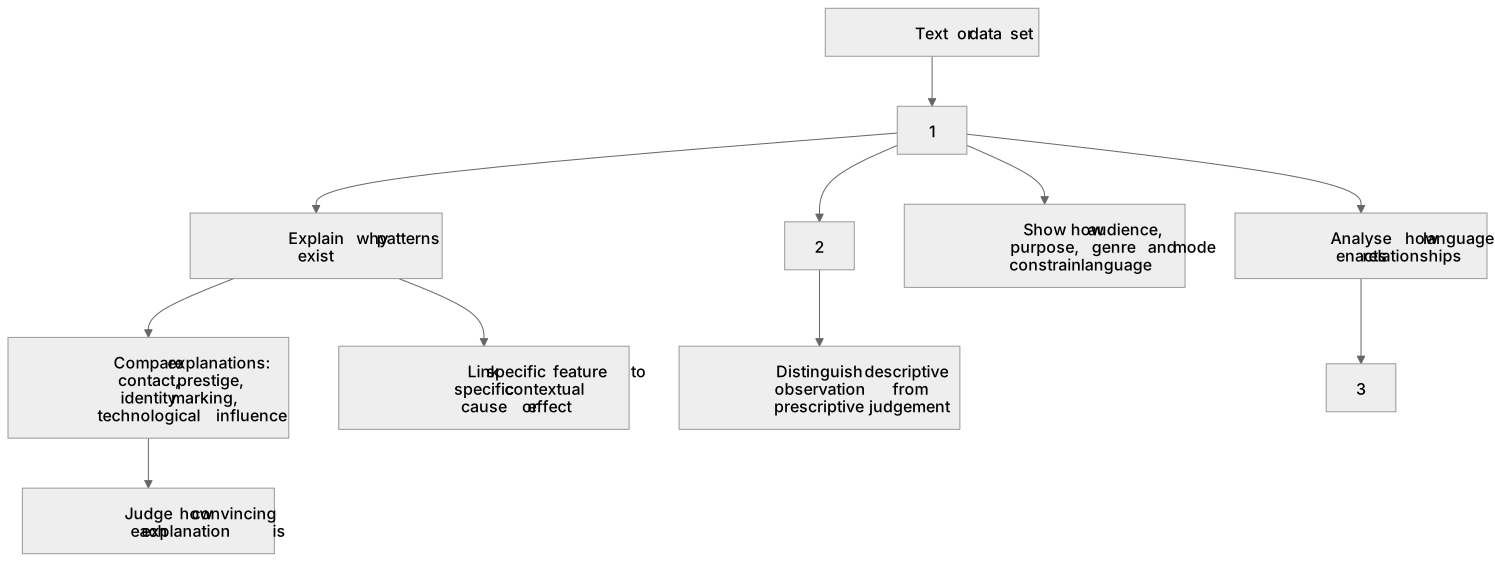
1Box 1
2Box 2
3Box 3
There is more to this lesson
The full lesson goes on to check your understanding and help you earn the marks. Create a free account to carry on, with your progress saved.
A week of Premium from your first lesson · Then the free plan continues · No card, no charge
Test your understanding of Language diversity and change: When analysing texts and data, students should explore: how language varies because of personal, social, geographical and temporal contexts; why language varies and changes, developing critical knowledge and understanding of different views and explanations; attitudes to language variation and change; the use of language according to audience, purpose, genre and mode; how language is used to enact relationships.
Active recall beats re-reading. Take an instant quiz now to test what you’ve learned and lock it into long-term memory.
A week of Premium from your first lesson · Then the free plan continues · No card, no charge