AQA · A-Level · English Language
Course version: 7702 · Version from Sept 2017
Grammar, including morphology: the structural patterns and shapes of…
Full specification wording
Language diversity and change - Methods of language analysis: grammar, including morphology: the structural patterns and shapes of English at sentence, clause, phrase and word level
Grammar is the system of rules and regularities that shapes English from the smallest meaningful units upwards.
Checked against the AQA 7702 specification (opens in a new tab) on .
- Point 4 of 6
- 4 key terms
Study notes
From the checked teaching notes for this specification point.
The idea
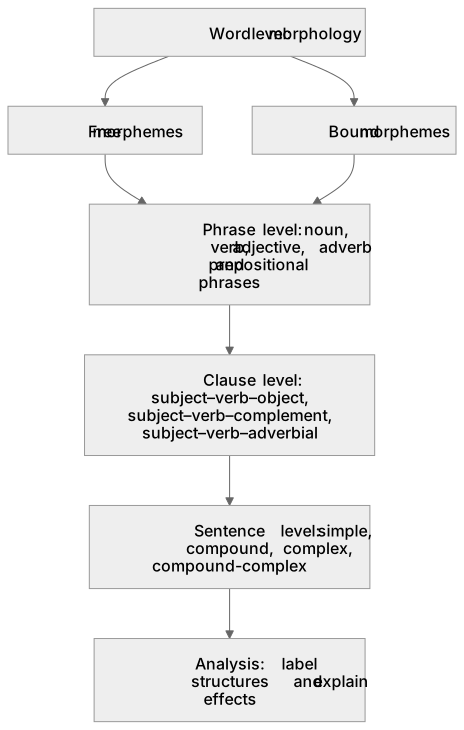
Grammar is the system of rules and regularities that shapes English from the smallest meaningful units upwards. Morphology examines word structure: free morphemes such as 'book' can stand alone, while bound morphemes such as the plural '-s' or past-tense '-ed' must attach to others, producing 'books' or 'walked'. At phrase level, words group into noun, verb, adjective, adverb and prepositional phrases, each with a head and possible modifiers. At clause level, patterns such as subject–verb–object ('The committee rejected the plan') or subject–verb–complement ('The plan seemed risky') organise meaning. At sentence level, simple, compound and complex sentences combine clauses through coordination or subordination. Analysing authentic texts means labelling these structures and explaining how they create effects, support meanings or position readers, rather than merely spotting them.
What earns the marks
- Accurate identification of morphemes, distinguishing free morphemes such as 'kind' from bound morphemes such as '-ness' in 'kindness'.
- Correct labelling of phrase types by their heads, for example noun phrase 'the noisy crowd', verb phrase 'has been waiting', prepositional phrase 'under the bridge'.
- Recognition of clause patterns, including subject–verb–object, subject–verb–complement and subject–verb–adverbial, with subjects and objects correctly distinguished.
- Classification of sentences as simple, compound, complex or compound-complex, with coordination and subordination accurately explained.
- Explanation of how grammatical choices construct meaning, such as passive voice shifting attention from agent to affected participant.
- Use of consistent terminology when discussing word classes, phrase functions and clause elements within an integrated analysis.
Common mistakes and how to put them right
Confusing word class with grammatical function.
Put it right: Identify the word class from its role in the specific sentence.
Treating any word ending in '-ing' as a verb.
Put it right: Check whether the form heads a verb phrase or functions as a modifier.
Calling every long sentence complex.
Put it right: Count independent and dependent clauses; a long simple sentence remains simple.
Mixing up phrases and clauses.
Put it right: Test for a finite verb before labelling a unit a clause.
Exam tips
- Quote short, precise extracts and label the grammatical feature immediately beside the quotation, then explain its effect in context.
- Build a personal terminology bank covering morphology, phrases, clauses and sentence types, and rehearse applying each term to unseen texts.
- When comparing texts, select grammatical contrasts that illuminate audience, purpose or representation rather than listing every feature you can find.
- Practise writing analytical sentences that move from identification to function, for example naming a passive construction and then explaining what it foregrounds.
Try the lesson
The start of the Language diversity and change - Methods of language analysis: grammar, including morphology: the structural patterns and shapes of English at sentence, clause, phrase and word level lesson, made from checked teaching notes for this specification point.
Have a go first
Which term describes the smallest unit of meaning in a word, such as the 'un-' in 'unhappy'?
Listen
Grammar is the system of rules and regularities that shapes English from the smallest meaningful units upwards. Morphology examines word structure: free morphemes such as 'book' can stand alone, while bound morphemes such as the plural '-s' or past-tense '-ed' must attach to others, producing 'books' or 'walked'. At phrase level, words group into noun, verb, adjective, adverb and prepositional phrases, each with a head and possible modifiers. At clause level, patterns such as subject–verb–object ('The committee rejected the plan') or subject–verb–complement ('The plan seemed risky') organise meaning. At sentence level, simple, compound and complex sentences combine clauses through coordination or subordination. Analysing authentic texts means labelling these structures and explaining how they create effects, support meanings or position readers, rather than merely spotting them. A strong answer earns marks for these points. Accurate identification of morphemes, distinguishing free morphemes such as 'kind' from bound morphemes such as '-ness' in 'kindness'. Correct labelling of phrase types by their heads, for example noun phrase 'the noisy crowd', verb phrase 'has been waiting', prepositional phrase 'under the bridge'. Recognition of clause patterns, including subject–verb–object, subject–verb–complement and subject–verb–adverbial, with subjects and objects correctly distinguished. Classification of sentences as simple, compound, complex or compound-complex, with coordination and subordination accurately explained. A common slip: Confusing word class with grammatical function: 'book' is a noun in 'the book' but a verb in 'to book a table'. Instead, identify the word class from its role in the specific sentence. Exam tip: Quote short, precise extracts and label the grammatical feature immediately beside the quotation, then explain its effect in context.
See it
Key words
Say what each word means before you turn the card.
Morphological structure of words
Try answering aloud or in your head before turning the card.
Phrase and clause architecture
Try answering aloud or in your head before turning the card.
Sentence variety and complexity
Try answering aloud or in your head before turning the card.
Grammar as a meaning-making resource
Try answering aloud or in your head before turning the card.
See every definition
- Morphological structure of words
- The study of how words are built from free morphemes that can stand alone and bound morphemes that must attach to others.
- Phrase and clause architecture
- Words group into phrases each with a head and possible modifiers, while clauses organise meaning through patterns such as subject–verb–object.
- Sentence variety and complexity
- Simple, compound and complex sentences combine clauses through coordination or subordination.
- Grammar as a meaning-making resource
- Labelling structures and explaining how they create effects, support meanings or position readers, rather than merely spotting them.
Label the diagram
Some boxes have lost their names. Pick the right name for each number.
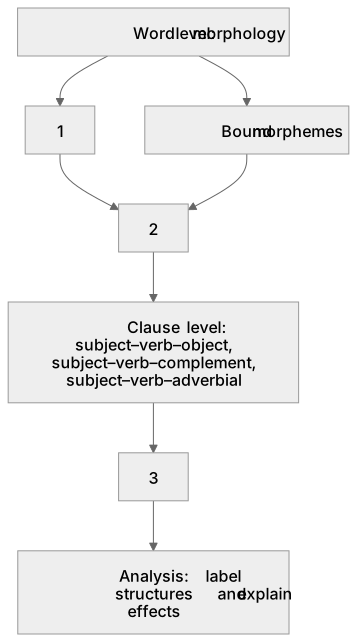
1Box 1
2Box 2
3Box 3
There is more to this lesson
The full lesson goes on to check your understanding and help you earn the marks. Create a free account to carry on, with your progress saved.
A week of Premium from your first lesson · Then the free plan continues · No card, no charge
Test your understanding of Language diversity and change - Methods of language analysis: grammar, including morphology: the structural patterns and shapes of English at sentence, clause, phrase and word level
Active recall beats re-reading. Take an instant quiz now to test what you’ve learned and lock it into long-term memory.
A week of Premium from your first lesson · Then the free plan continues · No card, no charge