AQA · A-Level · English Language
Course version: 7702 · Version from Sept 2017
Lexis and semantics: the vocabulary of English, including social and…
Full specification wording
Language diversity and change - Methods of language analysis: lexis and semantics: the vocabulary of English, including social and historical variation
Lexis is the vocabulary of English; semantics is meaning, including denotation, connotation, sense relations and how meaning shifts with context.
Checked against the AQA 7702 specification (opens in a new tab) on .
- Point 3 of 6
- 4 key terms
Study notes
From the checked teaching notes for this specification point.
The idea
Lexis is the vocabulary of English; semantics is meaning, including denotation, connotation, sense relations and how meaning shifts with context. This method asks you to examine word choices and meanings as evidence of social and historical variation. Social variation appears in dialect words, occupational jargon, slang and sociolect, for example 'bread' for money or 'sick' meaning excellent. Historical variation appears in archaic lexis, semantic change such as amelioration, pejoration, broadening and narrowing, and new formations. Method: identify the lexical item, give its denotation, explore connotations and sense relations such as synonymy, antonymy and hyponymy, then link the choice to user, audience, purpose, time or place. Assessment rewards precise linguistic description plus interpretation of variation, not dictionary definitions alone.
What earns the marks
- Identifies lexical items precisely and classifies them, for example dialect lexis, slang, jargon, euphemism, neologism, archaism and loanword.
- Explains denotation and connotation, showing how a word's associations contribute to meaning beyond its literal sense.
- Uses sense relations accurately, including synonymy, antonymy, hyponymy, polysemy and homonymy, to describe how meanings relate.
- Analyses semantic change over time, for example amelioration, pejoration, broadening, narrowing and metaphor, with a plausible example.
- Links lexical and semantic choices to social factors such as region, occupation, age, gender, ethnicity and social class.
- Explains how context and register shape meaning, for example technical lexis in a medical consultation compared with everyday synonyms at home.
Common mistakes and how to put them right
Treating lexis and semantics as a list of difficult words.
Put it right: Analyse why a word was chosen and what it means in context, including connotation and effect.
Confusing semantic change with simple spelling change.
Put it right: Semantic change concerns meaning, such as 'awful' shifting from 'full of awe' to 'very bad'; spelling belongs to orthography.
Assuming a word has one fixed meaning.
Put it right: Discuss polysemy and context-dependent meaning, showing how the same item can vary socially or historically.
Exam tips
- Quote the exact lexical item and label the semantic process or relation, then explain its effect in the text.
- Use a consistent analytical sequence: word, denotation, connotation, sense relation, variation link. This keeps answers focused.
- For change questions, date the usage where possible and explain the direction of meaning shift rather than asserting that language has simply improved or declined.
Try the lesson
The start of the Language diversity and change - Methods of language analysis: lexis and semantics: the vocabulary of English, including social and historical variation lesson, made from checked teaching notes for this specification point.
Have a go first
Which method of language analysis focuses on the vocabulary of English and how word meanings vary socially and historically?
Listen
Lexis is the vocabulary of English; semantics is meaning, including denotation, connotation, sense relations and how meaning shifts with context. This method asks you to examine word choices and meanings as evidence of social and historical variation. Social variation appears in dialect words, occupational jargon, slang and sociolect, for example 'bread' for money or 'sick' meaning excellent. Historical variation appears in archaic lexis, semantic change such as amelioration, pejoration, broadening and narrowing, and new formations. Method: identify the lexical item, give its denotation, explore connotations and sense relations such as synonymy, antonymy and hyponymy, then link the choice to user, audience, purpose, time or place. Assessment rewards precise linguistic description plus interpretation of variation, not dictionary definitions alone. A strong answer earns marks for these points. Identifies lexical items precisely and classifies them, for example dialect lexis, slang, jargon, euphemism, neologism, archaism and loanword. Explains denotation and connotation, showing how a word's associations contribute to meaning beyond its literal sense. Uses sense relations accurately, including synonymy, antonymy, hyponymy, polysemy and homonymy, to describe how meanings relate. Analyses semantic change over time, for example amelioration, pejoration, broadening, narrowing and metaphor, with a plausible example. A common slip: Treating lexis and semantics as a list of difficult words. Instead, analyse why a word was chosen and what it means in context, including connotation and effect. Exam tip: Quote the exact lexical item and label the semantic process or relation, then explain its effect in the text.
See it
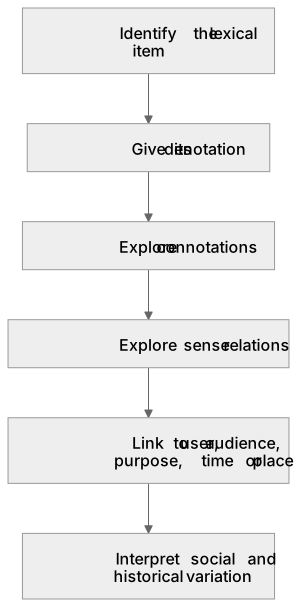
Put it in order
Put these steps in the order they happen.
- 1. Explore connotations
- 2. Give its denotation
- 3. Identify the lexical item
- 4. Interpret social and historical variation
- 5. Link to user, audience, purpose, time or place
- 6. Explore sense relations
Key words
Say what each word means before you turn the card.
Vocabulary and meaning
Try answering aloud or in your head before turning the card.
Denotation and connotation
Try answering aloud or in your head before turning the card.
Social and regional variation
Try answering aloud or in your head before turning the card.
Historical semantic change
Try answering aloud or in your head before turning the card.
See every definition
- Vocabulary and meaning
- Lexis is the vocabulary of English, while semantics is meaning, including denotation, connotation and sense relations.
- Denotation and connotation
- A word's literal sense is its denotation, while its associations contribute to meaning beyond that literal sense as connotation.
- Social and regional variation
- Social variation appears in dialect words, occupational jargon, slang and sociolect, such as 'bread' for money or 'sick' meaning excellent.
- Historical semantic change
- Historical variation appears in archaic lexis and semantic change such as amelioration, pejoration, broadening and narrowing, and new formations.
Label the diagram
Some boxes have lost their names. Pick the right name for each number.
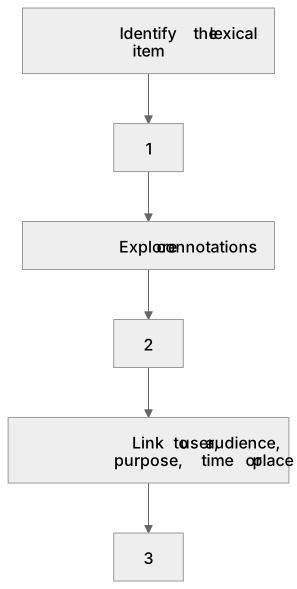
1Box 1
2Box 2
3Box 3
There is more to this lesson
The full lesson goes on to check your understanding and help you earn the marks. Create a free account to carry on, with your progress saved.
A week of Premium from your first lesson · Then the free plan continues · No card, no charge
Test your understanding of Language diversity and change - Methods of language analysis: lexis and semantics: the vocabulary of English, including social and historical variation
Active recall beats re-reading. Take an instant quiz now to test what you’ve learned and lock it into long-term memory.
A week of Premium from your first lesson · Then the free plan continues · No card, no charge