AQA · A-Level · English Language
Course version: 7702 · Version from Sept 2017
Phonetics, phonology and prosodics: how speech sounds and effects are…
Full specification wording
Language diversity and change - Methods of language analysis: phonetics, phonology and prosodics: how speech sounds and effects are articulated and analysed
This strand covers the sound system of spoken English.
Checked against the AQA 7702 specification (opens in a new tab) on .
- Point 1 of 6
- 4 key terms
Study notes
From the checked teaching notes for this specification point.
The idea
This strand covers the sound system of spoken English. Phonetics deals with how individual speech sounds are produced: place and manner of articulation for consonants, tongue and lip position for vowels, and voicing. Phonology concerns how sounds pattern in a language, including phonemes, assimilation, elision and insertion. Prosodics covers suprasegmental features like pitch, stress, tempo, volume and pauses, which carry meaning beyond individual sounds; intonation is a prosodic feature, not a phonological one. In written exams you analyse pre-transcribed data, so identify features in the transcript provided rather than producing your own transcription; transcription is relevant to the NEA Language Investigation.
For example: Falling intonation on a tag question invites agreement, while a pause before a key word can build suspense or signal hesitation.
What earns the marks
- Uses accurate phonetic terminology for place and manner of articulation, voicing and vowel description.
- Identifies phonological processes such as assimilation, elision and insertion in connected speech.
- Analyses prosodic features including pitch, stress, tempo, volume and pausing, and explains their communicative effect.
- Works accurately from pre-transcribed data provided in the exam, identifying features rather than producing a full transcription.
- Links sound-level choices to meaning, identity, audience or context rather than describing them in isolation.
- Distinguishes between phonetic description of articulation, phonological patterning and prosodic effect, including placing intonation under prosodics.
Common mistakes and how to put them right
Confusing phonetics with phonology.
Put it right by treating phonetics as articulation of sounds and phonology as how sounds pattern and function in a language.
Describing accent features as errors.
Put it right by analysing them neutrally as systematic, rule-governed variation.
Ignoring prosody and analysing only words.
Put it right by commenting on pitch, stress, tempo and pausing alongside segmental features.
Assuming you must transcribe speech in the written exam.
Put it right by working from the pre-transcribed data supplied, and reserving transcription for the NEA Language Investigation.
Classifying intonation as phonology.
Put it right by treating intonation as a prosodic/suprasegmental feature.
Exam tips
- Work from the pre-transcribed data provided, and quote only the short stretch you will analyse.
- Name the feature, give the example, then explain its effect in context in that order.
- Use IPA symbols accurately where they help, but always explain the point in words as well.
Try the lesson
The start of the Language diversity and change - Methods of language analysis: phonetics, phonology and prosodics: how speech sounds and effects are articulated and analysed lesson, made from checked teaching notes for this specification point.
Have a go first
Which area of language study focuses on how speech sounds are physically produced by the vocal organs?
Listen
This strand covers the sound system of spoken English. Phonetics deals with how individual speech sounds are produced: place and manner of articulation for consonants, tongue and lip position for vowels, and voicing. Phonology concerns how sounds pattern in a language, including phonemes, assimilation, elision and insertion. Prosodics covers suprasegmental features like pitch, stress, tempo, volume and pauses, which carry meaning beyond individual sounds; intonation is a prosodic feature, not a phonological one. In written exams you analyse pre-transcribed data, so identify features in the transcript provided rather than producing your own transcription; transcription is relevant to the NEA Language Investigation. For example, falling intonation on a tag question invites agreement, while a pause before a key word can build suspense or signal hesitation. A strong answer earns marks for these points. Uses accurate phonetic terminology for place and manner of articulation, voicing and vowel description. Identifies phonological processes such as assimilation, elision and insertion in connected speech. Analyses prosodic features including pitch, stress, tempo, volume and pausing, and explains their communicative effect. Works accurately from pre-transcribed data provided in the exam, identifying features rather than producing a full transcription. A common slip: Confusing phonetics with phonology. Instead, treating phonetics as articulation of sounds and phonology as how sounds pattern and function in a language. Exam tip: Work from the pre-transcribed data provided, and quote only the short stretch you will analyse.
See it

Key words
Say what each word means before you turn the card.
Phonetics
Try answering aloud or in your head before turning the card.
Phonology
Try answering aloud or in your head before turning the card.
Prosodics
Try answering aloud or in your head before turning the card.
Intonation
Try answering aloud or in your head before turning the card.
See every definition
- Phonetics
- The study of how individual speech sounds are produced, covering place and manner of articulation for consonants, tongue and lip position for vowels, and voicing.
- Phonology
- The study of how sounds pattern in a language, including phonemes, assimilation, elision and insertion.
- Prosodics
- The study of suprasegmental features like pitch, stress, tempo, volume and pauses, which carry meaning beyond individual sounds.
- Intonation
- A prosodic feature, not a phonological one, such as falling intonation on a tag question that invites agreement.
Label the diagram
Some boxes have lost their names. Pick the right name for each number.
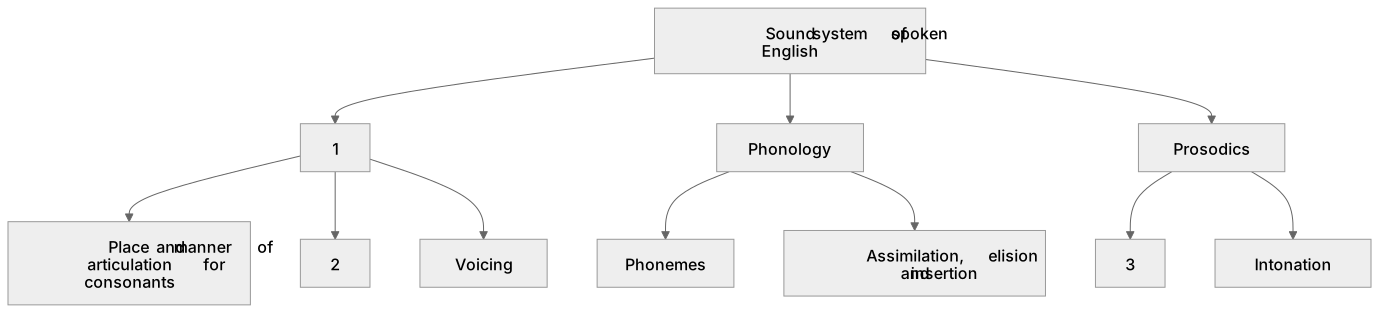
1Box 1
2Box 2
3Box 3
There is more to this lesson
The full lesson goes on to check your understanding and help you earn the marks. Create a free account to carry on, with your progress saved.
A week of Premium from your first lesson · Then the free plan continues · No card, no charge
Test your understanding of Language diversity and change - Methods of language analysis: phonetics, phonology and prosodics: how speech sounds and effects are articulated and analysed
Active recall beats re-reading. Take an instant quiz now to test what you’ve learned and lock it into long-term memory.
A week of Premium from your first lesson · Then the free plan continues · No card, no charge