AQA · A-Level · English Language
Course version: 7702 · Version from Sept 2017
Students can choose to pursue a study of spoken, written or multimodal…
Full specification wording
Language investigation: Students can choose to pursue a study of spoken, written or multimodal data, or a mixture of text types, demonstrating knowledge in areas of individual interest.
This guidance sets out the range of data open to you in the Language Investigation.
Checked against the AQA 7702 specification (opens in a new tab) on .
- Point 2 of 2
- 4 key terms
Study notes
From the checked teaching notes for this specification point.
The idea
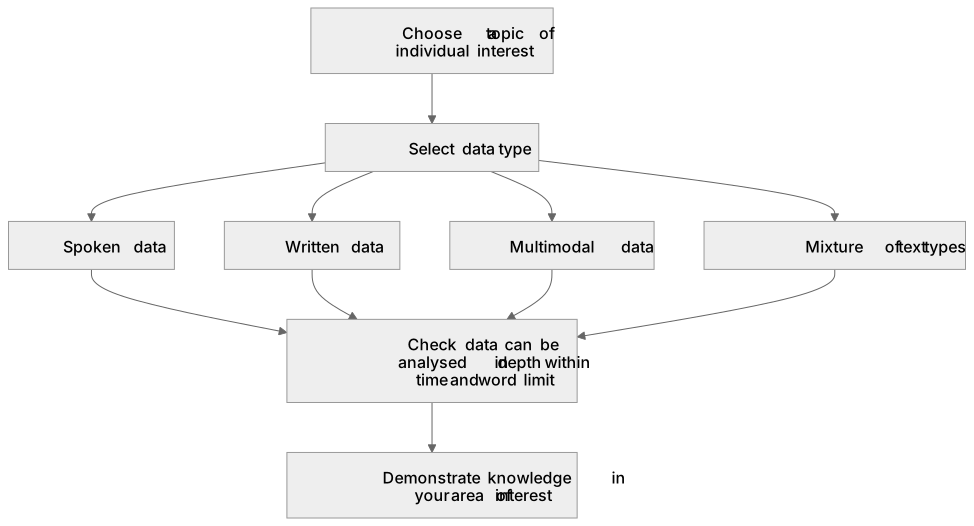
This guidance sets out the range of data open to you in the Language Investigation. You may work with spoken data, such as a recorded conversation; written data, such as a set of letters or articles; multimodal data, where meaning is carried by more than one mode at once, for example a webpage combining image, layout and wording; or a mixture of text types. The choice is yours, provided it lets you demonstrate knowledge in an area of individual interest. In practice, pick a topic you genuinely want to explore, then select data that can be analysed in depth within the available time and word limit. A mixed data set can be valuable when your question is comparative, but it must still be manageable and clearly focused.
Common mistakes and how to put them right
Assuming only written texts are permitted.
Put it right: Spoken, written and multimodal data are all allowed, as is a mixture of text types.
Choosing a topic with no personal interest because it seems 'safer'.
Put it right: The investigation is designed to let you demonstrate knowledge in areas of individual interest, so choose a focus you can sustain.
Collecting a very large or very varied data set that cannot be analysed in depth.
Put it right: Select data that is rich enough for analysis but small enough to treat thoroughly.
Treating multimodal data as only visual decoration.
Put it right: In multimodal data, modes such as image, layout and wording combine to make meaning, and analysis should address that combination.
Exam tips
- Write your research question first, then choose the data type or mixture that can actually answer it.
- For a mixed data set, state clearly what is being compared and why the comparison is worth making.
- Check that your chosen data allows you to demonstrate knowledge in your area of interest rather than only describing surface features.
Try the lesson
The start of the Language investigation: Students can choose to pursue a study of spoken, written or multimodal data, or a mixture of text types, demonstrating knowledge in areas of individual interest. lesson, made from checked teaching notes for this specification point.
Have a go first
Which of the following features is most characteristic of spontaneous spoken data compared to planned written data?
Listen
This guidance sets out the range of data open to you in the Language Investigation. You may work with spoken data, such as a recorded conversation; written data, such as a set of letters or articles; multimodal data, where meaning is carried by more than one mode at once, for example a webpage combining image, layout and wording; or a mixture of text types. The choice is yours, provided it lets you demonstrate knowledge in an area of individual interest. In practice, pick a topic you genuinely want to explore, then select data that can be analysed in depth within the available time and word limit. A mixed data set can be valuable when your question is comparative, but it must still be manageable and clearly focused. A common slip: Assuming only written texts are permitted. Instead, spoken, written and multimodal data are all allowed, as is a mixture of text types. Exam tip: Write your research question first, then choose the data type or mixture that can actually answer it.
See it
Key words
Say what each word means before you turn the card.
Spoken data
Try answering aloud or in your head before turning the card.
Written data
Try answering aloud or in your head before turning the card.
Multimodal data
Try answering aloud or in your head before turning the card.
Mixed text types
Try answering aloud or in your head before turning the card.
See every definition
- Spoken data
- Data such as a recorded conversation, which students may choose to pursue for their study.
- Written data
- Data such as a set of letters or articles, which students may choose to pursue for their study.
- Multimodal data
- Data where meaning is carried by more than one mode at once, for example a webpage combining image, layout and wording.
- Mixed text types
- A mixture of text types, which students may choose to pursue for their study.
Label the diagram
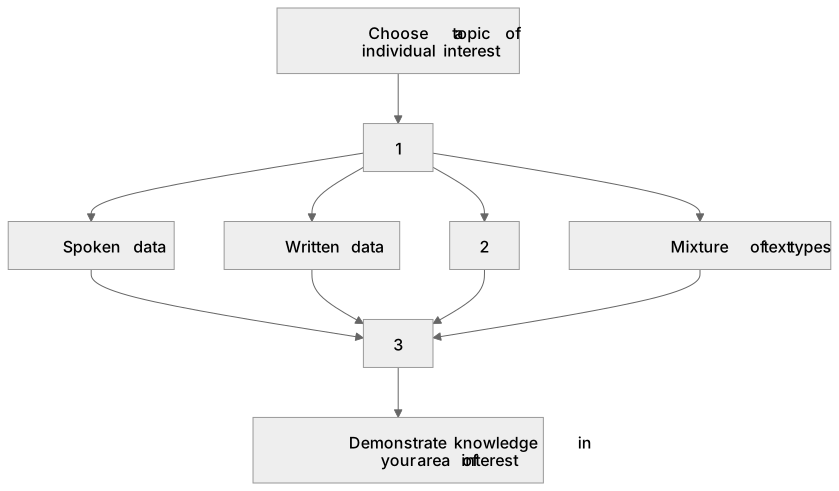
Some boxes have lost their names. Pick the right name for each number.
1Box 1
2Box 2
3Box 3
There is more to this lesson
The full lesson goes on to check your understanding and help you earn the marks. Create a free account to carry on, with your progress saved.
A week of Premium from your first lesson · Then the free plan continues · No card, no charge
Test your understanding of Language investigation: Students can choose to pursue a study of spoken, written or multimodal data, or a mixture of text types, demonstrating knowledge in areas of individual interest.
Active recall beats re-reading. Take an instant quiz now to test what you’ve learned and lock it into long-term memory.
A week of Premium from your first lesson · Then the free plan continues · No card, no charge