AQA · A-Level · English Language
Course version: 7702 · Version from Sept 2017
Underpinning this piece of research is the challenge that, in consultation…
Full specification wording
Language investigation: Underpinning this piece of research is the challenge that, in consultation with their supervising teacher, students should collect their own data as the basis of their study, as well as select their own approach for analysis.
This guidance defines the independence expected in the Language Investigation.
Checked against the AQA 7702 specification (opens in a new tab) on .
- Point 1 of 2
- 4 key terms
Study notes
From the checked teaching notes for this specification point.
The idea
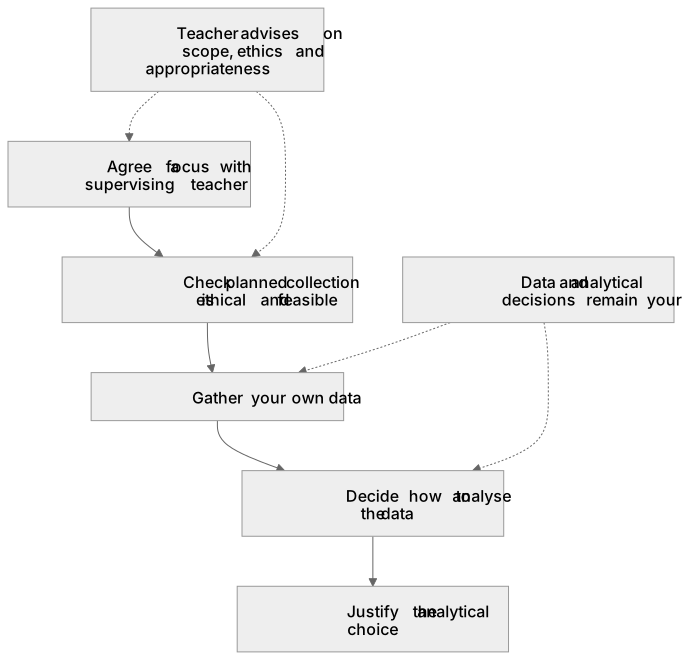
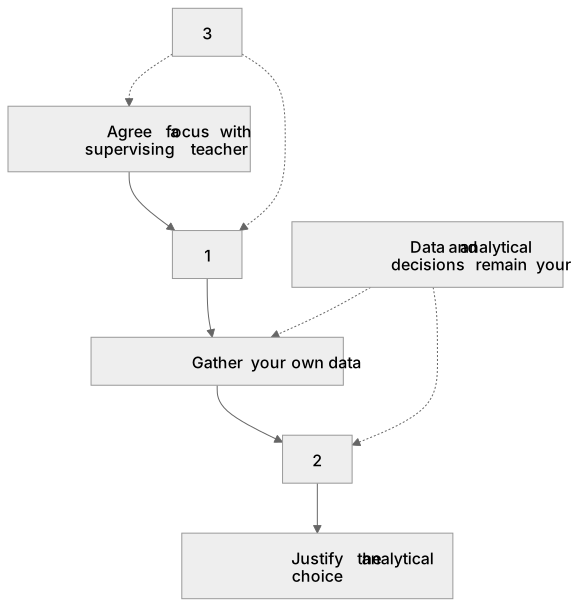
This guidance defines the independence expected in the Language Investigation. You are not given a ready-made data set: you design the collection yourself, and you choose the analytical approach that fits your question. The phrase 'in consultation with their supervising teacher' means the process is negotiated, not unsupervised. In practice you might agree a focus, check that your planned collection is ethical and feasible, then gather your own spoken, written or multimodal material, for example recording a short interaction or compiling a small corpus of texts. You then decide how to analyse it, such as a framework suited to your data, and justify that choice. The teacher's role is to advise on scope, ethics and appropriateness; the data and the analytical decisions remain yours.
Common mistakes and how to put them right
Assuming the teacher will supply the data set.
Put it right: The investigation requires you to collect your own data, using teacher consultation for guidance and approval rather than for provision.
Treating the analysis method as fixed in advance by the specification.
Put it right: You select your own approach for analysis and justify why it suits your data and question.
Collecting data first and only then asking whether it is ethical or feasible.
Put it right: Consult your supervising teacher before collection so scope, consent and practicality are agreed early.
Believing consultation removes your ownership of the project.
Put it right: Consultation shapes and safeguards your decisions; the study remains your own independent work.
Exam tips
- Draft a short plan naming your data source, your collection method and your intended analytical approach, then take it to your supervising teacher for comment before you begin.
- Keep a brief record of advice given and decisions taken, so you can explain and justify your independent choices when writing up.
- Pilot a small amount of collection first to test whether your method yields data that can actually answer your research question.
Try the lesson
The start of the Language investigation: Underpinning this piece of research is the challenge that, in consultation with their supervising teacher, students should collect their own data as the basis of their study, as well as select their own approach for analysis. lesson, made from checked teaching notes for this specification point.
Have a go first
When collecting original spoken data for a language investigation, which of the following is an essential ethical requirement?
Listen
This guidance defines the independence expected in the Language Investigation. You are not given a ready-made data set: you design the collection yourself, and you choose the analytical approach that fits your question. The phrase 'in consultation with their supervising teacher' means the process is negotiated, not unsupervised. In practice you might agree a focus, check that your planned collection is ethical and feasible, then gather your own spoken, written or multimodal material, for example recording a short interaction or compiling a small corpus of texts. You then decide how to analyse it, such as a framework suited to your data, and justify that choice. The teacher's role is to advise on scope, ethics and appropriateness; the data and the analytical decisions remain yours. A common slip: Assuming the teacher will supply the data set. Instead, the investigation requires you to collect your own data, using teacher consultation for guidance and approval rather than for provision. Exam tip: Draft a short plan naming your data source, your collection method and your intended analytical approach, then take it to your supervising teacher for comment before you begin.
See it
Key words
Say what each word means before you turn the card.
Independent data collection
Try answering aloud or in your head before turning the card.
Teacher consultation and supervision
Try answering aloud or in your head before turning the card.
Student-selected analytical approach
Try answering aloud or in your head before turning the card.
Research design and feasibility
Try answering aloud or in your head before turning the card.
See every definition
- Independent data collection
- Students gather their own spoken, written or multimodal material as the basis of their study, rather than being given a ready-made data set.
- Teacher consultation and supervision
- A negotiated process in which the supervising teacher advises on scope, ethics and appropriateness, while the data and analytical decisions remain the student's.
- Student-selected analytical approach
- Students choose their own approach for analysis, such as a framework suited to their data, and justify why it suits their data and question.
- Research design and feasibility
- Agreeing a focus and checking that planned collection is ethical and feasible with the supervising teacher before collection begins.
Label the diagram
Some boxes have lost their names. Pick the right name for each number.
1Box 1
2Box 2
3Box 3
There is more to this lesson
The full lesson goes on to check your understanding and help you earn the marks. Create a free account to carry on, with your progress saved.
A week of Premium from your first lesson · Then the free plan continues · No card, no charge
Test your understanding of Language investigation: Underpinning this piece of research is the challenge that, in consultation with their supervising teacher, students should collect their own data as the basis of their study, as well as select their own approach for analysis.
Active recall beats re-reading. Take an instant quiz now to test what you’ve learned and lock it into long-term memory.
A week of Premium from your first lesson · Then the free plan continues · No card, no charge